Worcester Massachusetts Día de los Muertos in the Woo Festival
On a Saturday in late October, Institute Park in Worcester fills with marigolds, photographs, music and the smell of food from trucks parked along the grass, as the city gathers to remember people who have died. The celebration is called Día de los Muertos in the Woo, and it brings a Mexican tradition of honouring the dead into a public park in the middle of Massachusetts. A listing layer documents the fifth annual edition on Saturday, October 24, 2026, running from eleven in the morning to four in the afternoon under the theme Love as Resilience. A city magazine layer previews that same edition, and a second magazine layer reports on it afterwards, describing music, dance, food trucks and a display of ofrendas, with an estimated one thousand people attending. The gathering is organised by Casita Cultura Latina, a volunteer organisation that celebrates the city’s Latino communities along with Latino artists and creatives.
About
The name itself tells a small story about how events get recorded. The sheet title behind this article carries the full county-and-state form, yet no layer read prints that long form exactly, and the sheet also drops the accent from the first word. The forms that actually appear in print are Día de los Muertos in the Woo, El Día de los Muertos in the Woo, and, in one listing layer, Día de los Muertos in the Woo Festival. Those printed forms are kept here exactly as they appear, accents included, rather than merged into a single tidier name. The shorter versions are the ones residents would recognise from posters and listings around the city.
Worcester is the host city, and it sits in Worcester County, where it serves as a county seat, a status confirmed by both a state reference layer and a comparison reference layer rather than assumed from its size. The festival ground is Institute Park, a green space in the city that hosts the altars, performances and food trucks for the day. One listing layer attaches a street address belonging to a neighbouring unit to the park, but no street number is relied on here; the park name alone is how the layers identify the place.
Casita Cultura Latina appears consistently across magazine, listing and news layers as the organising body, described as a volunteer organisation devoted to celebrating the Latino communities of Worcester and the Latino artists and creatives among them. A cofounder and board member is quoted in a magazine layer speaking about the celebration, referred to here by role rather than by name. An organiser web address exists in the magazine layer, noted only as existing, since its value is never reproduced.
Quick Facts
| Item | Detail |
| Published name | Día de los Muertos in the Woo |
| Also printed as | El Día de los Muertos in the Woo |
| Host city | Worcester, Massachusetts |
| County | Worcester County, where Worcester serves as a county seat |
| Venue | Institute Park |
| Organiser | Casita Cultura Latina |
| Documented edition | Saturday, October 24, 2026, billed as the fifth annual |
| Hours | Eleven in the morning to four in the afternoon |
| Theme for 2026 | Love as Resilience, printed in Spanish as amor como resiliencia |
| Admission | Free for the 2026 edition, per a city magazine layer |
History
The roots of the gathering reach back far beyond Worcester. Layers explaining the observance describe Día de los Muertos as typically observed around November 1 and 2, having evolved in Mexico from Native tradition together with the Catholic All Souls’ Day observance. The Worcester celebration is deliberately held earlier than those dates, in late October, so that the holiday itself remains personal for the families who mark it privately. That choice shapes the character of the event: the park gathering is a communal, artistic expression of the tradition, while the intimate observances of the first days of November stay within homes and families.
For a useful comparison, see the Worcester Massachusetts Irish Festival for another county festival.
Within Worcester, the layers bill the 2026 edition as the fifth annual, and one summary layer calls it the fifth annual iteration following a hiatus the year before. No founding year is stated anywhere in the layers read, and none can responsibly be worked out from the annual billing, because the skipped year breaks any simple arithmetic. The year before the return is described in two ways that sit side by side without being reconciled. One layer says the organisation decided not to hold the celebration, in part because of fear in the community arising from immigration enforcement operations. Another layer describes the 2025 edition as having been reimagined. Both agree the park celebration in its familiar form did not take place in 2025; each account is reported here on its own terms.
Each year of the celebration adopts a theme, and the theme for 2026 is printed in Spanish as amor como resiliencia and in English as Love as Resilience. The pairing of the two languages in the theme mirrors the bilingual character of the event itself, where Spanish and English sit alongside one another in the programme, the artwork and the conversation around the altars.
What to Expect
The heart of the day is the ofrendas. These are temporary altars raised to honour friends and family members who have died, displaying their photographs and decorated with calaveras, the painted skull ornaments associated with the observance, along with papeles picados, the cut tissue papers that flutter above the displays, and cempasúchil marigolds, whose orange and yellow blooms are a signature of the tradition. Visitors move slowly among the altars, reading names, looking at photographs and taking in the care that families and artists have put into each arrangement.
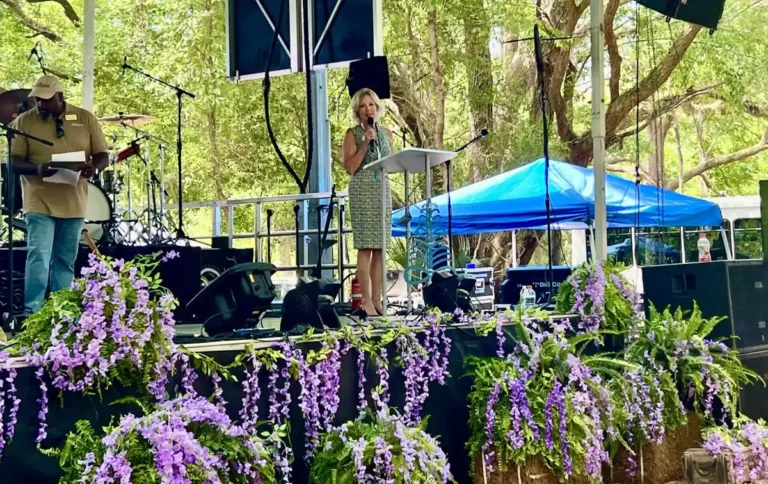
Performance runs alongside the remembrance. The layers describe live music and dance performances through the day, and the 2026 edition included a dance company’s oferatory dance, an offering made through movement rather than objects. Local artists and makers set up booths around the park, selling and showing work that connects the day to the city’s wider creative community. Food trucks serve Latin American food, and the second magazine layer’s report of the 2026 edition lists music, dance, food trucks and the ofrenda display as the elements that drew its estimated one thousand attendees.
The mood, as the layers present it, is neither a street party nor a sombre vigil. Remembrance sits at the centre, carried by colour, music and food rather than by silence. Children encounter the skull imagery as art, and neighbours who know little of the tradition learn its vocabulary by walking through it. The five-hour span from eleven to four keeps the gathering in daylight, suiting both the outdoor displays and the family audience.
Planning Your Visit
The documented edition ran on a Saturday from eleven in the morning until four in the afternoon at Institute Park, so the practical shape of a visit is a late-morning arrival and an unhurried afternoon. A city magazine layer states that admission to the 2026 edition was free; that detail belongs to that layer and that year, since no other edition’s admission terms appear in the layers read, and it should not be assumed to govern any future gathering without confirmation. Arriving near the opening hour gives the fullest view of the ofrendas before the midday crowd builds, and it leaves room to catch performances spread across the afternoon.
Because the celebration happens outdoors in late October, New England weather is part of the planning. Layers do not publish a rain policy, so visitors should dress for a cool autumn day and check the organiser’s current listings as the date approaches. Comfortable shoes matter: the altars, booths and food trucks are spread across grass, and the day is experienced on foot.
The early scheduling deserves a note of its own. Anyone who assumes the gathering falls on November 1 or 2, the traditional dates of the observance, will miss it entirely; the documented edition fell on October 24, a full week earlier, by design. Marking the October date rather than the November one is the single most important planning step.
A Day at the Festival
A visitor following the documented shape of the 2026 edition might arrive at Institute Park shortly before eleven, as the food trucks settle in and the first visitors begin walking the rows of ofrendas. The late morning suits a slow first circuit of the altars, when the photographs and decorations can be looked at closely.
Midday lends itself to the performances and to lunch from the trucks, with Latin American food eaten on the grass between sets of live music and dance. The early afternoon can go to the artists’ and makers’ booths, where local creatives show work tied to the day’s theme. A final pass among the ofrendas before four closes the visit the way it began, with the names and faces the day exists to honour.
How It Compares
Several other observances surface in the layers around this title, and keeping them separate matters. A university in Worcester holds a Día de Muertos lecture event, an academic occasion rather than a park festival. A church’s All Saints and Día de los Muertos service is a religious observance, distinct from this community celebration. In Boston, an orchestral Día de Muertos concert belongs to a different city altogether. None of these is the festival described here, and details from them are not borrowed for it.
The same organiser is also credited with ofrenda displays at the public library. Those displays are associated with Casita Cultura Latina and share the tradition’s imagery, but they are an associated exhibition rather than the festival day itself, with its performances, food trucks and park setting. Treating the library display and the Institute Park gathering as one event would blur two things the layers keep apart.
Visitor Checklist
- Confirm the October date in current listings rather than assuming the traditional November dates.
- Plan to arrive near the eleven o’clock opening to see the ofrendas before the crowd builds.
- Dress in layers for cool late-October weather in an open park.
- Bring comfortable shoes for walking on grass between altars, booths and trucks.
- Carry a camera for the displays, while remembering the altars honour real families.
- Leave time for the artists’ and makers’ booths as well as the performances.
- Check the organiser’s current information before travelling, since future editions are not dated in the layers read.
Beyond the Park
A trip to the festival can anchor a wider Worcester visit. The city is a county seat with the civic and cultural institutions that role tends to gather, and the festival’s own orbit points toward some of them: the public library that hosts the organiser’s associated ofrenda displays is one natural stop for anyone wanting to see the tradition’s imagery in a quieter setting. The artists and makers who booth at the festival work in the city year-round, so the day also introduces a creative community that extends well past a single Saturday.
The celebration also sits within a broader Latino cultural presence in Worcester. Food trucks at the park hint at the Latin American cooking available across the city, and the bilingual 2026 theme points to a community life carried on in both languages throughout the year.
Why It Matters
A festival like this one does cultural work that a museum label cannot. It takes a tradition rooted in Mexico, carried by families who now live in Massachusetts, and gives it a public, welcoming form in which neighbours of every background can participate respectfully. The ofrenda is an intimate object, a family’s memory made visible, and placing dozens of them in a city park turns private grief into shared understanding without stripping away its tenderness.
The 2026 return carries its own weight. After a year in which the celebration did not take place in the park, the fifth annual edition gathered an estimated one thousand people under a theme about love as a form of endurance. The resumption itself says something about why a volunteer organisation keeps rebuilding the event each autumn.
Frequently Asked Questions
What are the ofrendas that visitors see at Institute Park?
They are temporary altars built to honour friends and family members who have died. The layers describe them displaying photographs of the people remembered and decorated with calaveras, papeles picados and cempasúchil marigolds, and a report of the 2026 edition treats the display of ofrendas as one of the day’s central features.
Why does the Worcester celebration fall in October instead of on November 1 and 2?
The layers explain that the gathering is held early on purpose, so the holiday itself remains personal for the families who observe it privately. Día de los Muertos is typically observed around November 1 and 2, but the documented Worcester edition took place on October 24, 2026, a week ahead of the traditional dates.
Who organises the celebration each year?
Casita Cultura Latina, a volunteer organisation that the layers describe as celebrating the city’s Latino communities and its Latino artists and creatives. Magazine, listing and news layers print that same organiser name consistently, and a cofounder and board member of the organisation is quoted in a magazine layer about the event.
What happened to the edition that would have taken place in 2025?
The layers agree the park celebration did not happen that year, but they describe the absence differently and the two accounts are left standing side by side. One layer says the organisation decided not to hold it, partly because of fear in the community from immigration enforcement operations, while another layer says the 2025 edition was reimagined.
What to Expect From the Next Worcester Massachusetts Día de los Muertos in the Woo Festival
How often is Worcester Massachusetts Día de los Muertos in the Woo Festival held?
The billing in the layers is annual: the 2026 gathering was presented as the fifth annual edition, following a year in which the park celebration did not take place. That rhythm of one edition each autumn, with an occasional gap year, is the pattern the record supports.
When is the next Worcester Massachusetts Día de los Muertos in the Woo Festival?
No layer consulted for this article sets out a calendar date for an edition following the one held on October 24, 2026. Anyone hoping to attend a future gathering would need to watch for the organiser’s own announcements, which historically point to a Saturday in late October at Institute Park.
Will the dates change?
The documented date has already shown it can move relative to the traditional observance: the Worcester celebration is intentionally placed in late October rather than on November 1 and 2. Since no future date appears in the layers read, the honest position is that a later edition would most plausibly repeat the late-October pattern, without any specific day being promised anywhere in the record.
The Worcester celebration endures because it answers a real need: a place where memory can be public, colourful and shared. Built by volunteers and centred on altars raised by families, Día de los Muertos in the Woo has given Worcester an autumn gathering that honours the dead by celebrating the living community remembering them.