Sweet Grass County Montana Fair Festival
Three different events take turns on one set of grounds in Big Timber, and only one of them is the county fair. The Sweet Grass County Fair arrives in late July as the finishing week of the county’s 4-H year, when young members bring a season of project work to be judged and then sell what they have raised or made to the community that watched them grow. Sharing the same fairgrounds, at other points in the season, are a chamber festival with a rodeo and downtown music, and a Wednesday-night professional rodeo series on its own calendar. This article is about the fair alone. The other two gatherings are named only to draw the line around them, and nothing from their programmes is borrowed to fill the fair’s.

The Quiet Event at 78 Fairgrounds Road
The fair’s published name is the Sweet Grass County Fair, and its home is the Sweet Grass County Fairgrounds at 78 Fairgrounds Road in Big Timber, the county seat. Behind the event stand two working bodies rather than a private promoter. A county Fair Board handles the grounds and the fair’s organisation, and its meetings appear in the county commissioners’ own published business, including a board session held at the fairgrounds in early March 2026. Alongside the board, MSU Extension Sweet Grass County runs the youth programme that gives the fair its content, from an office recorded at 515 Hooper in Big Timber. That pairing explains the fair’s character: it is less a travelling show than the county’s own young people presenting their year’s work on county ground.
Quick Facts
| Item | Detail |
| Fair of record | The Sweet Grass County Fair |
| Fair town | Big Timber, which is also the county seat |
| Venue | Sweet Grass County Fairgrounds, 78 Fairgrounds Road, Big Timber |
| Organiser | The county Fair Board, working with MSU Extension Sweet Grass County |
| Season | Late July each year |
| A settled span for 2026 | Not published in any fair-side record behind this article |
| Youth programme | 4-H projects judged across the week, including interview judging |
| Closing event in the record | The Sweet Grass County Fair Sale, where members sell completed projects |
| Admission | No gate, pass or parking price appears in the fetched record |
| Fair-week camping | No camping offer appears in the fetched record |
A History Written in Annual Reports Rather Than Anniversaries
No founding year and no edition number for this fair appear in the sources behind this article, and an honest history has to leave both blanks empty instead of filling them with arithmetic. What the record offers instead is continuity of a different kind. Extension’s county reporting describes the fair in the present tense as an established annual event, the culmination of a youth programme that enrolled 127 young members guided by 26 volunteer leaders in the year it reported. A fair board that meets at its own fairgrounds in March is another kind of evidence: institutions do not schedule spring meetings for events improvised in summer.
The strongest historical colour the record allows is a single fenced figure. Extension’s annual account of the 2024–25 4-H year reports that the season’s fair sale grossed $464,000. That number belongs to that year alone. It is not a typical result, it is not a promise about any other edition, and it says nothing about what a future sale will raise. Carried within its fence, though, it does show the scale a small county’s buyers will support when the lots on offer are their own neighbours’ children and grandchildren and a full year of those children’s work.
What to Expect
A Week Built Around Judging
The fair’s documented centre is the judging of 4-H projects. Members present the work they have developed across the year, and the exhibits are assessed through the week rather than in a single afternoon. For an exhibiting family, that rhythm shapes everything: animals and projects arrive, are prepared, are shown, and are evaluated in turn, while parents and leaders move between barns and exhibit space keeping a young person’s many entries on schedule. A casual visitor wandering the grounds in the middle of the week is walking through an examination as much as an exhibition, which is why the atmosphere reads as focused rather than frantic.
For a useful comparison, see the Stillwater County Montana Fair Festival for another county festival.
Interview Judging, Face to Face
One element of the record deserves its own attention because it explains what the fair is really for. Interview judging forms part of the programme, meaning members sit down with judges and talk through their projects: what they set out to learn, what went wrong, what the animal or the exhibit demanded of them, and what they would change. The ribbon on the project is only half the assessment. The other half is a conversation in which a young person has to account for a year of decisions. Visitors rarely see this side of a fair, since interviews happen quietly and on the exhibitors’ schedule, but it is the mechanism that turns a summer project into an education.
The Sale That Closes the Week
The fair ends with the Sweet Grass County Fair Sale, in which members sell their completed projects to the community. For market livestock exhibitors especially, the sale is the financial conclusion of months of feeding, training and record keeping, and the buyers are local businesses, families and supporters bidding in person. The 2024–25 edition’s reported gross, noted earlier within its fence, shows how seriously Big Timber takes that closing ritual. A visitor who attends only one session should consider the sale, because it is the moment when the week’s judging converts into public appreciation, and the county quite literally pays for the work it has spent the week admiring.
What the Fair Is Not
Two neighbours on the calendar need clearing away plainly. The Sweet Grass Fest and its rodeo form a separate festival, promoted through the chamber, with rodeo action at the fairgrounds and music downtown; it is not this fair, and its dates, acts and rodeo bills belong to it alone. The Big Timber Weekly Pro Rodeo is likewise its own thing, a professional series staged on Wednesday nights at the same fairgrounds. Neither event supplies the county fair with a rodeo, a concert or a midway, and the fair’s own record claims none of those things. Anyone who arrives in late July expecting the festival’s downtown music or the Wednesday series’ professional card has mixed up three calendars that share one address.
Planning Your Visit
Aiming for Big Timber
Every part of the fair happens in Big Timber, which is both the county seat and the fair town, so the seat and the grounds sit in the same place and no cross-county navigation puzzle arises. The fairgrounds stand at 78 Fairgrounds Road, and the Extension office that can answer exhibitor questions is recorded at 515 Hooper in town. Because Big Timber is a small community, visitors should expect lodging and dining to be limited in number and to fill around the busiest days, and should arrange both earlier than they would in a larger Montana town.
Working With a Late-July Window
Extension’s standing description fixes the season as late July, and that window is the firmest timing a planner can honestly use. A statewide 4-H fair-dates list placed Big Timber in a July 21–25 window, but that list belongs to its 2025 edition, so the window describes that year and cannot be promoted into a 2026 schedule. No settled span for the 2026 fair was published in the fair-side sources behind this article. The practical consequence is simple: build plans around late July, then confirm the exact days for the year in question through the county or Extension as the season approaches, before committing to travel that cannot move.

Prices and Camping, Left Blank on Purpose
No admission, pass or parking figure for this fair appears in any source behind this article, so none is printed. That silence must not be misread. It does not establish free entry, and it does not authorise borrowing a number from the festival or the rodeo series that share the grounds, since their prices, whatever they are, price different events. Camping is in the same position: no fair-week camping offer is published in the record, so visitors who hope to stay at the grounds need to ask the county directly rather than arrive assuming space exists. A short enquiry before travelling is worth more than any figure copied from a listing site.
One Day Inside the Fair’s Shape
Begin a fair day slowly, while the barns are still in work mode, watching exhibitors wash, brush and settle animals before judging calls them forward. Spend the middle of the day in the exhibit areas, reading the project displays with the interview process in mind, because the boards and books make more sense once you understand that each one had to be defended in conversation. Take lunch in town, which supports the same businesses that will appear as buyers later in the week. Return for the afternoon judging sessions, when placings are announced and families regroup around the results. If your visit can stretch to the final session, stay for the sale, and watch a year of early mornings turn into a room full of raised paddles.
How This Fair Compares With Its Grounds-Mates
Most comparisons in this series set one county’s fair against another’s. Here the useful comparison is internal, because the fairgrounds host three events that outsiders routinely confuse. The county fair is the Extension-centred one: youth projects, judging, interviews and a closing sale, held in late July under a county board. The chamber festival is the public-party one, pairing a rodeo at the grounds with music downtown. The weekly rodeo series is the sporting one, a professional card repeated on Wednesday nights across its season. Each is diminished by being mistaken for another. The fair is also the quietest of the three in its publicity, which is precisely why it gets overlooked: it exists to finish a 4-H year, not to headline a tourism calendar.
A Checklist Before You Travel
- Confirm the exact days for your year with the county or Extension, since only the late-July season is firmly published
- Set navigation for 78 Fairgrounds Road in Big Timber, the county seat and fair town in one
- Keep the fair, the chamber festival and the Wednesday rodeo series as three separate events in your planning
- Budget without a quoted gate figure, because no admission price is published in the fair’s record
- Ask the county directly about any camping possibility rather than assuming grounds space exists
- Book lodging in or near Big Timber early, as small-town rooms are few during fair week
- If you exhibit, prepare for interview judging as seriously as for the show ring itself
- Try to be present for the closing sale, where the week’s work meets its buyers
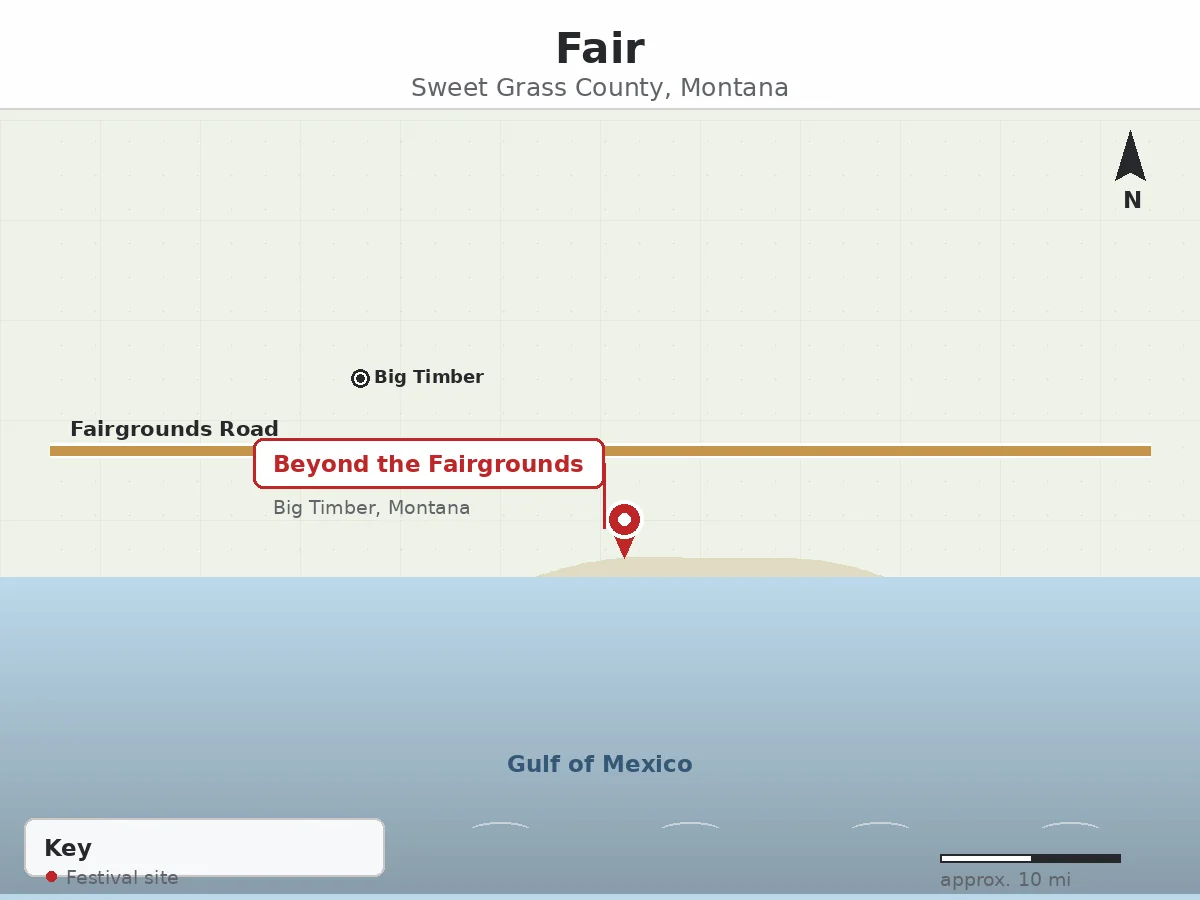
Beyond the Fairgrounds
Big Timber gives a fair trip a genuine second half. The town serves as the county seat, so its streets carry the character of a working Montana community rather than a resort strip, and meals, fuel and supplies are all handled within a few blocks. The fairgrounds themselves stay busy outside fair week, hosting county meetings and the other events this article has taken care to separate from the fair, which makes the grounds a year-round civic asset rather than a July-only enclosure. Travellers with spare days are in classic south-central Montana country, where ranch land runs toward mountain fronts and the driving itself, through big open valleys, becomes part of the visit.
Why This Fair Matters to Sweet Grass County
In a county where the enrolled 4-H programme counts its members in the low hundreds, the fair is one of the few occasions when nearly every family’s work is visible to every other family at once. Its importance is economic as well as social. The closing sale channels real money from local buyers to young producers, and the reported scale of the 2024–25 sale, carried here strictly as that year’s figure, suggests a community willing to underwrite its own children’s apprenticeships in agriculture. The interview judging matters in a different register: it teaches members to explain themselves, a skill that outlasts any single project. A fair run jointly by a county board and an Extension office keeps those benefits public and accountable, rooted in the county’s institutions rather than in a commercial promoter’s season.
Frequently Asked Questions
Which of the Big Timber events is the actual county fair?
The county fair is the late-July event built around 4-H project judging, interview judging and the closing Fair Sale at the Sweet Grass County Fairgrounds. The chamber festival with downtown music and the Wednesday-night professional rodeo series are separate events that use related ground but are not the fair.
Are exact dates published for the next edition?
Only the season is firmly established: late July. A statewide list gave Big Timber a July 21–25 window in its 2025 edition, but that window belongs to that year, and no settled span for 2026 appears in the fair-side record behind this article, so exact days should be confirmed with the county or Extension.
What does entry cost?
No admission, pass or parking price for this fair is published in the sources behind this article, and no figure is quoted here for that reason. The absence of a published price does not mean the fair is free, and prices for the other events at the grounds do not apply to it.
Who organises the Sweet Grass County Fair?
A county Fair Board oversees the fair and its grounds, with its meetings recorded in the county commissioners’ published business, while MSU Extension Sweet Grass County runs the 4-H programme whose projects, judging and sale make up the fair’s documented content.
What to Expect From the Next Sweet Grass County Montana Fair Festival
How often is the Sweet Grass County Montana Fair Festival held?
It is held once a year, in late July, as the closing week of the county’s 4-H year. The pattern is annual and seasonal rather than tied to a fixed set of calendar dates.
When is the next Sweet Grass County Montana Fair Festival?
The next edition falls in the next late-July window in Big Timber. Because no settled span for the upcoming edition is published in the record behind this article, the exact days should be taken from the county’s or Extension’s announcements as that summer approaches.
Will the dates change?
The late-July placing is the fair’s standing pattern and the detail a planner can rely on, while the precise days are set edition by edition and can move. Confirming the current year’s days before travelling is the sensible course, since an earlier year’s window cannot be carried forward.
When the last lot sells and the barns empty, the fair returns to being what it is for the other fifty-one weeks: a board’s agenda, an Extension office’s plans, and a hundred or so young people starting new projects. That modesty is its identity. On grounds shared with louder neighbours, the county fair remains the event that belongs most completely to the county itself.



One Comment