St. Louis County Missouri Saint Louis Art Fair Festival
Anyone who arrives in Clayton expecting a county fair will look in vain for livestock barns, a midway or a grandstand. The event this title names is something else entirely: a juried fine-art fair that takes over the streets of downtown Clayton each September and fills them with gallery-quality work sold by the people who made it. There is no county organiser behind it and no agricultural programme inside it. Saint Louis County’s September anchor is an art market, and the fair wears that identity openly.
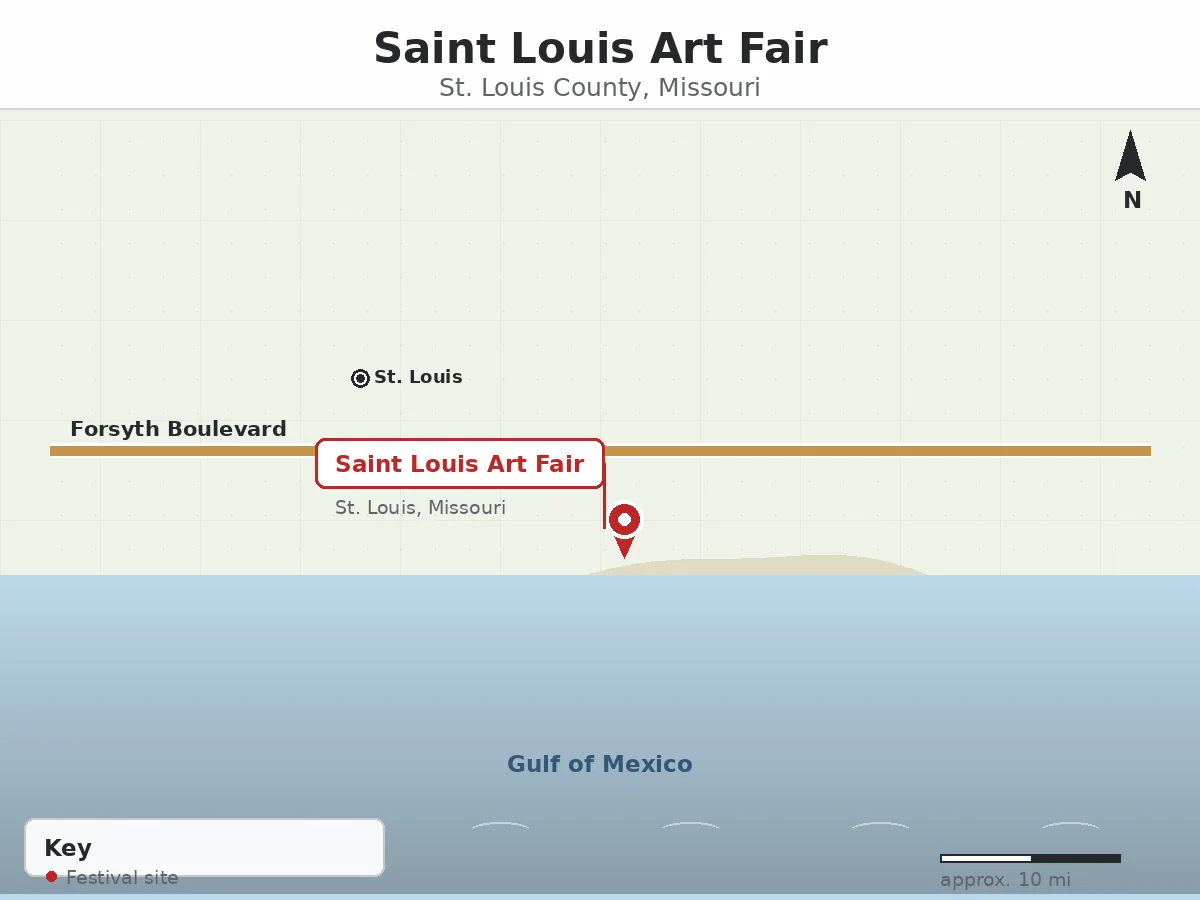
The event is the Saint Louis Art Fair, presented by Emerson, staged across the central business district of Clayton, the county seat. The fair billed its 2026 edition as its 33rd annual, and that documented edition ran from September 18 to September 20, 2026. For three days the ordinary traffic of a working county seat gives way to booth rows, performance stages and crowds drifting from one artist’s display to the next.
Admission costs nothing. The fair is a free street festival, and its scale is closer to a city celebration than to a craft show: an attendance estimate of 130,000 appears in the fair’s own materials prepared for artists, and cash awards of up to $15,000 hang over the juried competition. How many artists exhibit is, oddly, a question the record refuses to settle, and this guide carries that disagreement honestly rather than picking a favourite.
The Fair Behind the Title
The Saint Louis Art Fair is run by its own organisation, whose office sits at 8235 Forsyth Boulevard in Clayton. Emerson, the name attached to the fair’s title, is its presenting sponsor rather than its organiser, a distinction worth keeping because the event is sometimes casually described as though a corporation or the county itself produced it. Neither is true. The artist call for the 2026 edition named Sarah Umlauf as the fair’s Executive Director, and the organisation recently moved its office from South Meramec Avenue to that Forsyth Boulevard address, though the office is a workplace, not part of the festival site.
What separates this fair from an open-entry exhibition is the jury. Artists apply months ahead, a jury selects the field, and the chosen exhibitors sell from standard booths lined along the downtown streets. The economics on the artist side are published and plainly exhibitor costs, not visitor costs: an application fee of $45 in the early window or $55 in the late one, and $685 for a single booth space. The fair’s call also reported that artists at the 2025 edition averaged $14,379 in net sales, a figure quoted here only for what it is, an artist-side statistic from the fair’s own recruitment material.
For a useful comparison, see the St. Francois County Missouri Fair Festival for another county festival.
Quick Facts
| Detail | The documented picture |
| Event | Saint Louis Art Fair presented by Emerson |
| Kind of event | Juried fine-art festival on downtown streets |
| Town | Clayton, the Saint Louis County seat |
| Site | Streets of Clayton’s central business district |
| Documented edition | 33rd annual billing, September 18–20, 2026 |
| Daily hours | Friday 5–10 p.m.; Saturday 10 a.m.–9 p.m.; Sunday 11 a.m.–5 p.m. |
| Admission | Free |
| Artist field | Published counts disagree: 153, 181 and about 200 all appear |
| Around the booths | Creative Castle, three stages, Restaurant Row |
| Artist awards | Up to $15,000 in cash awards |
Three Decades Counted by the Fair Itself
The fair’s own billing supplies the only chronology this guide will assert: the 2026 edition was presented as the 33rd annual, and the fair describes itself as celebrating 33 years. No founding date is published in the record behind this article, and none will be derived by counting backwards, because annual billing and calendar arithmetic are not the same as a documented first edition.
What three decades of editions have built is visible in the fair’s present shape. A street exhibition that began as a local showing now fields a national juried competition in its own telling, supports three performance stages, runs a dedicated children’s art compound and draws an attendance estimate in six figures. The fair’s marketing to artists calls it one of the leading art fairs in the country; that is the fair’s billing for itself, offered here as colour rather than as a ranking this guide has independently judged.
What to Expect
Rows of Booths on Closed Streets
The core of the weekend is the exhibition itself: rank after rank of white booths along Clayton’s downtown streets, each one a small gallery staffed by the artist whose work hangs inside it. Painting, sculpture, ceramics, glass, jewellery, photography, fibre and wood all appear in a juried field of this kind, and the standard of entry is the point. Nothing here is entered on the day; every exhibitor survived a competitive application process months earlier, and the work is priced by the artists as gallery work, not as fairground merchandise.
The Creative Castle
Families are steered toward the Creative Castle, the fair’s hands-on art area for children. Its activity partners for the documented edition included the Contemporary Art Museum, COCA, the Magic House and the Girl Scouts, which tells a visitor the shape of the place: staffed making-stations where children produce something of their own rather than watching adults shop. For a household dividing its day between the booth rows and younger attention spans, the Castle is the natural pivot point.
Three Stages Running All Weekend
Performing artists work three stages spread through the grounds, covering music, spoken word and comedy. The stages change the texture of the streets between the booths; a visitor drifting with no purchase in mind still has a programme unfolding around them, and the schedule gives the longer Saturday a rhythm beyond browsing.
Restaurant Row and the Food Trucks
Eating is arranged rather than improvised. Restaurant Row serves food from Saint Louis restaurants inside the grounds, and food trucks work alongside it, so a full day at the fair never requires leaving the closed streets for lunch. Clayton’s own dining rooms stand just outside the booth rows for anyone who prefers a table, a chair and a quieter room at midday.
The Commemorative Print
Each edition produces a commemorative print, sold at the fair’s merchandise booth. The 2026 print, titled It is Written in the Stars, was created by Amy Koch. For collectors who follow the fair year over year, the annual print is the piece designed to be carried home by people who are not buying original art, and it doubles as the edition’s visual signature.
Planning Your Visit
The Shape of the Three Days
The documented 2026 hours describe the weekend’s rhythm. Friday opens in the evening only, from 5 to 10 p.m., giving the fair a lamplit first night aimed at the after-work crowd. Saturday is the marathon, 10 a.m. to 9 p.m., and carries the deepest crowds. Sunday runs 11 a.m. to 5 p.m. and is the shortest, calmest session. The fair’s standing season is a Friday-to-Sunday weekend in mid-September.
Getting Into Downtown Clayton
There are no fairgrounds to aim for; the destination is Clayton’s central business district itself, with its streets closed around the booths. The fair’s information booth stands at Forsyth Boulevard and Central Avenue, and it is the right first stop for a printed layout of the grounds. The fair publishes an accessible parking lot at 103 North Central Avenue, at the Maryland Avenue corner. No general visitor parking price appears in the fair’s published material, so drivers should treat parking cost as unknown rather than assume a figure, and anyone set on a particular artist should arrive early in a session.
What a Visit Costs
The gate, such as it is, does not exist: entry is free, and no ticket is sold. Spending inside is entirely at the visitor’s discretion. Original art carries gallery prices set by each artist, Restaurant Row and the food trucks charge their own menu prices, and the commemorative print offers the low-commitment purchase. A family can walk every street, hear every stage and work through the Creative Castle without spending anything at all.
Visiting With Children
The Creative Castle rewards an early visit, before small hands tire. Pair it with a stage performance and a food-truck lunch and Sunday’s shorter hours become a complete family outing rather than a compressed one. Because the grounds are ordinary city streets, pavements are level throughout, though the densest Saturday crowds make pushchairs slow going in the booth rows.
One Saturday, Hour by Hour
Arrive for the 10 a.m. opening and walk the booth rows while the light is good and the aisles still move, noting the artists worth a second look. Take the children through the Creative Castle late in the morning, then eat on Restaurant Row before the lunch queues build. Spend the early afternoon on a stage performance and a slow second pass through the booths, which is when most purchases are actually decided. Buy the commemorative print before the evening, stay for the late music as the fair runs toward its 9 p.m. close, and the longest day of the fair will have shown every side of itself.
Set Beside the County Fair It Is Not
The comparison is worth making directly, because the title invites the wrong one. A Missouri county fair is built on open competition: residents enter animals, produce and crafts, and the county judges its own. This fair inverts that model. Entry is closed and juried months in advance, the exhibitors are professionals rather than neighbours, the ground is a business district rather than a fairground, and the crowd comes to buy and to look rather than to see how the county’s entries placed. Both forms fill streets and grounds with people for a few days, and both anchor their communities’ calendars. Almost everything else about them runs in opposite directions.
Before You Set Out
- Admission is free, so no ticket purchase or advance booking is needed.
- Aim for the information booth at Forsyth Boulevard and Central Avenue first.
- Treat general parking cost as unpublished; the accessible lot is at 103 North Central Avenue.
- Go early in a session for the easiest access to individual artists.
- Schedule the Creative Castle early in the day for children.
- Expect gallery prices on original work and set a spending limit beforehand.
- Check the stage schedule on arrival so performances are not missed.
- Bring a bag or arrange shipping for any large piece bought on the street.
Beyond the Booth Rows
Clayton rewards the visitor who stays past the fair’s edge. It is the seat of Saint Louis County, so the courthouse and county government buildings stand within the same business district the fair occupies, and the streets around the booth rows hold the restaurants, coffee houses and shops of a working downtown rather than a resort strip. Forsyth Boulevard, where the fair keeps its office and its information booth, is the natural street for an evening meal after the booths close. The wider city’s museums and neighbourhoods lie a short drive east.
Why an Art Fair Anchors This County’s September
The significance of this event is partly the surprise inside it. A county of Saint Louis County’s size might be expected to mark September with an agricultural fair, and instead its seat hosts one of the country’s self-described leading juried art markets, free to enter, on public streets. That choice puts original art in front of an estimated six-figure crowd with no gate between the pavement and the paintings, which few gallery districts anywhere can match. For Clayton it concentrates a year’s worth of visitors into a single weekend. For the county named in the title, it is the rare festival whose subject is the work itself.
Frequently Asked Questions
Is this event actually a county fair?
No. Despite the festival title it carries in this series, the event is the Saint Louis Art Fair, an independent juried fine-art festival held on the streets of Clayton. Saint Louis County does not organise it, there are no livestock or agricultural exhibits, and its presenting sponsor, Emerson, supports the fair without running it. Everything about its structure, from the juried entry to the gallery pricing, belongs to the art-fair world rather than the county-fair one.
When does the fair run and what are the hours?
The fair occupies a Friday-to-Sunday weekend in mid-September. Its documented 2026 edition ran September 18–20 under a 33rd annual billing, opening Friday from 5 to 10 p.m., running Saturday from 10 a.m. to 9 p.m., and closing Sunday from 11 a.m. to 5 p.m. Those hours belong to the documented edition; the season and the three-day shape are the fair’s standing pattern.
How many artists take part?
The honest answer is that the fair’s own published figures do not agree. Its call for artists capped the show at 153 artists plus returning award winners. A summary of the same call put the field at 181 artists. The fair’s own programme pages describe approximately 200 artists. This guide reports all three because the record contains all three, and it will not pretend the disagreement away by selecting one.
Does it cost anything to attend?
Entry is free and no ticket is sold at any point. The fair publishes an accessible parking lot at 103 North Central Avenue, though it does not publish a general visitor parking price. Inside the grounds, spending is optional and self-directed: art is priced by the artists, food is sold at Restaurant Row and by food trucks, and the stage performances and Creative Castle activities carry no admission charge of their own.
What to Expect From the Next St. Louis County Missouri Saint Louis Art Fair Festival
How often is the St. Louis County Missouri Saint Louis Art Fair Festival held?
Once a year, on a single weekend. The fair is an annual event that takes over downtown Clayton for three days each September, and its 2026 edition was billed as the 33rd annual, which is the fair’s own way of stating the yearly rhythm.
When is the next St. Louis County Missouri Saint Louis Art Fair Festival?
The next edition follows the annual pattern and is expected on a Friday-to-Sunday weekend in mid-September 2027. Specific dates for that edition had not been published in the record behind this guide, so the firm reference point remains the documented 2026 edition of September 18–20, and the fair’s announcements closer to the season will fix the exact days.
Will the dates change?
The fair’s habit is a mid-September weekend running Friday to Sunday, and the documented edition followed it exactly, so a wholesale move looks unlikely. Exact calendar dates necessarily shift from year to year because the weekend itself moves, and hours can be adjusted by the organisers; the prudent course is to treat mid-September as the planning assumption and confirm the announced dates before booking travel.
Strip the title down to what it truly describes and the event needs no agricultural dressing to justify its place in this series. For one September weekend the Saint Louis County seat closes its business streets, hangs them with the work of a juried national field, feeds the crowd from its own restaurants and charges nobody a penny to walk in. That is not a county fair. It is something rarer, and Clayton is entitled to be proud of the difference.