Socorro County New Mexico Fair Festival
Every Labor Day weekend, Socorro County’s working heart moves onto one set of grounds in Socorro, the county seat. The event is the Socorro County Fair, published in fuller form as the Socorro County Fair & PRCA Rodeo: a five-show livestock week, halls of quilts and chiles, a downtown parade and two nights of professional rodeo, governed by a volunteer board and written down in the fair’s own fair book. It is not the Southern New Mexico State Fair in Las Cruces, not the state fair in Albuquerque, and not a rodeo with a fair attached. Its book, unusually complete on programme and rosters, publishes no gate price at all.
About a Fair Governed by Volunteers
The Socorro County Fair and Rodeo Association puts on the fair. Its book says so plainly: a volunteer board of directors governs the association, maintains the grounds and puts on the fair. The association’s mailing address is Post Office Box 1612, Socorro, and its board works through internal committees for livestock, the rodeo and the royalty contest — one body, not separate organisers. The 2026 book names President Jeff Fassett, Vice-President Wesley Bruton, Secretary Jessica Bauer and Treasurer Caleb Kerr; the previous year’s book carried a different president, and neither roster should be read as the other’s. Extension agents and the Socorro and Magdalena high school FFA advisors run the 4-H and FFA entry machinery, and City of Socorro Tourism coordinates the Saturday parade — partners, not producers. One rule shapes who may enter: the fair is open to exhibitors from anywhere, except that its 4-H and FFA departments are reserved for Socorro County’s own young exhibitors.
Quick Facts
| Item | What the record shows |
| Published name | Socorro County Fair, billed in full as the Socorro County Fair & PRCA Rodeo |
| Organiser | Socorro County Fair and Rodeo Association, run by a volunteer board of directors |
| Fair town | Socorro, at the Socorro County Fairgrounds |
| County seat | Socorro, which also hosts the fair |
| Main buildings | Zimmerman Hall, Kelly Hall, Finch Pavilion, Greenwood Barn, the Rabbit and Poultry Barn and the Convention Center |
| Rodeo venue | City of Socorro Rodeo Sports Complex, a separate city site |
| Season | Early September, over the Labor Day weekend |
| Public programme shape | Livestock shows and open halls Wednesday to Sunday, after two entry and set-up days |
| Admission | No gate, parking or rodeo ticket price is published in the fair’s own record |
| Camping | No fair camping or recreational vehicle offer appears in the fair’s own books |
A History the Fair Book Leaves Unnumbered
Anyone looking for the year this fair began will not find it in the fair’s own book, and this article will not invent it. No edition number or annual count for the fair itself is published in its current record; the only numbered billing inside the book belongs to a single contest, the chainsaw contest, which reached its eleventh annual running in 2026. What the book offers instead is heritage of a different kind: its essay on the story behind the brand traces livestock branding in New Mexico back to 1598 and Don Juan de Oñate, treating family brands as living heritage — never evidence of when a fair started. The paper trail that does exist belongs to the association, not the event: tax-exempt paperwork from 2018 records when a volunteer body’s status was recognised, not a founding. Trade coverage adds one dated rodeo layer: a successful Socorro rodeo in 2019 and none at all in 2020, the pandemic year. The themes — “Cowboy Boots Bucking Chutes” in 2026, “Meet Ewe at the Fair” the year before — are edition layers too, proving nothing about the fair’s age.
What to Expect
Five Livestock Shows Building to One Sale
The exhibitor week is built like a staircase. Wednesday evening opens the showing with the Goat Show at six o’clock, after a day of small-stock entries and market-animal weigh-in. Thursday starts with the Lamb Show at seven, continues with small-stock judging of rabbits and poultry, and closes with the Heifer Show at four, followed by the Steer Show. Friday brings the Swine Show at seven and Round Robin Showmanship at one. Market, booster and county-bred classes run through the book’s divisions, all funnelling toward the 4-H and FFA Junior Livestock Sale on Saturday at three o’clock in Greenwood Barn, where county buyers reward a summer of work.
Halls Full of the County’s Handiwork
The open division runs deep. Zimmerman Hall holds the 4-H indoor projects, while the open departments spread across the plant: school art, preserved foods, baked goods and candy — with a professional bakers and cooks category new in the 2026 book — an agriculture department running from fruit and vegetables to chiles, melons, pumpkins and eggs, including a “Whopper” largest-item class, plus fine art, photography, arts and crafts, sewing, fancy work and a flower show, with quilting in the Convention Center. The exhibit buildings open to the public on Thursday at three in the afternoon.
For a useful comparison, see the Sierra County New Mexico Fair Festival for another county festival.
Two Nights Under the Arena Lights
The PRCA Rodeo performs twice, on Friday and Saturday evenings at seven o’clock, and not at the fairgrounds. The fair’s own book places those performances at the City of Socorro Rodeo Sports Complex, the city’s covered arena, and rodeo layers confirm the Saturday performance, with a one o’clock slack and a named stock contractor. The fair deliberately borrows the city’s arena for its biggest nights rather than squeezing professional rodeo into a fairground ring. The book also carries a royalty pageant, with its own pages and a queen committee, at exactly that documented depth.
A Saturday That Starts With Pancakes
Saturday is the fair’s fullest day, much of it away from the barns. The Shooting Sports 4-H Pancake Breakfast runs from seven to nine in the morning in Finch Pavilion. At ten the City of Socorro Parade steps off from Sedillo Park, proceeding south on California Street to Spring Street past a judging stand at Bullock and California, with judged categories competing for rosette ribbons and a sweepstake trophy for the entry best depicting the year’s theme. Back at the grounds, the chainsaw contest registers at ten and competes at half past eleven in the northwest corner in front of Kelly Hall, its grand prize a new chainsaw donated by a local equipment firm, and Saturday also brings the Corgi Race.
Sunday Belongs to the Smallest Exhibitors
The fair closes gently. Exhibits are released between eight and ten on Sunday morning, Kelly Hall stays open until noon, and the day’s two fixtures carry the only no-charge terms in the fair’s own record. The Pet Show registers at nine o’clock in Greenwood Barn, where children from three to ten parade their pets — nearly any animal is welcome except horses, ponies and snakes. At ten the Pee Wee Rodeo takes over the same barn for children from three to eight, riding stick horses through barrel racing, a flag race, a bucking-horse event and a goat ribbon pull.
Planning Your Visit
One Fair, Two Addresses
Plan for two locations: the shows, halls, contests and junior sale at the Socorro County Fairgrounds, the rodeo nights at the city’s rodeo and sports complex. The fair book prints no street address for the fairgrounds; layers outside the book place the grounds on Fairgrounds Road, while the city arena’s published address is 1 Rodeo Road. Keep the two apart. California Street is the parade route downtown, never a fairgrounds address.
The Honest Answer About Prices
Neither fair book publishes an admission ladder, a parking price or a rodeo ticket price, and no figure here has been borrowed from another fair to fill that silence. The fair is never described as free in its own record; the only no-charge terms the book prints belong to the Sunday pet show and pee wee rodeo registrations. Money appears in the record only on the contestant side of the fence: chainsaw competitors pay a fifty-dollar entry fee and bring their own saw, fuel and tools, and the rodeo’s sanctioning layer lists contestant entries of seventy-six dollars for the barrel racing and one hundred forty-six dollars for the breakaway roping, alongside arena stall and hook-up charges that are contestant terms, never visitor prices. Carry cash and settle the gate question at the grounds.
Entry Days Are Not Fair Days
The schedule opens with two days that belong to exhibitors alone. On Monday and Tuesday, 4-H indoor exhibits and the sale-ring cake are entered, fine arts and photography come in and vendors set up; a visitor arriving then will find a working ground, not a fair. Public life begins with Wednesday’s first show; the halls open Thursday afternoon, and the week crests on Saturday.
A Saturday, Hour by Hour
Begin with pancakes in Finch Pavilion between seven and nine, cooked by the shooting sports families. Walk the barns while the morning is cool, then head downtown before ten to watch the parade come down California Street under the year’s theme. Return for the chainsaw contest at half past eleven and the Corgi Race before settling into Greenwood Barn at three for the Junior Livestock Sale. Eat early, then cross town to the city rodeo complex for the seven o’clock PRCA performance.
Staying Over Without a Fair Campground
No fair-week camping offer appears in the fair’s own record, and none should be assumed. The city rodeo complex rents recreational vehicle sites year-round under its own operation — a city arrangement at the arena, not a fair campground and not a fair price — so treat Socorro’s motels and vehicle parks as the plan, booked ahead for a holiday weekend. Exhibitors stable horses at the arena under the rodeo’s own terms.
Two Fairs Inside One Week
This single event behaves like two fairs sharing a calendar. The grounds fair is an exhibitor’s fair: judged, rule-bound and barn-centred, its audience largely the county watching its own work measured against the book. The arena fair is a spectator’s fair: two nights of professional rodeo under cover, produced at a municipal complex with professional machinery. Neither half is the other’s warm-up. The livestock week would be complete without a single bull ridden, and the rodeo would fill its seats in a town with no fair at all — yet the association deliberately holds them in one week.
Before You Go
- Settle your site first: fairgrounds for barns and halls, the city complex for rodeo nights.
- Arrive from Wednesday onward; the Monday and Tuesday of fair week are entry and set-up days for exhibitors only.
- Bring cash and confirm any gate charge at the grounds, since the fair’s own book publishes no ticket price.
- Put Saturday’s Junior Livestock Sale at three o’clock in Greenwood Barn at the centre of your plan.
- Watch the parade from California Street, near the Bullock judging stand.
- Keep Sunday morning free with small children; the pet show and stick-horse rodeo are written for them.
- Book Socorro lodging early for the holiday weekend, and do not count on camping at the fairgrounds.
- Leave midway expectations behind: this is a livestock and exhibits fair, and its book lists no carnival.
Beyond the Fairgrounds
The parade route is the town’s front room, running from Sedillo Park down California Street through the historic centre. The fairgrounds host other people’s occasions in other months — a Lions Club guns and crafts show in Kelly Hall is a tenancy, not fair programme — and the city rodeo complex runs its own year-round calendar. In November the town turns to the Festival of the Cranes at the Bosque del Apache refuge, a separate celebration on a separate footing; it belongs to late autumn, not to Labor Day.
Why a Volunteer Fair Carries a County
This fair is less an entertainment product than a county institution. The association’s stated work — organising the annual fair and rodeo, maintaining the grounds, running the Junior Livestock Sale and supporting agricultural education for 4-H and FFA members — describes civic machinery a ranch county uses once a year to take its own measure. The sale converts a season of youth labour into college funds and next year’s project money in a single Saturday afternoon. Where the book publishes no price and no founding year, the honest account leaves the space empty.
Frequently Asked Questions
Where in Socorro does the fair actually happen?
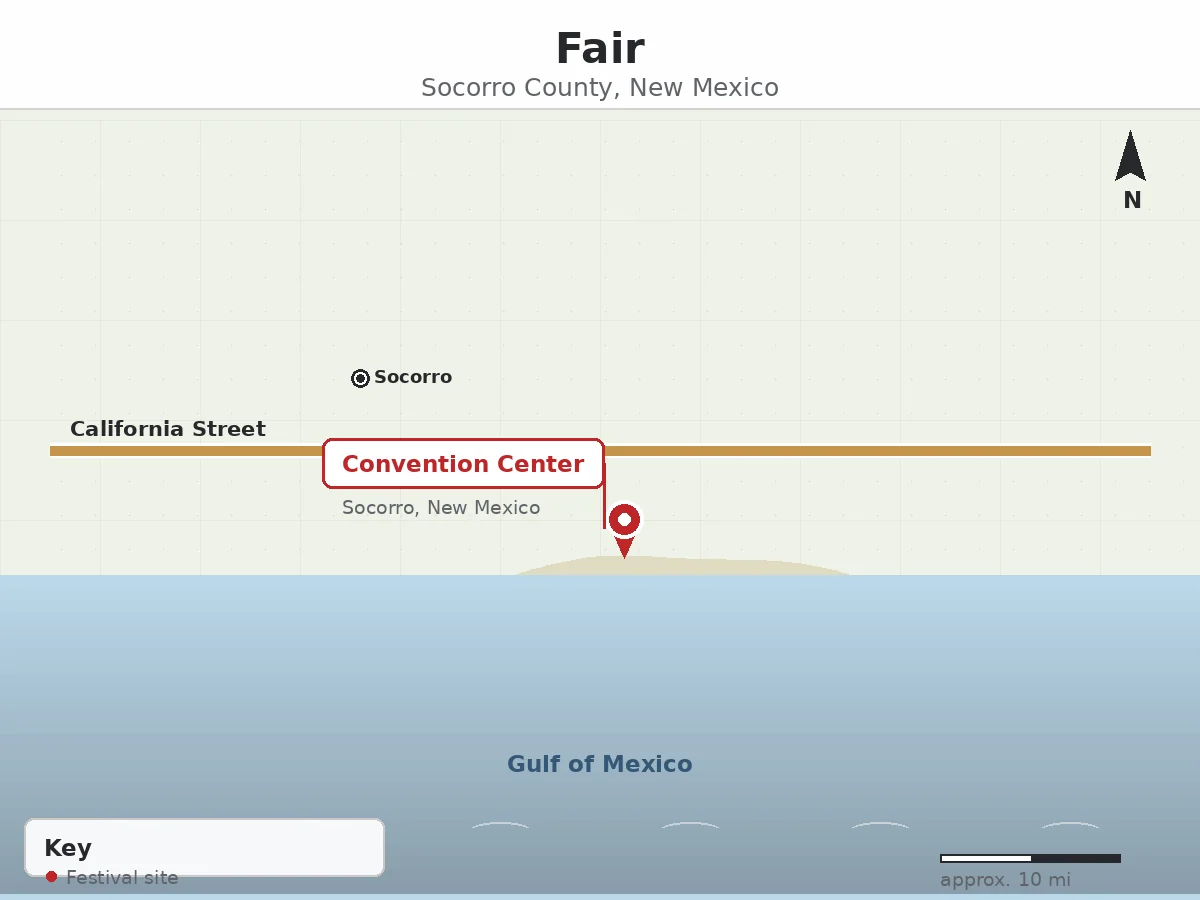
In two places, deliberately. The shows, halls, contests and sale sit at the Socorro County Fairgrounds, while the two PRCA Rodeo performances take place at the City of Socorro Rodeo Sports Complex, the municipal arena. The Saturday parade adds a third setting, downtown along California Street from Sedillo Park.
Why does the fair book print no ticket price?
Because the association has not published one. Neither the current fair book nor the previous year’s prints an admission ladder, a parking charge or a rodeo ticket price, so the gate terms are simply unpublished, which is not the same as free. The only no-charge entries in the book are the Sunday pet show and pee wee rodeo registrations for children.
Are the first two days of fair week open to visitors?
No — Monday and Tuesday are entry and set-up days, when exhibits are delivered and the grounds are a workplace. The public programme runs from Wednesday’s first show through Sunday’s release and children’s events.
Can I bring my camper and stay at the grounds?
The fair itself publishes no camping or recreational vehicle offer, so plan on Socorro’s motels or commercial vehicle parks instead. Vehicle sites at the city rodeo complex are a municipal year-round arrangement, not fair-week camping sold by the association.
What to Expect From the Next Socorro County New Mexico Fair Festival
How often is the Socorro County New Mexico Fair Festival held?
The fair is an annual event, held once a year across the Labor Day weekend, with each edition published in its own fair book by the Socorro County Fair and Rodeo Association.
When is the next Socorro County New Mexico Fair Festival?
The next edition falls on the following year’s Labor Day weekend in early September, keeping the documented shape: entry days first, a public programme from Wednesday to Sunday, the junior sale on Saturday afternoon and rodeo on Friday and Saturday nights. Exact dates arrive with that year’s fair book, the only span worth trusting.
Will the dates change?
The fair is anchored to Labor Day weekend, so its frame is stable even though the exact calendar days shift slightly from year to year as the holiday moves. Guide listings have disagreed with the fair book about this fair’s span, so the season and weekday shape are the reliable facts.
Closing
The Socorro County Fair asks a little more of its visitors than a fair with a ticket page and a midway map. It asks them to read a fair book, keep two addresses apart and arrive on the right day. What it returns is a ranch county’s year, judged class by class in its own barns and closed by children racing stick horses on Sunday morning.
One Comment