Orleans Parish Louisiana Mardi Gras Festival
New Orleans does not mark the weeks before Lent with a single festival on a single weekend. What the layers read describe is a season, a long stretch of parades, balls, street parties and neighbourhood gatherings that builds from early January to a single Tuesday, then stops all at once. Anyone who arrives expecting one gate, one stage and one programme will miss the shape of the thing entirely, because the shape is the calendar itself: a slow opening, a quickening run of parades in the final two weeks, and a final day when the city turns out in force. The sheet title names a festival, yet no single event is printed under that name in any layer read. The honest way to write about it is to write about the season as the season, with its own dates, its own parade route and its own cast of krewe organisations, and to let the reader see how the separate pieces fit together.

About
Mardi Gras in New Orleans is the Carnival season of the city, running from early January to the day before Ash Wednesday. The season opened on 6 January 2026 and closed on Mardi Gras Day, Tuesday 17 February 2026, which the layers call Fat Tuesday. The previous year, Mardi Gras Day fell on 4 March 2025, so the closing date moves from year to year. The season is published as Mardi Gras and as Carnival, and both names describe the same stretch of weeks rather than two different events.
There is no single organiser. The season is made by the krewes, the organisations that create the parades, and each krewe runs its own parade, its own ball and its own traditions. Some krewes are old and large, with long histories on the streets of the city. Others are newer and smaller, and their parades fill the middle of the season, when the pace is steadier and the crowds are thinner. A visitor who sees three parades sees three different organisations, three different themes and three different crowds.
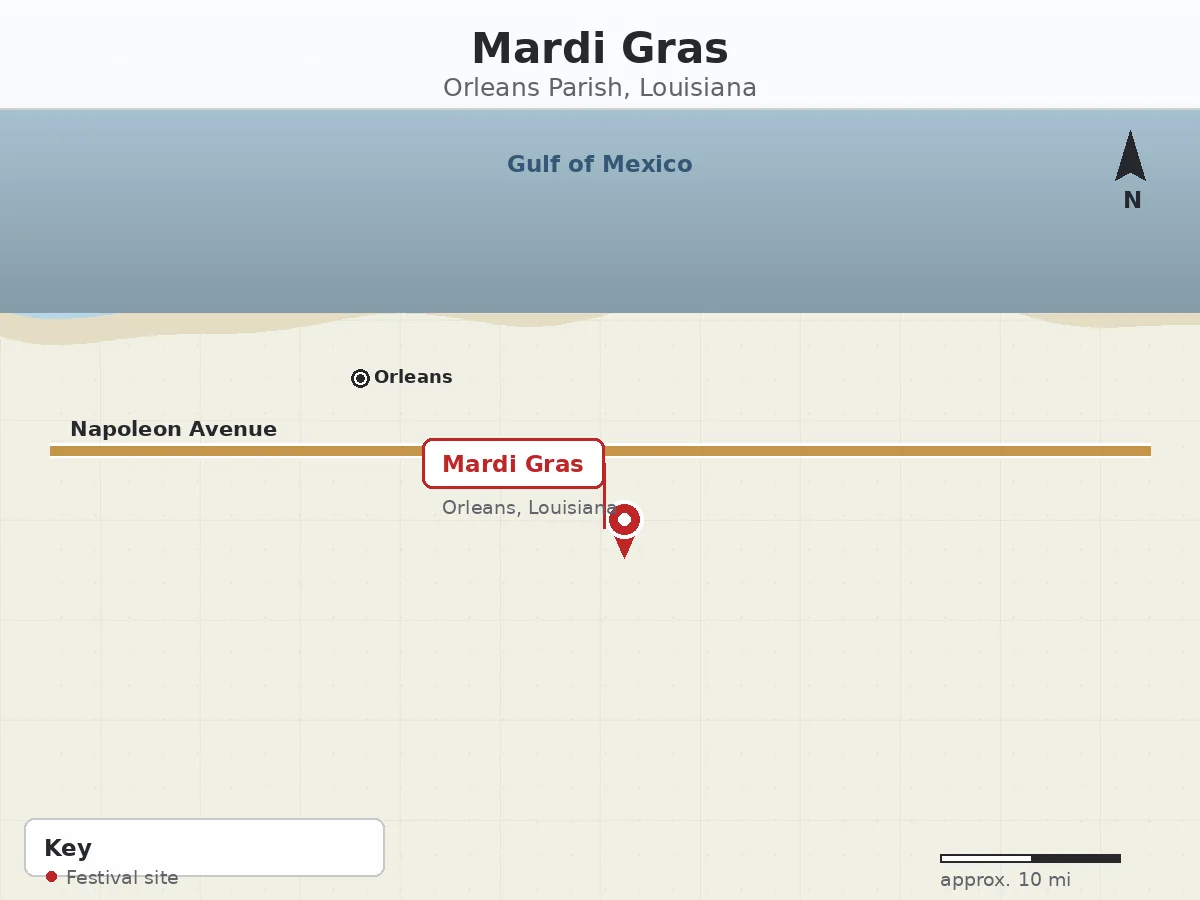
The parades are the public heart of the season. They roll nearly every day from late January through Fat Tuesday, and the final weekend carries the largest and best known of them. The main parade route runs from Napoleon Avenue along Saint Charles Avenue in Uptown to Canal Street in the Central Business District, and parades also gather in the French Quarter, where the streets fill with costumed walkers rather than floats. Balls and parties run alongside the parades, mostly in the evenings, and they are the ticketed part of the season.
Quick Facts
| Detail | What the record shows |
| Host city | New Orleans |
| Parish seat | New Orleans |
| Season | Carnival, from early January to the day before Ash Wednesday |
| Latest season | 6 January to 17 February 2026 |
| Mardi Gras Day 2026 | Tuesday 17 February 2026 |
| Mardi Gras Day 2025 | 4 March 2025 |
| Main parade route | Napoleon Avenue along Saint Charles Avenue to Canal Street |
| Other parade area | The French Quarter |
| Organiser | No single organiser; the krewes create the parades |
| Parade admission | Free public events |
History
The history of the season is the history of its krewes, and two of them anchor the record. Rex has paraded since the 1870s, and its long run gives the season one of its oldest continuous threads. Zulu was founded in 1909, and its parade on Mardi Gras Day itself is one of the most recognisable sights of the final morning. These are krewe histories, not the founding story of a single festival: no year in any layer read shows one body founding the season as a whole, because the season grew out of the separate krewes and their separate parades.
For a useful comparison, see the Natchitoches Parish Louisiana Melrose Arts and Crafts Festival for another county festival.
The season took shape around the parade calendar. The opening on 6 January marks the start of Carnival, and the weeks that follow belong to the krewes in turn, each one preparing its floats, its throws and its ball for its own night. By late January the parades begin rolling in earnest, and the final weekend brings the largest crowds to the Uptown route. The closing day, Fat Tuesday, belongs to the morning parades and to the street parties that follow them, and when the day ends the season ends with it.
That rhythm, a quiet opening and a loud close, is older than any single parade on the calendar. The krewes keep their own records, their own themes and their own memberships, and the season holds them together without merging them.
What to Expect
Expect crowds, colour and noise on the main route, and a very different mood in the French Quarter. The Uptown parades on Saint Charles Avenue are large, with marching bands, floats and riders throwing beads, cups and small trinkets to the crowds along the kerb. People arrive hours early to claim a spot. The floats pass slowly, the bands pass loudly, and the throws keep the crowd reaching upward for the whole length of the parade.
The final weekend carries the heaviest programme. Krewe of Endymion rolls on 14 February 2026, Krewe of Bacchus on 15 February 2026, and Krewe of Orpheus on 16 February 2026, which the layers call Lundi Gras. Krewe of Muses rolls on 12 February 2026, earlier in the same week. On Mardi Gras Day itself, Krewe of Zulu and Krewe of Rex parade in the morning, and the streets stay full long after the last float has passed.
The French Quarter offers a smaller scale. There the celebration is on foot, with costumed walkers, small bands and street parties filling the narrow streets. A visitor who wants the grand parade should head for the Uptown route; a visitor who wants to wander, listen and watch the costumes up close should head for the Quarter. Both belong to the same season, and both are free to join from the street.
Planning Your Visit
Begin with the dates for the year you plan to travel, because the closing day moves. The layers read give Mardi Gras Day as Tuesday 17 February 2026 and 4 March 2025, so the season never sits on the same dates two years running. Confirm the new season’s dates against a current listing before booking anything, and plan around the final weekend.
Arrive early for the large Uptown parades, and choose a spot on the route with room to stand and a clear view of the floats. The main route runs from Napoleon Avenue along Saint Charles Avenue to Canal Street, and the crowds thicken as the parade nears the Central Business District. Wear comfortable shoes, dress in layers, and carry water, because a parade afternoon is long and the weather in February can turn quickly. The parades cost nothing to watch, so the budget goes to travel, lodging and food rather than to tickets.
Balls and some parties are ticketed, and they are a separate purchase from anything on the street. A visitor who wants a ball should arrange it well ahead of the season, since the well known ones fill early. Mardi Gras celebrations in other Louisiana parishes are different events with their own dates, and the Family Gras event in Jefferson Parish is a separate event too.
Sample Itinerary
A three day visit across the final weekend catches the season at its fullest. Arrive on the Friday and spend the afternoon walking the French Quarter, where the costumes and street music give a first taste of the season without the crush of the main route.
Saturday belongs to the Uptown route. Claim a place on Saint Charles Avenue in the morning, well before the parade, and settle in for the afternoon. Krewe of Endymion rolls on 14 February 2026, and the scale of its parade shows what the large krewes can put on the street.
Sunday brings Krewe of Bacchus on 15 February 2026, and Monday brings Krewe of Orpheus on 16 February 2026, Lundi Gras. Tuesday, Mardi Gras Day, starts early with Krewe of Zulu and Krewe of Rex, and the morning parades give way to street parties that run through the afternoon. Leave the evening free, because the day is long and the crowds are at their largest.
Comparison
The season offers three distinct ways to take part, and each suits a different visitor. The large Uptown parades are the grandest, with floats, marching bands and throws along Saint Charles Avenue, and they reward an early arrival and a fixed spot on the route. They are the best choice for a first time visitor who wants the classic picture of Mardi Gras, and they are also the most crowded.
The French Quarter gatherings are smaller and closer, with costumed walkers, small bands and street parties rather than floats. They suit a visitor who prefers to wander, to listen and to watch the costumes at arm’s length, and they cost nothing beyond the price of being there. The trade off is that there is no fixed programme to follow, and the best moments arrive unannounced.
The balls are the third way in, and they are the most formal. They are ticketed evening events run by the krewes, with music, dancing and costumes of a different order from the street. They suit a visitor who wants a planned evening and a closer look at krewe tradition, and they need booking well ahead.
Checklist
- Confirm the new season’s Mardi Gras Day date before booking, since it moves each year
- Pick your parade days from the dated krewe list, and plan around the final weekend
- Arrive hours early for the large Uptown parades and claim a spot on Saint Charles Avenue
- Wear comfortable shoes and dress in layers for a long afternoon outdoors
- Carry water and a small bag for throws, and keep valuables close in the crowds
- Remember the parades are free, and budget separately for any ticketed ball
- Keep the French Quarter for wandering, and the Uptown route for the grand parades
- Check whether the ball or party you want needs booking ahead of the season
Beyond the Season
New Orleans rewards a visitor who looks past the parades as well. The French Quarter, the riverfront and the neighbourhoods around the parade route are worth walking on the quieter days of the season, when the streets are open and the pace is slower. Local food is part of the visit, and a meal between parades is often the best rest a long day offers.
The city also carries its own history beyond Carnival, in its architecture, its music and its riverfront. A visitor who arrives a few days early can see the city before the crowds peak, and a visitor who stays a day after Fat Tuesday will find the streets suddenly quiet, with the season packed away until the next January.
Significance
The season matters because it belongs to the city rather than to any single organiser. The krewes are community organisations, and their parades are the work of members who build floats, sew costumes, rehearse bands and plan balls for months before the season opens. Rex has paraded since the 1870s and Zulu was founded in 1909, and those long runs give the season a depth that a new event could not borrow. The parades are free to watch, which keeps the season open to anyone who can reach the route.
The season also matters to the city as a whole. It fills the streets, the hotels and the restaurants in the weeks before Lent, and it gives the krewes a public stage for traditions they keep through the rest of the year. For a visitor, the significance is simpler: there is no other week in the city when so many separate organisations, so many bands and so many costumed walkers share the same streets at the same time.
Frequently Asked Questions
Do I need a ticket to watch a parade?
No. The parades are free public events, and anyone can watch from the street along the route. The main route runs from Napoleon Avenue along Saint Charles Avenue to Canal Street, and the French Quarter gatherings are free as well. Balls and some parties are ticketed, and those are separate purchases.
Which parade should a first time visitor choose?
The final weekend is the safest choice. Krewe of Endymion rolls on 14 February 2026, Krewe of Bacchus on 15 February 2026, and Krewe of Orpheus on 16 February 2026, and those three parades show the large krewes at their grandest. Mardi Gras Day itself, with Krewe of Zulu and Krewe of Rex in the morning, is the most crowded day of all.
What should I bring to a parade?
Bring comfortable shoes, layers for changing weather, water, and a small bag for the throws that riders toss from the floats. Arrive hours early for the large Uptown parades, and choose a spot with a clear view and room to stand. Keep valuables close, since the crowds along Saint Charles Avenue are thick.
Is the season only about Mardi Gras Day itself?
No. The season runs from early January to Fat Tuesday, and parades roll nearly every day from late January onward. Mardi Gras Day, Tuesday 17 February 2026 in the latest dated season, is the closing day, not the whole event. A visitor who comes only for that day will miss the build up and the weekend parades.
What to Expect From the Next Orleans Parish Louisiana Mardi Gras Festival
How often is Orleans Parish Louisiana Mardi Gras Festival held?
The season returns each year, opening in early January and closing on Mardi Gras Day, the Tuesday before Ash Wednesday. The layers read give the 2026 season as 6 January to 17 February 2026, and the 2025 closing day as 4 March 2025. Each year brings a fresh season with its own parade dates, so the calendar should be checked anew.
When is the next Orleans Parish Louisiana Mardi Gras Festival?
The most recent dated season in the layers read runs from 6 January to 17 February 2026, with Mardi Gras Day on Tuesday 17 February 2026. The layers read do not print the dates of the following season, so the next season’s dates should be confirmed against a current listing before any travel is booked.
Will the dates change?
Yes. The two dated Mardi Gras Days in the layers read fall on different dates, Tuesday 17 February 2026 and 4 March 2025, so a visitor should expect the dates to move from year to year. The parade days of the named krewes will move with the season.
The season is a long build to a single Tuesday, and it rewards the visitor who treats it that way: pick the parade days, claim a spot early, wander the Quarter in the evenings, and save the final morning for Zulu and Rex. New Orleans does not stage one festival; it opens its streets to a season of separate parades.