Dallas County Alabama Selma Cinema Festival
For four days each spring, Selma becomes a cinema town. The Selma Cinema Festival brings independent filmmakers, documentaries, shorts, and community conversations to a city with a long and complicated relationship to the American story, and it does so with free admission and open doors. It is one of the newest additions to Dallas County’s cultural calendar, and it has already become a reason for filmmakers and film lovers to make the drive to the Black Belt.
The festival matters because it puts Selma on the map for a different kind of storytelling than the one the city is famous for. Instead of a single defining chapter of history, audiences get a program of new work, from Alabama filmmakers and from artists well beyond the state, screened in venues within walking distance of the Edmund Pettus Bridge. The result is a weekend that feels both contemporary and deeply connected to place.
| Festival name | Selma Cinema Festival |
| Location | Selma, Dallas County, Alabama |
| Typical timing | Late March, four days |
| Founded | 2025 |
| Format | Independent film screenings, panels, and community events |
| Primary venue | Foot Soldiers Park Auditorium, 1018 Water Avenue |
| Admission | Free screenings and events |
| Focus | Independent filmmaking from Alabama and beyond |
About the Selma Cinema Festival
The Selma Cinema Festival is an annual independent film festival held in Selma over four days in late March. It is built around free screenings, panel discussions, and community events, and it welcomes both established and emerging filmmakers. Screenings take place at venues including the Foot Soldiers Park Auditorium on Water Avenue, with additional programming at other downtown locations.
The festival is a young event, with its first edition in 2025 and a second planned for March 2026, but it has already attracted attention from regional media and from filmmakers looking for a platform outside the larger markets. Its location is part of its appeal. Selma offers an audience that cares about storytelling, a compact downtown that makes a multi-venue festival walkable, and a history that gives any program about the South a natural context. To see how a rural county celebrates a very different art form, the nearby Dallas County Alabama Alabama Tale Tellin’ Festival shows how a county can build a beloved tradition around its signature crop at Smith Lake Park each Labor Day.
Why Selma Embraced Film
Selma’s connection to film runs deeper than a single festival. The city’s pivotal role in the civil-rights movement has made it the subject of major motion pictures, including the 2014 feature “Selma,” which dramatized the voting-rights marches and renewed national interest in the city. Filmmakers have long been drawn to the region for its historic architecture and its riverfront setting, and the presence of the Foot Soldiers Park, a monument to the young activists who marched in 1965, gives the festival a symbolic home.
That context shapes the kind of films the festival tends to attract: documentaries about place and memory, narrative shorts rooted in Southern life, and work by Black filmmakers telling stories that larger festivals often overlook. By keeping admission free, the organizers have made the event accessible to local residents as well as visiting film buffs, which aligns with the city’s broader effort to make its cultural institutions open to its own community.
Dallas County at a Glance
Dallas County was established on February 9, 1818, and covers roughly 975 square miles in west-central Alabama. Its western edge is the Alabama River, which curves past Selma on a high bluff, and the Cahaba River crosses the northern part of the county. Selma is the county seat and largest city, and U.S. Highway 80 runs east toward Montgomery and across the state.
The county anchors the Black Belt, a region of dark, fertile soil that once made it one of the wealthiest agricultural areas in the South. Cahaba, now a ghost town south of Selma, served as Alabama’s first state capital. The county’s economy has shifted over the decades from plantation agriculture toward manufacturing, health care, and services, but its identity is still shaped by the land, the river, and the landmarks of the civil-rights era. That mixture of history and small-city life gives the cinema festival a distinctive audience and setting.
The Festival Program
Screenings and featured films
The core of the festival is its slate of independent films, which has included documentaries, narrative features, and short films from Alabama and across the country. Recent editions have unveiled feature films from a range of genres and have offered multiple screening blocks across the four days. Because the program changes each year, the best way to plan is to check the festival’s schedule once it is released, but you can expect a mix of premieres and recent independent work.
Panels and filmmaker conversations
Between screenings, the festival hosts panel discussions and question-and-answer sessions with filmmakers. These conversations are a signature part of the experience, giving audiences a chance to hear about the craft behind the work and to engage directly with directors, producers, and writers. For aspiring filmmakers in the region, the panels are an unusually accessible chance to learn from people working in the field.
Community events and access
The festival emphasizes community participation, with free screenings and events designed to bring local residents and visiting filmmakers together. Venues cluster downtown, so attendees can move between screenings on foot and take in the city’s historic streets along the way. Food and refreshments have been part of the program, and the atmosphere is deliberately informal rather than gated.
Planning Your Visit
Getting to Selma
Selma sits about fifty miles west of Montgomery on U.S. Highway 80, which crosses the Alabama River at the Edmund Pettus Bridge. Alabama Highways 22 and 14 also pass through the area, and the historic downtown venues are close together on and around Water Avenue. Montgomery Regional Airport is the nearest commercial airport, roughly an hour away by car.
Where to stay
Selma offers a small selection of hotels and inns, with a wider range of rooms in Montgomery for visitors who prefer more choice. Because the festival spans four days, many attendees base themselves in Selma for at least a night or two and commute for the remaining screenings. Book early during festival week, as lodging in the city is limited.
Parking and getting around
Downtown Selma is compact, and most venues are within a short walk of one another. On-street parking is generally available, though it can fill during the busiest screening blocks. Arriving early in the day gives you the most flexibility, and comfortable shoes make it easy to move between the auditorium and other downtown venues.
Tickets and costs
Screenings and community events have been free in recent editions, making the festival an unusually low-cost weekend. Some special programs or receptions may require registration, so check the festival’s current schedule for details. Because the event is free, it is a good introduction to independent film for audiences who might not otherwise attend a festival.
Weather and what to wear
Late March in the Black Belt is mild and often pleasant, with warm afternoons and cool mornings, though spring storms are possible. A light layer is useful for evening screenings, and an umbrella is worth packing. Clothing is casual, and most venues are indoors, so comfort is the main consideration.
A Cinema Weekend Plan
- Thursday: arrive in Selma, pick up a schedule, and catch the opening screenings.
- Friday: spend the day moving between film blocks, then stay for a panel discussion.
- Saturday: see the featured films, walk the historic downtown between screenings, and visit the bridge.
- Sunday: catch the closing program and any filmmaker conversations before heading home.
Nearby Festivals to Compare
Selma’s cultural calendar has grown crowded in a good way. The Bridge Crossing Jubilee each March commemorates the voting-rights marches, the Selma Pilgrimage opens historic homes in spring, and the Selma Rising Mural Festival brings community painting to Phoenix Park in the fall. The Alabama Tale Tellin’ Festival, held each October, celebrates the spoken word. Together they give Dallas County a year-round identity as a place where history, art, and storytelling intersect.
What to Bring
- A light layer for cool mornings and evenings.
- Comfortable shoes for walking between downtown venues.
- A notebook for panel discussions and filmmaker talks.
- Cash for local shops and food.
- An umbrella for spring showers.
Beyond the Screenings — Exploring the Area
Between screenings, Selma offers plenty to fill the hours. Sturdivant Hall, an 1850s Greek Revival mansion, is one of the finest historic houses in Alabama, and the Old Depot Museum and Vaughan-Smitherman Museum tell the city’s story in different keys. The Edmund Pettus Bridge and the National Voting Rights Museum anchor the civil-rights history, while the city’s Old Town district rewards an unhurried walk along brick streets.
Out in the county, the landscape opens into farmland and river bottom. Cahaba, Alabama’s first capital, lies a short drive south, and the rural towns of Orrville and Marion Junction keep a slower rhythm. The Alabama River offers fishing, boating, and riverfront views, and the surrounding countryside is especially attractive in the spring, when the dogwoods and redbuds are in bloom.
The Significance of the Festival
A young film festival in a small Southern city faces real odds, but the Selma Cinema Festival has a set of advantages that few new events can claim. It has a nationally recognized setting, a walkable downtown, and a community that understands why stories matter. By keeping admission free, it also avoids the trap of becoming an event only for outsiders. For filmmakers, it offers an engaged audience and a meaningful venue; for Selma, it offers another reason to bring visitors downtown and to build a cultural economy around the city’s identity.
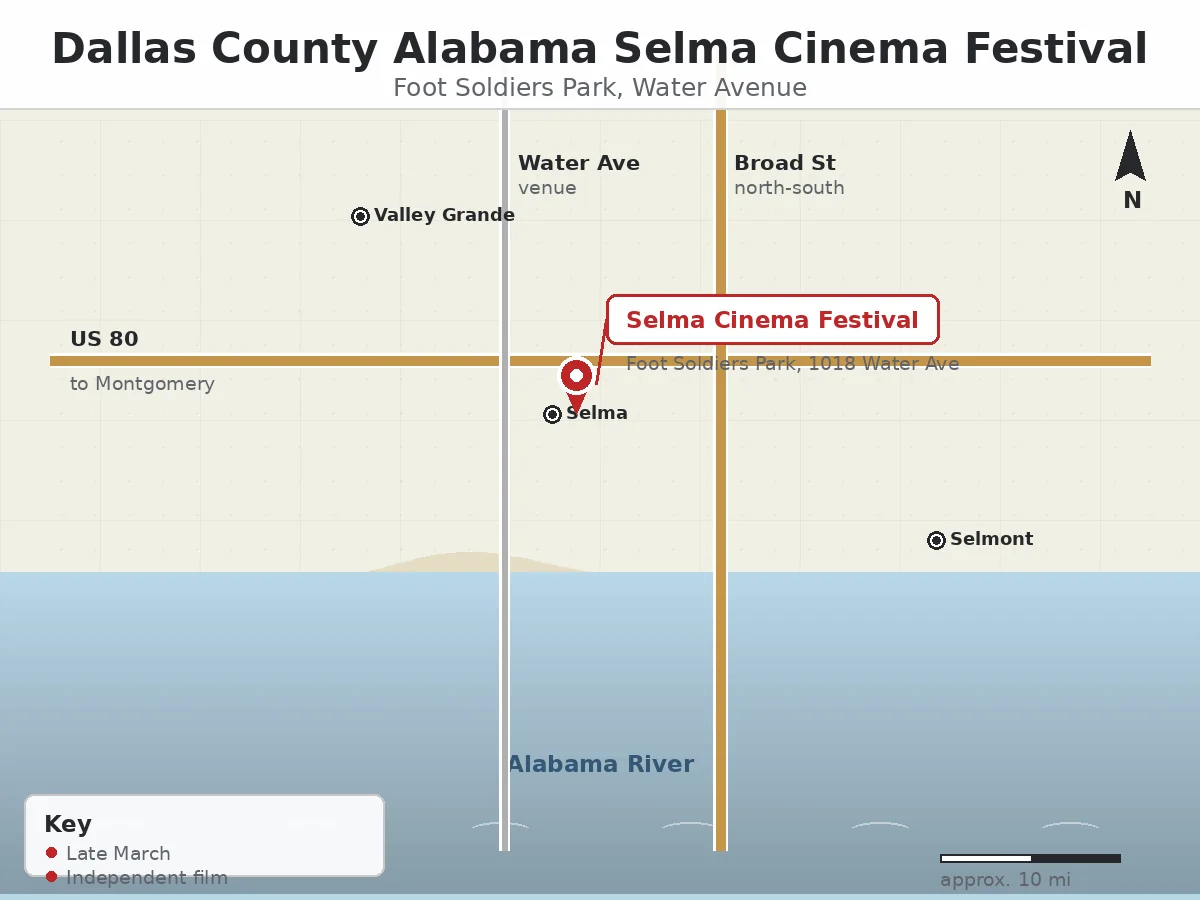
Festival Area Map
The festival is centered in downtown Selma, Dallas County, with the primary auditorium on Water Avenue near U.S. Highway 80.
Frequently Asked Questions
When is the Selma Cinema Festival?
The festival is held over four days in late March. Recent editions have run from a Thursday through a Sunday, with the 2026 event set for March 26 through 29. Confirm the exact dates with the organizer before you travel.
Is the festival free?
Yes, screenings and community events have been free in recent editions. Some special programs may require registration, so check the current schedule for details.
Where are films screened?
Screening venues have included the Foot Soldiers Park Auditorium at 1018 Water Avenue and other downtown Selma locations. Because the festival uses more than one venue, check the schedule for the location of each block.
How long has the festival been running?
The festival launched in 2025, making it one of the newer events on Alabama’s film calendar. A second edition followed in March 2026.
What kind of films are shown?
The program focuses on independent filmmaking, including documentaries, narrative features, and short films, with a strong presence of work from Alabama and the South. The lineup changes each year, so check the festival’s announcement for the current slate.
Is the festival good for families?
Much of the programming is suitable for general audiences, though some films may be intended for mature viewers. Check the ratings or descriptions for individual screenings if you are bringing children.
What should I bring to the festival?
Bring a light layer for cool mornings, comfortable shoes for walking between venues, and cash for local shops and food. An umbrella is useful for spring showers.
Where can I stay near the festival?
Selma has a small selection of hotels and inns, and Montgomery, about an hour east, offers a wider range of lodging. Booking early is advisable, since rooms in Selma are limited during festival week.
What to Expect From the Next Selma Cinema Festival
The Selma Cinema Festival is an annual event and is still in its early years, so it can be expected to return each spring in most years. The timing follows late March, and the four-day format has been consistent across its first two editions. The free-admission model and the mix of screenings and panels appear likely to continue, though the lineup will change.
Because the festival is young, details such as venues and program times may evolve from year to year. Confirm the schedule with the organizer before planning travel, and book lodging early, since Selma’s inventory is limited. Visitors who want a wider choice of restaurants and hotels often stay in Montgomery and drive in for the screenings.
How often is the Selma Cinema Festival held?
It is an annual event, held each spring since its launch in 2025.
When is the next Selma Cinema Festival?
The next edition is expected in late March, following the festival’s established pattern. Check with the organizer for the confirmed dates.
Will the dates or venues change?
As a newer festival, it may adjust dates or venues as it grows. Confirm details close to the event, and check the current schedule for each screening location.
Last updated: October 2026
The Selma Cinema Festival is young, but it is built on something durable: a city that has always understood the weight of a story well told. If you care about independent film, or simply want to see Selma through a new lens, put a late-March weekend on your calendar and take a seat.