Clarke County Alabama Pioneer Day Festival
Clarke County’s Pioneer Day is the living-history festival held at the Clarke County Historical Museum in Grove Hill, where for one autumn Saturday the museum grounds fill with people demonstrating the skills that once kept rural households fed, clothed and sheltered. Quilting frames, pottery wheels, soap kettles and corn shuck dolls replace the quiet of an ordinary museum day. The museum itself calls Pioneer Day its largest program, a living history event that draws more than 1200 people to the museum, and a University of Alabama events calendar that republishes organiser-submitted listings bills it plainly as a free, living history and folk festival.
Grove Hill hosts the festival, and Grove Hill is the county seat of Clarke County, so the courthouse town and the festival town are the same place. That should not be confused with size: the largest city in Clarke County is Jackson, not Grove Hill, and Jackson neither hosts Pioneer Day nor holds the county seat. Pioneer Day belongs to Grove Hill and to its downtown museum corner.
About the Festival
Pioneer Day turns the grounds of the Clarke County Historical Museum into a working village for a day. Costumed re-enactors demonstrate early life in southwest Alabama, and the emphasis is on process rather than display: visitors do not just look at a finished quilt or a dipped candle, they watch the spinning, weaving, churning and knapping that produced such things. The 2026 edition’s listing counts more than 30 interactive demonstrations.
The festival sits at the meeting point of two organiser name forms, kept distinct here rather than merged into one invented body. The university calendar listing and the museum’s own website present the event under the Clarke County Historical Museum. A regional newspaper’s account of state arts funding names the Clarke County Historical Society, which received a grant of seven thousand two hundred dollars from the Alabama State Council on the Arts to support the 23rd annual Pioneer Day, reported on September 18, 2024. A southwest-Alabama heritage site likewise describes the museum as a project of the society.
Admission could hardly be simpler. The university calendar states that Pioneer Day is a free, living history and folk festival, and the museum’s own site says the same in its own words: this event is free for adults and children. No layer of the documentation records any charge for walking onto the grounds.
For a useful comparison, see the Choctaw County Alabama Fall Festival for another county festival.
Quick Facts
| Item | Detail |
| Event name | Pioneer Day |
| Host town | Grove Hill, the county seat of Clarke County |
| Venue | Clarke County Historical Museum, in the Alston-Cobb House |
| Published address | 116 West Cobb Street, Grove Hill, AL 36451 |
| Scheduling pattern | The last Saturday in October, as published by the museum |
| Documented hours | 9 a.m. to 3 p.m. in the 2023, 2024 and 2026 layers |
| Admission | Free for adults and children |
| Organiser name forms | Clarke County Historical Museum in listings; Clarke County Historical Society in the arts-grant layer |
| Signature content | More than 30 interactive pioneer-skill demonstrations |
History
The setting carries its own long timeline. The Alston-Cobb House, which holds the museum, was built in 1854, and a heritage site places the museum on the corner of Cobb Street and N. Jackson Street in downtown Grove Hill. The museum opened in 1986 as a project of the Clarke County Historical Society. Around the main house stand smaller survivors of the county’s early building stock: the Creagh Law Office from about 1834, the Turner corn crib, and the restored Mathews Dogtrot Cabin from the 1830s. Inside, the museum’s best-known exhibits are fossils of Basilosaurus cetoides, a prehistoric whale whose remains connect this inland county to a far older sea.
Against that backdrop, Pioneer Day’s own documented edition history is more recent and, in one respect, untidy. The county newspaper billed the gathering of Saturday, October 28, 2023, from 9 a.m. to 3 p.m., as the 22nd annual Pioneer Day. A regional newspaper billed the following year’s festival, on Saturday, October 26, 2024, from 9 a.m. until 3 p.m., as the 23rd annual, and the arts-council grant supporting that edition named the same 23rd billing. The university calendar then bills the edition of Saturday, October 31, 2026, from 9 a.m. to 3 p.m., as the 25th annual Pioneer Day.
Those numbers do not reconcile neatly, and this article does not force them to. The billings run from the 22nd in 2023 to the 23rd in 2024 and then to a 25th billed for 2026, a sequence with a step the sources do not explain. No 2025 date or edition billing was verified in the record assembled for this article, so none is asserted here. Just as firmly, no founding year is calculated from any ordinal: counting backwards would manufacture a start date no source states. What can be said is that the museum publishes a steady pattern, the last Saturday in October, and that documented editions in 2023, 2024 and 2026 all honour it.
What to Expect
Expect a grounds-wide circuit of working demonstrations rather than a stage show. The university calendar’s 2026 programme lists quilting, basket making, spinning cotton, pottery, shingle-making, Indian fingerweaving, soap making, Native Medicine, butter churning, candle dipping, Creek language lessons, quill writing, hide tanning and the atlatl throw, alongside Native Creek encampments depicting women’s life. The museum’s own list adds syrup making, shingle splitting, clothes washing, flint knapping, storytelling, horse shoeing, salt making, corn shuck doll making and games for the children.
One station carries a name worth repeating exactly as the museum publishes it: Blue Herron, a Creek Indian, has set up an authentic Creek hunting village on the museum grounds. The spelling follows the museum’s own site. A heritage site’s account adds blacksmithing and forging, hand-made bows and arrows, candle making, basket weaving, wool spinning, chair caning and rope making to the circuit.
The buildings join in as well. In the 2024 layer, the Alston-Cobb House and the Mathews log cabin were open for free tours during the festival, so visitors could step from watching a demonstration outside to walking through the rooms and timbers that frame the museum’s permanent story. With demonstrations running side by side across the grounds, the day rewards wandering: follow the sound of the forge, the smell of syrup, or a crowd gathered around the atlatl throw.
Planning Your Visit
Anchor the trip on the museum’s published pattern first: Pioneer Day is held the last Saturday in October, and the documented editions in 2023, 2024 and 2026 each ran from 9 a.m. to 3 p.m. at the Clarke County Historical Museum, 116 West Cobb Street, Grove Hill. Because the edition numbers do not line up perfectly, the safest habit is to confirm the specific year’s date and billing through the museum before travelling.
Six hours sounds generous until more than 30 demonstrations compete for attention, so arriving near the 9 a.m. start is the most useful decision a visitor can make. Early hours spread the crowd and leave room to revisit a favourite station later. Families should note that the programme includes games for the children, and that the festival is expressly free for adults and children alike.
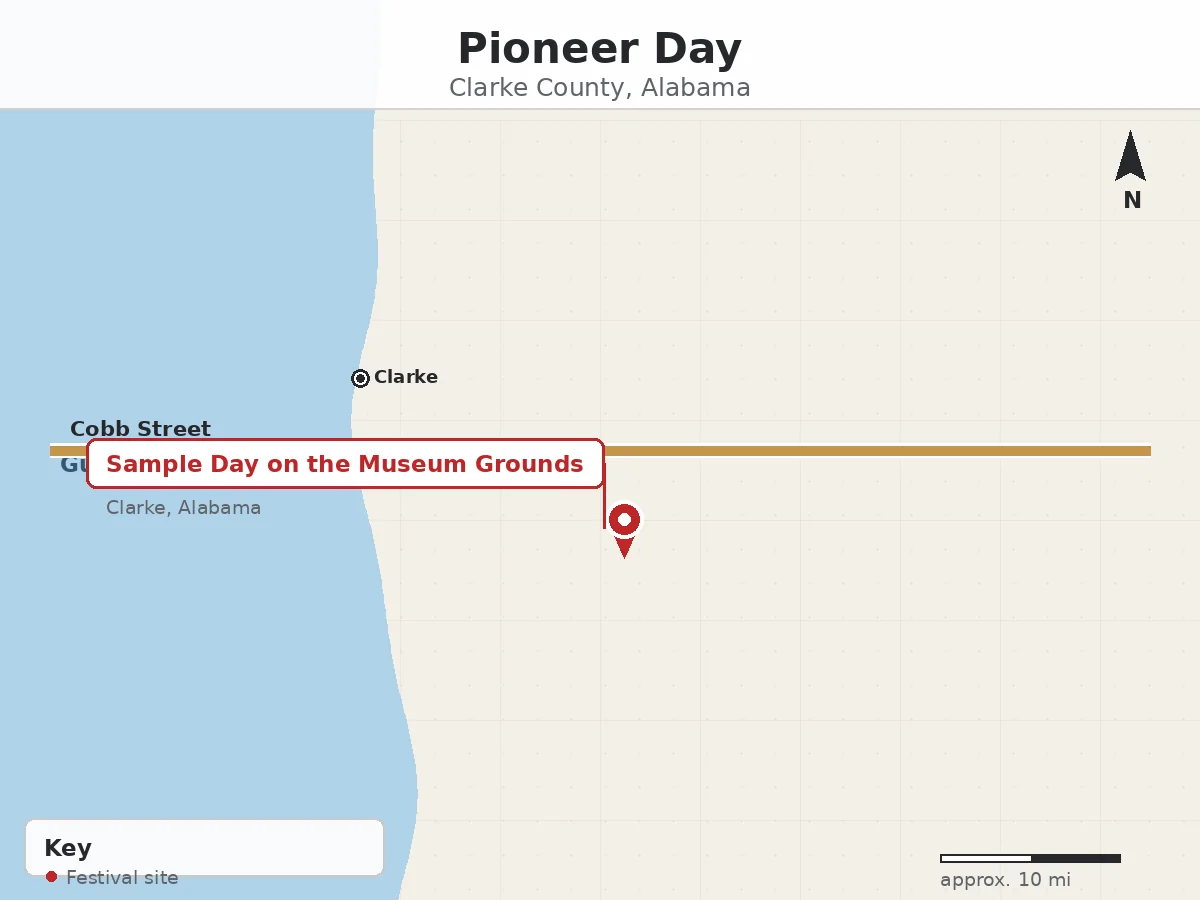
Grove Hill is the county seat, so the visit naturally centres on downtown, where the museum stands on its Cobb Street corner. Anyone building a longer trip should remember the record’s distinction: Jackson is Clarke County’s largest city but neither the seat nor the host, so travel plans should aim at Grove Hill.
A Sample Day on the Museum Grounds
A workable rhythm begins at 9 a.m., with a slow first circuit of the grounds to map where each demonstration sits. The forge, the pottery and the shingle-making draw early crowds, so watching those before the onlookers thicken pays off. By mid-morning, butter churning, soap making, syrup making and candle dipping all reward a few unhurried minutes each.
Late morning suits the Creek programming, from the language lessons and fingerweaving to Blue Herron’s hunting village and the encampments depicting women’s life. Midday is a natural point to tour the Alston-Cobb House and the Mathews Dogtrot Cabin while demonstrations continue outside. Save the second circuit for the afternoon: return to anything missed, let children finish at their games, and close with storytelling before the 3 p.m. end.
Pioneer Day and an Ordinary Museum Day
The contrast with a regular visit is the festival’s whole point. On an ordinary day, the museum presents its exhibits in rooms and cases: the Basilosaurus fossils, the house’s furnishings, the law office and cabin as preserved structures. Pioneer Day keeps all of that but adds the missing ingredient of motion. A corn crib on a quiet day is a building; on Pioneer Day, the skills that filled such cribs are practised a few steps away, by people in period dress who can explain each motion as they make it.
The festival also changes the museum’s scale: one building becomes a campus of more than 30 simultaneous demonstrations, and the audience becomes the crowd of more than 1200 that the museum itself attaches to this programme, its largest. Visitors who can come only once a year should choose the festival day.
Planning Checklist
- Confirm the current year’s date against the last-Saturday-in-October pattern through the museum before travelling
- Plan to arrive at the Clarke County Historical Museum, 116 West Cobb Street, Grove Hill, near the 9 a.m. start
- Budget nothing for admission, since the documented position is free entry for adults and children
- Allow the full six hours, because more than 30 demonstrations run across the grounds
- Wear walking shoes suited to moving between outdoor stations on museum grounds
- Build in time for free tours of the Alston-Cobb House and the Mathews Dogtrot Cabin
- Seek out Blue Herron’s Creek hunting village and the Creek language lessons during the day
- Bring children to the games arranged for them on the museum’s programme
- Remember that Grove Hill, not Jackson, is both the county seat and the host town
Beyond the Festival
Pioneer Day is the peak of the museum’s year, but the museum rewards a visit in any season. The Alston-Cobb House, dating to 1854, anchors grounds that include the Creagh Law Office from about 1834, the Turner corn crib and the restored 1830s Mathews Dogtrot Cabin, a compact survey of how the county’s early residents worked, governed and housed themselves. The Basilosaurus cetoides fossils tie a day of pioneer crafts to a prehistoric sea that covered this region long before any county existed.
Grove Hill itself, as the county seat, offers the courthouse-town setting that explains why the museum stands where it does, and a festival trip can extend into a slower look at the downtown streets.
Why Pioneer Day Matters
Pioneer Day matters because it teaches with hands rather than labels. Skills like hide tanning, quill writing, salt making and shingle splitting survive only where someone keeps performing them, and a festival gathering more than 30 of those performances in one place, free to all who walk in, does preservation work no display case can match. The state arts grant supporting the 23rd annual edition shows this value is recognised beyond the county line as well.
The festival also holds Grove Hill’s identity in place. The county seat is not the county’s largest city, yet it is Grove Hill that keeps the museum, the 1854 house, the law office and the cabin, and fills them with demonstrators each October, giving the county a shared memory of how its households once functioned.
Frequently Asked Questions
Which crafts on the programme can visitors watch being made from start to finish?
The documented programme is built around exactly that kind of watching. The 2026 listing alone names quilting, basket making, spinning cotton, pottery, shingle-making, soap making, butter churning, candle dipping, hide tanning and quill writing among more than 30 interactive demonstrations, while the museum’s own list adds syrup making, shingle splitting, flint knapping, horse shoeing, salt making and corn shuck doll making. Each station shows a process, not just a finished object.
Why do the annual numbers attached to recent editions refuse to add up?
Because the sources bill them that way. The county newspaper called 2023 the 22nd annual and a regional newspaper called 2024 the 23rd annual, yet the university calendar bills 2026 as the 25th annual, leaving a step no checked source explains. No verified 2025 billing fills the gap, so each edition number is reported here with its own year, and no founding year is back-calculated from any of them.
Is the free admission real, or is there a charge waiting at the gate?
The free admission is stated twice, in two independent layers of the record. The University of Alabama events calendar describes Pioneer Day as a free, living history and folk festival, and the museum’s own site says the event is free for adults and children. No layer of the documentation records a gate charge.
Who runs Pioneer Day, the museum or the historical society?
Both names appear, in different layers, and they are not merged here. Listings and the museum’s website present the Clarke County Historical Museum as the event’s home and presenter, while the regional newspaper’s grant report names the Clarke County Historical Society as the body that received seven thousand two hundred dollars from the Alabama State Council on the Arts to support the 23rd annual edition. A heritage site describes the museum as a project of the society, which explains the overlap.
What to Expect From the Next Clarke County Alabama Pioneer Day Festival
How often is Clarke County Alabama Pioneer Day Festival held?
Pioneer Day returns to the museum grounds each autumn on the rhythm the museum itself publishes, the last Saturday in October. The documented editions of 2023, 2024 and 2026 all sit on that final October Saturday, each running the same six-hour span from 9 a.m. to 3 p.m.
When is the next Clarke County Alabama Pioneer Day Festival?
Going by the museum’s published pattern, the next edition falls on the last Saturday of October following the 25th annual billing attached to Saturday, October 31, 2026. Because the edition numbers in the sources do not reconcile neatly, the wise course is to confirm the exact date and billing for the coming year directly from the museum rather than relying on anniversary arithmetic.
Will the dates change?
The scheduling rule itself shows no sign of moving: the last Saturday in October governed the 2023, 2024 and 2026 editions alike, and the museum states the pattern in those words. What shifts is only the calendar date the rule produces, since the final Saturday of October lands on different numbers in different years. Treat the rule as stable and the printed date as the thing to check each autumn.
Pioneer Day asks very little of its visitors: no ticket money, no elaborate plan, only a Saturday given over to watching skilled hands do old work well. In return it offers Clarke County’s fullest day of living history, staged on grounds where an 1854 house, an early law office, a dogtrot cabin and the fossils of an ancient whale already tell much of the story. The demonstrations complete that story by setting it in motion.