Chatham County Georgia SCAD Sidewalk Arts Festival

Spring in Savannah has a rhythm all its own. The azaleas come in, the live oaks leaf out, the light turns gold by late afternoon, and everyone in Chatham County seems to find an excuse to be outdoors. Into that season comes the SCAD Sidewalk Arts Festival, a chalk-drawing tradition that covers a stretch of downtown pavement with color for one long, crowded, sunlit day.
The premise is stubbornly analog. Artists claim a square of sidewalk, kneel down, and spend hours turning it into something vivid — portraits, patterns, animals, lettering, whole imagined worlds. By mid-afternoon the ground is a gallery. By the next hard rain, most of it is gone.
That impermanence is the whole point. This is a festival about season and setting, about making something beautiful in public and letting the weather decide how long it lasts.
Savannah and Chatham County: The SCAD Sidewalk Arts Festival at a Glance
If you are planning a spring trip to coastal Georgia and want the short version before the long one, start here. The details below cover where the festival sits, when it typically happens, and what it costs to wander through.
| Town | Savannah, Georgia |
| County | Chatham County, Georgia |
| County seat | Savannah |
| County population | 295,291 |
| County land area | 632 square miles |
| County founded | 1777, named for William Pitt |
| Region | Coastal Georgia, near the South Carolina line |
| Typical timing | Spring, during SCAD’s spring quarter |
| Admission | Typically free and open to the public |
| Setting and organizer | Outdoor park setting in downtown Savannah, organized by the Savannah College of Art and Design |
What SCAD Sidewalk Arts Actually Is — and Why Savannah Suits It
SCAD Sidewalk Arts is exactly what its name suggests: an arts festival conducted on sidewalks, with chalk as the medium and pavement as the canvas. The Savannah College of Art and Design organizes it, and participants come largely from the college community — students, alumni, and affiliated artists — alongside members of the wider public who arrive to watch, photograph, and wander.
Savannah is an unusually good host for this kind of event. The city is famously walkable, its historic district is laid out around squares and tree-lined streets, and daily life moves outdoors for much of the year. A festival that needs nothing more than flat pavement and foot traffic fits the place almost perfectly.
The scale is human rather than monumental. You do not need a ticket, a schedule, or a plan. You walk, you look down, you stop, and you end up crouching beside a stranger to watch a face emerge from dust and water.

From Campus Curiosity to Chatham County Spring Ritual
The festival grew out of the college’s own culture rather than from a city commission or a tourism board. In SCAD’s early decades in Savannah, sidewalk drawing became a way for students to work in public, in daylight, with no gallery wall between them and an audience. What began as a campus exercise gradually drew spectators, then alumni, then the wider city.
Moving into a larger public park changed the character of the day. A courtyard can hold a few dozen artists; a downtown park can hold hundreds of squares, a stage, food vendors, and a crowd that drifts in and out for hours. The event became a spring institution rather than a school tradition.
It also became a reunion. Alumni return with families and their own chalk, often claiming squares near former classmates. Faculty and staff work the registration tables. Nearby businesses plan spring staffing around it. The result is a festival that belongs to the college and the city at once.
What has not changed is the format: a square of ground, a few hours of work, and an outcome that disappears. Few Savannah traditions are so honest about how temporary art can be.
What a Chalk Saturday in Savannah Feels Like
A day at the festival unfolds slowly, then all at once. Morning is quiet and practical — artists laying out grids, taping edges, filling spray bottles. Early afternoon is the peak. Late afternoon is golden, crowded, and full of cameras.
Food and Drink Within Walking Distance of the Squares
The festival is not primarily a food event, and that is part of its charm. Vendors typically set up near the drawing area with cold drinks, coffee, snacks, and quick meals, while the surrounding blocks of downtown Savannah do the heavy lifting. Within a short walk you will find Southern cooking, seafood, bakeries, ice cream, and coffee houses. Bring cash for small vendors, and eat either before the midday crush or after the artists start packing up. Water matters most; kneeling in the sun for hours is thirsty work, and spectators feel it too.
Music, Performance, and the Sound of a Spring Afternoon
Live entertainment usually runs through the day, with student and local performers sharing a stage or scattered performance spots around the park. Expect acoustic sets, small bands, dance and theater students showing work, and the general ambient noise of a crowd: strollers, dogs, cameras, and children being told not to step on the art. The programming is deliberately informal. Nothing here is meant to hold you in one place — the music is a backdrop to the drawing, and the drawing is the main event.
Family Activities and Kid-Friendly Chalk Zones
Families make up a large share of the crowd, and the layout reflects that. Dedicated areas typically let children draw on their own patches of pavement, often with chalk provided, which solves the problem of toddlers wanting to “help” with a competition piece. Strollers handle park paths reasonably well, though the busiest hours make them a challenge. Bring a blanket for the grass, sunscreen for everyone, and a change of clothes for the child who inevitably sits in the chalk. Restrooms and shade are limited in a park setting, so scout both early.
Planning Your Spring Trip to the SCAD Sidewalk Arts Festival
The festival falls during the college’s spring quarter, which means the surrounding weeks are already busy with campus events, graduations, and warm-weather tourism. A little planning goes a long way.
Getting to Savannah and Around Chatham County
Savannah sits on the Georgia coast, roughly midway between the South Carolina line and the state’s southern barrier islands. Most visitors arrive by car via Interstate 16 or Interstate 95, and the historic district is compact enough to explore on foot once you park. Amtrak serves the city, and the regional airport handles connecting flights from major hubs. Within Chatham County a car helps for day trips toward the coast, but on festival day you can leave it parked and walk. Rideshare drop-offs work well if you pick a meeting point a few blocks from the busiest streets.
Where to Stay for a Chalk-and-Squares Weekend
Anywhere in or near the historic district puts you within walking distance of the festival. Boutique inns and bed-and-breakfasts occupy restored townhouses, larger hotels cluster near the riverfront and the main commercial corridors, and short-term rentals fill the blocks around the squares. Book early for spring weekends, when college events and pleasant weather push demand up. Travelers on a budget can look farther out along the interstate and plan to drive in early.
Parking and Traffic on Festival Day
Parking downtown is a perennial puzzle, and festival day makes it harder. City garages and metered street spaces fill quickly, so arriving before mid-morning is the simplest strategy. Expect temporary street closures and heavy pedestrian traffic around the park, plus slow one-way streets. If you are staying nearby, walking or biking is genuinely faster than driving. Do not count on finding a space within sight of the chalk.
Admission, Costs, and What You’ll Actually Spend
Admission is typically free and open to the public, which is central to the festival’s character. Costs come from everything around it: parking, food, drinks, tips for performers, and any merchandise or art supplies you decide to buy. Some workshops or special programs may carry their own fees, so check the organizer’s listings if a specific activity matters to you. Budget for a long, hot day rather than a ticketed event.
Spring Weather on the Georgia Coast
Spring in Savannah is warm, humid, and changeable. Mornings can be cool enough for a light layer, afternoons are genuinely hot in the sun, and thunderstorms roll through with little warning. Chalk artists watch the radar the way sailors watch the wind. Wear breathable clothing, bring a hat and sunscreen, and keep a compact rain jacket in your bag. If rain does arrive, the art is temporary by design, which softens the disappointment.
A Sample Weekend Built Around the Sidewalk Squares
Friday. Arrive in Savannah in the afternoon, check in, then spend the evening doing nothing in particular: a walk along the riverfront, dinner somewhere casual, an early night. The festival rewards people who show up rested and ready to be on their feet.
Saturday. Get moving early. Coffee and breakfast near the park, then arrive as the artists lay out their squares. Watch the first hour of work, when drawings are still outlines and the pavement is still mostly gray. Stay through midday for the most colorful stretch, eat when the lines thin out, and return in late afternoon when the light turns soft and the photographs get good.
Sunday. Use the second day for everything the crowds made difficult: the historic squares, a museum, a slow brunch, a drive toward the coast. If the weather held, some chalk will still be visible in the morning — a fading record of Saturday’s work.
How This Festival Compares with Other Coastal Georgia Traditions
Savannah hosts festivals all year, and each occupies a different corner of the calendar. The city’s autumn jazz tradition leans on ticketed concerts and evening sets in venues around town, drawing an audience that plans months ahead. The film festival brings screenings and an industry crowd. Both are indoor, scheduled, and built around performances you sit still for.
SCAD Sidewalk Arts sits at the opposite end of that spectrum: free, outdoor, unstructured, and entirely dependent on the weather. Nearby communities such as Tybee Island, Beaufort, and Hilton Head host their own spring and summer events, usually tied to water, seafood, or beach culture. What makes the sidewalk festival distinctive is that it is neither a beach event nor a performance event. It is a making event, and the audience stands over the artists’ shoulders.
The Chalk-Dust Checklist for a Savannah Spring Saturday
Pack for heat, sun, and kneeling. Bring a refillable water bottle, sunscreen, a wide-brimmed hat, and sunglasses. Wear shoes you can stand in for hours and clothes that can take a smudge of chalk dust. Carry cash and a card for vendors, a small towel, and hand wipes. A camera or phone with a good lens matters more than you expect, because the drawings are detailed and the light is bright. Add a light rain layer, a tote for anything you buy, and a folding mat if you plan to sit on the grass. Leave the drone at home, keep dogs leashed, and resist the urge to cross a square someone has been working on since morning. Arrive early, stay hydrated, and tip the performers.
Beyond the Sidewalk Squares: Chatham County After the Chalk
The festival is a good excuse to spend a full weekend in the region rather than a single afternoon. Savannah’s historic district rewards slow walking — squares, churches, house museums, cemeteries, and the riverfront all sit within a couple of miles of one another. Chatham County stretches well beyond downtown, from marshland and tidal creeks to the islands at its eastern edge.
Outdoor options are plentiful: kayaking, birding, walking trails, and beach time. The food scene runs from low-country classics to newer kitchens near the college. With an extra day, drive toward the coast for a change of pace, or stay in town and spend it in a museum. Either way, the chalk is the anchor, not the whole trip.
What This Festival Means to Savannah and Chatham County
Chatham County — roughly 295,291 residents across 632 square miles, founded in 1777 and named for William Pitt — has a long habit of putting its public spaces to work. Streets double as gathering places, squares serve as front yards, and pavement becomes a gallery when the occasion calls for it.
The SCAD Sidewalk Arts Festival matters to the community for reasons that have little to do with visitor counts. It gives students a public audience. It gives residents a free Saturday. It gives alumni a reason to come home. And it reminds a city that trades heavily on its own beauty that beauty can be made quickly, in public, by anyone willing to kneel down and start.
Where the Chalk Meets the Ground in Savannah
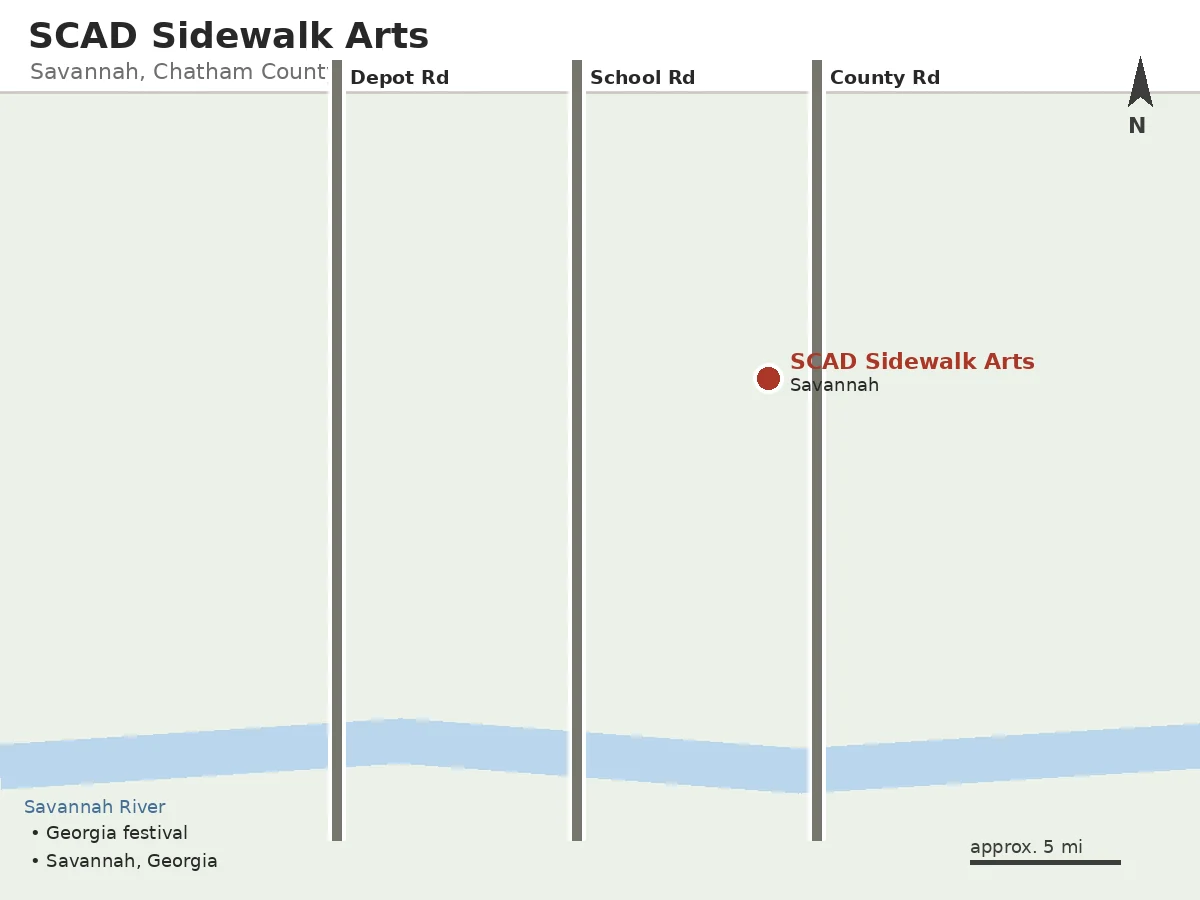
The SCAD Sidewalk Arts Festival is held in a downtown Savannah park in Chatham County, within walking distance of the city’s historic squares and the riverfront.
Answers for First-Timers at SCAD Sidewalk Arts
Is the festival free to attend?
Admission is typically free and open to the public. You may spend money on parking, food, drinks, or merchandise, but there is generally no ticket required to walk through the drawing area and watch the work.
When does it usually take place?
It is held each spring, tied to the college’s spring quarter. The exact date shifts from year to year, so check the organizer’s calendar before booking travel.
Do I need to be a student to take part?
The competition side of the festival is built around students and alumni, and participants typically register in advance for a square. Spectators and casual visitors need no affiliation at all, and open family drawing areas let anyone try their hand.
How long does the chalk art last?
Only as long as the weather allows. Chalk on pavement fades with foot traffic and disappears with rain, so the best viewing window is the day of the festival itself, ideally in the afternoon.
Is it a good event for young children?
Yes. Family drawing areas, open space, and short walking distances make it manageable for kids, though midday heat and crowds are real considerations. Go early, bring water, and plan to leave before everyone is tired.
What should I bring with me?
Water, sunscreen, a hat, comfortable shoes, cash for vendors, and a camera. A light rain jacket is worth the space in your bag during spring on the Georgia coast.
What happens if it rains?
Spring showers are common, and artists often work around them. If weather turns severe, the organizer may adjust the schedule, so check official updates before heading to the park.
Looking Ahead at Chalk, Spring, and Savannah
The festival’s future is tied to two things it cannot control: the weather and the calendar. As long as spring keeps arriving in coastal Georgia and the college keeps producing artists, the basic format — pavement, chalk, daylight, audience — will keep working. It is inexpensive to stage, easy to understand, and impossible to digitize.
What may change is the crowd. Savannah’s popularity keeps growing, and a free outdoor festival in a walkable downtown is exactly the kind of event that draws more visitors each year. Managing that growth without losing the loose, informal character of the day will be the real challenge.
Last updated: October 2026
If you go, go for the small moments: a student stepping back to check proportions, a child copying a design onto a square of her own, a stranger holding someone’s water bottle while they finish a detail before the light goes. The drawings will be gone by the next storm. The habit of making them in public is what lasts.
One Comment