Chatham County Georgia Savannah Music Festival
At 7:40 on a Saturday morning, the Harper family is already arguing about parking. Marisol wants the garage near the riverfront; Devon insists on a side street off one of the downtown squares. Their two kids, nine and thirteen, are in the back seat with headphones on, which is either a good sign or a bad one on a day built entirely around live music. This is what a spring Saturday looks like for a household in Chatham County when the Savannah Music Festival is running — a day that starts with logistics and ends, if everything goes right, with a thirteen-year-old humming something she swears she hated two hours earlier.
Chatham County spreads across 632 square miles of Georgia coast, marsh, and city grid, with Savannah as its county seat and roughly 295,291 people calling the county home. On festival weekends, a good number of them seem to be downtown at the same time, which is part of the pleasure and part of the challenge. The Harpers have done this enough times to know the rhythm: park once, walk everywhere, eat early, and let the schedule bend when a set runs long.
By 9:15 they are seated in a hall with tall windows and wooden floors that creak underfoot. A brass ensemble is warming up, and the nine-year-old has already spotted a friend from school three rows back. For the next hour, the family sits inside a sound that feels enormous and close at once — the kind of acoustics that make you aware of the room as much as the players. Marisol, who grew up twenty minutes away and spent years treating downtown as a place to avoid on weekends, leans over during the second piece and says, quietly, “I forgot it was like this.”
Lunch happens on a square, on a bench, with sandwiches bought from a corner shop and shared with a very bold squirrel. Then it is back into the music: an afternoon program that swings from string quartets to something with a bass line you can feel in the pavement outside. The thirteen-year-old, who came in announcing that she only listens to three artists and none of them are dead, is the one who asks to stay for the encore. That, more than anything, is the day the Harpers will remember.
The Savannah Music Festival at a Glance for Chatham County Visitors
| Town | Savannah |
| County | Chatham County, Georgia |
| County seat | Savannah |
| County population | 295,291 |
| Region | Coastal Georgia and the Lowcountry |
| Typical timing | Each spring, generally across several weeks in March and April |
| Admission | Most performances are ticketed; selected events are free or low cost |
| Setting | Historic downtown Savannah venues, from grand theaters to intimate halls and churches |
| Features | Jazz, classical, gospel, Americana, blues, and world music across multiple stages |
| Organizer | A Savannah-based nonprofit festival organization |
What the Savannah Music Festival Actually Is
The Savannah Music Festival is a multi-week, multi-venue celebration of live performance staged in and around downtown Savannah each spring. Rather than concentrating everything in a single park or arena, it spreads across the city’s historic buildings — theaters, recital halls, churches, and smaller rooms — which means the experience changes dramatically depending on which ticket you hold on a given afternoon. A listener might spend the morning with a chamber ensemble in a high-ceilinged sanctuary and the evening with a jazz quartet in a room where the bar is six feet from the piano.
The programming is deliberately wide. Jazz and classical form the backbone, but gospel, blues, Americana, and international artists appear throughout the run, and educational events, masterclasses, and youth-oriented performances sit alongside the headline concerts. For families in Chatham County, that breadth is the point: there is usually something a nine-year-old and a grandparent can both sit through without checking the time.
Because the festival is not confined to one address, “going to the Savannah Music Festival” is really a series of small decisions. Which venues? Which nights? How much walking? The answers shape the day as much as the music does, which is why locals tend to build their weekends around two or three shows rather than trying to catch everything.

Savannah’s Long Musical Lineage and the Festival’s Place in It
Chatham County was founded in 1777 and named for William Pitt, and Savannah has been a port city with a soundtrack for nearly as long as it has been a city at all. Hymns and spirituals poured out of its churches, work songs and sea chanteys drifted up from the river, brass bands played for parades, and jazz found its way into clubs and ballrooms through the twentieth century. Music here has always been a public act, performed in rooms people share rather than rooms people own.
The Savannah Music Festival grew out of that habit rather than arriving as an outside import. Over successive seasons it expanded from a handful of concerts into a sprawling spring institution that recruits internationally known performers while keeping a strong local footprint, including work with students and young musicians in the Savannah area. The festival’s calendar has shifted and stretched over time, but its anchor has stayed the same: a few weeks each spring when the city’s historic spaces fill with audiences who walk from one venue to the next.
For residents, that has meant something subtler than tourism revenue. It has meant that a Tuesday night in March can include a world-class pianist ten minutes from your own kitchen, and that children in Chatham County can hear instruments and traditions they might otherwise only encounter on a screen.
What a Festival Day Feels Like on the Ground
Food and Drink Between the Sets
Downtown Savannah rewards anyone willing to eat at odd hours. Because performances cluster around late morning, late afternoon, and evening, families quickly learn to grab an early lunch before the 1 p.m. set and an early dinner before the 7 p.m. one. Expect Southern staples, coastal seafood, and plenty of small cafes and bakeries within walking distance of the main venues. Many places near the historic district fill up fast on festival weekends, so reservations or a willingness to eat at the bar help. If you have kids in tow, a picnic assembled from a market and eaten on a square is often the cheapest and happiest option — and it doubles as a break from sitting still.
The Music Itself, Room by Room
Programming leans on jazz and classical, with strong showings of gospel, blues, folk, Americana, and global traditions. What distinguishes the Savannah Music Festival is the pairing of artist and architecture: a solo cellist in a sanctuary, a horn section in a restored theater, a singer-songwriter in a room built for conversation. Sets generally run about an hour to ninety minutes, often without a long intermission, which makes it easy to stack two or three in a day. Arrive early. Historic venues have character, and character often means limited sightlines and seats that were designed for a different century.
Keeping Children Engaged Across a Long Day
Families do well to treat the festival as a series of short adventures rather than one marathon. Choose one performance that clearly suits your kids’ attention spans, then build the rest of the day around movement: walking the squares, watching the river, visiting a museum, or simply sitting outside with a snack while the adults trade off on a second ticket. Many festival programs are designed to be welcoming to younger listeners, and daytime events tend to be more relaxed than evening ones. Bring water, expect some wiggling, and leave before anyone melts down — including the adults.
Practical Logistics for a Chatham County Music Weekend
Getting Into Savannah and Around the Venues
Savannah sits at the center of Chatham County, reachable by interstate from inland Georgia and by a short drive from the coastal islands. Most festival venues cluster in or near the historic district, which means the smartest strategy is to arrive once and stay on foot. If you are coming from a neighboring county, plan for traffic on spring weekends and give yourself a buffer before the first downbeat. Rideshare and local transit can fill the gaps when venues are farther apart than your legs would like.
Where Families Usually Sleep
Downtown hotels and inns put you closest to the action but book early during the spring run. Alternatives include properties near the riverfront, midtown Savannah, and the islands east of the city, where rates are often lower and parking is easier. Vacation rentals suit families who want a kitchen and a washing machine. If you are local to Chatham County, the honest best advice is to sleep at home and spend your money on tickets and dinner instead.
Parking Without Losing Your Mind
Parking in downtown Savannah is a game of patience. City garages near the historic district are the most predictable option, and street parking exists but comes with time limits, meters, and residential rules that visitors regularly misread. Choose one garage for the whole day, pay for the full stretch, and walk. Trying to move your car between venues will cost you more time than it saves.
Tickets, Costs, and Free Options
Admission is typically ticketed per performance, with pricing that varies by artist, venue, and seating. Some events are free or low cost, and daytime and educational programming tends to be the most accessible entry point for families on a budget. Buy in advance for anything you genuinely want to see; popular shows sell out. If money is tight, pick one marquee concert and fill the rest of your weekend with free performances, street music, and the city itself.
Spring Weather and What to Wear
Coastal Georgia in spring is mild and unpredictable — warm afternoons, cool evenings, and the occasional rain shower rolling in off the water. Dress in layers, bring a light rain jacket, and choose shoes you can walk in for a mile or more. Venues range from climate-controlled theaters to older buildings with uneven heating, so a cardigan or light sweater is never wasted. Sunscreen is not a joke here, even in March.
A Two-Day Rhythm: Sample Itinerary for a Savannah Music Weekend
Friday evening: Arrive mid-afternoon, park once, and check in. Take a walking loop through the squares to get your bearings, then eat an early dinner. Catch an evening performance — something with energy, ideally in a theater where the room itself is part of the show.
Saturday morning: Coffee and a pastry, then a late-morning set. This is the best slot for children: shorter programs, daylight, and a crowd that expects some noise. Lunch on a square afterward.
Saturday afternoon: Split up if you need to. One parent takes a second concert while the other explores a museum or the riverfront with the kids, then swap. Regroup for an early dinner.
Saturday night: The headline show. Book a sitter or choose a family-friendly evening program, and leave room afterward for dessert and a slow walk back to the car.
Sunday: A gospel or brunch-adjacent performance if one is on the schedule, then a drive out toward the marshes or the coast before heading home. It is a gentler ending than another packed day, and it sends everyone back with sand in their shoes and a tune in their heads.
How Savannah Compares With Other Nearby Georgia Getaways
Savannah’s festival identity is urban and architectural — you move between historic buildings, and the city is as much a performer as anyone on stage. By contrast, a beach day on Tybee Island, just east in Chatham County, offers the same coastal light with none of the scheduling; it is the recovery plan, not the main event. Beaufort, South Carolina, up the coast, trades Savannah’s density for a smaller, slower waterfront feel and makes an easy add-on for travelers already in the region. Inland, Statesboro brings a college-town energy with a very different nightlife rhythm. Families who want variety can pair the festival with any of them across a long weekend.
A Short Checklist Before You Leave the House
Confirm your tickets and print or download them; check start times and venue addresses the morning of; charge phones and bring a portable battery; carry water and a snack for kids; wear broken-in walking shoes; pack a light rain layer and a sweater; bring cash or a card for garage parking; keep a paper backup of your schedule in case service is spotty in older buildings; and decide in advance which performance you are willing to skip if everyone is exhausted. Flexibility, more than planning, is what makes a festival weekend work.
Beyond the Stages: Chatham County Between Sets
The music is the reason you came, but the county rewards a slower look. Savannah’s historic district is made for wandering, with squares, gardens, and architecture that change character block by block. The riverfront offers shops, views, and a constant low hum of activity. Outside the city, Chatham County opens into marshland, waterways, and small communities where the pace drops immediately — good for a Sunday drive, a kayak trip, or a seafood lunch with a view of the water. Museums, historic homes, and cemeteries give history-minded visitors plenty to fill the hours between sets, and the coastal islands east of Savannah offer beaches and birding within a short drive.
What This Festival Means to Savannah’s Neighborhoods
A city of roughly 295,291 residents in its county does not host a multi-week international music festival by accident. It happens because local institutions, volunteers, donors, and audiences decide it is worth the effort year after year. The Savannah Music Festival brings visiting artists into schools and gives young musicians in the region a reason to keep practicing. It fills restaurants and hotels in a shoulder season. And it gives longtime residents a rare excuse to see their own city the way visitors do — as somewhere remarkable, worth dressing up for and walking into town to hear something new.
For families like the Harpers, the significance is smaller and more durable: a Saturday when everyone is in the same room, listening to the same thing, and nobody is looking at a phone. That is not a small return on a day’s parking fee.
Where Savannah Sits on the Georgia Coast
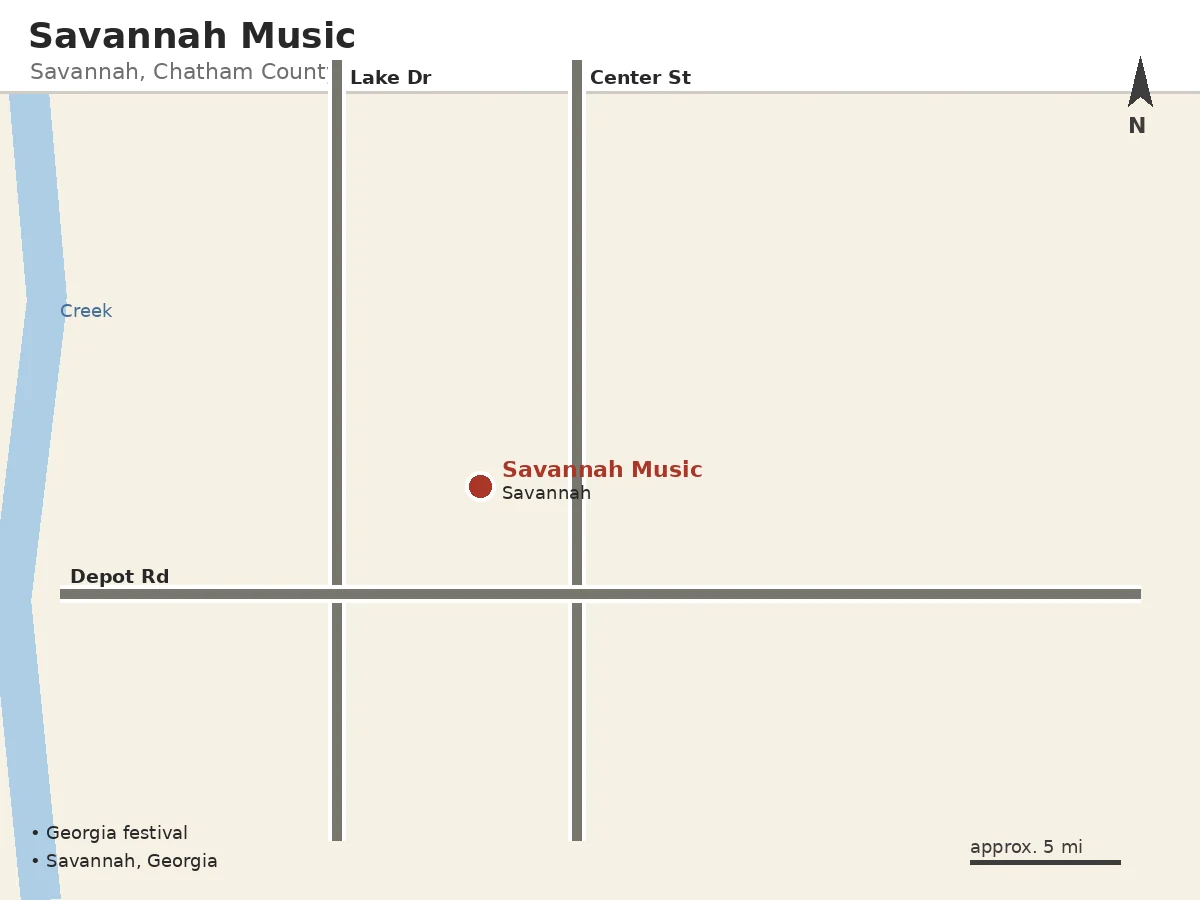
Savannah is the county seat of Chatham County, positioned on the Savannah River in coastal Georgia, roughly midway between the South Carolina line and the Atlantic beaches to the east.
Savannah Music Festival Questions From First-Time Visitors
When does the Savannah Music Festival usually happen?
It is held each spring, generally across several weeks in March and April. Exact dates shift from year to year, so check the official schedule before booking travel.
Do I need to buy tickets in advance?
For headline performances, yes — popular shows can sell out. Smaller and daytime events are sometimes available at the door, and a limited number of free events typically appear on the schedule.
Is the festival appropriate for young children?
Generally yes, with planning. Daytime and educational programs suit families best, and shorter sets make it easier to keep kids engaged. Evening concerts may run later and expect quieter audiences.
What kinds of music will I hear?
Expect jazz and classical as the core, with gospel, blues, folk, Americana, and international artists appearing throughout the run. Because the lineup is broad, it helps to read program descriptions before choosing.
Where in Savannah do performances take place?
Across historic downtown venues — theaters, halls, churches, and smaller rooms — rather than at a single site. That means walking between locations is part of the experience, so plan your day geographically.
How should I get between venues?
On foot, wherever possible. Downtown Savannah is compact and pleasant to walk, and parking once for the day saves considerable time. Rideshare works for longer hops, especially in the evening.
What should I wear to a performance?
Dress is generally smart casual, and comfort matters more than formality given the walking involved. Layers handle both warm afternoons and cool, air-conditioned halls.
Can I enjoy the festival without spending much?
Yes. Choose one ticketed performance that matters most to you, then build the rest of your day around free events, street music, squares, and the riverfront. Picnicking downtown keeps food costs low as well.
Looking Ahead to Future Springs in Savannah
As long as Savannah keeps its historic rooms standing and its audiences curious, the festival has a natural home. Expect the format to stay recognizable — many venues, many genres, a spring calendar — while programming continues to evolve toward younger audiences and broader traditions. Families planning ahead should watch for schedules to be published in the months before spring, book lodging early, and treat the lineup as a menu rather than a mandate. The best festival weekends are the ones with room to wander.
Last updated: October 2026
If you go, take the Harpers’ lesson with you: pick two or three performances that genuinely excite you, leave the middle of the day open, and let the city do some of the entertaining. Chatham County has been making music in public for a very long time, and for a few weeks each spring it invites everyone to listen in.