West Feliciana Parish Louisiana Day the War Stopped Festival
On a June morning in St. Francisville, the small historic district fills with the sound of a parade and the low murmur of a crowd gathered outside a white church. The occasion is not a battle reenactment in the usual sense. It is a commemoration of a single act from the Civil War: the Masonic burial of a Union naval officer by the Confederate officer who had been his enemy, carried out in the churchyard of Grace Episcopal Church in eighteen sixty-three. The Day the War Stopped Festival takes its name from that burial, and from the pause it represented in the middle of a war. Each June, St. Francisville marks the anniversary with a reenactment, lectures, a parade and a cook-off competition in and around the historic district. The record for the event rests on one dated listing and on reference layers that describe the yearly pattern, but the burial at its centre is a matter of historical record.
About
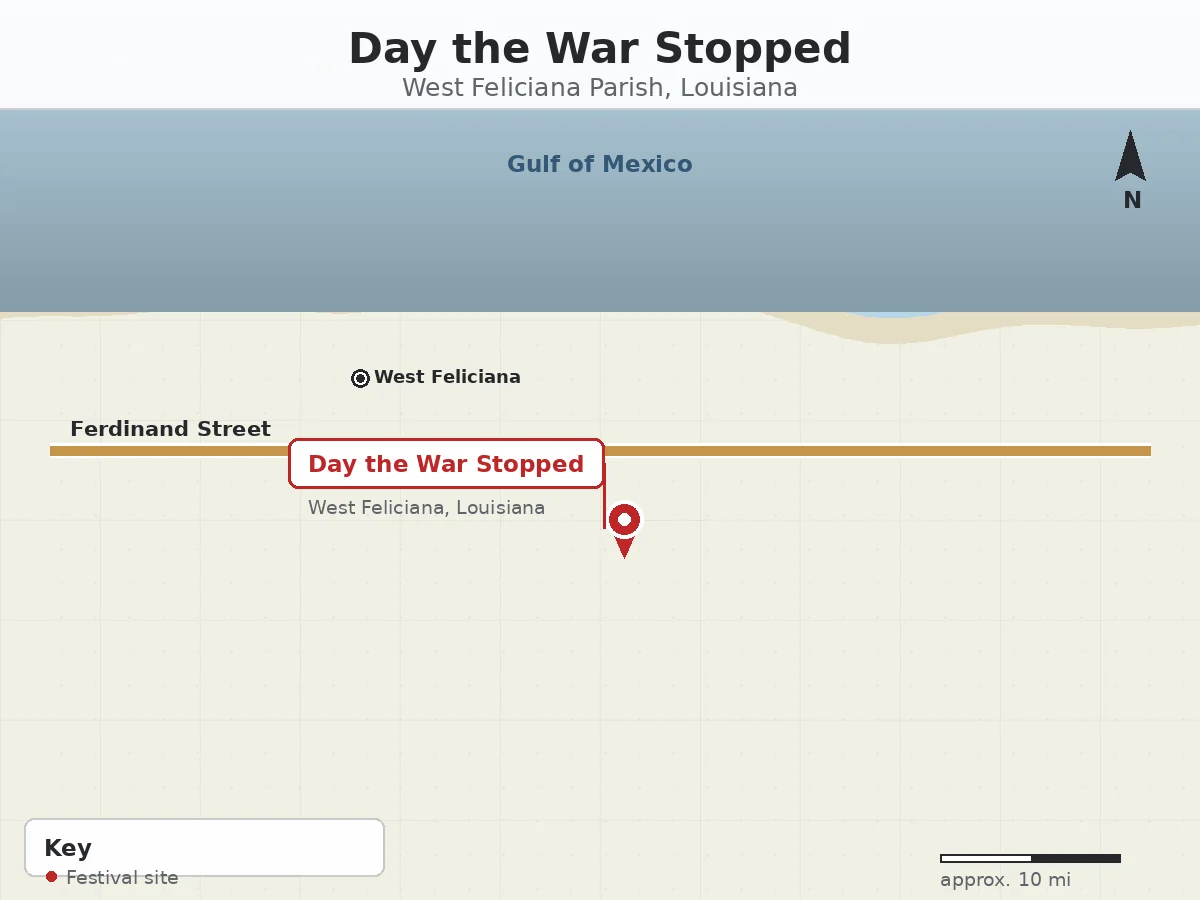
The Day the War Stopped Festival is the published name of a June commemoration in St. Francisville, Louisiana, the parish seat of West Feliciana Parish. Its shorter printed form, The Day the War Stopped, appears in the same layers. The sheet title is never printed exactly in the layers read, so the article follows the published names wherever the event itself is discussed. The commemoration centres on the historic district and on the Grace Episcopal Church area along Ferdinand Street, where the reenactment of an eighteen sixty-three burial takes place. The reenactment is staged by the St. Francisville Masonic lodge, known as Feliciana Lodge, and no separate festival organiser name form is documented in the layers read. The one dated edition with particulars in the record is Saturday the seventh of June, twenty twenty-five, listed by a parish tourism events layer as running from nine in the morning to eleven-thirty at night. Reference layers describe a three-day June commemoration held every year, though no other dated edition with particulars was found. The programme, as the layers describe it, consists of the burial reenactment, lectures, a parade and a cook-off competition. No layer read takes a position on admission, and none describes tickets of any kind.
Quick Facts
| Item | Detail |
| Published name | The Day the War Stopped Festival |
| Shorter form | The Day the War Stopped |
| Host town | St. Francisville, Louisiana |
| Parish seat | St. Francisville |
| Venue | Historic district and Grace Episcopal Church area, Ferdinand Street |
| Staging body | St. Francisville Masonic lodge, Feliciana Lodge |
| Dated edition | Saturday the seventh of June, twenty twenty-five |
| Hours listed | Nine in the morning to eleven-thirty at night |
| Programme | Burial reenactment, lectures, parade, cook-off competition |
| Reenactment began | Nineteen ninety-nine |
History
The story the festival commemorates begins on the Mississippi River in the summer of eighteen sixty-three, during the operations around Port Hudson. Union Lieutenant Commander John E. Hart died on the eleventh of June, eighteen sixty-three, aboard USS Albatross, a vessel engaged in the Port Hudson operations. Hart was a Union naval officer, and his death placed his body in enemy hands. What happened next is the reason the commemoration exists. Confederate officer William Walter Leake arranged for Hart to receive a Masonic burial at Grace Episcopal Church in St. Francisville, with the rites of the fraternity observed across the lines of the war. Leake and Hart were both Masons, and the burial was conducted under a flag of truce, with Confederate officers taking part in the service for a Union officer they had never met. The act has been retold in St. Francisville ever since: a day when the fighting stopped long enough for enemies to bury one of their own with honour.
The reenactment tradition itself is much younger than the burial. It began in nineteen ninety-nine, staged by a Masonic-lodge historian, Frank Karwowski, working with the St. Francisville lodge. Karwowski is named in reference layers as a documented originator of the tradition, and the lodge he worked with is the same Feliciana Lodge that stages the reenactment today. The tradition has been carried on in the years since, growing from a single reenactment into a commemoration that reference layers describe as running for three days each June, with lectures, a parade and a cook-off competition added around the burial ceremony. The layers read do not give a dated edition for every year of that run; the only edition with a full date and hours is the Saturday the seventh of June, twenty twenty-five listing. One detail in that listing deserves a plain note: the same parish tourism events layer that dates the edition to twenty twenty-five also carries the words Saturday, the seventh of June, twenty twenty-seven. The two dates cannot both be right, and the listing’s own date is the one this article follows.
What to Expect
The centre of the day is the reenactment itself, staged in the Grace Episcopal Church area of the historic district. Participants in period dress gather at the church to play out the burial of Lieutenant Commander Hart, with the Masonic rites at the heart of the ceremony and the story of Leake’s arrangement told as the service unfolds. Visitors who come for the reenactment should expect a solemn occasion rather than a battle display: there is no clash of armies in this commemoration, and the drama lies in the quiet of the churchyard and the words spoken over a grave. Around the reenactment, the commemoration fills out with lectures on the burial and on the Port Hudson campaign, a parade through the historic district, and a cook-off competition that brings a livelier note to the weekend. The reference layers describe a three-day event, so a visitor planning around a single Saturday should check which elements fall on which day. The twenty twenty-five listing runs from nine in the morning to eleven-thirty at night, a long day, though the layers read do not fix the order of events. The historic district’s shops and porches give the weekend a small-town setting that suits an event built around a single churchyard.
For a useful comparison, see the West Feliciana Parish Louisiana Southern Garden Symposium Festival for another county festival.
Planning Your Visit
Planning a visit to the Day the War Stopped Festival means planning a visit to the historic district of St. Francisville, and the district rewards a visitor who arrives on foot and takes time. The venue is the Grace Episcopal Church area along Ferdinand Street, within a compact historic district that is easy to walk once a visitor is there. The dated listing for twenty twenty-five runs from nine in the morning to eleven-thirty at night, so the day is a long one, and a visitor who wants to see the reenactment itself should aim for the earlier hours rather than drifting in at midday. No layer read sets out an admission charge or a ticketing arrangement, and none describes reserved seating, so a visitor should confirm the arrangement for the year in question before setting out. June in Louisiana is hot and humid, and much of the commemoration takes place outdoors, so water, shade and sun protection belong at the top of any packing list. The three-day pattern means a visitor with a free weekend can spread the lectures, the parade and the cook-off across more than one day, while a visitor with only a Saturday can still catch the heart of the event.
A Sample Day
A single Saturday at the commemoration might run like this. Arrive in the historic district in the morning, in time for the reenactment at Grace Episcopal Church, and stay for the ceremony rather than treating it as a photo stop; the burial is the reason the weekend exists, and it repays attention. After the ceremony, walk Ferdinand Street and the surrounding blocks, where the historic district’s houses and shops give the town its setting, and find a place for lunch among the town’s eateries. Spend the afternoon at one of the lectures, which set the burial in the context of the Port Hudson operations and the war on the river. In the later afternoon, catch the parade as it moves through the historic district, and end the day at the cook-off competition, where the competitive cooking gives the evening its flavour. A visitor staying for the full three days can spread the same elements more thinly across the weekend.
How the Day Compares
Most Civil War commemorations in Louisiana are built around battles, with cannon fire, marching columns and the clash of opposing lines. The Day the War Stopped Festival is built around the opposite of a battle: a burial, carried out under a flag of truce, in which the two sides cooperated. That difference shapes everything about the weekend. The reenactment is quiet where a battle reenactment is loud, and its interest lies in the words spoken and the rites observed rather than in the movement of troops. A visitor who has attended a battlefield anniversary will find the St. Francisville commemoration smaller, slower and more reflective: the historic district is a place of porches and churchyards rather than open fields, and the event fits its setting. The cook-off competition and the parade keep the weekend from feeling like a lecture alone, but the burial remains the anchor, and the commemoration never lets the celebration outgrow the story.
A Checklist for the Day
- Water and sun protection for a long June day outdoors
- Comfortable shoes for walking the historic district
- A hat or shade for the churchyard ceremony
- A camera for the parade and the reenactment
- Money in hand for food and any purchases along the way
- A light layer for the evening hours
- Time set aside to arrive early for the reenactment
Beyond the Festival
The historic district of St. Francisville rewards a visitor who stays past the commemoration. Grace Episcopal Church and its churchyard are worth a quiet visit on their own, and the streets around Ferdinand Street hold houses and shops that carry the town’s history in their porches and gardens. The Port Hudson operations that frame the story of Hart’s death took place down the river from the town, and the ground of that campaign lies within reach of a visitor with a car and an afternoon to spare. A longer stay can take in the river itself, which shaped the town’s fortunes and the war that came to it. The commemoration is a good reason to come to St. Francisville in June, but the town is not a single-event place, and a visitor who arrives for the burial will find plenty to fill the rest of the weekend.
Why the Day Matters
The Day the War Stopped Festival matters because its story cuts against the way the Civil War is usually remembered. The war is remembered in battles and in bitterness, and the burial at Grace Episcopal Church shows the other side of that record: two officers on opposite sides, bound by a shared fraternity, honouring a dead man they had never met. Leake’s decision to bury Hart with Masonic rites changed nothing about the campaign around Port Hudson, but it has outlasted the campaign in the town’s memory, and the reenactment keeps it alive. The commemoration also matters as a piece of St. Francisville’s own identity. The town’s historic district is full of stories, and this is the one the town has chosen to mark each June, with a ceremony in the churchyard where the burial took place. For a visitor, the value of the weekend is not in spectacle but in the chance to stand where the story happened and to hear it told in the place it belongs.
Frequently Asked Questions
Why is a Civil War burial reenacted at a church in St. Francisville?
Because the burial itself took place there. Union Lieutenant Commander John E. Hart died aboard USS Albatross during the Port Hudson operations in eighteen sixty-three, and Confederate officer William Walter Leake arranged for him to receive a Masonic burial at Grace Episcopal Church. The reenactment returns the story to the churchyard where it happened, and the church is the anchor of the whole commemoration.
What happens across the three days of the commemoration?
The reference layers describe a three-day June commemoration built around the burial reenactment, with lectures, a parade and a cook-off competition alongside the ceremony. The one dated listing covers a single Saturday, the seventh of June, twenty twenty-five, from nine in the morning to eleven-thirty at night, so a visitor should confirm which elements fall on which day.
Who stages the reenactment each year?
The reenactment is staged by the St. Francisville Masonic lodge, Feliciana Lodge. The tradition began in nineteen ninety-nine, when a Masonic-lodge historian, Frank Karwowski, staged the first reenactment with the lodge, and the lodge has carried the tradition since. No separate festival organiser name form is documented in the layers read.
Does the commemoration keep the same shape every year?
The reference layers describe a three-day June commemoration held every year, with the burial reenactment at its centre and lectures, a parade and a cook-off around it. The dated record is thin, with only the twenty twenty-five listing giving a full date and hours, so the shape of any single year should be confirmed against the listing for that year.
What to Expect From the Next West Feliciana Parish Louisiana Day the War Stopped Festival
How often is West Feliciana Parish Louisiana Day the War Stopped Festival held?
The reference layers describe a three-day June event that returns each year, with the burial reenactment at its heart. The dated record carries only the twenty twenty-five edition with a full date.
When is the next West Feliciana Parish Louisiana Day the War Stopped Festival?
No dated edition beyond the twenty twenty-five listing is documented in the layers read. The pattern described in the reference layers points to June, and a visitor planning ahead should look for the next listing as June approaches.
Will the dates change?
The commemoration’s pattern is June, and the reference layers describe it as a yearly June event. The one dated edition in the record fell on the seventh of June, twenty twenty-five, and the day of the month will move with the calendar from year to year, so the exact dates of the next edition should be checked against the listing for that year.
The Day the War Stopped Festival is a small commemoration built around a large story, and its size is part of its character. A visitor who comes to St. Francisville in June will find a churchyard ceremony, a parade, lectures and a cook-off, all set in the historic district where the burial itself took place. The record for the event is thinner than the story deserves, but the story itself is sound, and the town’s yearly marking of it keeps a remarkable act of wartime decency in living memory.