Wayne County Nebraska Fair Festival
The Wayne County Nebraska Fair Festival is the Wayne County Fair: four days in late July at the Wayne County Fairgrounds in Wayne, Nebraska, the county seat, run by the Wayne County Agricultural Society. It stands out for a practical reason — its own published record carries a complete gate, with season-pass tiers, a gate-only day pass and free admission for children twelve and under. One caution belongs at the front. Another American county fair carries this exact name in Iowa and publishes its own price page; none of its dollars, dates or parking promises belong to Nebraska. Everything here comes from the Nebraska fair’s record: four grandstand nights in a row and a pass ladder that rewards spring buyers.
About the Fair at Wayne
The fair’s real published name is simply the Wayne County Fair, and the body behind it is the Wayne County Agricultural Society. That name is the one carried on the fair’s meeting notices — a March 2026 notice announces the society’s regular monthly meeting — and on its commercial vendor contract. Local newspapers often write about a “Fair Board” for the people introduced at the opening ceremonies; that is press shorthand for the society’s operating board, not a second organisation and not the organiser’s name.
The grounds sit at 301 Pheasant Run, on the west edge of town, a full county-fair layout: the Leland Herman Memorial Arena, a swine arena whose name appears in two forms — the Kaden Schmale Swine Arena and the Kaden Schmale Memorial Arena — Ag Hall, also called the Agriculture Hall, the Wayne County Expo Center, the 4-H Building, the Horse Arena, the Little Theatre, a Kid Zone, the grandstand, a beer garden and a bingo tent. Nebraska Extension in Wayne County runs the 4-H and FFA side from its office at 510 North Pearl Street; it handles exhibit paperwork and is a different office from the fair’s own.
Quick Facts
| Item | Detail |
| Published name | Wayne County Fair |
| Fair town | Wayne, Nebraska (the county seat) |
| Venue | Wayne County Fairgrounds, 301 Pheasant Run, on the west edge of town |
| Organiser | Wayne County Agricultural Society |
| 2026 dates | Thursday July 23 to Sunday July 26 |
| Season | Late July, four public days |
| Season pass | Fifty dollars early bird, April 1 to May 31; sixty dollars, June 1 to July 23; sixty-five dollars at fair time |
| Day pass | Twenty dollars, sold at the gate only |
| Children | Twelve and under admitted free |
| Parking and camping | No price published in the fair’s Nebraska record |
A Century Counted in Billing, Not in Arithmetic
Wayne’s fair carries a long count, and the honest way to repeat it is exactly the way it was published. The Wayne Herald billed the 2022 edition the 100th annual Wayne County Fair, and coverage of the 2024 fair billed that July week the 102nd annual. A local bank that sponsors the fair, State Nebraska Bank and Trust, has said in its own release that it has supported the fair from its beginning in 1922. That is the sponsor’s statement about its own support, sitting alongside the papers’ billing; it is not an independently established founding year, and this article does not turn the 100th and 102nd billings into a founding date by subtraction.
Recent editions show the fair’s steady shape and slow drift. The 2023 fair ran July 27 to 30, the 2024 fair July 25 to 28, the 2025 fair July 24 to 27, and the fair’s own site sets the 2026 fair for July 23 to 26 — always a Thursday-to-Sunday block, easing a few days earlier across the decade. The midway has never belonged to one operator: River City Carnival appears in the 2021 and 2022 layers, and Garry Moore Amusements in the 2024 layer.
For a useful comparison, see the Washington County Nebraska Fair Festival for another county festival.
What to Expect
One Grandstand, Four Different Shows
The spine of the 2026 fair is four consecutive grandstand nights, each a different kind of show. Thursday July 23 opens with the Ultimate Bull Riding Tour. Friday July 24 brings the Outlaw Truck and Tractor Pull, and Friday is also the day of the annual Free Barbecue — an established fixture whose own numbering does not reconcile cleanly from one year’s preview to the next, so it is named here without an ordinal. Saturday July 25 is the concert night, headlined in 2026 by Trace Adkins on his 30th Anniversary Tour. Sunday July 26 closes the fair with the Demolition Derby.
Barns, Ag Hall and the Exhibit Core
Underneath the grandstand run sits the exhibit fair that Extension’s fairbook organises. The 4-H and FFA departments cover beef — including home-raised and county-raised classes — dairy, swine, sheep, goats, poultry, rabbits and horses, and premiums are published class by class. The swine show works out of the Kaden Schmale Swine Arena, while home-economics entries fill Ag Hall. The day programme documented in the 2024 press layer gives the texture between the shows: a Farmers Pride Breakfast, open-class livestock judging, a chainsaw artist at work, the opening ceremonies, and music in the beer garden each night. Exhibitors should note that their fair starts before the public’s does — contest day, the small-animal shows and static judging all fall in the days ahead of July 23, as entry machinery rather than public fair days.
Earlier Editions’ Colour, Kept in Its Own Years
Some of the fair’s most repeated colour belongs to earlier editions. A preview layer from 2023 describes barbecue awards, pitch and horseshoe tournaments, a Sunday worship service, mud volleyball, Ag Olympics, team roping, the Round Robin and a Sunday livestock bonus auction; those are features of that era’s fair, not a promise for any later year. The concert lineage is likewise year by year: Josh Turner in 2021, The Frontmen and then Priscilla Block in 2024, and Scotty McCreery in 2025, before Trace Adkins took the Saturday slot in 2026. The 2024 midway layer priced its pleasures — ride tickets at one dollar each and a session wristband at thirty dollars — midway prices charged by that year’s operator, never part of the fair’s gate.
Planning Your Visit
Reading the Pass Ladder
The fair’s own site publishes the full 2026 ladder. A season pass bought in the early-bird window, April 1 through May 31, costs fifty dollars. From June 1 until July 23 the same pass costs sixty dollars, and at fair time it costs sixty-five. Day passes are twenty dollars, sold at the gate only — there is no advance day ticket to hunt for. Children twelve and under are admitted free. The price list also prints one further line, a Saturday price of forty dollars at 5 p.m., exactly in that unexplained form; it is carried here as published, without any guess at what it covers. Press coverage of the 2024 fair quoted the same fair-time figures, suggesting the ladder’s top end has held steady.
Arrival, Parking and the Office That Is Not the Fair’s
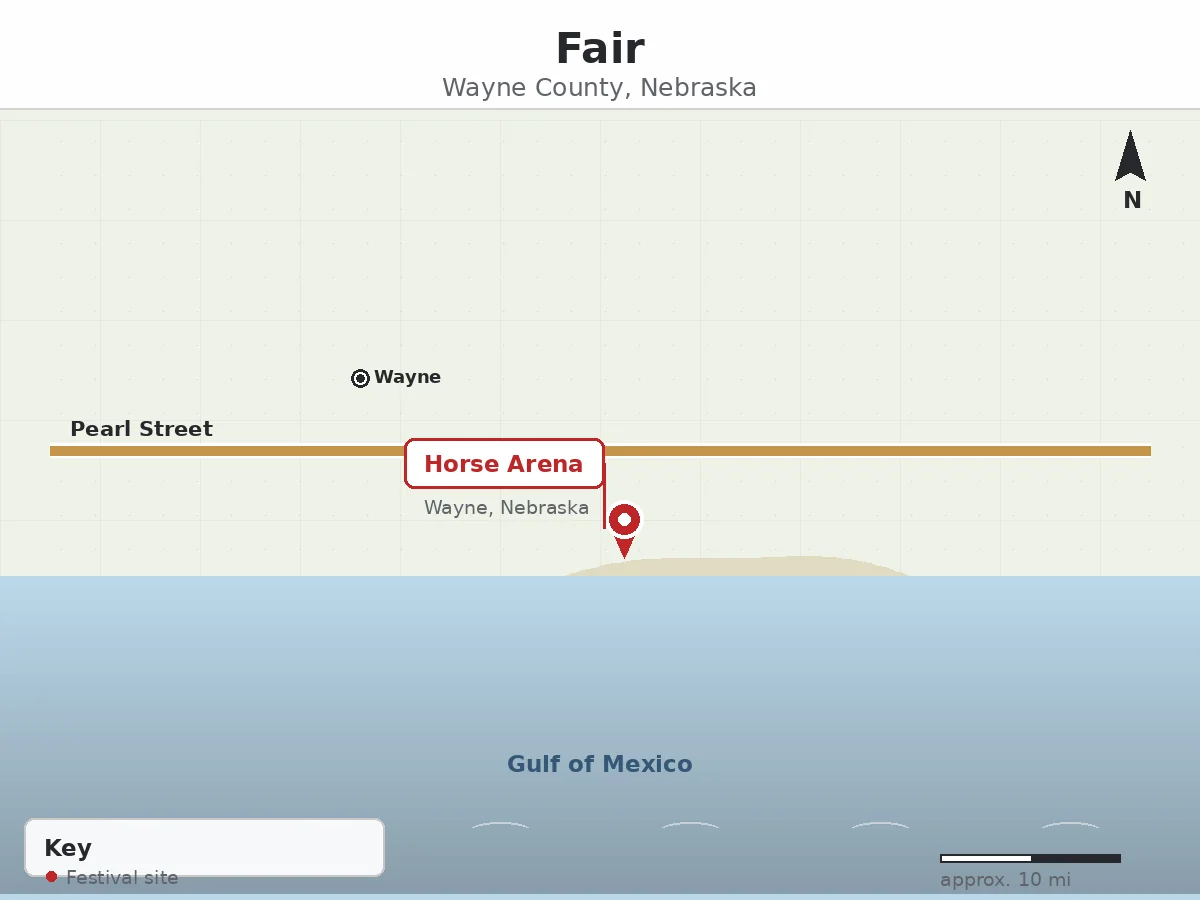
Aim for the fairgrounds at 301 Pheasant Run on the west edge of Wayne and you have the geography right. On money beyond the gate, the Nebraska record is silent: no fair-side Nebraska source publishes a parking charge, and none publishes camping prices or terms. Claims in search results that parking at the Wayne County Fair costs nothing belong to the same-name fair in another state, and the detailed camping packet that surfaces for this fair’s name belongs to yet another state’s fair entirely; neither may be read across the state line. The Extension office at 510 North Pearl Street is where 4-H paperwork lives — its staff move to the fairgrounds in fair week — but it is not the fair office.
A Sample Saturday at the Fair
Build Saturday July 25 around the documented shape of a day at this fair. Start with the livestock barns while the morning is cool, then give Ag Hall its time before the buildings warm up. Let children spend their free admission in the Kid Zone and around the bingo tent. Return to the barns for the late-afternoon showing, and be in the grandstand in good time, because Saturday belongs to the concert — in 2026, Trace Adkins and his 30th Anniversary Tour — and the day’s crowd will be aiming at the same seats.
How Wayne’s Fair Compares
The fairest comparison here is with the record-keeping of county fairs generally. Most fairs in its region leave their gate to be discovered at the fence; Wayne’s publishes its whole ladder months ahead, down to the date on which the price changes. Against the same-name Iowa fair, the comparison is one to make carefully and then stop: the two fairs share a name and nothing else, their price pages describe different gates in different states, and the only safe habit is to use each fair’s own figures on its own ground. Wayne’s four-night grandstand spine gives it the shape of a small festival wrapped around an exhibit fair, rather than a fair that saves its one big night for Saturday.
Checklist
- Buy a season pass before May 31 if you can; the early-bird tier is fifty dollars and the same pass costs sixty-five at fair time.
- Carry cash or a card for a twenty-dollar day pass, which is sold at the gate only.
- Remember that children twelve and under get in free on every day of the fair.
- Pick your nights deliberately: bull riding Thursday, the pull and the Free Barbecue Friday, the concert Saturday, the demolition derby Sunday.
- Do not budget from any parking or camping price attached to this fair’s name online; the Nebraska record publishes neither.
- Exhibitors, work to the pre-fair calendar — contest day, small-animal shows and static judging all happen before the public gates open.
- Double-check that any schedule in your hands is the Nebraska fair’s; a same-name fair in Iowa runs on different dates at different prices.
- Leave time on Saturday evening to reach the grandstand before the concert crowd settles.
Beyond the Fairgrounds
Wayne is a county seat that hosts its own fair, which gives fair week a particular compactness: the fairgrounds on the west edge of town, the Extension office on North Pearl Street handling the exhibit paperwork, and the society meeting month by month through the year, so the fair is a standing piece of the town’s calendar. Outside the four public days, the grounds’ arenas, expo building and 4-H Building are the county’s exhibit plant, and the fair’s presence runs through the year in meeting notices and fairbook deadlines.
Why This Fair Holds Its County
A fair that can be billed as passing its hundredth annual edition is not surviving on nostalgia; it is being re-chosen every year by the families who enter its barns and halls. The exhibit core still runs on published premiums and named classes, the grandstand still commits to four different kinds of night in a row, and the gate is printed plainly enough that a family can decide in April what July will cost. That combination — an agricultural society running its own fair, on its own grounds, in its own county seat, with its prices on the table — is the significance of the place in one sentence.
Frequently Asked Questions
How much does it cost to get into the Wayne County Fair?
The fair’s own published ladder for 2026 sets a season pass at fifty dollars in the early-bird window from April 1 to May 31, sixty dollars from June 1 to July 23, and sixty-five dollars at fair time. A day pass costs twenty dollars and is sold at the gate only. Children twelve and under are admitted free. The price list also carries an unexplained Saturday line of forty dollars at 5 p.m., printed without explanation.
Why do some listings show different prices for a Wayne County Fair?
Because more than one American county fair carries this name, and at least one same-name fair in another state publishes a complete price page of its own. Those figures describe that fair’s gate, in that state, and none of them applies at Wayne, Nebraska. The only prices that govern this fair are the Nebraska fair’s own, set out above.
Which night should a first-time visitor choose?
Each grandstand night offers a different fair. Thursday is bull riding with the Ultimate Bull Riding Tour, Friday pairs the Outlaw Truck and Tractor Pull with the annual Free Barbecue, Saturday is the concert night — Trace Adkins in 2026 — and Sunday closes with the Demolition Derby. For the exhibit fair at its fullest, come in the daytime on any of the four days and stay for whichever night suits you best.
Is parking or camping free at the Wayne fairgrounds?
The Nebraska record does not say, and this article will not guess. No fair-side Nebraska source publishes a parking charge or camping terms for this fair, so both should be treated as unpublished rather than waived. Statements that parking at a Wayne County Fair is free, and detailed camping packets attached to this fair’s name, belong to same-name fairs in other states and say nothing about the grounds at Wayne, Nebraska.
What to Expect From the Next Wayne County Nebraska Fair Festival
How often is the Wayne County Nebraska Fair Festival held?
It is held once a year, in late July, on a Thursday-to-Sunday pattern. The fair’s billing history — a 100th annual edition counted in 2022 and a 102nd in 2024 — is consistent with an unbroken annual rhythm, and every documented recent edition, from 2023 through 2026, has arrived on that same late-July cadence.
When is the next Wayne County Nebraska Fair Festival?
Following the edition of July 23 to 26, 2026, the next fair falls due in late July 2027 on the established pattern. The society had not published the 2027 dates in the record used here, so the honest answer is a window rather than a day: a Thursday-to-Sunday block in the second half of July, with exact dates to come from the fair’s own announcements.
Will the dates change?
They already move by small steps. The documented editions ran July 27 to 30 in 2023, July 25 to 28 in 2024, July 24 to 27 in 2025 and July 23 to 26 in 2026: the Thursday-to-Sunday frame held every time while the whole block eased a few days earlier within late July. A future edition is therefore more likely to shift by days inside the same season than to leave late July altogether, but no weekend is guaranteed until the fair publishes it.
The Wayne County Fair asks very little of a visitor beyond turning up in the right state. Its prices are printed, its nights are distinct, its barns are full, and its count of annual editions runs into three figures on the say-so of its own hometown paper. Buy the pass in spring if you can, pick your nights with intent, and let the four days in late July do what they have evidently been doing for a long time.