Waldo County Maine Belfast Poetry Festival
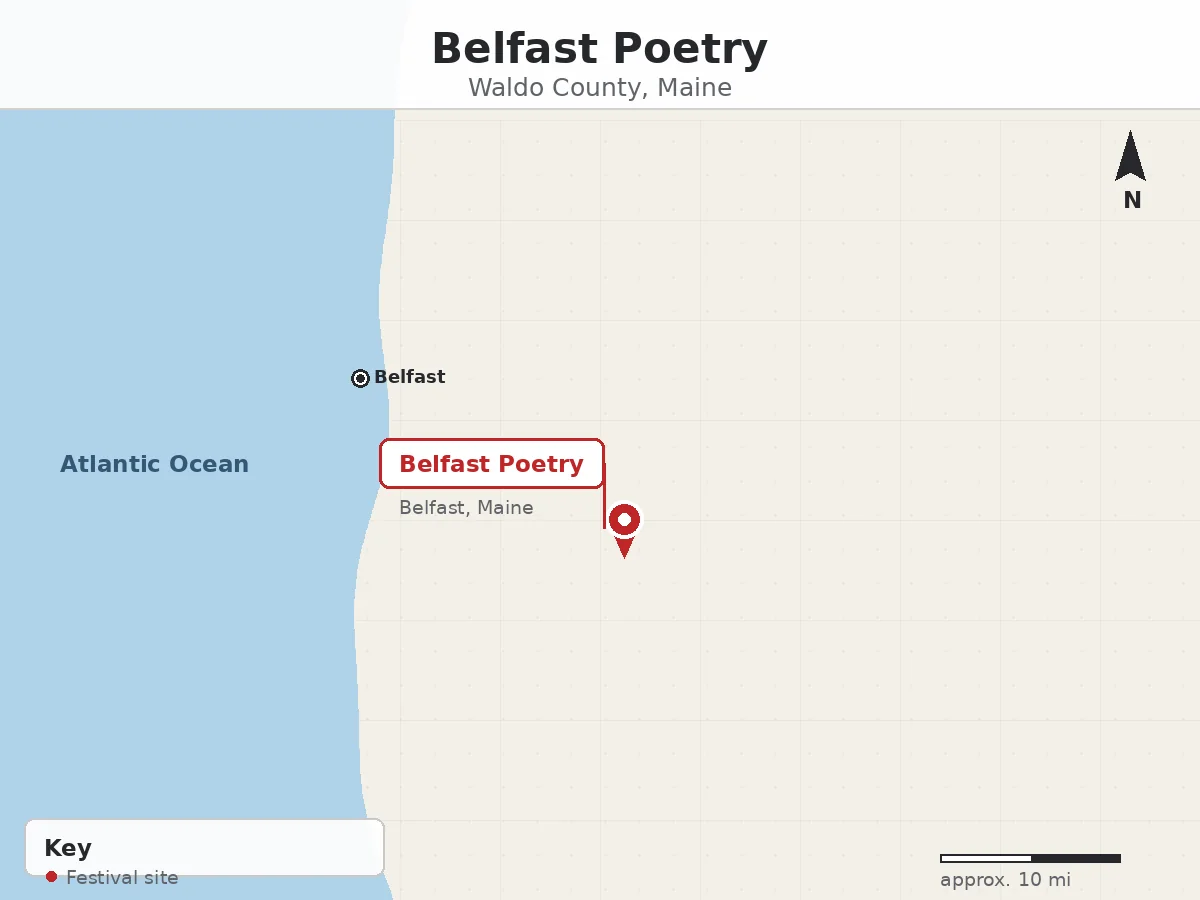
Belfast keeps its poetry close to the water. The town sits on the western shore of Penobscot Bay, where working boats still move past the waterfront and the downtown streets run short distances between a library, a theatre, a market hall and the harbour. Once a year, that compact geography turns into a walking festival of verse. Readings fill small rooms, and a typewriter poet takes subjects from passers-by. The Belfast Poetry Festival has grown out of that scale rather than away from it. It began in 2004 as a small community experiment and, more than two decades later, still feels like something the town makes for itself: volunteer-run, spread across familiar downtown venues, and open to anyone who wants to listen, write or simply wander in off the street.
About
The Belfast Poetry Festival is a community literary gathering held in Belfast, the county seat of Waldo County, Maine. Its published name is simply Belfast Poetry Festival, and that is the name under which it has been listed in organiser notices, state arts listings and local coverage across its history. The festival is organised by the Belfast Poet Laureate, a post appointed by the Belfast City Council, working with a steering committee of Waldo County volunteers. The laureate’s role gives the gathering a civic anchor: the person charged with carrying poetry into the town’s public life is also the person charged with shaping the weekend.
Quick Facts
| Detail | Information |
| Festival name | Belfast Poetry Festival |
| Host town | Belfast, Maine |
| County | Waldo County |
| County seat | Belfast, designated in 1827 |
| Venues | Belfast Free Library, Colonial Theatre, Waterfall Arts, Belfast Boathouse, United Farmers Market, Local Color Gallery |
| Organiser | Belfast Poet Laureate with a Waldo County steering committee of volunteers |
| Founded | 2004, under the auspices of Festivo |
| Founders | Annaliese Jakimides and Troy Casa, with the Festivo steering committee |
| Latest dated edition | 21st annual, Thursday 15 October to Sunday 18 October 2026 |
| Admission | All events free or low cost, except workshops |
History
The festival began in 2004 under the auspices of Festivo, a steering committee that hoped to seed a community arts event in Midcoast Maine. Festivo’s idea was modest and practical: bring poets and readers together in the town’s existing rooms, keep the gathering open to the public, and let a volunteer committee carry it forward. Annaliese Jakimides and Troy Casa founded the festival with that committee, and the shape they set in the first year has held through the decades since — a weekend of readings, workshops and small performances, organised locally and priced so that cost is rarely a barrier.
The record of dated editions shows a festival that kept going and kept growing in small steps. The 17th annual edition took place on Saturday 15 October 2022, a single-day gathering documented in an organiser newsletter. By the 20th annual edition, Friday 17 October to Sunday 19 October 2025, the festival had become a three-day weekend. The 21st annual edition, Thursday 15 October to Sunday 18 October 2026, stretched to four days and added new programming billed as the Volta, Po-Jazz and the Poetry Crawl. The numbering tells its own story: a gathering that began as a one-day experiment now fills a long weekend, yet still runs on volunteer labour and still meets in the same downtown rooms.
The laureate changes and the programme adds new strands, but the founding premise — poetry as a shared public activity in a small coastal town — has not shifted. A state arts layer describes the festival as one of the few community-based, non-academic literary festivals in the country: built by a local committee, not by a university or a publishing house, and still in local hands.
For a useful comparison, see the Waldo County Maine Belfast Ice Festival for another county festival.
What to Expect
A weekend at the Belfast Poetry Festival moves at walking pace, and the programme rewards visitors who treat it that way. The core of the gathering is the reading: poets read their own work in rooms where the audience sits close enough to hear every pause. Some readings feature the winners of the Maine Postmark Poetry Contest, whose short poems arrive by postcard and get their moment on stage. Other readings bring together local writers, visiting poets and the keynote reader, the Maine State Poet Laureate.
Alongside the readings sit craft-oriented workshops, the festival’s most hands-on element. These sessions ask participants to write rather than only listen, and registration is required because the rooms are small and the places fill. A workshop in 2022 cost twenty-five dollars, and workshops remain the one part of the festival that carries a charge while other events are free or low cost.
The lighter side of the weekend is where the festival shows its personality. The Haiku Death Match, in its third annual running in 2026, turns the shortest of poetic forms into a lively contest. The Typewriter Poet in Residence sets up at the Free Library, taking subjects from visitors and returning typed poems on the spot. The 2026 closing celebration brought the Boston Typewriter Orchestra to the Belfast Boathouse, a performance built around typewriters as instruments. New programming in 2026 added the Volta, Po-Jazz and the Poetry Crawl, strands that mix music, movement between venues and the spoken word.
Planning Your Visit
Belfast is a small town, and the festival is designed around that fact. The venues all sit downtown, within easy walking distance of one another, so a visitor can move from a workshop at the library to a reading at the theatre to a market-hall event without needing a car. Parking in the downtown area fills during festival hours, so arriving on foot from a nearby place to stay, or leaving extra time to find a space, makes the day easier. The waterfront sits a short walk from the main venues, and the harbour makes a natural pause between events.
October weather on the Maine coast can turn quickly. Layers, a waterproof outer layer and comfortable walking shoes cover most conditions, and an umbrella is worth carrying even on a fair morning. The festival runs across several days, so it pays to choose in advance which events matter most: workshops need registration and have limited places, while readings and performances are generally open to all. Check the current year’s programme before the weekend to avoid arriving at a full room.
Meals are straightforward in downtown Belfast, where cafes and restaurants cluster near the venues. The United Farmers Market, one of the festival venues, also gives visitors a taste of the town’s food culture. Because most events are free or low cost, a day at the festival costs little beyond food and lodging; the exception is a workshop, which carries its own charge. Lodging in Belfast and nearby Midcoast towns should be booked early for an October weekend.
Sample Itinerary
A first visit works best across two days, with one day given to writing and one to listening. Arrive on a Friday afternoon and settle into a downtown stay, then walk to an early evening reading to get a feel for the festival’s tone. Saturday morning belongs to a workshop: register in advance, bring a notebook and a pen, and expect to write through the session rather than sit and listen. After lunch, move to the library for the Typewriter Poet in Residence, offer a subject and watch a poem take shape, then stay for the Maine Postmark Poetry Contest winners’ readings.
Saturday evening is for the livelier strands — the Haiku Death Match if it falls that night, or a performance such as the closing celebration. On Sunday, take a slower route: a morning reading at Waterfall Arts or the Local Color Gallery, a walk along the waterfront between events, and the keynote reading by the Maine State Poet Laureate. Leave time for the Poetry Crawl, which moves between venues and suits a visitor who enjoys discovering a town on foot.
Comparison
Maine has several poetry gatherings, and the Belfast festival’s character becomes clearer when set beside them. The Camden Poetry Festival, the Portland Poetry Festival and the Plunkett Poetry Festival in Augusta are different events, each with its own organisers, venues and history, and none of them should be confused with the Belfast gathering. Camden’s festival belongs to its own harbour town to the south, Portland’s to the state’s largest city, and the Plunkett festival to the capital. Belfast’s event is smaller and more deliberately local than a city festival: it is run by the town’s laureate and a county committee, it meets in downtown rooms rather than a single large hall, and its audience is a mix of Midcoast residents and visitors who have come specifically for the weekend.
That local scale is also what distinguishes the festival from academic literary conferences. University gatherings tend to centre on scholarship, publication and professional networks; Belfast centres on the act of writing and hearing poems in a community setting. The workshops are craft sessions for working writers, the contests invite anyone to send a postcard poem, and the typewriter poet turns a passer-by’s suggestion into verse.
Checklist
- Register in advance for any workshop, since places are limited and registration is required
- Bring a notebook and pens for workshop sessions and for lines worth keeping
- Carry layers and a waterproof outer layer for October weather on the coast
- Wear comfortable walking shoes for moving between downtown venues
- Check the current year’s programme for times, venues and any registration deadlines
- Arrive early for popular readings, since the rooms are small
- Bring a subject or a few words for the Typewriter Poet in Residence
- Allow time between events for the waterfront walk and downtown cafes
- Keep cash or a card ready for workshop charges and market purchases
- Book lodging early for an October weekend in Belfast
Beyond the Festival
Belfast rewards a visitor who stays past the last reading. The town’s waterfront, with its working harbour and views across Penobscot Bay, is a short walk from every festival venue, and the downtown streets hold bookshops, galleries and cafes that suit a poetry-minded traveller. The library, the theatre and Waterfall Arts all run year-round cultural programming beyond the festival weekend.
Waldo County around Belfast offers more for a longer stay. The Midcoast region’s farms, forests and shoreline make easy day trips, and the county seat’s history — Belfast was designated the seat in 1827 — shows in its nineteenth-century downtown buildings. The festival’s venues, all working parts of the town rather than purpose-built halls, make that connection easy.
Significance
The Belfast Poetry Festival matters because it keeps poetry in public life without making it academic or exclusive. A community-based literary festival run by a town laureate and volunteers is a rare thing, and the state arts layer’s description of it as one of the few such gatherings in the country points to why it endures. It gives Midcoast writers a stage, a workshop table and an audience in their own town, and it gives visitors a reason to spend an October weekend in Belfast listening to new work.
Staying power is the other half of its worth. A festival founded in 2004 by Annaliese Jakimides and Troy Casa with a local steering committee has now passed its twentieth annual edition, and the 21st annual gathering in 2026 added new programming rather than repeating the old. That growth — from a single day in 2022 to a four-day weekend in 2026 — shows a community event still finding new energy, adding a strand here and a venue there while keeping the rooms small enough for a poem to be heard properly.
Frequently Asked Questions
Which Belfast venues host the festival’s readings and workshops?
Readings and workshops take place across several downtown venues: the Belfast Free Library, the Colonial Theatre, Waterfall Arts, the Belfast Boathouse, the United Farmers Market and the Local Color Gallery. The venues sit close together downtown, so visitors move between them on foot.
How does the Maine Postmark Poetry Contest fit into the weekend?
The contest invites poets to send short poems on postcards, and its winners read their work during the festival. The winners’ readings are one of the weekend’s regular strands, giving new and established writers alike a place on stage. The contest’s postcard form keeps the entry simple, and the readings let the audience hear the winning poems spoken aloud.
What is the Haiku Death Match and how does it work?
The Haiku Death Match is a competitive event built around haiku, the short three-line form, and it reached its third annual running in 2026. Poets face off by composing and performing haiku, with the contest format giving the weekend a playful, competitive edge. It sits alongside the more reflective readings and workshops as the festival’s liveliest strand.
Is the festival suitable for someone who has never written a poem?
Yes. The festival welcomes listeners as warmly as writers, and most events are free or low cost to attend. A newcomer can spend the weekend hearing readings, watching the Typewriter Poet in Residence and joining the Poetry Crawl without writing a line.
What to Expect From the Next Waldo County Maine Belfast Poetry Festival
How often is Waldo County Maine Belfast Poetry Festival held?
The festival is an annual gathering, held once each year in Belfast. Its numbering carries that pattern: the 17th annual edition took place in 2022, the 20th annual in 2025 and the 21st annual in 2026. A visitor planning ahead can count on a single October weekend each year, with the exact dates set by the organisers for that year’s edition.
When is the next Waldo County Maine Belfast Poetry Festival?
The most recent dated edition was the 21st annual festival, held Thursday 15 October to Sunday 18 October 2026. The next edition would fall in October of the following year, with its exact dates announced by the organisers once the new programme is set. Look for the organiser’s announcement for the coming year rather than assuming a date.
Will the dates change?
October has been the festival’s season across the dated editions on record, from the single day in 2022 through the four-day weekend in 2026. The length of the gathering has shifted over the years — one day, then three, then four — so the span of days may vary again. The month itself has held steady, and the organiser’s listing for the coming year is the place to confirm the exact dates before travelling.
A weekend in Belfast with the poets is a weekend spent at walking pace, in small rooms, with poems read aloud. The festival asks little of its visitors — a notebook, a willingness to listen, a walk between venues — and gives back a town full of verse.