Labette County Kansas Flagpole Festival
Most small-town festivals gather around a park, a courthouse square or a fairground. In Mound Valley, Kansas, the gathering point is a flagpole. The pole stands in the center of Hickory Street in the town’s business district, and the celebration that has grown up around it is published under a small family of names that this account keeps separate, exactly as their layers print them. Local news and festival-guide layers call it the Mound Valley Flagpole Festival. The city of Mound Valley’s own history page calls it The Flagpole Festival. Guide layers also print the shorter Flagpole Festival. No layer read adds a county prefix. The record behind the event is a moderate one: a detailed preview in a local newspaper, the city’s own history page, and festival-guide listings spread across two years. There is no organiser’s own site in the record, so this account leans on those layers and says plainly where they run out.
About the Festival
Mound Valley is a small community in Labette County, in the southeast of Kansas. It is not the county seat; that role belongs to Oswego, and the reference layers are consistent on the point. The festival belongs to Mound Valley itself, and its setting is unusually specific. According to the city’s own history page, the celebration centres on the flagpole standing in the center of Hickory Street in the business district, so the event’s heart sits in the middle of the town’s main street. The documented schedule reaches beyond that single spot: a local newspaper preview places the garden tractor pull at the ball park and a breakfast at the Mound Valley Methodist Church, spreading the weekend across three corners of the town.
Who runs the festival is a question the record answers only in outline. The city’s history page states that a group of young adults started The Flagpole Festival. No group name is printed in any layer read, and no later layer names a committee, a board or a sponsoring organisation, so this account invents none. The one named organiser of any single element is the Labette County High School girls wrestling programme, which the newspaper preview credits with organising the turtle race.
Quick Facts
| Item | Detail |
| Published names | Mound Valley Flagpole Festival; The Flagpole Festival; Flagpole Festival |
| Host town | Mound Valley, Labette County, Kansas |
| County seat | Oswego; Mound Valley is not the seat |
| Festival centre | The flagpole in the center of Hickory Street, in the business district |
| Other documented places | The ball park; the Mound Valley Methodist Church |
| Organiser | Started by a group of young adults, per the city’s history page; no group name is printed |
| Fullest documented edition | The twenty-seventh and twenty-eighth of June, in a local newspaper preview whose copy does not print its year |
| Guide listings | The twenty-eighth of June, two thousand twenty-five; the twenty-seventh of June, two thousand twenty-six |
| Timing as described | The weekend before the Fourth of July |
| Admission | No admission statement appears in any layer read |
History
The history this festival carries is, strictly speaking, the history of a flagpole. The city’s own history page records that in nineteen twenty-two the town decided to erect a flagpole by popular subscription, the money raised from the townspeople themselves. A fifty-foot flagstaff was apparently erected, and the city’s page says it still stands in the center of Hickory Street. That apparently is the city’s own caution, and it is kept here: the page reports the pole’s story as the town hands it down. The pole has stood over Hickory Street for roughly a century, and it remains the physical anchor of the business district.
When the festival itself began is a different question, and the record does not answer it. The city’s history page says only that a group of young adults started The Flagpole Festival, with no year attached, and no other layer read supplies one. Nothing here derives a founding year from the pole’s nineteen twenty-two subscription, because a flagpole’s age and a festival’s age are separate things, and blending them would manufacture a fact the layers do not contain. The same page describes the festival as a time of fun and fellowship for all, held the weekend before the Fourth of July. That late-June placement, just ahead of Independence Day, is the closest thing the record offers to a tradition line.
For a useful comparison, see the Labette County Kansas Oswegofest Festival for another county festival.
What to Expect
Friday evening opens the fullest documented edition, and it opens at the ball park. The local newspaper preview gives the garden tractor pull as the first event, beginning at six in the evening on the twenty-seventh of June. Nothing else is scheduled for that first evening in the preview, so Friday reads as a single, deliberate curtain-raiser: engines, dust and a crowd warming up for the main day.
Saturday is the full day, and it starts early at the Mound Valley Methodist Church, which serves breakfast from seven to ten in the morning. At eight, while breakfast is still being served, events kick off at the flagpole with a 5K and a mile fun walk that start and end at the pole itself, turning the town’s landmark into both a starting line and a finish line. At noon comes the turtle race, organised by the Labette County High School girls wrestling programme, a pairing of school athletics and small-animal chaos that only a hometown festival would think to schedule. Running underneath the whole weekend is a scavenger hunt whose clues are posted daily on the festival’s own page and at a local business. Taken together, the preview’s programme is modest in scale and deliberately local: a pull, a run, a church breakfast, a turtle race and a hunt.
Planning Your Visit
The honest starting point for a trip is the calendar’s shape rather than a confirmed date. The city’s history page places the festival on the weekend before the Fourth of July, and the guide listings agree with late June: one lists the Mound Valley Flagpole Festival on the twenty-eighth of June, two thousand twenty-five, and another gives the twenty-seventh of June, two thousand twenty-six. The detailed newspaper preview covers the twenty-seventh and twenty-eighth of June but the copy read does not print its year, so its schedule and the guide’s two thousand twenty-five date are recorded side by side here, unmerged. A visitor should treat the late-June weekend as the pattern and confirm the current year’s dates closer to the time.
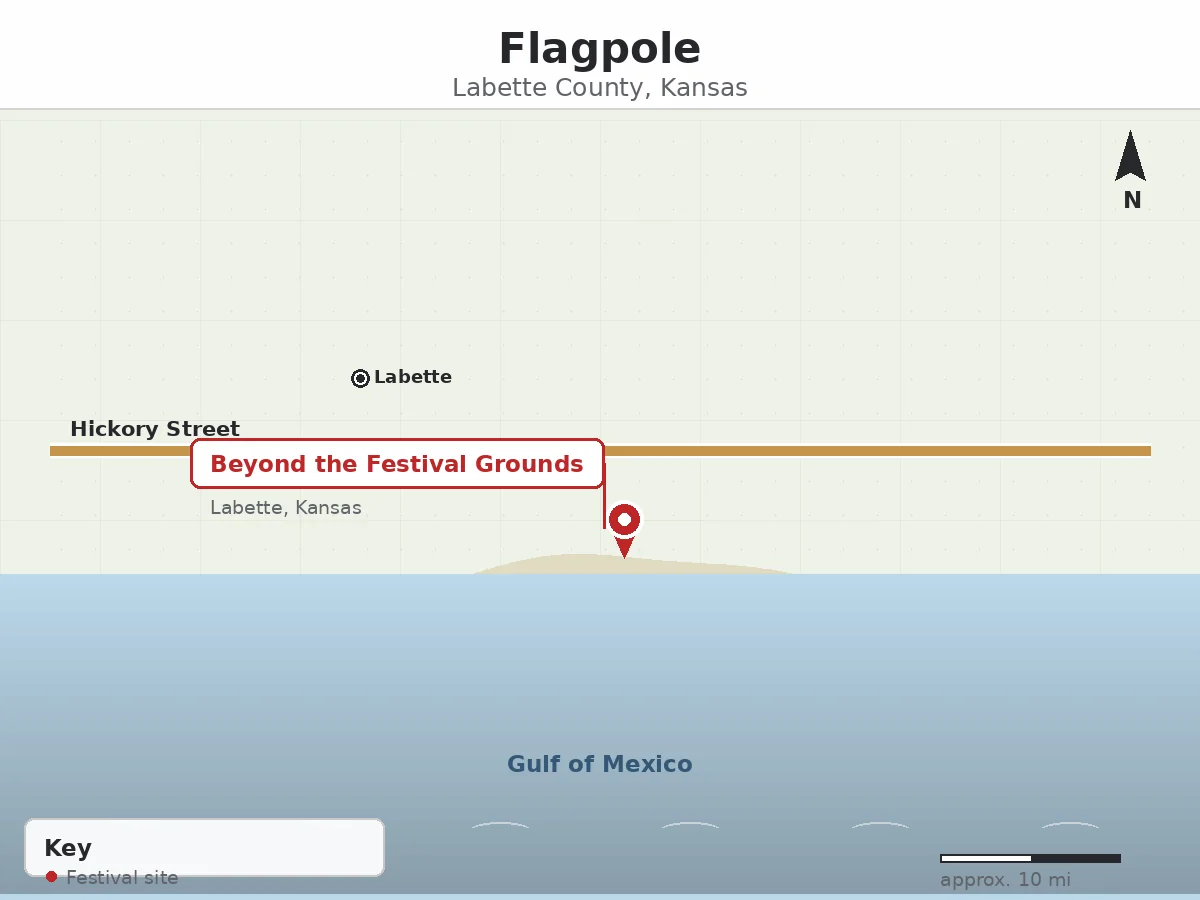
On the ground, the geography is simple. The flagpole stands in the center of Hickory Street in the business district, and the Saturday run begins and ends there, so the pole is the natural landmark to navigate by. The ball park hosts Friday’s garden tractor pull and the Methodist Church hosts Saturday’s breakfast, so a morning arrival can be fed before the noon turtle race. Because no layer read states any admission position in either direction, a visitor should carry some cash for food and any element charges rather than assume the weekend is free or assume a gate exists; the record simply does not say.
The Festival Weekend, Step by Step
Friday belongs to a single event. Arrive by early evening and head for the ball park, where the garden tractor pull begins at six and carries the whole first night on its own. With no competing programme in the documented schedule, the pull is both the entertainment and the social hour.
Saturday layers the whole town into one morning. Breakfast runs at the Methodist Church from seven to ten, and the 5K and mile fun walk leave the flagpole at eight, so runners and walkers can eat before or after their circuit. Late morning belongs to the scavenger hunt, whose daily clues send visitors between the festival’s own page and the participating business. At noon the turtle race takes over, the one fixed point of the afternoon in the documented schedule. The preview prints nothing after the race, so the rest of Saturday is open time.
How the Flagpole Festival Compares
A festival built around a flagpole in the middle of a street is a rarer thing than a festival built around a park. Most community celebrations anchor themselves to grounds, grandstands or fair buildings; Mound Valley’s anchors itself to a piece of street furniture that the townspeople paid for by subscription in nineteen twenty-two and that still stands where they put it. The comparison that matters most is with the Altamont Flag Day Celebration, held elsewhere in Labette County. Despite the similar patriotic colouring, that is a different town’s event, and nothing from it belongs in this festival’s record. Searches further afield return flagpole festivals in Brazil and Vietnam, unrelated celebrations that are disowned here in full. The pole is not a backdrop here. It is the venue, the landmark and the reason.
A Flagpole Festival Checklist
- Aim for the weekend before the Fourth of July, and confirm the current year’s dates nearer the time
- Use the flagpole in the center of Hickory Street as your landmark for the whole weekend
- Be at the ball park by six on Friday evening for the garden tractor pull
- Plan breakfast at the Mound Valley Methodist Church, served from seven to ten on Saturday
- Reach the flagpole by eight on Saturday if you mean to join the 5K or the mile fun walk
- Check the festival’s own page and the participating local business daily for scavenger-hunt clues
- Be in place by noon on Saturday for the turtle race
- Carry cash for food and any element charges, since no layer states an admission position
Beyond the Festival Grounds
The festival’s own footprint is small, so the town around it does much of the work. Hickory Street’s business district is both the setting and part of the programme, since the scavenger hunt routes visitors into a local business and the pole itself stands among the shops. The ball park and the Methodist Church, the weekend’s other two documented places, are ordinary working parts of Mound Valley life that the festival borrows rather than builds. A county newspaper’s roundup of its two thousand twenty-four headlines includes a headline announcing that the Flagpole Festival was set for Mound Valley, showing the event was covered the year before the fullest preview as well; that is a headline reference, not edition evidence, and it is recorded as such.
Why the Flagpole Festival Matters
The festival’s significance sits in what it chooses to celebrate. Rather than a crop, a railroad or a founding family, Mound Valley celebrates a flagpole its own residents subscribed to buy in nineteen twenty-two, planted in the middle of its main street and never moved. The city’s history page frames the gathering as a time of fun and fellowship for all, and the documented programme bears that framing out: a high school wrestling programme runs the turtle race, a church runs the breakfast, a local business helps with the scavenger hunt, and a group of young adults, unnamed in every layer, started the whole thing. Its organisation is hard to see because the town itself is the organisation, and keeping a late-June weekend alive across the years documented here, from a two thousand twenty-four headline to a two thousand twenty-six listing, is its own kind of record.
Frequently Asked Questions
Why does Mound Valley hold its festival around a flagpole?
Because the pole is the town’s landmark. The city’s own history page records that residents decided in nineteen twenty-two to erect a flagpole by popular subscription, and that a fifty-foot flagstaff was apparently erected and still stands in the center of Hickory Street. The festival centres on that pole, and the Saturday run starts and finishes at it.
Who organises the Flagpole Festival?
The city’s history page says a group of young adults started The Flagpole Festival, and no layer read prints the group’s name or names a successor committee. The only named organiser of any element is the Labette County High School girls wrestling programme, credited in the newspaper preview with the turtle race.
Which dates do the published layers actually give?
A festival-guide layer lists the festival on the twenty-eighth of June, two thousand twenty-five, and another guide listing gives the twenty-seventh of June, two thousand twenty-six. The detailed newspaper preview covers the twenty-seventh and twenty-eighth of June without printing its year, and the city’s history page places the event on the weekend before the Fourth of July.
What will a visitor find besides the events at the pole?
The documented programme spreads across town. Friday’s garden tractor pull is at the ball park. Saturday brings breakfast at the Methodist Church from seven to ten, the 5K and mile fun walk at eight, the turtle race at noon, and a scavenger hunt whose clues appear daily on the festival’s own page and at a local business.
What to Expect From the Next Labette County Kansas Flagpole Festival
How often is Labette County Kansas Flagpole Festival held?
The city’s own history page describes the festival as a recurring gathering held on the weekend before the Fourth of July, and the surrounding evidence fits a yearly rhythm: a headline in a two thousand twenty-four roundup, a guide listing in two thousand twenty-five, and another in two thousand twenty-six. No layer prints a formal statement of frequency, so the pattern is read from those listings rather than from an organiser’s promise.
When is the next Labette County Kansas Flagpole Festival?
The latest dated trace in the record is a festival-guide listing on the twenty-seventh of June, two thousand twenty-six, a listing only, offered without a schedule. Beyond that, the city’s history page points to the weekend before the Fourth of July as the festival’s standing place in the year, so that late-June weekend is where a future edition would be expected to fall, subject to confirmation through the festival’s own page.
Will the dates change?
They have already moved within the month in the documented record: the guide listings give the twenty-eighth of June in two thousand twenty-five and the twenty-seventh of June in two thousand twenty-six, and the fullest preview’s two-day span is not tied to a printed year at all. Since the anchor is a weekend rather than a fixed date, some drift is built into the event, and checking the festival’s own page before travelling is the sensible course.
Closing Thoughts
The Labette County Kansas Flagpole Festival is documented the way many small-town celebrations are documented: warmly, locally and incompletely. A pole raised by subscription in nineteen twenty-two still stands in the center of Hickory Street. A group of young adults started a festival around it at a date no layer records. A newspaper preview preserves one full weekend of pulls, runs, breakfasts and turtle races, and guide listings carry the name forward into two thousand twenty-six. What the record supports is a modest, durable hometown gathering with an unmistakable centre, and this account has kept it that way.