Elmore County Alabama Alabama Frontier Days Festival
Each November, the grounds of Fort Toulouse–Fort Jackson Park in Wetumpka become a working frontier settlement for a few days, as living history presenters recreate the world of the Southeast between 1700 and 1820. The event is Alabama Frontier Days, presented by the Alabama Historical Commission, which owns and operates the park. The longer wording carried in this article’s title is the county listing form; both the commission and the state tourism department call the gathering simply Alabama Frontier Days, and that shorter name is the one used on official listings and park materials. Across four days, the programme moves through three layers of the region’s past: the French colonial period, the world of the Creek people, and the early American years that followed.
About the Festival
Alabama Frontier Days is a living history event devoted to frontier life in the Southeast across the years 1700 to 1820. Rather than a fairground format built around rides and midway food, the gathering is organised around demonstration and interpretation: costumed presenters show how people in French colonial settlements, Creek communities and early American households worked, cooked, built, traded and defended themselves. The Alabama Historical Commission bills it as one of Alabama’s largest and most authentic living history events, a description that reflects both the size of the gathering and the commission’s role as the state body responsible for the historic site where it happens.
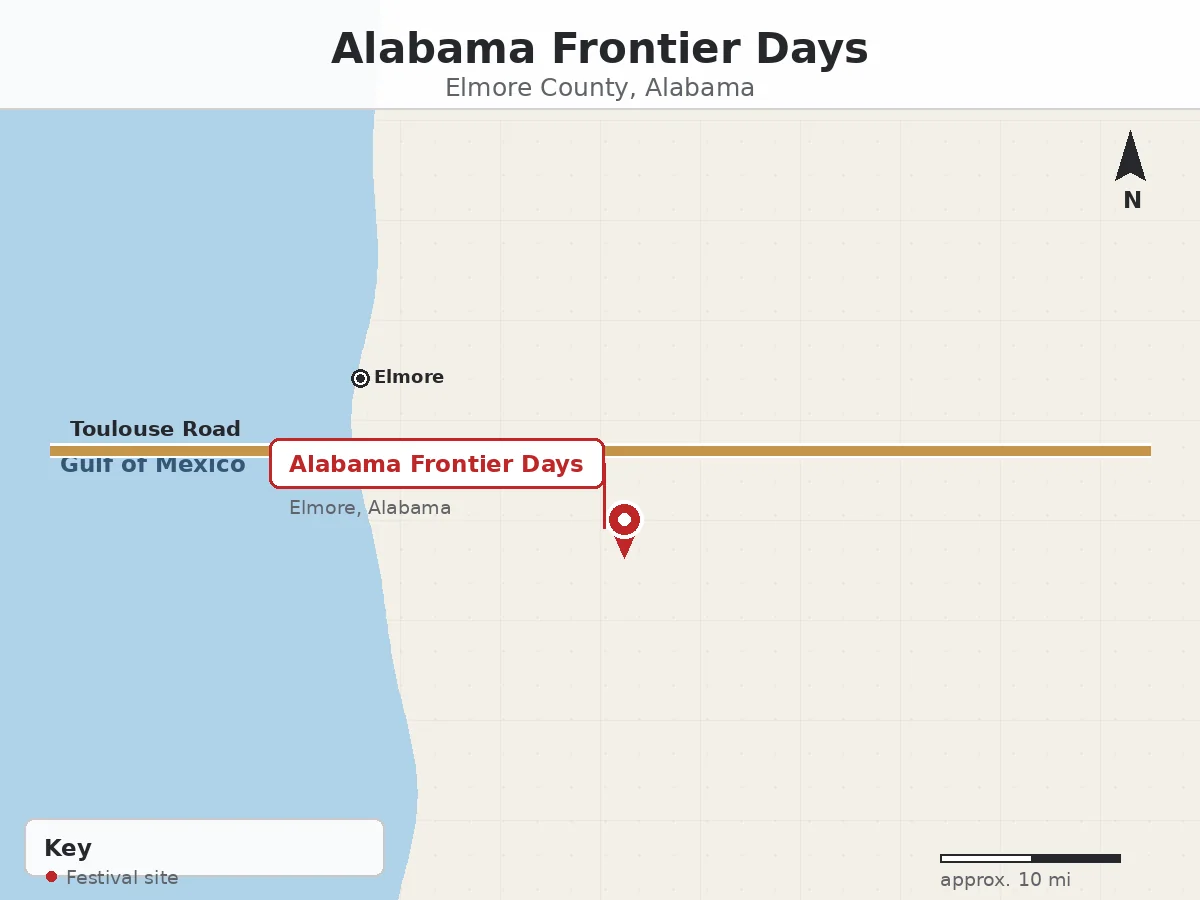
The host is Wetumpka, and the same town serves as the seat of Elmore County, so the host community and the county seat are one and the same here. The venue is Fort Toulouse–Fort Jackson Park, published at 2521 West Fort Toulouse Road, Wetumpka, AL 36093 in the state tourism listing. Because the commission both owns the park and produces the event, the festival and its setting are managed by a single authority, and the historic ground itself forms part of what visitors come to experience.
The shape of the gathering follows from that arrangement. Commission educational material notes that school groups attend during the week by reservation only, so the event works partly as an outdoor classroom across its weekday dates, while the weekend opens the same ground to the general visitor. That dual role explains the programme’s emphasis on explanation: presenters are there to teach processes rather than simply to stage a spectacle, and the billing as one of the state’s largest and most authentic gatherings of its kind rests on that teaching purpose as much as on the scale of attendance.
Quick Facts
| Detail | Information |
| Event name | Alabama Frontier Days |
| Host town | Wetumpka, Elmore County |
| Venue | Fort Toulouse–Fort Jackson Park |
| Address | 2521 West Fort Toulouse Road, Wetumpka, AL 36093 |
| Organiser | Alabama Historical Commission |
| 2026 dates | November 4–7, 2026 |
| 2026 hours | 9 a.m. to 3 p.m. each day |
| Theme | Southeastern frontier life, 1700–1820 |
| Admission | Charged; published figures differ by source layer |
History
The festival’s own starting year is not something the published record settles. No founding year and no edition number for Alabama Frontier Days itself appears in the sources checked, so any claim about a first edition would be guesswork. What the record does document is the history of the park that hosts it. Fort Toulouse–Fort Jackson Park was declared a National Historic Landmark in 1961, and the Alabama Historical Commission acquired the site in 1971. Those two dates belong to the park’s biography, not to the festival’s, and they should never be converted into a founding claim for the event.
For a useful comparison, see the DeKalb County Alabama Fyffe UFO Days Festival for another county festival.
Personnel accounts also shift with the years. A commission release layer names Calvin Chappelle as site director, while an older magazine layer identifies Ove Jensen as site director from 2014 onward. Each name belongs to the layer that printed it; the two accounts cover different periods, and neither should be presented as the permanently current officeholder. What remains constant across the layers is the commission’s stewardship: the agency that preserves the forts also stages the November gathering on their grounds, which ties the modern event to the site’s longer public history even though the festival’s own first year stays unpublished.
A further caution concerns edition numbers. Some long-running festivals print an ordinal on every poster, but no such numbering for Frontier Days appears in the material checked, so the event cannot be placed within a sequence of numbered years. Its history, as published, is instead a history of the ground it occupies and of the agency that runs both, and the honest summary is that the celebration is documented through its site, its organiser and its recurring November slot rather than through a dated first edition.
What to Expect
Visitors move among encampments and demonstration areas representing three successive frontiers. The French colonial layer covers the earliest period within the event’s 1700–1820 span, the Creek layer presents the Indigenous world that shaped the region, and the early American layer carries the story into the years after the colonial era. Expect the texture of a demonstration-led event: handwork shown at close range, period clothing, camp routines and presenters explaining processes rather than performing a stage show. Saturday carries a special billing in commission material, where it is labelled Family Day, marking it as the day the programme leans most heavily toward general audiences.
One commission release describes an edition running Wednesday through Saturday, November 6–9, with grounds hours of 9:00 a.m.–4:00 p.m., a longer day than the hours published for 2026. School parties form a large part of the weekday audience: commission educational material explains that school groups attend on Wednesday, Thursday and Friday by reservation only, which means weekday grounds can be busy with organised classes even though general visitors are also present. Families arriving without a reservation will generally find the weekend, and especially the billed Family Day on Saturday, the natural fit.
The balance of the crowd changes across the four days. The reserved school parties give Wednesday through Friday an organised field-trip rhythm, with classes moving between demonstrations in groups, while Saturday’s Family Day billing signals the edition’s broadest public-facing programme. Visitors who prefer to watch the teaching side of the commission’s work may find a weekday rewarding, whereas households looking for the most general-audience atmosphere will usually aim for the Saturday session.
Planning Your Visit
Begin by separating the two sets of published hours, because they do not describe the same edition. The state tourism department’s 2026 listing gives November 4–7, 2026, Wednesday to Saturday, with hours of 9 a.m. to 3 p.m. each day. The commission release layer, covering a November 6–9 edition, prints 9:00 a.m.–4:00 p.m. instead. Treat the 2026 listing as the guide for the 2026 trip and the release figures as the record of a different year’s arrangement, not as a contradiction to average out.

Admission requires the same care. The 2026 listing states only that admission is charged, with no amount attached, so no figure can honestly be tied to the 2026 edition. Figures do exist in other layers: the commission release prices entry at fifteen dollars for adults and ten dollars for children aged six to eighteen, valid inside that release’s edition only. An older utility magazine layer puts Frontier Days admission at eight dollars and seven dollars, and a school field-trip form prices group visits at ten dollars per student and fifteen dollars per adult, which is group pricing rather than a gate rate. That same magazine layer lists ordinary park admission at two dollars for adults and one dollar for children; those small figures describe a normal park day, not the festival, and should never be quoted as the event’s price. Carry enough flexibility to confirm the current charge through official channels before travelling.
Choosing which published layer to follow is therefore the central planning task for this festival. Dates and hours for a specific year belong to that year’s tourism listing, prices belong to whichever document printed them, and the park’s ordinary admission belongs to ordinary days. Keeping those categories separate prevents the commonest mistake, which is assembling one confident figure from fragments that were never published together. A short check of the newest official listing shortly before departure settles the details that the older layers cannot.
A Sample Day at Frontier Days
Arrive near the 9 a.m. opening, when the grounds are quietest and the demonstration areas are being set up for the day. Spend the morning in the French colonial section, watching presenters establish camp routines and explain the earliest layer of the site’s story. Move to the Creek demonstrations before midday, then pause for lunch while the encampments reset. Use the early afternoon for the early American areas, where the story reaches the end of the event’s 1700–1820 span, and finish with a walk around the fort grounds themselves before the 3 p.m. close given in the 2026 listing. On a Saturday visit, the Family Day billing makes this same circuit the centre of a programme aimed squarely at households with children.
How Frontier Days Compares
Most county festivals in this series are built around a harvest, a food or a single town celebration, and their programmes run on stages and vendor rows. Alabama Frontier Days works differently: its programme is the interpretation itself, spread across a historic site that the organising commission preserves all year. It also differs from a conventional re-enactment weekend by covering three cultures in sequence rather than one battle or one army. Compared with the park on an ordinary day, when entry costs the two dollars for adults and one dollar for children given in the older magazine layer, the November event layers scheduled demonstrations, school programming and the Family Day billing on top of the same ground, at a separate event charge.
Planning Checklist
- Confirm the current year’s dates and hours in the state tourism listing before booking travel.
- Check the admission charge through official channels, since published figures differ by layer.
- Choose Saturday for the Family Day programme, or a weekday for a quieter circuit.
- Reserve ahead if bringing a school group, because weekday class visits run by reservation only.
- Dress for outdoor walking on park ground, with layers for November mornings.
- Bring payment flexibility, as the exact gate charge for the current edition is not published.
- Allow a full day so all three cultural sections get unhurried time.
- Keep the park’s ordinary admission figures separate from the festival charge when budgeting.
Beyond the Festival
Wetumpka gives the trip a second half once the park closes for the day. The town serves as the Elmore County seat, so its downtown carries the courthouse-centred character of a working county town, and the park itself rewards a return visit outside the festival window, when the fort grounds can be walked at an ordinary park pace. Travellers who come for the November event often find that the site reads differently without the encampments: quieter, and more focused on the ground and the structures the commission maintains. Pairing the festival days with a slower park visit on a separate trip lets each version of the place stand on its own terms.
The November timing also makes the festival a natural anchor for an autumn trip into Elmore County. Giving one day to the event’s full circuit and another to the park in its everyday state underlines how much of the festival is temporary interpretation layered onto a permanent historic landscape, and how much of the place’s character survives unchanged once the presenters have gone home.
Why Alabama Frontier Days Matters
The gathering gives the public a structured way into a complicated century. Between 1700 and 1820 the Southeast passed through French colonial ambitions, a Creek world under growing pressure, and the arrival of the early American republic, and those transitions are difficult to grasp from dates alone. By placing the three layers side by side on one historic property, the commission turns that sequence into something visitors can walk through and question directly. The event also reinforces the purpose of the park’s landmark status, declared in 1961: the ground is preserved so that this history can be taught on the spot where its later chapters unfolded, and the November festival is the most concentrated expression of that teaching mission each year.
There is a practical significance for the site as well. A landmark designation protects ground and structures, yet an annual public event is what keeps the protected place in regular use as a teaching venue. Frontier Days therefore does double duty: it interprets the years 1700 to 1820 for a modern audience, and it renews, each November, the public connection to a park that the commission has held since 1971.
Frequently Asked Questions
Which centuries does the programme cover?
The published focus runs from 1700 to 1820. Within that span, the presentations address French colonial life, the Creek world and the early American period, in that order.
Why do the published hours disagree with each other?
Because the sources describe different editions. The 2026 tourism listing gives 9 a.m. to 3 p.m. for November 4–7, 2026, while a commission release for a November 6–9 edition gives 9:00 a.m.–4:00 p.m.; each set belongs to its own layer.
Can a school class attend on a weekday?
Yes, but only by arrangement. Commission educational material states that school groups attend on Wednesday, Thursday and Friday by reservation only, so teachers need to book rather than arrive unannounced.
Why is there no single settled ticket figure?
Each surviving figure is fenced to a different source: a commission release, an older magazine account and a field-trip form all price entry differently, and the 2026 listing confirms a charge without naming an amount.
What to Expect From the Next Elmore County Alabama Alabama Frontier Days Festival
How often is Elmore County Alabama Alabama Frontier Days Festival held?
Commission educational material describes the event as held annually in November, so the rhythm is one edition each year, placed in that month.
When is the next Elmore County Alabama Alabama Frontier Days Festival?
The next dated edition in the published listings runs November 4–7, 2026, from Wednesday to Saturday. No later edition has published dates in the sources checked, so plans beyond that window rest on the established November pattern.
Will the dates change?
They can move within the month, because the known editions anchor to a Wednesday-to-Saturday block in November rather than to fixed calendar dates. Checking the newest official listing each autumn is the reliable way to fix the exact days.
For travellers who like their history outdoors and hands-on, Alabama Frontier Days offers a rare combination: a landmark park, a state commission as host, and three frontier worlds arranged across a single November visit in Wetumpka.