Thurston County Nebraska Dakota-Thurston County Fair Festival
For a Thurston County family, fair week begins with a drive out of the county. The fair this county calls its own — the Dakota-Thurston County Fair — stands at South Sioux City, across the line in Dakota County, and Thurston’s exhibitors, officers and 4-H members all travel to reach it. That is the design of the institution, not an accident of geography: Thurston County holds no fairgrounds fair of its own because it co-owns this one, through the Thurston County Agricultural Society, whose officers are printed in the fair’s own 2026 fair book beside the Dakota County society. Read from the Thurston side, the fair is a lesson in shared government: two societies, one executive board, one set of grounds, and a fair manager who is Thurston’s own secretary and treasurer, running the eight days for both counties.

The Half of the Partnership That Travels
The Thurston County Agricultural Society is a governing body in its own right, and the 2026 fair book prints it as one. Its president is Ray Sanderson of Thurston, its vice president is Kevin Bonneau of Thurston, and its secretary and treasurer is Mary Paeper of Pender. Around them the book spreads directors and committee members across the county’s communities — Kip Ahlers of Thurston, Curt Bonneau of Rosalie, Kim Knecht of Walthill, Cindy Sebade and Cari Mousel of Emerson, and Scott Bousquet, Lisa Bousquet and Cherie Conley carrying Hubbard addresses on the county line’s orbit, exactly as printed — a small county sharing out its fair government rather than concentrating it in the seat. The society’s fingerprints are on the working fair, too: Sanderson chairs its Farm Show – Outdoor Exhibits committee, and society people staff the Fair Office. Above both county societies sit the fair’s joint bodies: an Executive Board — president Miranda Estochen of Homer, with Kevin Bonneau holding its vice presidency as well as his own society’s, and Cherie Conley of Hubbard as secretary and treasurer — and a Board of Directors drawn from both societies. The Dakota County Agricultural Society, led in the same book by Scott Bousquet of Hubbard with Greg Utech as vice president and Cherie Conley as secretary and treasurer, is the partner across the page. No merged society bearing both counties’ names exists anywhere in the record, and none should be invented: the fair works because each county keeps its own society, officers and name.
Quick Facts
| Detail | What the record shows |
| Fair | Dakota-Thurston County Fair |
| Read from | Thurston County, the partner county without the grounds |
| Fair town | South Sioux City, Nebraska, in Dakota County |
| Fairgrounds | 1547 Stable Drive, South Sioux City |
| County seat | Pender, which holds the Extension office and never hosts the fair |
| Thurston County’s body | Thurston County Agricultural Society |
| Joint government | An Executive Board and a Board of Directors spanning both county societies |
| 2026 edition | July 26 to August 2, as the fair published it |
| 2026 theme | “Where Traditions Meet” |
| Admission and parking | Free entrance and free parking on the fair’s own published terms; some inside events are ticketed, with fees noted on the schedule |
A Partnership With Paper Instead of a Birthday
Anyone hunting for the year this partnership began will finish the fair’s own record empty-handed. No founding year is published for the joint fair, no edition number is printed, and neither society carries a start date in the record behind this article — so none is offered here. What the record preserves instead of chronology is continuity. The fair books of 2024 and 2025 print committee pages very close to 2026’s, with small differences where names and roles shift — one Pender director line in the 2024 book differs from the 2026 book — and those earlier pages are evidence for their own years only. From the Thurston side, the steadiness they show is the history that matters: documented, unglamorous, and written in rosters rather than anniversaries — a printed list of neighbours who keep agreeing to run a fair together.
What to Expect
Grounds That Belong to Both Counties
The fairgrounds at 1547 Stable Drive in South Sioux City host the whole joint enterprise: barns and show rings where both counties’ livestock stand side by side, and exhibit space for the judged projects of two counties’ 4-H programmes. Everything Thurston County shows, it shows here — familiar neighbours’ animals and entries at an unfamiliar address, an away fixture played on ground its own society co-governs.
Iron, Engines and the Outdoor Exhibits
The Thurston society’s most visible committee work is the Farm Show – Outdoor Exhibits, chaired by its president in the 2026 book. The farm show is the fair’s machinery and outdoor-exhibit corner, and in this partnership that corner answers to a Thurston chairman. Thurston’s contribution is not only exhibitors in the barns: the county supplies part of the fair’s management, down to named committees with named chairs.
For a useful comparison, see the Thomas County Nebraska Fair Festival for another county festival.
One Book, Two Counties in the Barns
Thurston exhibitors reach the fair through Nebraska Extension in Dakota & Thurston Counties, the joint unit that serves both counties’ 4-H Councils and runs both programmes into the one fair. The unit’s trophy programme presents its awards at this fair, a small sign of how completely the two youth programmes are intertwined. On the grounds, Thurston members show under the same book as Dakota members, and its closing rules bind both counties identically: a single Bonus Auction ends the selling, and release follows its terms. Nobody from Thurston shows on a visiting ticket — the rules governing their week were co-written by their own society.
Free at the Gate, Fees Where the Schedule Says So
Entrance and parking are published as free by the fair itself, and this article repeats those terms at exactly the scope the fair gives them. Inside the fence, the fair’s own schedule marks some events as ticketed, and their fees live on that schedule rather than in any price list behind this article. A Thurston family budgeting for the trip should plan on a free gate, a free car park, food money, and something in reserve for the inside events they choose — never repeating the free terms as though they covered everything inside the fence.
Planning Your Visit
Begin at the Pender Office
For Thurston County families, the fair’s front door stands in Pender. The Thurston County Extension Office in the county seat is the home office for the county’s exhibitors — where 4-H questions, entries and fair paperwork begin — while the joint unit’s other office sits in Dakota City. Pender’s role is entirely administrative: it hosts the office, is the fair manager’s home base, and hosts no part of the fair itself. Sorting entries at home, before the drive, is the most useful planning step a Thurston exhibitor can take.
The Drive Is Part of the Fair
Every Thurston exhibitor makes the same journey: projects, animals and families loaded at home and carried across the county line to South Sioux City. Build the week around that road. Visitors coming purely to watch should make the same calculation — the fair is an easy day trip from anywhere in Thurston County, but the drive home after a long fair day deserves a place in the plan.
Getting Exhibits Home Again
The fair book’s release rules are the week’s least glamorous and most binding text, applying to both counties’ exhibitors without distinction. Static exhibits are released at 4:00 in the afternoon; livestock are released at 3:00 in the afternoon or immediately following the Bonus Auction; and premiums are forfeited on early removal. Read plainly: nothing leaves early, however long the drive home, because leaving early costs the premium the exhibit earned. Plan the closing day backwards from those times — auction first, release second, road third.
A Closing Day, Run From Thurston County
Take the fair’s final day as the model itinerary, because it is the day the Thurston arrangement shows itself whole. Leave the county in good time and drive to Stable Drive while the grounds are still setting up their last programme. Spend the middle of the day where Thurston’s week is on display: the barns holding the county’s livestock strings, the exhibit displays carrying its static entries, and the outdoor farm show ground its society’s committee runs. Keep the afternoon for the Bonus Auction, the sale that closes the fair’s business for both counties together. Then work to the book’s clock — livestock released at 3:00 in the afternoon or immediately after the auction, static exhibits at 4:00 — load in the order the release allows, and take the road home with premiums intact and the partnership wound up for one more year.
An Away Fair, Weighed Against a Home One
Set beside the ordinary pattern — one county, one society, grounds inside the county — Thurston’s arrangement trades convenience for scale and voice. The costs are real: every exhibitor travels, no Thurston town gets a fair week on its own streets, and the county seat’s role shrinks to an office. The returns are equally concrete. Thurston’s exhibitors compete in a full eight-day fair rather than a small home show; its society sits in the fair’s government with named officers; its vice president holds the joint board’s second chair; and its secretary and treasurer manages the entire fair. A county of Thurston’s size, going alone, would struggle to field any of that — Thurston did not lose its fair to Dakota County; it pooled its fair with a neighbour’s, kept its name on the government, and accepted the drive as the price of the scale.
The Thurston Side Checklist
- Start fair business at the Thurston County Extension Office in Pender, the exhibitors’ home office.
- Set navigation for 1547 Stable Drive, South Sioux City; Pender hosts no part of the fair itself.
- Expect free entrance and free parking, on the fair’s own published terms.
- Keep money back for inside events the schedule marks as ticketed; their fees appear on the schedule.
- Never pull an exhibit early: premiums are forfeited on early removal.
- Work closing day to the release clock — livestock at 3:00 in the afternoon or after the Bonus Auction, static exhibits at 4:00.
- No camping terms are published for fair week; arrange lodging instead.
- Credit the fair to both counties’ societies; no single merged society runs it.
Beyond the Fairgrounds
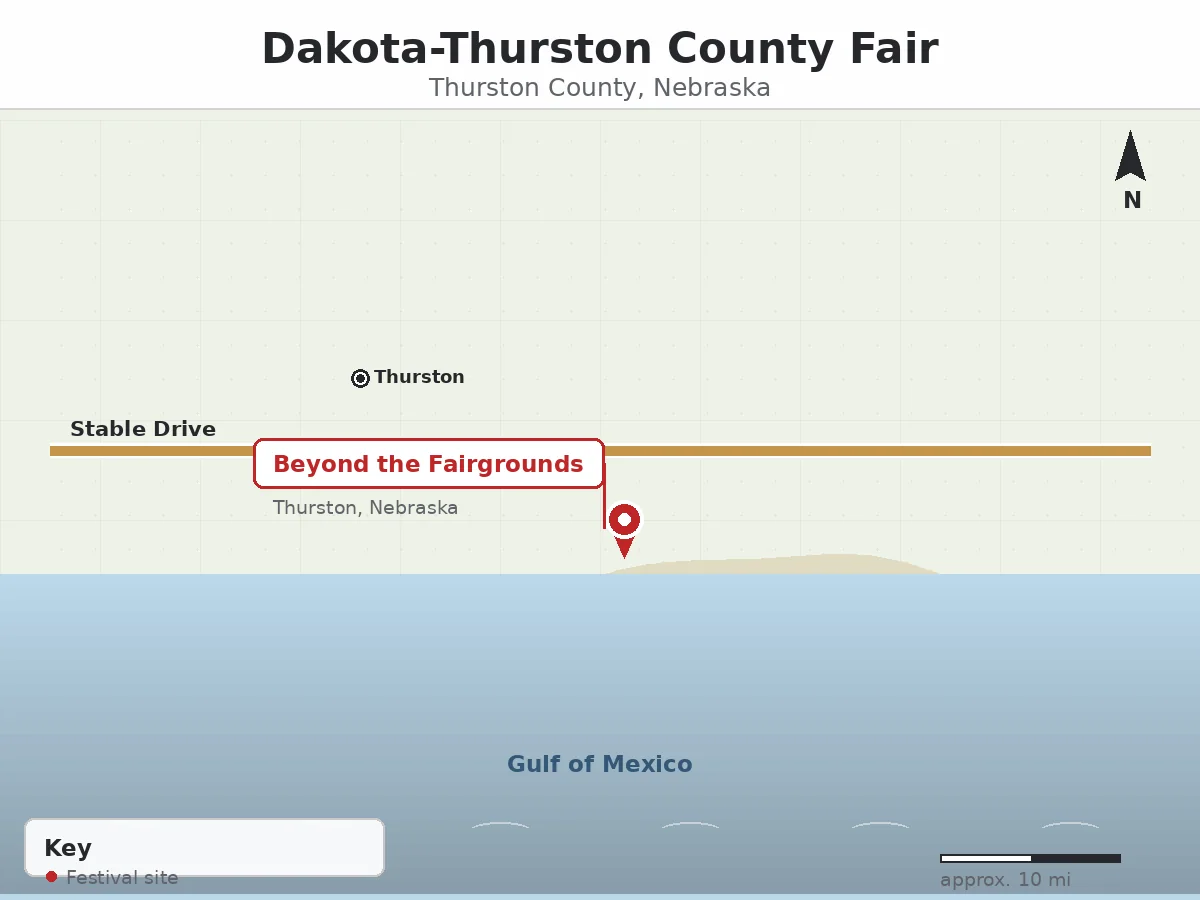
The home county repays attention too. Pender, the seat, is a working courthouse town where the fair’s paperwork lives. Walthill and Macy anchor the county’s Omaha and Winnebago tribal communities, a central fact of Thurston County life offered as county context and no part of the fair’s history. Rosalie, Emerson and the village of Thurston itself supply the small-town map the society’s director list is drawn from. At the far end of the fair trip, South Sioux City adds the Missouri River: Iowa across the water, and riverfront ground to walk before the drive into Nebraska.
What Co-Owning a Fair Gives Thurston County
The partnership’s deepest value to Thurston County is representation that cannot be outvoted by geography. The grounds may stand in Dakota County, but the fair’s book names a Thurston president over a Thurston society, a Thurston vice president in the joint board’s second seat, and a Thurston secretary and treasurer holding the fair manager’s job for the whole event. Thurston exhibitors show under rules their own society co-writes, sell in the same closing auction, and answer to the same release clock as the home county’s families. For a small county, that is the difference between attending someone else’s fair and owning half of one — and the 2026 theme, “Where Traditions Meet,” describes Thurston’s position as accurately as Dakota’s: two traditions, meeting on shared ground, neither one absorbed.
Frequently Asked Questions
Why is Thurston County’s fair held outside the county?
Because the county co-owns a joint fair rather than running a separate one. The Dakota-Thurston County Fair is governed by both counties’ agricultural societies under a shared executive board, and its grounds are at South Sioux City in Dakota County. Thurston County’s role is ownership and government, exercised from across the county line.
Which Thurston County body helps govern the fair?
The Thurston County Agricultural Society, printed in the fair’s own 2026 book with Ray Sanderson as president, Kevin Bonneau as vice president and Mary Paeper as secretary and treasurer. It is a body separate from the Dakota County Agricultural Society — the two are partners under the fair’s Executive Board, never a merged society — and Paeper also serves as the fair’s manager.
Where do Thurston County 4-H families handle entries and questions?
At home first: the Thurston County Extension Office in Pender is the home office for the county’s exhibitors within Nebraska Extension in Dakota & Thurston Counties, the joint unit serving both counties’ 4-H Councils. Entries, questions and fair paperwork for Thurston families begin in Pender, even though the fair itself is in South Sioux City.
When can exhibits go home, and what does leaving early cost?
The fair book sets the release clock for both counties alike: livestock are released at 3:00 in the afternoon or immediately following the Bonus Auction, and static exhibits at 4:00 in the afternoon. Leaving early costs the premium the exhibit earned, because premiums are forfeited on early removal — so exhibitors plan the closing day around the auction and the release times, not around the drive.
What to Expect From the Next Thurston County Nebraska Dakota-Thurston County Fair Festival
How often is the Thurston County Nebraska Dakota-Thurston County Fair Festival held?
The fair is held once every year, in the summer, as a standing joint institution of the two counties. Its government — two societies under one executive board — continues between editions, so each year’s fair renews the partnership rather than starting a new arrangement.
When is the next Thurston County Nebraska Dakota-Thurston County Fair Festival?
Expect the next edition in the window the fair already occupies: late July turning into early August. The 2026 edition ran from July 26 to August 2, and that span is the pattern to plan around rather than a promise of the next dates. Watch the Pender Extension office and the fair’s own announcements for the confirmed days.
Will the dates change?
The season is the dependable part, and the exact days are set edition by edition, so a movement of a few days between years should surprise nobody. What does not change is the arrangement behind the dates: the fair returns to South Sioux City under the same two-county government, and any new span will be published by the fair.
The Dakota-Thurston County Fair asks Thurston County to do something unusual: to own a fair it cannot walk to. The county’s answer, printed in the fair’s own book, is a society with its own officers, a vice president seated on the joint board, a manager running the whole show, and exhibitors who cross the county line to show under rules their own neighbours helped write. From Thurston, the fair is not somewhere else’s event with Thurston entries in it. It is half Thurston’s, and the drive is simply how the county gets to its own fairgrounds.