St. Landry Parish Louisiana Yambilee Festival
Opelousas, the parish seat of Saint Landry Parish, once spent the last full weekend of October honouring the crop that shaped its fields and its tables. The Yambilee Festival, billed in reference layers as the Yambilee Festival and the Louisiana Yambilee Festival, grew out of the local sweet-potato industry and ran for more than six decades before coming to an end in 2012. Its home was the Yambilee Festival Grounds in Opelousas, and its organiser was the Louisiana Yambilee Association. Parades, pageants, rides and yam cookery filled the grounds each October. The festival’s story is a plain one: two friends saw a way to honour the growers and shippers who made the parish known for yams, and a town took up the idea and kept it going year after year. This article gathers what the documented record gives about the celebration — its first gathering in the autumn of 1946, its sixty-first annual edition in 2006, its programme, and the funding and support troubles that brought it to a close — and it keeps the separate Southwest Louisiana Zydeco Festival, which shares the same grounds, apart from it.
About
The Yambilee Festival was Opelousas’s tribute to the sweet potato, a crop the parish grew, shipped and ate with pride. Reference layers bill the event as the Yambilee Festival and as the Louisiana Yambilee Festival, and the sheet title is printed as the event’s name, so the published forms and the sheet title all point at the same gathering. The festival belonged to Opelousas, the parish seat, and it filled the Yambilee Festival Grounds with parades, pageants, rides, music, food and a fine-art exhibition. The Louisiana Yambilee Association organised it, and the event’s rhythm was fixed by the calendar: it opened on the Wednesday of the last full weekend of October and ran through the weekend. That timing put the celebration at the close of the harvest season, when yams were fresh in memory and in the kitchen. The Grand Louisiyam Parade gave the weekend its public centrepiece, and the yam cookery and the Yam-i-mal competition gave it a flavour no other parish gathering could claim. The festival ended in 2012, when funding ran short and public support fell away, and no later edition followed. What remains is the record of a long-running civic celebration and the grounds that still carry its name.
Quick Facts
| Item | Detail |
| Published name | Yambilee Festival, also billed Louisiana Yambilee Festival |
| Host town | Opelousas, parish seat of Saint Landry Parish |
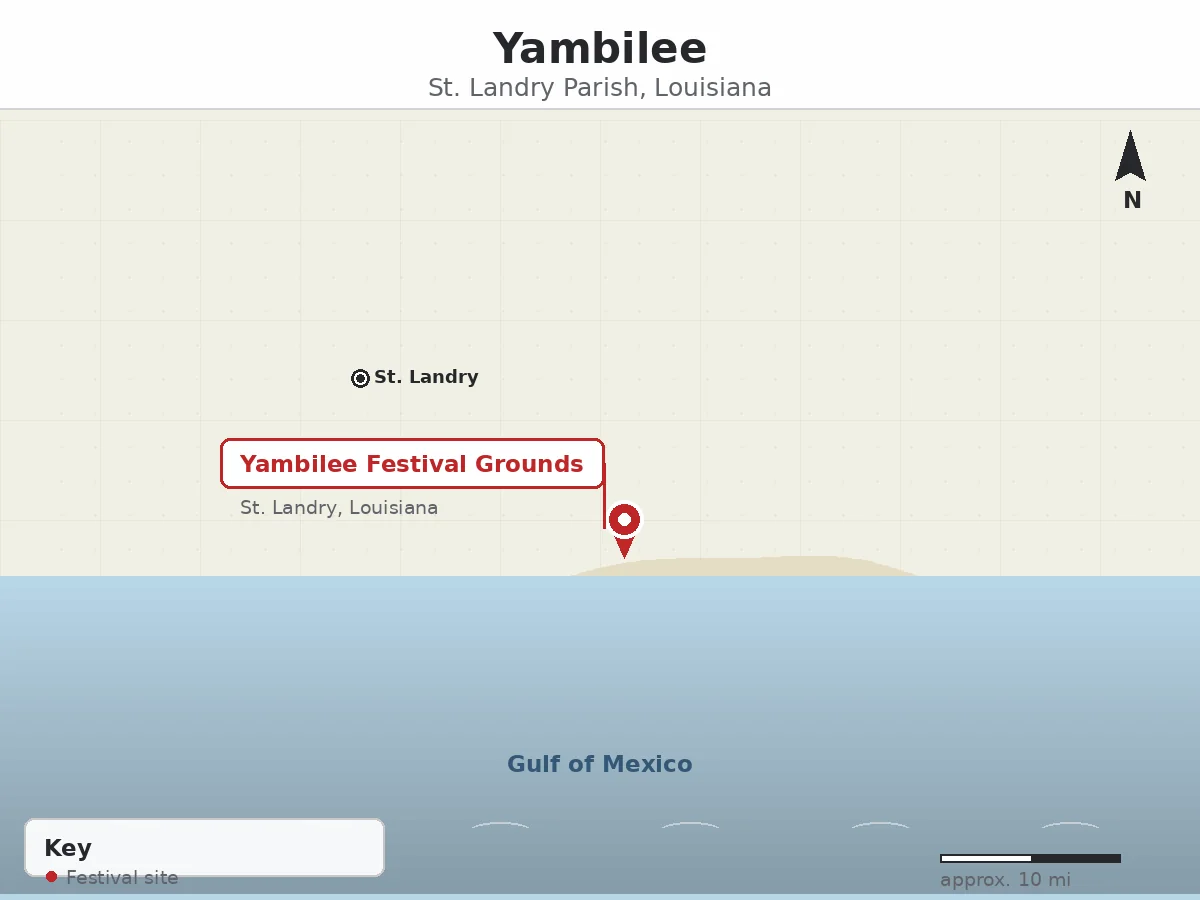
| Venue | Yambilee Festival Grounds in Opelousas |
| Organiser | Louisiana Yambilee Association |
| First celebration | Nine and ten October, nineteen forty-six |
| Sixty-first annual edition | Twenty-eight and twenty-nine October, two thousand six |
| Usual timing | Wednesday of the last full weekend of October through the weekend |
| Status | Discontinued in two thousand twelve |
| Signature programme | Grand Louisiyam Parade, pageants, carnival rides, yam cookery, Yam-i-mal competition, fine-art exhibition |
| Nearby different event | Southwest Louisiana Zydeco Festival, founded nineteen eighty-two, same grounds |
History
Two friends started the Yambilee, and the record keeps them in their roles: one was a native Texan, the other a yam shipper and processor. Together they wanted a public occasion to honour the local sweet-potato industry, the trade that put Opelousas on the map for growers and buyers alike. The Louisiana Yambilee Association took up the work, with a first board of directors steering the new organisation, and the first Louisiana Yambilee celebration took place on the ninth and tenth of October in 1946. From that beginning the festival settled into its October pattern, opening on the Wednesday of the last full weekend of the month and running through the weekend, so that each year’s gathering arrived as the harvest closed. The sixty-first annual edition fell on the twenty-eighth and twenty-ninth of October in 2006, a marker of how long the celebration had endured. The end came in 2012, when the festival was discontinued because funding had run short and public support had fallen away. A celebration that had run since 1946 could not carry on without money and without the backing of the town it served. The grounds in Opelousas still carry the Yambilee name, and the Southwest Louisiana Zydeco Festival, founded in 1982, still uses the same grounds for a different event. The Yambilee itself, though, belongs to the past, and its history is best read as a long run of Octobers in which a parish paused to honour the crop that fed it.
What to Expect
A Yambilee weekend opened with the town turning toward the grounds, where the Grand Louisiyam Parade gave the celebration its loudest and most public hour. Floats, bands and marching groups carried the yam theme through Opelousas, and the parade’s name alone told a visitor what the weekend was about. Pageants followed their own course across the weekend, with crowns and titles marking the festival’s royalty and giving young participants a stage. Carnival rides turned above the grounds for children and for adults who still liked a spin, and music played through the day and into the evening. Food stalls served the parish’s cooking, and the yam cookery contests put the sweet potato at the centre of the table, with cooks showing what the crop could do beyond the familiar baked yam. The Yam-i-mal competition added a note of invention, inviting entries that played with the yam in unexpected ways, and the fine-art exhibition gave painters and makers a quieter corner of the grounds. What the record does give is a picture of a full weekend, rooted in one crop and open to the whole parish.
Planning Your Visit
Because the festival ended in 2012, a visit today means a visit to Opelousas and the grounds rather than to a living event, and the planning starts from that honest footing. Opelousas is the parish seat of Saint Landry Parish, so it is easy to reach and easy to walk, and the Yambilee Festival Grounds sit in the town that hosted the celebration for more than six decades. A traveller who wants to understand the festival should begin with the grounds themselves, then with the town around them, and should keep the dates in mind as history: the last full weekend of October was the festival’s season, and the Wednesday opening set the rhythm of each year’s gathering. The Southwest Louisiana Zydeco Festival uses the same grounds, and it is a different event with its own founding year of 1982, so a visitor should confirm its own arrangements separately rather than assuming anything from the Yambilee’s record. The practical advice is simple: come to Opelousas, walk the grounds, look for the traces of a harvest celebration in the town’s food and markets, and read the festival’s story as the story of a parish that once gathered each October to honour its yams.
For a useful comparison, see the St. Landry Parish Louisiana Cajun Mardi Gras Festival for another county festival.
Sample Itinerary
A festival Saturday, as the record describes the weekend, began with the Grand Louisiyam Parade moving through Opelousas in the morning, the floats and bands setting the tone for the day. After the parade, the grounds filled, and the middle of the day belonged to the yam cookery contests and the Yam-i-mal competition, where visitors could watch cooks work and taste what the sweet potato could become. The afternoon offered a choice: carnival rides for those who wanted motion and noise, or the fine-art exhibition for those who wanted a slower hour among paintings and handmade work. Pageant events ran through the day, and food stalls kept the parish’s cooking close at hand from morning to evening. As the light faded, music took over the grounds, and families stayed for the evening’s entertainment before heading home. The itinerary above follows the programme the layers document, and it keeps the festival’s own order: parade first, cookery at midday, rides and art in the afternoon, music in the evening.
Comparison
The Yambilee and the Southwest Louisiana Zydeco Festival share an address and little else, and the contrast between them shows what the Yambilee was. Both used the Yambilee Festival Grounds in Opelousas, and a visitor standing on the grounds today could mistake one for the other if the name on the gate were the only guide. The difference lies in purpose and in date. The Yambilee began in 1946 as a tribute to the sweet-potato industry, founded by two friends who worked in and around the yam trade, and its signature events were yam cookery and the Yam-i-mal competition. The Zydeco festival was founded in 1982, more than three decades later, and it celebrates music rather than a crop. The Yambilee ran on the Wednesday of the last full weekend of October through the weekend, while the Zydeco festival follows its own calendar, and the two should never be blended into a single story. The Yambilee also differs from a general harvest fair in its single-crop focus: it did not celebrate farming in the abstract, but the yam in particular, with contests and cookery built around one vegetable. That narrow focus was its strength while it lasted, and it is the reason the festival’s name still means something in Opelousas even though the event itself ended in 2012.
Checklist
- Read the festival’s dates as history: the celebration ended in 2012 and no later edition followed.
- Walk the Yambilee Festival Grounds in Opelousas and note the name the grounds still carry.
- Keep the Southwest Louisiana Zydeco Festival separate in any plan — same grounds, different event, founded in 1982.
- Bring an appetite for yam dishes and sweet-potato cookery when sampling parish food.
- Ask in Opelousas about the sweet-potato trade that the festival honoured, and about the growers and shippers behind it.
- Remember that no gate price is documented, so no entry figure should be expected or quoted.
- Look for the fine-art tradition the festival supported, and for the pageant and parade customs it carried.
- Treat the Wednesday opening of the last full weekend of October as the festival’s old rhythm, not a coming date.
Beyond the Festival
Opelousas repays a visit beyond the festival grounds, because the town is the parish seat and the centre of Saint Landry Parish life. Its streets carry the history of a parish built on farming, and the sweet-potato trade that the Yambilee honoured is part of that larger story. A visitor can spend a day walking the town, eating in its restaurants, and getting a sense of how a Louisiana parish seat holds together its markets, its churches and its civic buildings. The parish around Opelousas is farm country, and the yam fields that fed the festival’s cookery contests are the same fields that still shape the landscape. The Yambilee’s end in 2012 did not end the parish’s farming, and the crop it celebrated is still grown and eaten across the region. The festival is gone, but the parish it honoured is still there, and a visit to Opelousas is the nearest way to understand what the celebration meant.
Significance
The Yambilee mattered because it gave a farming parish a public way to honour its own work. Sweet potatoes were not a novelty in Saint Landry Parish; they were a livelihood, and the festival turned that livelihood into a civic occasion, with parades, pageants and cookery contests that said the crop was worth celebrating. Two friends saw that possibility in 1946, and the town kept it alive for more than six decades, which is a long life for any local festival. The celebration also mattered as a gathering place: growers, shippers, cooks, children and visitors met on the same grounds. Its end in 2012 matters too, as a reminder that local celebrations depend on funding and on public support, and that both can run out even for an event with a long history. The grounds keep the Yambilee name, and the Zydeco festival keeps the grounds in use, but the yam celebration itself now lives only in the record. That record is worth keeping, because it shows a parish that once paused each October to honour the crop that fed it, and to do so together.
Frequently Asked Questions
Why did the Yambilee come to an end?
The festival was discontinued in 2012 because funding had run short and public support had fallen away. Reference layers give both reasons together, and the celebration did not return after that year.
What put the yam at the centre of the celebration?
The festival was founded to honour the local sweet-potato industry, the trade of growing, shipping and cooking yams in Saint Landry Parish. Its signature events were yam cookery contests and the Yam-i-mal competition, both built around the one crop.
Did another festival share the Yambilee grounds?
Yes, and it still does. The Southwest Louisiana Zydeco Festival, founded in 1982, is held on the same Yambilee Festival Grounds in Opelousas, but it is a different event with its own purpose, celebrating music rather than the yam harvest.
What did a festival day feel like for a family?
A Saturday began with the Grand Louisiyam Parade, moved into yam cookery and the Yam-i-mal competition at midday, offered carnival rides and the fine-art exhibition in the afternoon, and closed with music in the evening, with food stalls close at hand throughout the day.
What to Expect From the Next St. Landry Parish Louisiana Yambilee Festival
How often is St. Landry Parish Louisiana Yambilee Festival held?
In its running years the celebration returned each October, opening on the Wednesday of the last full weekend of the month and running through the weekend. It no longer runs, having been discontinued in 2012.
When is the next St. Landry Parish Louisiana Yambilee Festival?
There is no next edition on the calendar. The festival ended in 2012, and the material consulted gives no later gathering, so no future date can be offered.
Will the dates change?
Nothing remains to move. The festival’s old rhythm was the Wednesday of the last full weekend of October, and that pattern belongs to its history now that the celebration has ended.
The Yambilee Festival ran from the autumn of 1946 to the autumn of 2012, and in that long stretch it did something simple and rare: it gathered a parish around the crop that fed it, and it did so with parades, pageants, cookery and music rather than with speeches. Opelousas still holds the grounds, and the parish still grows the yams, but the October weekend that once brought them together has passed into the record. What the record keeps is worth the reading — a celebration founded by two friends, carried by a town for more than six decades, and ended when funding and support ran out. The festival’s name endures on the grounds it once filled, and its story endures as a reminder of how a local harvest, honoured well, can become a town’s own occasion.