Seneca County New York Fair Festival
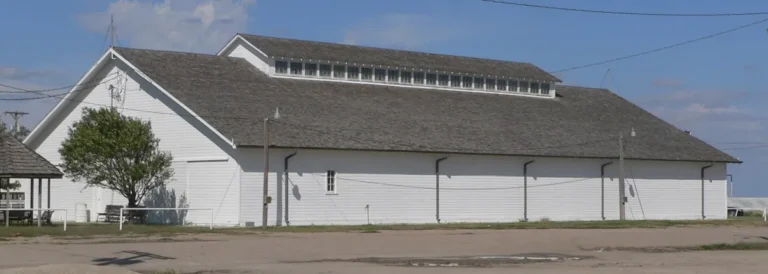
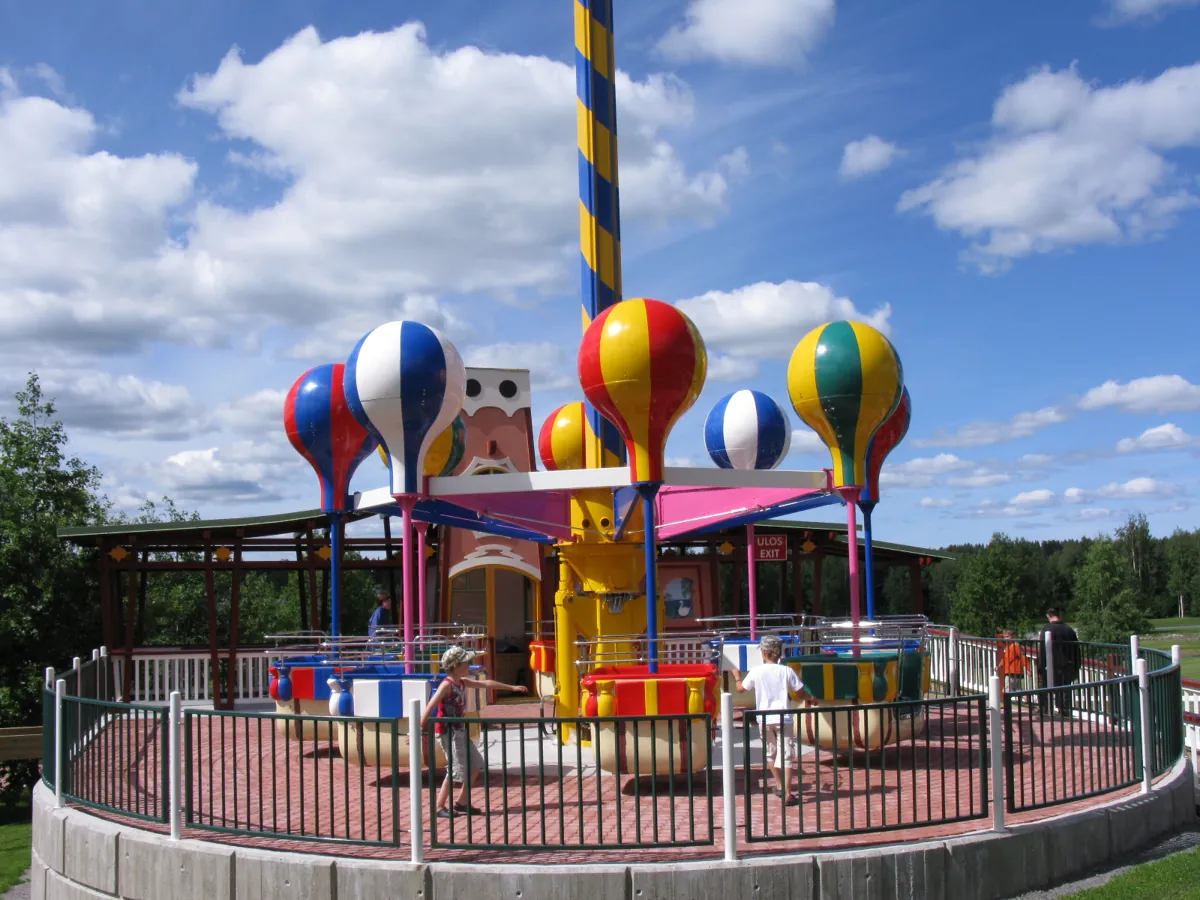
The Seneca County Fair comes with a civics lesson built in, because Seneca County keeps two county seats instead of one. Waterloo and Ovid have shared that status since 1822, and Waterloo — the primary seat, where most county offices sit — hosts the fair at the Seneca County Fairgrounds on Swift Street. Ovid, the other seat, does not host the modern event at all. Across four days, Wednesday to Saturday in the third week of July, the grounds fill with livestock shows, exhibition halls, a midway and two demolition derbies. Walking through the gate costs nothing: the Society announces free admission as its own published position. Spending sits at the edges — paid parking whose price the fair nowhere publishes, grandstand seats for the derbies, and a pay-one-price midway wristband.
A Society-Run Fair in a Two-Seat County
The Seneca County Agricultural Society presents and runs this fair as a not-for-profit organisation, the operator named by the fair’s own premium book and the state fairs directory alike. County government does not organise the event. Cornell Cooperative Extension, 4-H, the FFA and the Grange appear inside the programme as exhibitors and display partners, yet none of them operates the fair. The Society’s stated purpose pairs running the fair with agricultural education for the public.
Place matters here more than at most fairs. Seneca Falls is the county’s largest community in reference listings, but it is neither a seat nor the fair’s town. The fair’s own rules fix the gathering at Waterloo during the third week of July, on grounds at the corner of Swift Street and North Road. Its post office box is a mailing address only.
Quick Facts
| Detail | What the record shows |
| Event | Seneca County Fair |
| Organiser | Seneca County Agricultural Society, a not-for-profit organisation |
| Fairgrounds | Seneca County Fairgrounds, 100 Swift Street, Waterloo, at North Road |
| Host community | Waterloo, which also serves as the primary county seat |
| County seats | Two — Waterloo and Ovid, an arrangement dating to 1822 |
| Fair week | Four days, Wednesday to Saturday, in the third week of July |
| 2026 edition | July 15 to 18, billed by the fair as its 182nd Annual |
| Admission | Free to the fairgrounds, in the fair’s own published words |
| Parking | Paid parking offered; no price published anywhere |
| Camping | No camping offer appears in the fair’s published record |
An 1841 Billing and a Story Told Two Ways
The fair bills itself as established in 1841, and the 2026 edition carries the billing of the 182nd Annual. Both figures are the fair’s own billing — not a founding date verified here, and no edition number can be derived from them by arithmetic. One secondary listing gives 1843 instead, which conflicts with the fair’s own line and is not followed.
The longer narrative comes from local newspaper history rather than the Society’s publications, and should be read as that account. In that telling, the first fair was held in October 1841 in Ovid, taking in two hundred seventy-nine dollars. The fair moved to Waterloo in 1842, the Society reorganised in 1856, and the event alternated between the seats before settling permanently in Waterloo in 1870; the same account has the grounds bought from William Burton in 1882 for six thousand dollars. Those histories also record years the fair did not run — 1941, 1942 and 1945, plus the pandemic year — which is why the published billings, 176th in 2019, 179th in 2023, 180th in 2024 and 182nd in 2026, stand as a sequence of billings, never a reconciled count.
For a useful comparison, see the Schuyler County New York Watkins Glen Grand Prix Festival for another county festival.
What to Expect
Livestock Shows Carry the Four Days
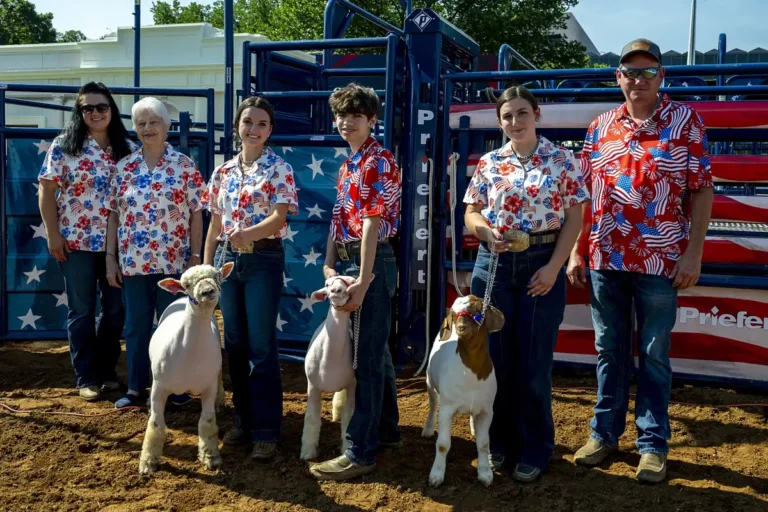
Each day of the 2026 fair carried its own theme — Opening Day on Wednesday, Small Animal Day on Thursday, Dairy Day on Friday, and Kids Day and Beef Day sharing Saturday. The barns followed that rhythm: Thursday brought the youth and open swine and sheep shows; Friday centred on dairy cattle and working steer and oxen; Saturday closed with beef cattle at noon. Horses worked the arena across the week — trail challenge Thursday, barrel racing Friday, the full horse show Saturday morning. One absence deserves stating plainly: the 2026 book heads its poultry department with a notice of no poultry show or competition this year.
Floral Hall and the Free Everyday Layer
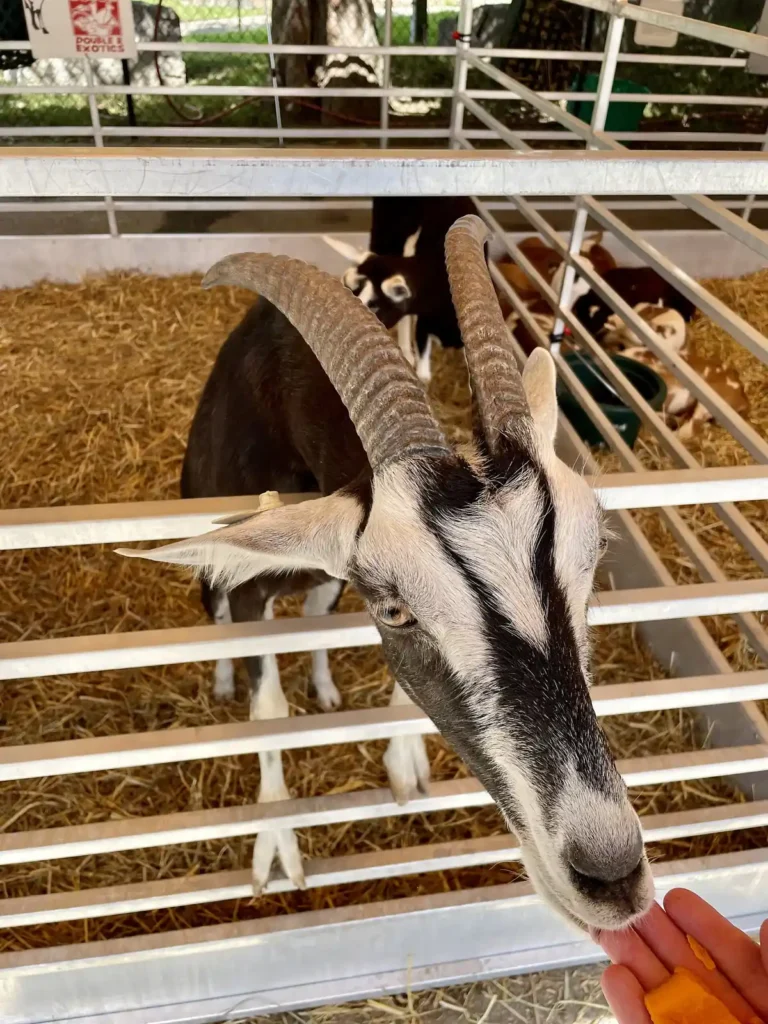
Floral Hall is the fair’s indoor heart, holding open creative arts alongside Grange and FFA exhibits and an antique farm display. A display about the old Maple Grove Speedway sits in the hall too — display only, since no speedway racing forms part of the fair, and the directory records no harness racing here either. The published everyday layer lists the midway, an artist lounge, a tractor club display, a petting zoo, a butterfly encounter with a strolling princess, and a mechanical bull challenge running Wednesday through Saturday. Food stands include a dairy bar staffed by Waterloo Girl Scouts, and radio-controlled cars race at the RC derby inside Floral Hall on Thursday evening.
Grandstand Nights Built Around Demolition
The grandstand programme leans hard on demolition. Wednesday’s derby opens with a Power Wheels derby for children before lawnmowers, figure-eight cars, four- and six-cylinder classes, a junk run and a chain-and-bang class for newer eight-cylinder cars take their turns. Saturday answers with a four-cylinder championship, another chain-and-bang round and one-and-done stock and pro stock eight-cylinder heats. Between those bookends, Thursday brings a garden tractor pull and Friday three freestyle motocross performances — both marked free in the fair’s own book.
Bands, Fireworks and a Saturday Prize Drawing
Evening music plays from a portable stage: a country band holds Thursday night and a variety band takes Friday, each listed as free. Friday closes with fireworks at half past nine, sponsored by a local landfill company. Saturday’s family anchor is the Kids Prize Drawing in the late afternoon; the winner must be present to collect. The pattern holds throughout — a generous free layer daily, charges gathering around seats, pits and rides rather than the gate.
Planning Your Visit
Finding Swift Street and Parking the Car
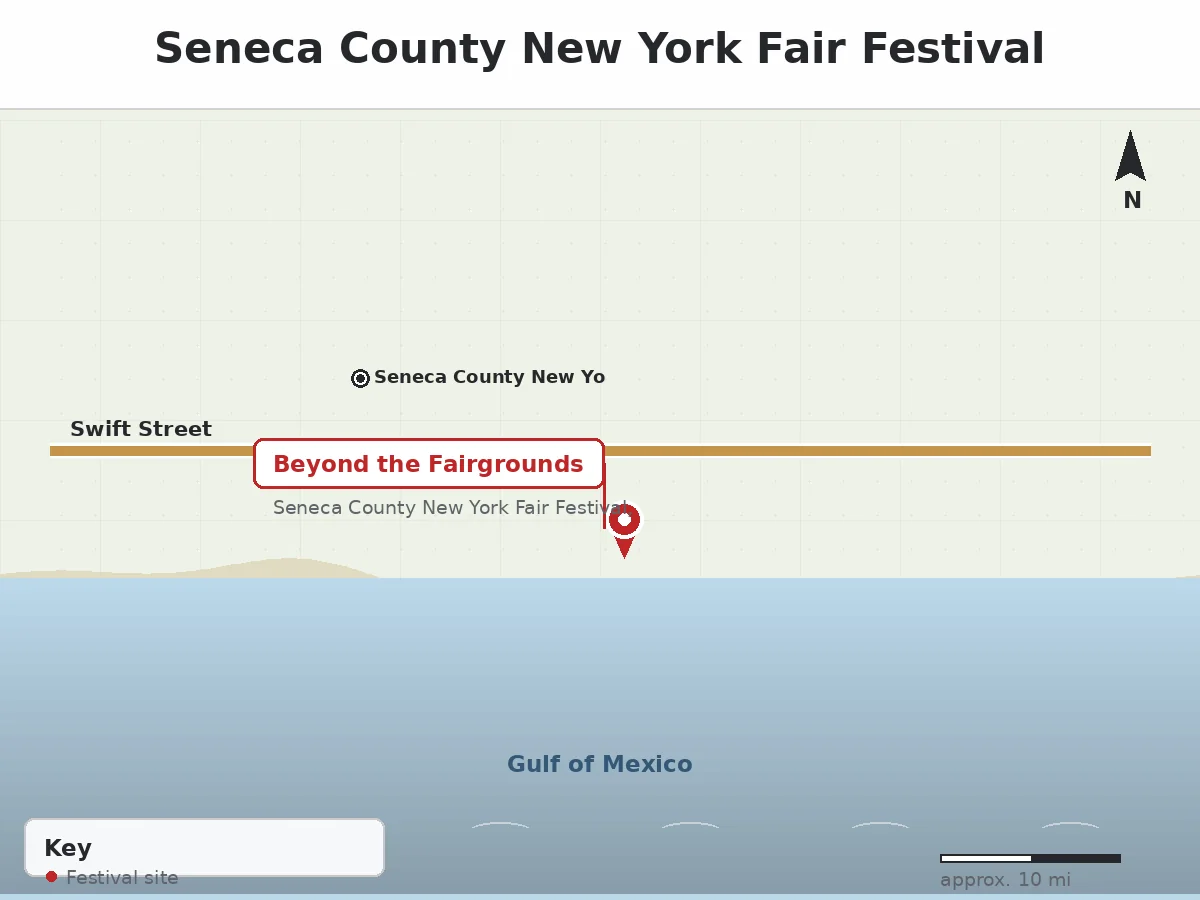
Aim for the corner of Swift Street and North Road in Waterloo, where the fairgrounds stand at 100 Swift Street. Paid parking is available, in the fair’s own words — but the amount is published nowhere in the fair’s site, book or state listings. So carry money for parking; no figure will be invented here. The rules also require vehicles to park only in spaces the management designates, so expect directed parking. Exhibit intake happens the Monday and Tuesday before opening, and the Sunday after closing is clean-up day — neither is a public fair day.
Budgeting Beyond the Free Gate
Free admission covers the grounds, Floral Hall, the portable-stage bands, the tractor pull and the motocross shows. The clearest charge in the 2026 book is the demolition derby grandstand: fifteen dollars per person for all ages, lap children free. The pits sit behind a separate fence of prices — thirty-five dollars for a car and driver, ten dollars for each extra car by the same driver, and twenty-five dollars per person entering, where nobody under eighteen is admitted and a pit pass buys no grandstand entry. Rides run on a thirty-dollar pay-one-price wristband, sold for evening windows Wednesday to Friday and from early afternoon Saturday. Older documents carry older numbers — a 2017 preview lists pit passes at twenty-five dollars and a rodeo at ten dollars in advance or twelve on the day, and a 2024 schedule prices a Friday rodeo at twenty dollars per adult and ten dollars per child — but each figure belongs to its own year’s paper and none prices the current fair.
A Sample Saturday on Kids Day and Beef Day
Arrive for the horse show at nine, then drift through Floral Hall while the displays are still quiet. Take the beef cattle show at noon as the centrepiece; let the wristband window from one o’clock carry the afternoon, with the petting zoo and butterfly encounter filling gaps. Be near the stage before five for the Kids Prize Drawing — the winner must be standing there to win — and finish with the Saturday demolition derby at half past six, grandstand ticket in hand.
Dogs, Camping and the Day-Trip Shape of This Fair
Two rules shape the visit. The fair’s own regulations state that no dogs are allowed on the fairgrounds, so pets stay home. And no camping offer appears in the published record — no campsite terms, no nightly rate — so plan a day trip and arrange overnight stays elsewhere. Anyone reading about families camping at a Seneca County Fair has found the Tiffin, Ohio fair — a different event entirely, as the comparison below explains.
Not the Ohio Fair, Not an Ovid Fair
Seneca County, Ohio runs its own county fair at Tiffin, under its own society, on its own dates — a genuinely separate event sharing only a name. Its programme, prices and camping belong to Ohio; the Waterloo fair publishes no camping at all, the quickest way to tell the two apart in search results. Within New York the comparison is historical: Ovid hosted the first fair in the newspaper account and shared it in alternating years long ago, yet hosts nothing today, and Seneca Falls has never been this fair’s town in the record. Neighbouring Finger Lakes counties run their own fairs under their own societies, and none of their figures should be borrowed to fill this fair’s gaps.
A Waterloo Fair Checklist
- Confirm the year’s exact dates against the Society’s own announcements before travelling
- Carry payment for parking, since the fair publishes no parking price in advance
- Set aside fifteen dollars per person if the demolition derby grandstand is on your list
- Check the wristband windows before promising children an afternoon of rides
- Leave dogs at home, because the fair’s rules bar them from the grounds entirely
- Plan the trip as a day visit, as no camping is offered in the fair’s record
- Anchor the visit to one livestock day theme — small animal, dairy or beef
- Keep Saturday’s prize drawing in mind, since the winner must be present to collect
Beyond the Fairgrounds
Waterloo rewards a slower look once the derby noise fades. It is the primary seat of a county that has kept two seats since 1822: courthouse functions live here, while Ovid, a short drive south, keeps its own historic courthouse complex from the same dual-seat history. That arrangement explains the fair’s past — it began in Ovid in the old accounts precisely because Ovid shared the county’s civic standing. Seneca Falls, the county’s largest community, makes a separate day out under its own name and should never be confused with the fair’s home. Treat the two seats as the frame: the fair in Waterloo, the history split between them, the rest of the county a bonus rather than a substitute.
Why This Fair Matters to Seneca County
A free gate is a civic statement as much as a pricing decision, and at Waterloo it is a long-standing one, recorded across many recent years of local coverage and in the fair’s own announcement. Keeping the grounds free puts the emphasis where the Society’s mission puts it — agricultural education, and grounds filled without a ticket barrier between neighbours. The derbies give the fair its roar; the youth and open livestock shows give it its purpose. In a county with two seats, the fair also settles an old question every July: the whole county gathers in one place, and that place is Waterloo.
Frequently Asked Questions
Is admission to the Seneca County Fair genuinely free?
Yes, for the fairgrounds themselves — the Society’s own site announces free admission in those terms, with paid parking available for all four days. What it does not cover is the parking, whose price the fair publishes nowhere, the fifteen-dollar demolition derby grandstand seats, the separate pit charges, and the thirty-dollar midway wristband. The honest summary is a free gate with paid extras.
Why do some sources place this fair in Ovid, Seneca Falls or Ohio?
Each confusion has a different root. Ovid is the county’s other seat and, in the newspaper history, where the first fair was held in 1841 and a sometime alternating host — a historical role, never the present one. Seneca Falls is simply the largest community, and size gets mistaken for hosting. Ohio is a separate trap: Tiffin hosts a different state and county’s fair. The fair’s own rules settle it — the event is held at Waterloo.
Can visitors camp at the fairgrounds or bring a dog along?
The published record allows neither. The regulations bar dogs from the grounds outright, with no exception printed. Camping differs only in that nothing is said at all: no camping section, form, fee or campsite term appears in the book or listings, so no camping may be assumed or priced from this record. Visitors needing a bed should book one away from the fairgrounds.
Will there be a rodeo, donkey basketball or a poultry show?
Not in the current record. The 2026 premium book contains no rodeo and no donkey basketball, and its poultry department is expressly headed as carrying no poultry show or competition. Those events belong to earlier years’ coverage — a rodeo was priced in the 2024 schedule — and carrying them forward would misdescribe this edition. The state directory also records no harness racing here.
What to Expect From the Next Seneca County New York Fair Festival
How often is the Seneca County New York Fair Festival held?
The fair returns once every year. Its own rules state the rhythm plainly: the Seneca County Fair takes place at Waterloo, New York, during the third week of July, running four days from Wednesday to Saturday. That standing rule, not any single year’s poster, fixes the event’s place in the calendar.
When is the next Seneca County New York Fair Festival?
By the fair’s own standing rule, the next edition falls in the third week of July following the most recent fair, again Wednesday to Saturday at the Waterloo fairgrounds. The Society publishes exact dates in its own announcements and premium book as each year approaches; those dates are the Society’s to release and should be taken from its pages, not assumed from the pattern.
Will the dates change?
The fair’s own rules allow postponement or cancellation for weighty causes — the rule names war, acts of God and government regulations — and history records occasional years when no fair ran. Within that allowance, the third week of July is the settled home in every modern layer, so the week is dependable even though precise dates are confirmed year by year.
The Seneca County Fair asks little of its visitors — no gate money, no camping arrangements, no dog in tow — and gives back four dense days of livestock, exhibits and demolition smoke. In a two-seat county, it remains the one appointment the whole county keeps in the same place: Waterloo, third week of July, every year the rules allow.