Orleans Parish Louisiana Greek Festival
For one long weekend near the end of May, a quiet cathedral corner of New Orleans turns into a small piece of Greece. Lamb turns on a spit on the grounds of Holy Trinity Greek Orthodox Cathedral, a bouzouki line rises from a stage, dancers in embroidered costumes step through a circle while onlookers clap the rhythm, and families settle at long tables with plates of pastitsio and baklava. The New Orleans Greek Festival, also billed as the Greek Festival of New Orleans, is one of the city’s most loved neighbourhood gatherings, where the Greek community opens its doors and invites everyone else to pull up a chair.

About
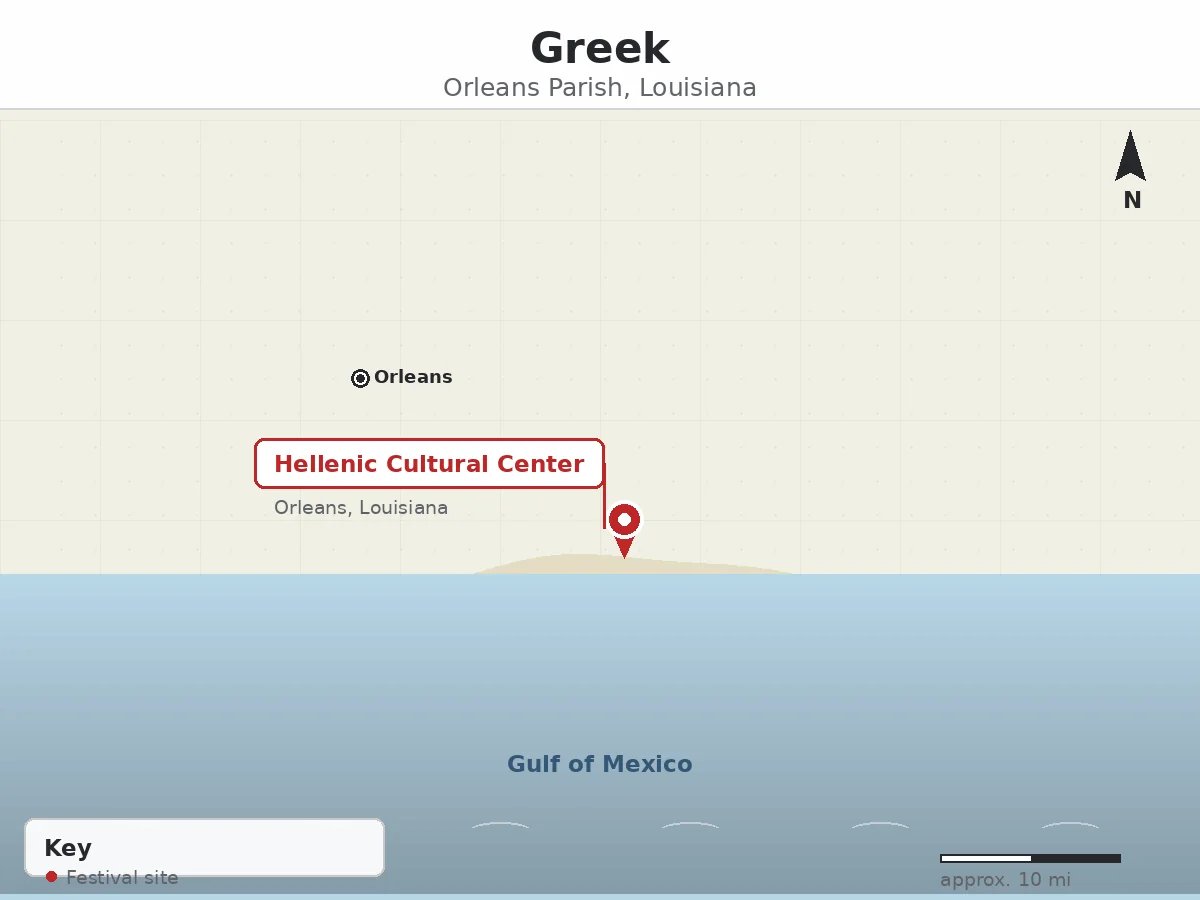
The Orleans Parish Louisiana Greek Festival is a Greek cultural festival hosted by Holy Trinity Greek Orthodox Cathedral in New Orleans, the parish seat of Orleans Parish. It takes place on the cathedral grounds and inside its Hellenic Cultural Center, on the banks of Bayou Saint John, in a residential neighbourhood away from the crowds of the French Quarter. The cathedral community organises the gathering, and parish volunteers cook, serve, dance and staff the booths. The published names for the event are “New Orleans Greek Festival” and “Greek Festival of New Orleans”, and the sheet title is printed as the event’s name in the layers read.
The festival runs from Friday through Sunday, with a soft opening on Thursday in some years. The most recent dated editions are Friday 22 May through Sunday 24 May 2026, billed the 51st annual festival; Friday 23 May through Sunday 25 May 2025, billed its 50th anniversary; Friday 24 May through Sunday 26 May 2024, billed the 49th annual festival; and 23–26 May 2019, billed the 46th annual festival. The timing sits beside the Memorial Day weekend. One travel-guide layer calls the gathering a Memorial Day weekend tradition since 1973, while a festival-guide layer says it was founded in 1974. Both accounts are recorded here as printed, unmerged, and no single founding year is settled in this article.
Visitors find a full weekend of Greek food, traditional dancing, live music, cultural exhibits, a Greek Festival 5K Run/Walk and a Toga Contest on Sunday. Food booths serve parish recipes: lamb and chicken souvlaki, gyros, pastitsio, moussaka, spanakopita, dolmades, Greek salads, loukoumades and baklava. Dance troupes perform through the weekend, and visitors are often drawn into the circle for a syrtos or a hasapiko. Inside the Hellenic Cultural Center, exhibits explain Greek history, faith and art. The festival is a fundraiser for the cathedral community and a homecoming for Greek families across the region.
Quick Facts
| Detail | Information |
| Festival name | Orleans Parish Louisiana Greek Festival |
| Published names | New Orleans Greek Festival; Greek Festival of New Orleans |
| Host town | New Orleans, parish seat of Orleans Parish |
| Venue | Holy Trinity Greek Orthodox Cathedral and Hellenic Cultural Center, on the banks of Bayou Saint John |
| Organiser | Holy Trinity Greek Orthodox Cathedral |
| Most recent edition | Friday 22 May through Sunday 24 May 2026, billed the 51st annual festival |
| Previous editions | Friday 23 May through Sunday 25 May 2025, billed its 50th anniversary; Friday 24 May through Sunday 26 May 2024, billed the 49th annual festival |
| Programme highlights | Greek food, traditional dancing, live music, cultural exhibits, Greek Festival 5K Run/Walk, Toga Contest on Sunday |
| Admission | Eight dollars Friday through Sunday in the 2019 edition, with a five-dollar Thursday soft opening; no current gate price documented |
| Season | Late May, beside the Memorial Day weekend |
History
The history of the festival is told in more than one way in the layers read, and this article keeps those accounts side by side. A travel-guide layer calls the gathering a Memorial Day weekend tradition since 1973. A festival-guide layer says it was founded in 1974. The annual billings printed in the record run 46th in 2019, 49th in 2024, 50th in 2025 and 51st in 2026, and those billings are carried here exactly as printed. No founding year is derived from the arithmetic of those billings, and the two origin accounts are left unmerged.
For a useful comparison, see the Orleans Parish Louisiana Gentilly Festival for another county festival.
The festival grew out of the Greek community centred on Holy Trinity Greek Orthodox Cathedral. Greek families settled in New Orleans across the nineteenth and twentieth centuries, working as merchants, sailors, restaurateurs and tradespeople, and the cathedral became the centre of that community’s religious and social life. A church festival built around food, music and dance was a natural way for the parish to raise funds and share its culture with neighbours. Early editions were smaller, and the festival lengthened over the years to a full weekend with a Thursday soft opening in some years.
By 2019 the festival was billed the 46th annual festival and ran from 23 May through 26 May, a four-day span that included the Thursday opening. The 2024 edition, billed the 49th annual festival, ran Friday 24 May through Sunday 26 May. The 2025 edition, billed its 50th anniversary, ran Friday 23 May through Sunday 25 May, and the 2026 edition, billed the 51st annual festival, ran Friday 22 May through Sunday 24 May. The golden anniversary in 2025 drew particular attention as a milestone for a gathering that began as a parish fundraiser and grew into a citywide date on the calendar.
One claim in the record is set aside entirely. A content-farm layer places a first festival in 1984, and that claim is disowned here: it does not agree with the billings or with the other layers. The Greek Festival in Baton Rouge is a different city’s event, hosted by a different cathedral, and it is fenced out of this article as well.
What to Expect
Arriving at the cathedral grounds, the first thing most visitors notice is the food. Long lines form at the booths, and the lines move with the unhurried confidence of people who know the food is worth the wait. Souvlaki comes off the grill in generous portions, gyros are wrapped to order, and trays of pastitsio and moussaka go out in steady rotation. The pastry table is its own destination: baklava layered with honey and walnuts, loukoumades dusted and dripping, and koulourakia for the walk home. Greek beer and wine are poured beside the food booths, and a coffee stand serves thick Greek coffee.
Music and dancing run through the weekend. A stage carries live bands playing Greek folk music and modern Greek songs, and dance troupes in traditional dress perform sets that move from slow, stately circles to fast, foot-stamping lines. Dancers step down from the stage and invite visitors to join, and the circle grows to include children, grandparents and first-timers who learn the steps as they go.
Inside the Hellenic Cultural Center, the festival slows down. Exhibits present Greek history, Orthodox iconography, language and art, and docents answer questions from visitors. Vendors sell imported olive oil, ceramics, jewellery, icons, books and textiles. The Greek Festival 5K Run/Walk draws runners and walkers through the surrounding neighbourhood in the morning. On Sunday, the Toga Contest brings out the festival’s playful side, with entrants draping bedsheets into togas and competing for the crowd’s applause.
Planning Your Visit
The festival is held in late May beside the Memorial Day weekend, and the most recent edition ran Friday through Sunday. Hours in the recent editions have run from late morning into the evening, with the fullest crowds on Saturday afternoon and Sunday. Arriving early on Friday or in the first hour on Saturday is the easiest way to eat without a long wait. Sunday carries the Toga Contest and a slightly slower pace, which suits families with young children.
Admission is fenced carefully in the record. In the 2019 edition, admission was eight dollars Friday through Sunday, with a five-dollar Thursday soft opening, according to a city magazine layer. A 2016 blog layer records free Sunday entry for toga wearers, and that detail belongs to that layer and that year alone. No current gate price is documented in the layers read, so visitors should check the cathedral’s own announcements before travelling and bring cash as well as cards, since some booths have taken cash only in past years.
The venue sits in a residential neighbourhood on the banks of Bayou Saint John, and parking in the surrounding streets fills quickly on Saturday. Rideshare drop-off and public transit are sensible choices, and the grounds are flat and walkable, with shade under the trees and tents. May in New Orleans is warm and humid, so light clothing, sunscreen, a hat and water are worth carrying. For food, pace yourself: portions are generous and the menu is wide, so sharing plates across a group is the best way to taste souvlaki, pastitsio, spanakopita and baklava in one visit.
Sample Itinerary
A first-time visitor can cover the festival well in a single Saturday. Arrive in the late morning, just as the food booths open fully, and start with a gyro or a souvlaki plate while the lines are still short. Eat at a table under the trees and watch the first dance set. After lunch, walk through the Hellenic Cultural Center, where the exhibits give the food and music context, and spend time with the vendors. In the mid-afternoon, catch a full dance performance and join the circle if a dancer invites you in, then work through the pastry table: baklava first, loukoumades second, and a Greek coffee to finish. On Sunday, arrive in time for the Toga Contest and use the slower pace to revisit any booth you missed.
Comparison
New Orleans hosts a long run of neighbourhood food festivals through the spring, and the Greek Festival holds a distinct place among them. The French Quarter festivals draw the largest crowds and the widest mix of visitors, with multiple stages and a downtown footprint that can feel overwhelming. The Greek Festival is smaller and more rooted in one community, and that is its strength: the cooks are parish volunteers working from family recipes, the dancers are community members rather than hired acts, and the cultural center gives the weekend an educational thread. Compared with the city’s big music festivals, the Greek Festival is gentler on the feet and the wallet. There is no single headliner to chase and no vast field to cross; everything sits within a short walk on the cathedral grounds.
Checklist
- Check the cathedral’s own announcements for the current year’s dates and gate price before travelling.
- Arrive early on Friday or in the first hour on Saturday to eat before the longest lines form.
- Bring cash as well as cards, since some booths have taken cash only in past years.
- Wear light clothing, sunscreen and a hat, and carry water; May in New Orleans is warm and humid.
- Wear comfortable shoes for walking between the food booths, the stage and the cultural center.
- Share plates across your group to taste souvlaki, pastitsio, spanakopita and baklava in one visit.
- Visit the Hellenic Cultural Center exhibits early.
- Plan a meeting point if children in your group drift toward the games and the music.
- Allow time on Sunday for the Toga Contest, the weekend’s lightest hour.
- Use rideshare or public transit, since street parking fills quickly on Saturday.
Beyond the Festival
The cathedral grounds sit on the banks of Bayou Saint John, and the bayou itself is worth a walk before or after the festival. The waterway runs through a green corridor of the city, and it gives the festival its setting: a neighbourhood gathering beside the water rather than a downtown event on closed streets. A weekend built around the festival leaves room for the wider city: the French Quarter is a short drive away, and the New Orleans Jazz Museum at the Old U.S. Mint offers a deeper look at the city’s musical history.
Significance
The significance of the festival is not measured in crowd size or in headlines. It is measured in continuity. A parish community has cooked, danced and sung together on the same grounds for more than five decades, and each year it opens that gathering to the whole city. A festival that reaches its 50th anniversary and then its 51st is a quiet achievement. Greek culture in New Orleans is small in numbers but long in history, and the festival is the one weekend a year when that culture is on full display for neighbours who might otherwise never taste pastitsio or hear a bouzouki. Children of the parish learn the dances and the recipes by working the booths beside their parents and grandparents, so the festival is also a classroom, where the next generation picks up the traditions by doing them.
Frequently Asked Questions
When does the Orleans Parish Louisiana Greek Festival usually take place?
The festival is held in late May, beside the Memorial Day weekend. The most recent edition ran Friday 22 May through Sunday 24 May 2026, billed the 51st annual festival, and the 2025 edition ran Friday 23 May through Sunday 25 May 2025.
What dishes should a first-time visitor try at the festival?
Start with a souvlaki plate or a gyro, then try pastitsio or moussaka, spanakopita and dolmades. Finish at the pastry table with baklava and loukoumades, sharing plates across your group to taste widely in one visit.
How do families with small children spend the day at the festival?
The grounds include children’s activities and games, the dance circle welcomes young visitors, and the Sunday Toga Contest is a family favourite. The Hellenic Cultural Center exhibits give older children something to explore between meals.
Does the festival charge for entry, and what did it cost in past years?
In the 2019 edition, admission was eight dollars Friday through Sunday, with a five-dollar Thursday soft opening, according to a city magazine layer. No current gate price is documented in the layers read, so visitors should check the cathedral’s own announcements before travelling.
What to Expect From the Next Orleans Parish Louisiana Greek Festival
How often is Orleans Parish Louisiana Greek Festival held?
The festival is an annual late-May gathering, held once each year beside the Memorial Day weekend. The record shows consecutive annual editions in 2024, 2025 and 2026, billed the 49th, 50th and 51st annual festivals.
When is the next Orleans Parish Louisiana Greek Festival?
The most recent edition in the record ran Friday 22 May through Sunday 24 May 2026, billed the 51st annual festival. A following edition would fall in the same late-May window, but no later edition is documented in the layers read, so visitors should watch the cathedral’s own announcements for the confirmed dates.
Will the dates change?
The late-May timing has held steady across the recent editions, with Friday-through-Sunday runs in 2024, 2025 and 2026, so a similar window is the reasonable expectation. The festival has shifted its span before, running four days with a Thursday soft opening in 2019, so check the confirmed dates before travelling.
For a city that celebrates almost everything, the Orleans Parish Louisiana Greek Festival stands out by celebrating one community well. Visitors leave with a full plate, a few Greek words, and a sense of having been welcomed into something that belongs to a neighbourhood.