Livingston County Kentucky Bluegrass, Brew and BBQ Fest Festival
Grand Rivers, a small town in Livingston County, Kentucky, closes out April each year with a weekend built from three ingredients its name keeps repeating: bluegrass music, brewed drinks and barbecue. The gathering fills Little Lake Park across two days, pairing a band lineup with food, craft and brew vendors, and it has become the anchor of the town’s spring calendar. Travel-magazine layers describe it as the biggest annual event Grand Rivers holds, a characterisation the town’s own tourism calendar supports by placing it in its own slot on the last weekend of April.
One naming caution runs through everything written about this festival. No source consulted prints the wording of the title above exactly as it stands. The organiser’s own page, maintained by the Grand Rivers town tourism body, calls the event the “Bluegrass, Brew, & BBQ Festival”. Festival guide layers shorten that to “Bluegrass, Brew and BBQ Fest”, while travel-magazine layers settle on “Bluegrass, Brew, and BBQ Festival”. Those three printings name one and the same Grand Rivers weekend, and this article keeps them separate rather than merging them.
The evidence behind the event is moderate in depth. One edition, the April two thousand twenty-six gathering, is documented by the organiser’s own page with full particulars. Around that solid core sit recurring festival-guide listings reaching back to two thousand twenty-four and travel-magazine layers. No founding year, first-edition claim or organiser’s history appears in any layer read, so the account below works strictly from what the printed sources contain.
About
The festival belongs to Grand Rivers, in the western part of Kentucky, and the town tourism body presents and tickets it through its own pages. Grand Rivers is not the seat of its county: encyclopedia and reference layers name Smithland, elsewhere in Livingston County, as the county seat, so this is a county festival hosted by a town that does not hold the courthouse. The event’s identity is tied to Grand Rivers itself rather than to any county institution.
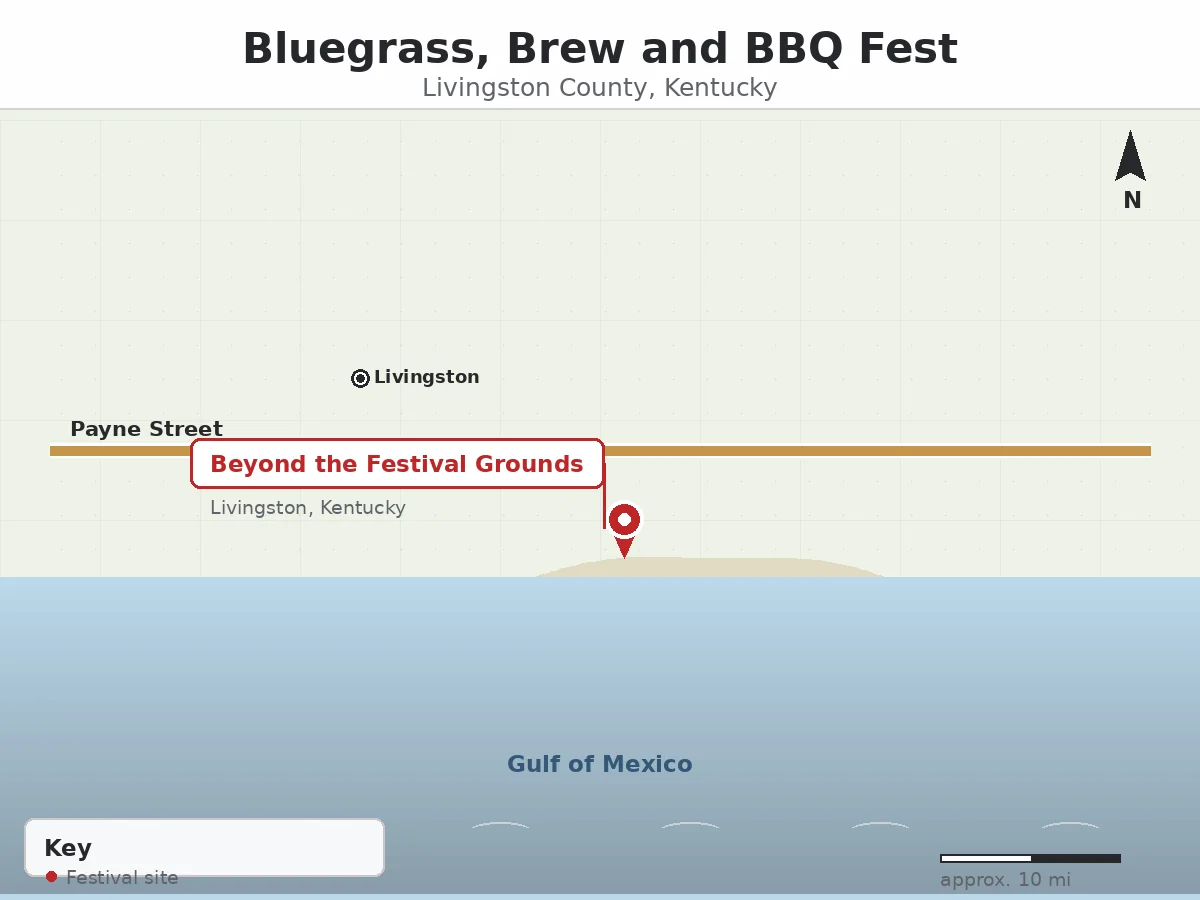
Its home ground is Little Lake Park, on Payne Street in Grand Rivers, as the organiser’s own festival page prints it. The town tourism calendar describes the event as held on the last weekend of April, and it records food, craft and brew vendors as accepted participants, which gives the weekend its market character alongside the music. The organiser’s page adds that the two thousand twenty-six edition “is powered by” a named sponsor company; no incorporated organiser name is given in any layer read, so none is asserted here.
For a useful comparison, see the Livingston County Kentucky Patti’s Lights Festival for another county festival.
Quick Facts
| Item | Detail |
| Organiser’s printed name | Bluegrass, Brew, & BBQ Festival |
| Guide-layer short form | Bluegrass, Brew and BBQ Fest |
| Travel-layer form | Bluegrass, Brew, and BBQ Festival |
| Town | Grand Rivers, Livingston County, Kentucky |
| County seat | Smithland, not Grand Rivers |
| Venue | Little Lake Park, on Payne Street |
| Usual slot | The last weekend of April |
| Documented listings | April two thousand twenty-four and April two thousand twenty-six |
| Admission, two thousand twenty-six | Friday evening free; Saturday pass twenty-five dollars online |
| Presented through | The Grand Rivers town tourism body’s own pages |
History
The printed record offers no origin story for this festival. Nothing in the layers read states when the first edition took place, who proposed it, or how the combination of bluegrass, brewing and barbecue was chosen, and this article does not fill that silence with guesses. What the sources preserve instead is a short trail of listings and one detailed organiser’s account.
The earliest dated trace is a festival guide layer listing the “Bluegrass, Brew and BBQ Fest” at Grand Rivers on the twenty-sixth and twenty-seventh of April two thousand twenty-four. That listing establishes the event’s presence, its town and its late-April position, but prints nothing about programme or prices. Two years later the record becomes far fuller: the organiser’s own page documents the two thousand twenty-six edition day by day, with a free Friday evening session and a ticketed Saturday, as the sections below describe.
Between those two points, travel-magazine layers supply the only continuity the record has. They call the gathering the town’s biggest annual event and describe it as held each April. The town tourism calendar’s standing description, built around the last weekend of April, points the same way. Read together, the layers sketch a recurring town festival that surfaces clearly in two thousand twenty-six and only thinly before it, with its deeper past undocumented.
What to Expect
Bluegrass runs through both days of the weekend. The organiser’s page and the town calendar agree on the programme’s shape: a bluegrass band lineup spread across the two days, surrounded by food vendors, craft vendors and brew vendors. The music is the organising centre, and everything else on the ground supports it.
The two days are built differently, at least in the one edition the organiser documents in full. On Friday, the twenty-fourth of April two thousand twenty-six, the event ran as a free evening session from five to eight, with an opening act the page names. Saturday, the twenty-fifth of April, became the ticketed day, carrying a multi-band lineup that the organiser’s page prints in full. Anyone weighing which day to attend should notice the contrast the page itself draws: a short, free Friday evening against a longer, paid Saturday.
Weather does not cancel the plan. The organiser’s page states plainly that the event takes place rain or shine, and that all ticket sales are final. Those two conditions shape the weekend’s character as much as the lineup does: the music goes ahead under whatever April sky arrives, and a Saturday pass bought online is a firm commitment.
Planning Your Visit
The town tourism calendar fixes the rhythm first, placing the festival on the last weekend of April. That standing slot, rather than a single year’s dates, is the surest guide the record gives, because the documented editions shifted within the month: the two thousand twenty-four listing fell on the twenty-sixth and twenty-seventh, while the two thousand twenty-six edition fell on the twenty-fourth and twenty-fifth.
Money needs care, because the only prices printed anywhere belong to one edition. For April two thousand twenty-six, the organiser’s own page made the Friday evening free and set the Saturday pass at twenty-five dollars, sold online. No price for any other year appears in the layers read, so those figures should be treated as the two thousand twenty-six arrangement rather than a permanent tariff. Friday’s free entry, in particular, applies to that Friday evening session alone and should not be stretched into a claim that the whole festival is free.
Practical preparation follows from the printed conditions. Since ticket sales are final, the Saturday decision is best made before the weekend rather than at the gate in uncertain weather. Since the event runs rain or shine, wet-weather clothing is a sensible part of any packing list for an outdoor park weekend in April. Contact details for the festival appear on the tourism body’s own pages for anyone who needs them. The town calendar records food, craft and brew vendors as accepted, so prospective sellers have a documented route into the weekend.
A Sample Itinerary
A visitor following the shape of the documented two thousand twenty-six edition might build the weekend like this. Arrive in Grand Rivers on Friday in time for the free evening session at Little Lake Park, when the opening act plays between five and eight and the vendor rows are open for a first unhurried circuit. Use that evening to learn the ground: where the music sits, which food stalls appeal, and how the park fills.
Saturday then becomes the main day. With the pass bought online in advance, the day can be given over to the multi-band lineup the organiser prints, moving between the music and the craft and brew vendors across the park. Because the event proceeds rain or shine, the itinerary holds in any weather, with the day’s rhythm set by the bands rather than by the forecast. Nothing beyond Saturday is documented for the festival itself, so a longer stay in the area rests on the traveller’s own plans rather than on any printed third day of programming.
How It Compares
Grand Rivers keeps a busy town calendar, and three neighbouring events can be confused with this one unless the distinctions are kept clear. The Labor Day Arts & Crafts Festival belongs to the autumn end of the calendar and centres on crafts; the Hunter’s Moon Festival is another separate entry on the same town calendar; and a spring Quilt Festival named in a travel layer is likewise a different event. None of those gatherings is part of the April weekend described here, and none of their details belong in its account.
Within its own record, the comparison that stands out is between editions. The two thousand twenty-four appearance is a bare guide listing, little more than a name, a town and two dates. The two thousand twenty-six appearance is a full organiser’s document, with session times, a free evening, a priced Saturday pass, a named opening act, a printed multi-band lineup and stated rain-or-shine terms. The festival itself may have changed little between those years, but the surviving evidence changes a great deal, and any judgement about the event should rest on the fuller of the two accounts.
Visitor Checklist
- Confirm the last weekend of April on the town tourism calendar
- Remember that Grand Rivers, not Smithland, hosts the festival
- Treat Friday evening and ticketed Saturday as separate plans
- Buy the Saturday pass online before travelling, since sales are final
- Pack for rain, because the event runs in any weather
- Give the craft stalls and brew vendors time between sets
- Keep the autumn town festivals separate when planning a return trip
Beyond the Festival Grounds
The festival sits inside a wider Grand Rivers pattern of gatherings spread across the year, from spring through autumn, each occupying its own weekend on the town calendar. The April slot belongs to the bluegrass, brew and barbecue weekend, and the calendar’s structure suggests a town that spaces its celebrations so that each one keeps its own identity. Little Lake Park, on Payne Street, serves as the documented home of this event, giving the town’s biggest annual gathering, as the travel layers call it, a fixed address rather than a rotating ground.
The county frame matters too. Livingston County’s seat is Smithland, yet its best-documented festival stage in these layers is Grand Rivers, a reminder that a county’s social calendar does not always centre on its courthouse town. Visitors who come for the music will find a small town presenting its own event through its own tourism body.
Why It Matters
For a town of Grand Rivers’ size, holding what travel-magazine layers call its biggest annual event carries weight beyond one weekend. A recurring festival on a fixed late-April slot gives the town a dependable point around which vendors, musicians and visitors can plan, and the organiser’s own page for two thousand twenty-six shows that machinery working at full stretch: sessions scheduled by the hour, ticketing arranged online, a sponsor attached, and terms stated in advance.
The record also shows the value of the tourism body’s own documentation. Without the organiser’s page, this festival would survive in the sources as a name and a pair of dates in a guide listing, indistinguishable from dozens of others. Because the page prints particulars, the weekend can be described honestly: which evening costs nothing, which day is ticketed, what the pass cost in the documented year, and where the limits of the evidence lie. That is why the moderate depth of the record is stated openly here rather than smoothed away.
Frequently Asked Questions
Which of the printed names is the organiser’s own form?
The town tourism body’s festival page prints “Bluegrass, Brew, & BBQ Festival”. Guide layers shorten the name to “Bluegrass, Brew and BBQ Fest”, and travel-magazine layers write “Bluegrass, Brew, and BBQ Festival”, but the organiser’s page carries the ampersand form.
Is any part of the weekend free to enter?
In the documented two thousand twenty-six edition, the Friday evening session from five to eight in the evening was free. Saturday of that edition was ticketed, so the free entry covers the Friday session only and not the festival as a whole.
What happens to the weekend if it rains?
The organiser’s page states that the event takes place rain or shine. The same page adds that all ticket sales are final, so poor weather neither cancels the programme nor opens a route to a refund.
Does the record say when this festival first began?
It does not. The layers read contain listings and descriptions reaching back to two thousand twenty-four, together with the organiser’s full account of two thousand twenty-six, but no layer states a founding year or describes a first edition.
What to Expect From the Next Livingston County Kentucky Bluegrass, Brew and BBQ Fest Festival
How often is Livingston County Kentucky Bluegrass, Brew and BBQ Fest Festival held?
Travel-magazine layers describe the event as held each April, and the town tourism calendar places it on the last weekend of that month, so the documented rhythm is a single late-April weekend in each year the layers cover.
When is the next Livingston County Kentucky Bluegrass, Brew and BBQ Fest Festival?
The layers consulted for this article stop at the April two thousand twenty-six edition, which the organiser’s page documents in full. Working from the standing slot the town calendar describes, a following edition would be looked for on the last weekend of April, although no specific dates for a later edition are printed in the layers read.
Will the dates change?
They have moved within April before: the two thousand twenty-four listing fell on the twenty-sixth and twenty-seventh, while two thousand twenty-six fell on the twenty-fourth and twenty-fifth. The month and the last-weekend slot look steady in the record, but the exact days plainly shift from year to year, so each edition’s dates need checking against the organiser’s page.
Final Thoughts
This is a festival whose printed footprint is narrower than its reputation. Travel layers call it the biggest annual event in Grand Rivers, the town calendar gives it a settled late-April place, and the organiser’s page for two thousand twenty-six shows a carefully arranged weekend of bluegrass, food, craft stalls and brews at Little Lake Park. Set against that, the archive offers no founding story and no prices beyond a single edition. Taken on those honest terms, the weekend stands as a well-documented recent edition of a recurring town gathering, best approached through the organiser’s own page and the free Friday evening that opens it.