Lee County Alabama Water Festival
Every May, the Opelika Sportsplex and Aquatics Center fills with the noise of hundreds of fourth-graders moving between science stations, and for a couple of days Lee County’s youngest residents become water stewards. The Lee County Water Festival is a free, hands-on field trip that turns the water cycle, filtration, and groundwater into games children can hold in their hands. It is one of the few festivals in Alabama built entirely around a school lesson, and it has quietly become a spring tradition across the county’s public and private schools.
Lee County sits in east-central Alabama, along the Georgia line, and is one of the fastest-growing counties in the state. Auburn University anchors its northern half, Opelika serves as the county seat, and the Chattahoochee River forms the eastern boundary. Water is a genuine local concern here: the county’s creeks and reservoirs supply a fast-expanding population, so teaching children where their drinking water comes from is both practical and popular.
What makes the Water Festival unusual is its focus. It is not a street fair or a music event. It is a two-day education festival organized by stormwater professionals, city staff, and volunteers from across the county, and its purpose is simple: to help students understand how surface water and groundwater move, why clean water matters, and what they can do to protect it.
| Festival name | Lee County Water Festival |
| Location | Opelika Sportsplex and Aquatics Center, Opelika, Lee County, Alabama |
| Typical timing | Two days in early May |
| Format | Free educational festival with rotating science stations |
| Audience | Fourth-grade classes from Lee County schools, open to the public |
| Admission | Free |
| Organizers | City of Opelika, City of Auburn, Auburn University, City of Smiths Station, and Lee County |
| Signature features | Water cycle bracelets, natural filtration, edible aquifers, Live Fish Show |
About the Lee County Water Festival
The Water Festival is an annual event attended by hundreds of fourth-grade students from public and private schools across Lee County. Organizers deliberately target that grade level because water quality fits neatly into the fourth-grade science curriculum, so the field trip reinforces what students are already studying in class. For many children, it is their first close look at how a community manages the water it depends on.
The experience is interactive rather than lecture-based. Students rotate through stations in small groups, each one built around a single idea and a hands-on task. Volunteers from the host cities and Auburn University guide the activities, which keeps the atmosphere energetic and personal. The event is free, and the same partners return year after year to run it. Readers who enjoy the region’s creative festivals will find a different flavor of community spirit in an event like the Lauderdale County Alabama Arts Alive Festival, but both share the same instinct: bring people together around something the whole county cares about.
Because the festival is hosted at the Opelika Sportsplex, it has room for large groups and indoor backup space. That matters in early May, when Alabama afternoons can turn warm or stormy. The facility’s pools and gymnasium make the setting appropriate for a water-themed event, and the central location puts it within easy reach of schools across the county.
How the Water Festival Began and Grew
The festival grew out of the region’s stormwater education efforts. As Lee County’s population expanded, local governments and Auburn University looked for ways to teach residents about runoff, pollution, and water conservation. A dedicated school event proved to be the most effective approach, and the festival has been held annually since, drawing more students almost every year.
Attendance has climbed steadily. Early editions drew around a thousand fourth-graders, and by the mid-2020s the event hosted well over 1,300 students in a single year. Each spring, volunteers coordinate bus schedules, station supplies, and registration so that classes can cycle through in an orderly way. The festival has become a fixture on the school calendar rather than a one-off experiment.
- Launched as a stormwater education event for local schools
- Grew from roughly a thousand students to more than 1,300 per year
- Expanded to include Auburn University and multiple city partners
- Added the Live Fish Show as a recurring favorite
- Continues as a free annual event each May
What to Expect at the Festival
The learning stations
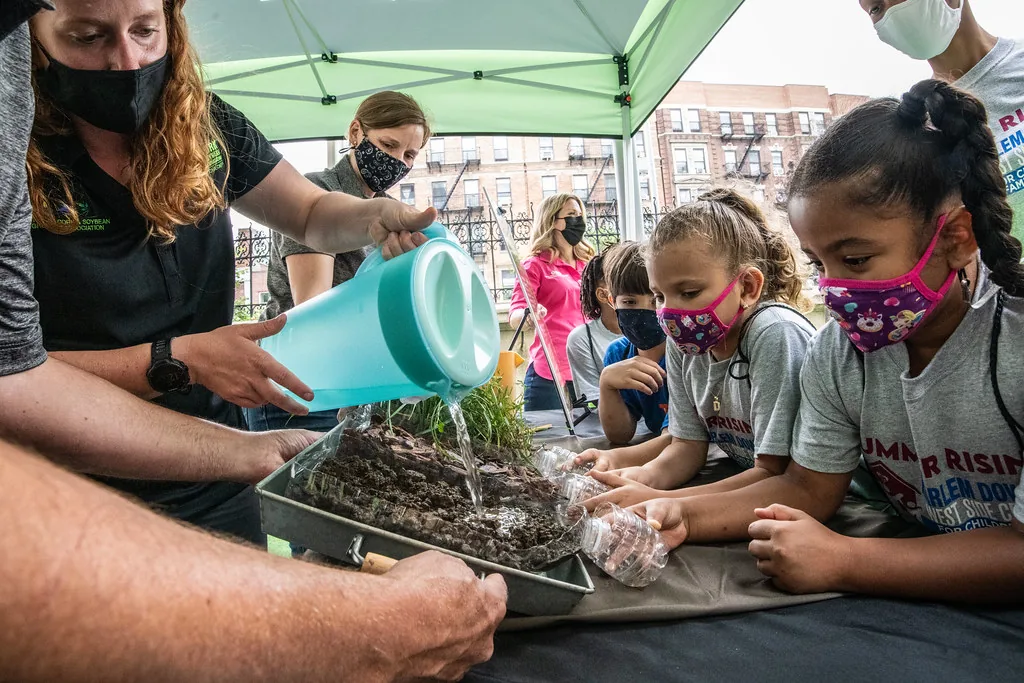
Students typically rotate through three core stations. At the first, they build colorful water cycle bracelets, with each bead standing for a stage in the journey water makes from clouds to tap to river. At the second, they work with miniature filters to see how soil and rock naturally clean water as it seeps downward. At the third, they assemble an edible aquifer from sodas and candies, a sweet demonstration of how groundwater is stored underground.
The Live Fish Show
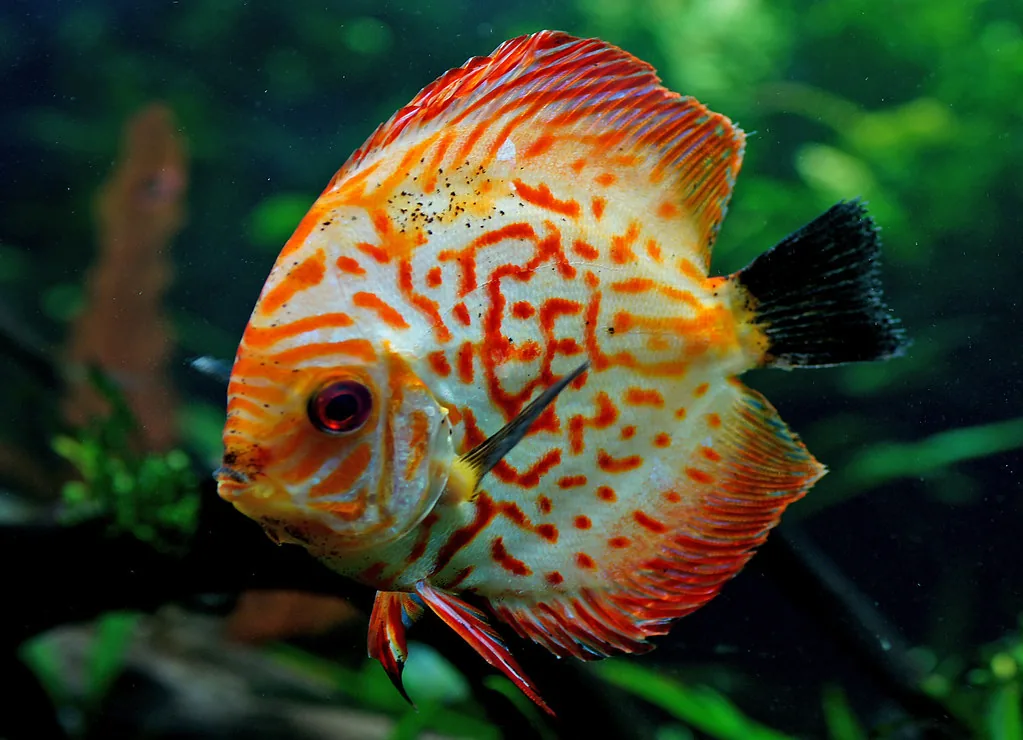
The festival’s grand finale is the Live Fish Show, where students meet native fish species and learn how those animals depend on clean waterways. It is consistently the most popular part of the day, because it turns an abstract lesson about ecosystems into something students can see moving in front of them. Volunteers use the show to connect water quality directly to the wildlife in Alabama’s rivers and creeks.
Family and public access
Although the schedule is built around school groups, the event is free and open to the public, and families sometimes attend alongside the classes. Because the activities are designed for fourth-graders, younger siblings and parents usually find them easy to follow. The atmosphere is busy but well organized, with volunteers directing groups from one station to the next.
Planning Your Visit
Getting to Opelika
Opelika sits at the crossroads of Interstate 85 and U.S. Highways 280 and 431, roughly halfway between Montgomery and Atlanta. The Opelika Sportsplex is a short drive from downtown and is easy to reach from anywhere in Lee County. School groups generally arrive by bus, while families can park on site.
Where to stay
Visitors from out of town have a wide choice of lodging in the Auburn-Opelika area, from national hotel chains near the interstate to smaller inns closer to downtown. Because Auburn University hosts its own busy calendar of events, it is worth booking early if you plan to stay overnight in early May.
Admission and logistics
There is no charge to attend, and no ticket is required. The main consideration for schools is registration: organizers ask volunteers and classes to sign up in advance so stations and bus parking can be planned. Families who simply want to visit should check with the host cities for the year’s exact dates before making the trip.
A Sample Day at the Water Festival
A typical visit unfolds over a few hours rather than a full day. Classes usually arrive in the morning, gather for a short welcome, and then split into groups for the first rotation. Each station lasts long enough for every student to take part, and volunteers keep the groups moving so the schedule stays on track.
Midway through, students switch stations, which gives them a mix of crafts, experiments, and demonstrations in a single visit. The edible aquifer tends to be a favorite because it ends with a snack. After the final rotation, the groups come together for the Live Fish Show before boarding buses back to school.
For families attending on their own, the same flow applies, minus the bus. Arrive near the start of a session, follow a group through the stations, and stay for the fish show. Because the venue is indoors, the event is comfortable regardless of the weather, and there is no need to plan around heat or rain.
Other Festivals to Compare
Lee County’s festival calendar is varied, and the Water Festival occupies a niche of its own. The table below sets it beside a few of the area’s other recurring events so visitors can see how it differs in format and purpose.
| Festival | Focus | Typical season |
| Lee County Water Festival | Water science education for fourth-graders | May |
| Opelika Book Festival | Authors, readings, and a local author fair | Late February |
| Opelika Songwriters Festival | Original singer-songwriters across downtown venues | Spring |
| Oysterfest | Gulf oysters, live music, and games | January |
Practical Checklist
- Check the year’s exact dates with the host cities before visiting
- Teachers and volunteers should register classes in advance
- Wear comfortable shoes; groups stand and move between stations
- Bring a water bottle and a light layer for indoor air conditioning
- Plan to stay for the Live Fish Show at the end of the session
Beyond the Festival
While you are in the area, Lee County offers plenty beyond a single event. Auburn University’s campus, the Jule Collins Smith Museum of Fine Art, and the historic downtowns of Opelika and Auburn are all close by. Chewacla State Park, just south of Auburn, has trails, a lake, and a swimming area that make a natural follow-up to a festival about water.
Opelika’s downtown has been revived in recent years, with restaurants, a brewery, and a growing arts scene. For families combining a school event with a day out, the county’s mix of campus culture and small-town streets gives the trip more to offer than the festival alone.
Why the Water Festival Matters
The festival’s value goes beyond a fun field trip. Lee County is one of the fastest-growing counties in Alabama, and growth puts pressure on the creeks, reservoirs, and stormwater systems that supply and drain the region. Teaching children how water moves and why it must be protected builds a base of understanding that lasts well beyond fourth grade.
Just as important is the partnership behind the event. Cities, a major university, and the county all contribute volunteers and expertise, which is why the festival has been able to grow without charging admission. It is a model of civic collaboration, and it gives students a positive first impression of the people who keep their water clean.
Festival Area Map
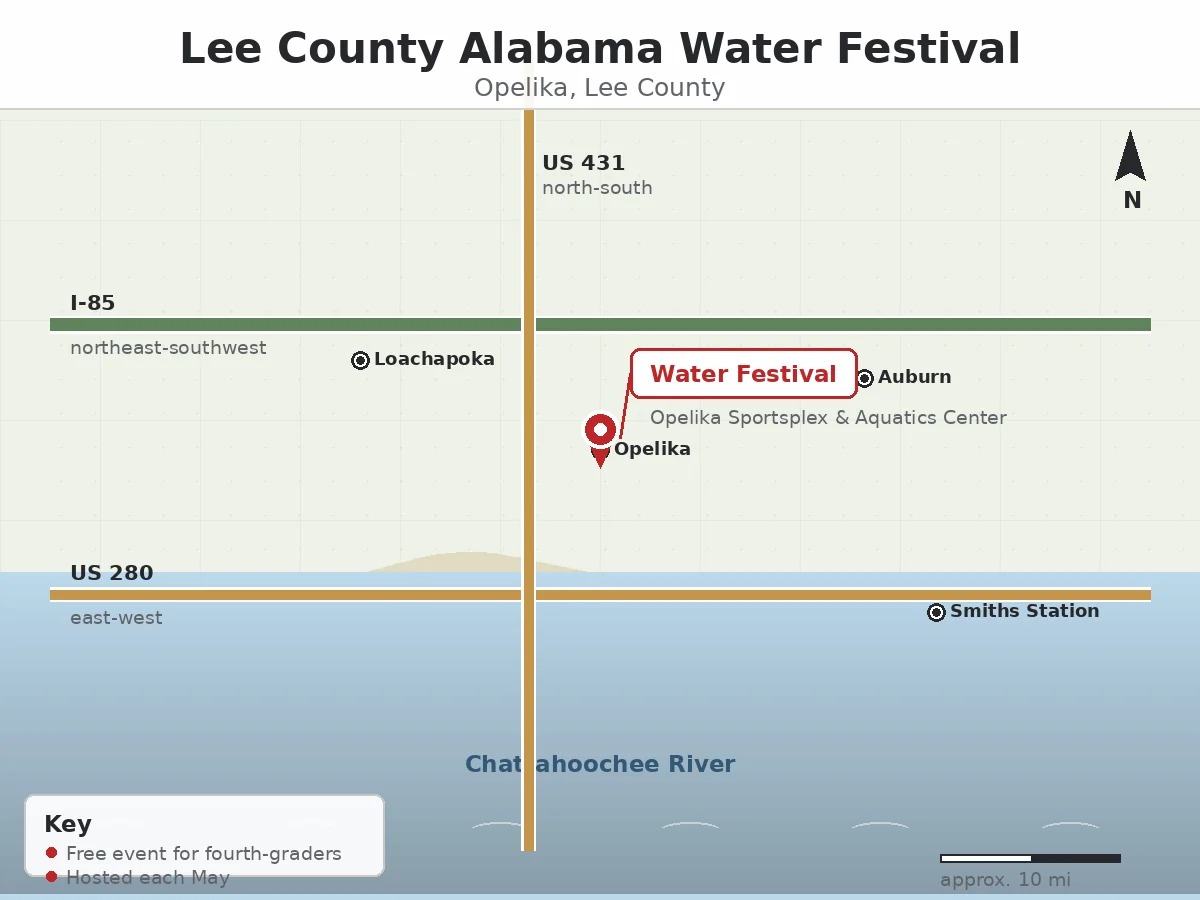
The Water Festival is held at the Opelika Sportsplex and Aquatics Center in Opelika, in the heart of Lee County near the junction of Interstate 85 and U.S. Highway 280.
Frequently Asked Questions
Is the Lee County Water Festival free to attend?
Yes. The festival is a free event, with no ticket or admission charge. Organizers ask volunteers and school groups to register in advance so the stations and parking can be planned, but there is no cost to take part.
Who can attend the festival?
The event is designed for fourth-grade students from public and private schools in Lee County, but it is open to the public as well. Families with younger children often attend, and the hands-on activities are easy for a range of ages to enjoy.
Where is the festival held?
It is held at the Opelika Sportsplex and Aquatics Center in Opelika. The indoor setting means the event can run regardless of the weather, and the location is easy to reach from across the county.
What activities can students expect?
Students rotate through stations on the water cycle, natural water filtration, and edible aquifers, and they finish with a Live Fish Show featuring native species. Each station pairs a short lesson with a hands-on task.
When is the festival usually held?
The festival is traditionally held over two days in early May. Because the exact dates are set each year, visitors should confirm them with the host cities before planning a trip.
Do I need to bring anything?
Comfortable shoes and a water bottle are the main things to bring. The event is indoors, so weather is not a concern, though a light layer can help in air-conditioned spaces. All activity materials are provided.
What to Expect From the Next Water Festival
The Water Festival has been held every year without interruption, and organizers plan to keep it going as a free spring event for Lee County students. The core format, a set of hands-on stations plus the Live Fish Show, has stayed consistent even as attendance has grown.
How often is the Water Festival held?
It is held annually, once each spring, over two days in early May.
When is the next Water Festival?
The next edition is expected in early May, following the pattern of previous years. The exact dates are announced by the host cities closer to the event.
Will the dates change?
Dates can shift slightly from year to year to fit school schedules, so it is best to confirm them with the organizers before making plans. The early-May timing has been consistent.
Last updated: October 2026
The Lee County Water Festival proves that a festival does not need rides or headliners to bring a county together. By turning a serious subject into a day of experiments, crafts, and fish, it gives students a lesson they remember and a reason to care about the water beneath their feet. For families and teachers in the Auburn-Opelika area, it is a spring tradition worth circling on the calendar.





One Comment