Ingham Michigan ScrapFest Festival
Old Town Lansing has a habit of turning its industrial past into street-level creativity, and few weekends show that off better than the one when Turner Street fills with sculptures built entirely from salvaged metal. The event is published simply as ScrapFest, with listing layers sometimes lowercasing the name to Scrapfest and later editions carrying numbered billings such as ScrapFest 14, Scrapfest 15 and Scrapfest 16. The fuller sheet title, Ingham Michigan ScrapFest Festival, never appears in print in that exact shape, because no layer read adds a second “Festival” after ScrapFest itself. What the layers do agree on is the character of the weekend: a competitive sculpture build that grew into a two-day art festival about reuse, staged on a closed street in the city’s oldest commercial district, with music, food trucks, eco-art booths and a runway show of clothing sewn from scrap fabric.
About
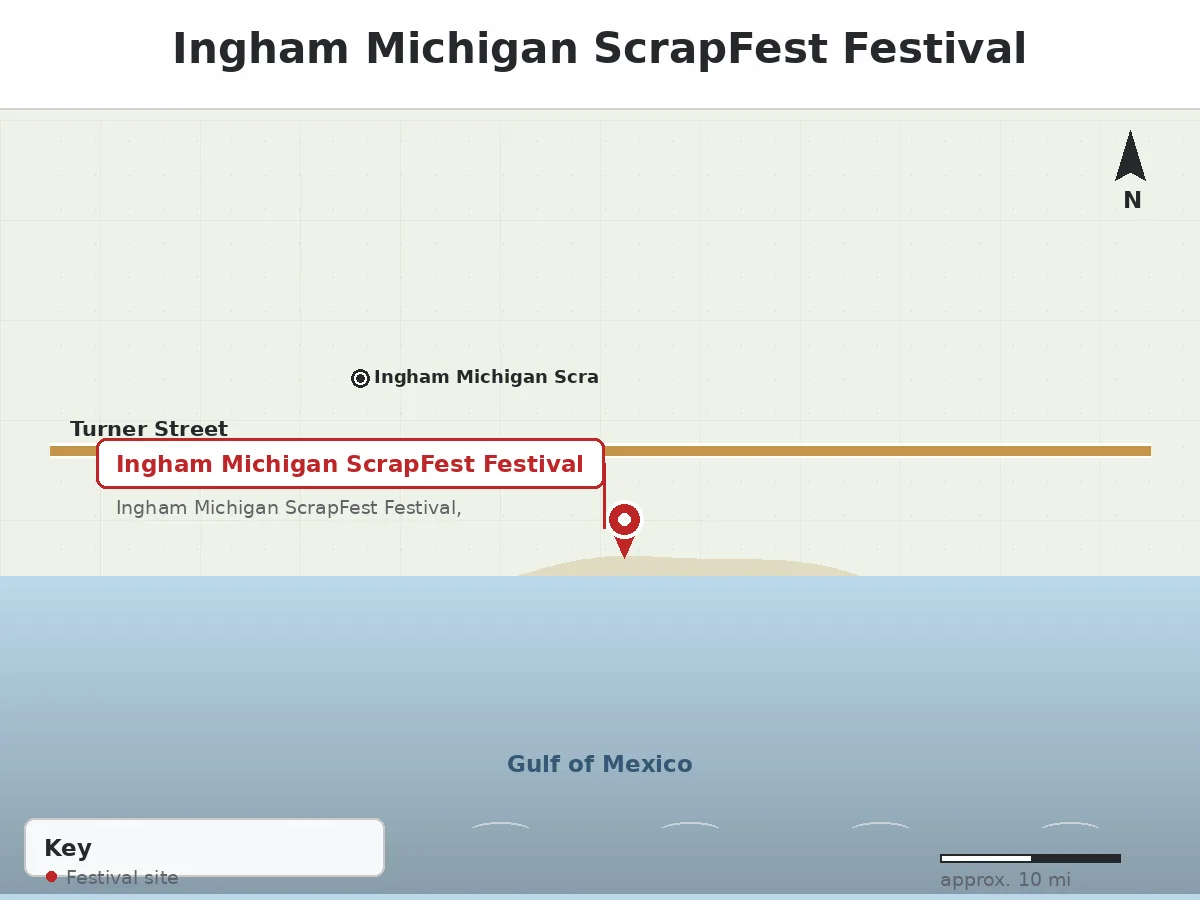
ScrapFest takes place in Old Town, the historic neighbourhood on the north side of Lansing in Ingham County. Lansing carries two distinctions that are easy to blur together: it is the state capital and the county’s largest city, yet a reference layer is clear that Mason, not Lansing, serves as the county seat of Ingham County. The festival belongs to Lansing’s creative quarter rather than to any courthouse square. A 2025 news layer describes Turner Street shut to traffic between a boulevard and Beaver Street for the occasion, with the main stage standing on Turner Street itself and the surrounding blocks given over to displays and booths.
The organisational picture is unusually direct for a street festival of this kind. A university recycling layer states that ScrapFest is organised and led by Friedland Industries, the Lansing recycling business, which fits the event’s whole reason for existing: the raw material of the headline competition comes out of the scrap stream. The scrap-metal collection that starts each team’s build happens at a local recycling processor’s plant in Old Town, according to sponsor and news layers, before the finished pieces return to Turner Street. One element has its own hosts: the same university layer places the ReFashion Show with sewing businesses working in partnership, hosts belonging to that element alone rather than to the festival as a whole.
Quick Facts
| Item | Detail |
| Sheet title | Ingham Michigan ScrapFest Festival |
| Published name | ScrapFest, also listed as Scrapfest |
| Host city | Lansing, in the Old Town neighbourhood |
| County | Ingham County |
| County seat | Mason (Lansing is the state capital, not the county seat) |
| Main venue | Turner Street, Old Town, closed to traffic for the weekend |
| Organiser as printed | Friedland Industries, per a university recycling layer |
| Documented editions | July 2023, July 2024, July 2025 and July 2026 |
| Headline element | Scrap-metal sculpture competition with a silent auction |
| Signature element | ReFashion Show of garments made from scrap fabric |
History
The layers read describe an event that began narrowly and widened. Artist and listing layers state that ScrapFest started out as a scrap metal artwork competition and gradually evolved into a full art festival centred on up-cycled and repurposed artwork. A local news layer, looking back, describes the original idea as a scrap metal art contest conceived a decade and a half before its own report, while a university layer calls it an annual festival that began over a decade ago. Those are impressions of age rather than a founding date, and the layers never pin the first edition to a single calendar year: ScrapFest has run for well over ten years, grew out of a contest rather than a fair, and still rests its identity on that contest today.
The numbered billings trace the growth without settling the arithmetic of an origin year. The 2024 edition was billed as ScrapFest 14 in an artist’s own event layer and a listing layer; the 2025 edition was described in a local news layer as now in its 15th year; and the 2026 edition arrived billed as Scrapfest 16. Those numbers suggest a steady annual rhythm, but a billing is a claim printed for one edition, not a birth certificate, so this article reports them as printed and declines to work backwards to a first year.
For a useful comparison, see the Huron Michigan Harbor Beach Maritime Festival for another county festival.
What changed across that span is the scale of the supporting programme. The early concept asked artists simply to make art from scrap; by the editions documented here, the competition sat inside a much larger street party of eco-art vendors, family activities, food trucks, live music, a fashion show and a documentary strand. The heart of it never moved, though: everything still begins with a limited weight of metal and ends with finished sculptures standing in a row on a closed city street.
What to Expect
The centrepiece is the sculpture competition, and its rules give the weekend its particular tension. Teams take part in a timed collection at the recycling plant, gathering a limited weight of scrap metal, and then have roughly a month to build a finished sculpture from what they collected. The work is judged in two divisions, a large-piece category and a small-piece category, so a monumental welded construction and a tabletop piece never compete head to head. When the weekend arrives, the completed sculptures line Turner Street — nearly four dozen of them, over forty pieces, in the local news layer’s account of the 2025 edition — turning the closed street into an open-air gallery of objects that were discarded metal weeks earlier.
Visitors can do more than admire the results. The finished sculptures are offered through a silent auction during the festival, and a sponsor layer explains that a share of the auction proceeds returns to the artists who made the work, giving the bidding a direct line back to the builders. Around the sculpture rows, eco-art booths sell jewellery, household pieces and artwork made from reclaimed materials. Food trucks work the street, family activities run alongside the displays, and live music plays from the main stage on Turner Street.
Friday evening brings the festival’s second signature event. The ReFashion Show presents garments made from scrap fabric, modelled as a proper runway show; the festival’s own layer places the 2026 edition of the show on Friday 10 July at seven in the evening, and the 2025 edition likewise put the show on its Friday programme. A documentary and short-film element adds a quieter corner, following the competing artists through the collection scramble and the month of building behind the sculptures. One artist layer’s description of an edition also includes the Great Scrap Run, a run and walk held as part of the festivities.
Planning Your Visit
Timing is the first decision, because the two days have different shapes. The 2024 edition, billed as ScrapFest 14, ran from five in the evening to nine on Friday 12 July and from eleven in the morning to seven in the evening on Saturday 13 July, in an artist’s own event layer and a listing layer. The 2025 edition followed the same pattern on 11 and 12 July, and the 2026 edition was set for 10 and 11 July. A Friday arrival catches the opening-night atmosphere and the ReFashion Show; a Saturday visit gives the longest stretch of sculpture viewing, booths and stage music. Anyone set on a particular sculpture in the silent auction should be present before bidding closes rather than treating the auction as background colour.

Admission is the simplest part of the budget. Local news layers covering both the 2025 and the 2026 editions state that admission is free, and that position is reported here for those editions as those layers give it. Money still changes hands inside the festival: auction bids, vendor and food purchases, and registration connected with the run are element-level costs rather than any charge at the street entrance. The festival’s own layer carries sign-up and contact details for individual elements such as the ReFashion Show, which is where prospective participants need to look.
Old Town rewards a little wandering beyond the festival footprint. The closed stretch of Turner Street sits among galleries, studios and independent shops, and the district’s brick blocks make the walk between sculptures part of the experience. Comfortable shoes matter, because the gallery here is a street and most of the day is spent standing on pavement. Drivers should expect the Turner Street closure described in the 2025 news layer.
A Sample Weekend Itinerary
A relaxed Friday might begin with an early evening arrival in Old Town, a first slow pass along the sculpture rows while the light is still good, and dinner from a food truck before the ReFashion Show at seven. Saturday then becomes the deep-dive day: return late in the morning, walk the eco-art booths, watch the stage programme, note the pieces worth a second look, and follow the silent auction as the afternoon builds. Anyone drawn to the participatory side can fold in the Great Scrap Run where it appears on an edition’s programme.
How ScrapFest Compares
ScrapFest occupies a niche that neighbouring Lansing-area events do not. The East Lansing Art Festival, which appears in the same event listings, is a juried art fair of a conventional kind, built around artists selling finished work rather than competitors building to a deadline from salvaged material. The Lansing Pride Festival, another listing-mate, is a celebration of a different community and purpose entirely. ScrapFest is closer to a sporting contest wearing the clothes of an art fair: its artists work against a clock at the collection, inside a weight limit, in set categories, and the audience watches the outcome of that process rather than a curated selection. Few festivals anywhere hand their exhibitors a pile of scrap and a month.
Visitor Checklist
- Confirm the Friday and Saturday dates and hours for your edition
- Arrive Friday evening if the ReFashion Show is a priority
- Allow unhurried time for the sculpture rows, which numbered over forty pieces in 2025
- Bring a bidding plan if the silent auction interests you, and note when bidding closes
- Carry payment for food trucks and eco-art booth purchases
- Wear shoes suited to a full day on closed city pavement
- Check the festival’s own layer for element sign-up details if you hope to participate
Beyond the Festival
The weekend pairs naturally with the rest of what Lansing and Ingham County offer a July visitor. Old Town itself is the first extension: its galleries, public art and riverfront walks sit within the same few blocks as the festival street. Downtown Lansing adds the capitol grounds and the state’s historical collections to an itinerary, and the Grand River corridor ties the districts together for walkers and cyclists. Mason, the county seat, makes a quieter counterpoint for anyone touring the county by car.
Why ScrapFest Matters
ScrapFest makes an argument that most art festivals never attempt: that discarded industrial material is not an endpoint but a starting stock. The competition structure forces the point. Artists do not choose ideal materials from a supplier; they take what a timed scramble through a scrap yard gives them, within a fixed weight, and answer for the result in public a month later. That the organising hand belongs to a recycling business, as the university recycling layer states, closes the loop neatly — the same world that processes Lansing’s scrap also stages the proof of what that scrap can become. For Old Town, the festival reinforces a district identity built on studios, workshops and reuse, and for visitors it offers a before-and-after story visible in a single street.
Frequently Asked Questions
What exactly happens to the scrap metal before the festival weekend?
Teams collect a limited weight of scrap in a timed collection held at a local recycling processor’s plant in Old Town, then spend about a month building their sculptures. The finished pieces are brought to Turner Street, where they are displayed, judged in large-piece and small-piece categories, and offered through a silent auction.
Which days and hours did recent editions run?
The documented editions all follow a Friday-and-Saturday pattern in July. The 2024 edition ran from five to nine in the evening on Friday 12 July and from eleven in the morning to seven on Saturday 13 July, per an artist’s event layer and a listing layer, while the 2025 edition fell on 11 and 12 July and the 2026 edition on 10 and 11 July.
What is the ReFashion Show, and when does it take place?
The ReFashion Show is the festival’s runway element, presenting garments made from scrap fabric, hosted by sewing businesses working in partnership. It anchors the Friday evening programme: the festival’s own layer scheduled the 2026 show for Friday 10 July at seven in the evening, and the 2025 edition likewise placed it on Friday evening.
Does the festival really publish its name without the word Festival?
Yes, in every layer read. The event appears as ScrapFest, as Scrapfest in event listings, and with numbered billings such as ScrapFest 14 and Scrapfest 16. No layer read adds a second “Festival” after the name, which is why the longer sheet title never shows up in print in exactly that form.
What to Expect From the Next Ingham Michigan ScrapFest Festival
How often is Ingham Michigan ScrapFest Festival held?
The documented editions form an unbroken annual sequence across the middle of the decade: mid-July weekends in 2023, 2024, 2025 and 2026, each carrying a numbered billing that climbs by one from ScrapFest 14 to Scrapfest 16. A university layer also describes ScrapFest straightforwardly as an annual festival, and nothing in the layers read suggests a gap within that documented run.
When is the next Ingham Michigan ScrapFest Festival?
The most recent documented edition is the one billed as Scrapfest 16, held on 10 and 11 July 2026 in an artist’s event layer, with its ReFashion Show on the Friday evening. The layers read document editions only through that weekend, and they point to a mid-July Friday and Saturday as the festival’s established slot, so anyone planning ahead should confirm the coming edition’s dates through the festival’s own channels nearer the summer.
Will the dates change?
The festival has shown a steady pattern rather than a wandering one, settling on the second Friday and Saturday of July across the 2024, 2025 and 2026 editions after a mid-July weekend in 2023. Hours have likewise held a recognisable shape, with a shorter Friday evening opening and a full Saturday. Steady habits are not guarantees, but the record gives visitors a reasonable expectation of a mid-July weekend in Old Town.
A July weekend in Old Town Lansing usually means crowds drifting between galleries and café tables; during ScrapFest it also means a street of sculptures that began the summer as scrap. Between the timed collection at the recycling plant, the month of building, the runway of salvaged fabric and the auction that sends a share of its proceeds back to the makers, the festival keeps every stage of reuse in public view. Whether a visitor comes to bid, to browse the eco-art booths or simply to see what forty artists can coax out of discarded metal, ScrapFest offers one of the most distinctive summer weekends in Ingham County.