Hancock County Maine Acadia Night Sky Festival
For thirteen Septembers, the darkest hours over Mount Desert Island belonged to people looking upward. The Acadia Night Sky Festival turned Bar Harbor and Acadia National Park into a gathering place for stargazers, photographers, researchers, and families who wanted to see the Milky Way without city light washing it out. Its venues were the places where the island’s night sky shows itself best: the summit of Cadillac Mountain and the curve of Sand Beach. The festival was organised by the Bar Harbor Chamber of Commerce together with other local organisations, and it ran every September from its first edition in 2009. Then it stopped. A reference layer states plainly that the festival is no longer active and officially concluded in 2022, so this account treats it as a finished chapter.
About
The Acadia Night Sky Festival was a September celebration of darkness. In a part of Maine where the night sky is dark enough for the Milky Way to stretch from horizon to horizon, the festival gave visitors a reason to stay out after sunset and to look up with guidance. Its programme mixed public stargazing with learning: star parties where telescopes were pointed at planets and deep-sky objects, workshops on reading the sky and photographing it, talks by speakers, researchers, photographers, and artists, night hikes through the park, and sessions devoted to astrophotography. At night, the summit of Cadillac Mountain offers a wide, open view of the sky. Sand Beach, tucked between rocky headlands on the park loop, gave the festival a shoreline venue where the sound of the surf ran under the stars. The festival was built for people willing to stay up late, since the sky rewards patience more than any other kind of sightseeing does.
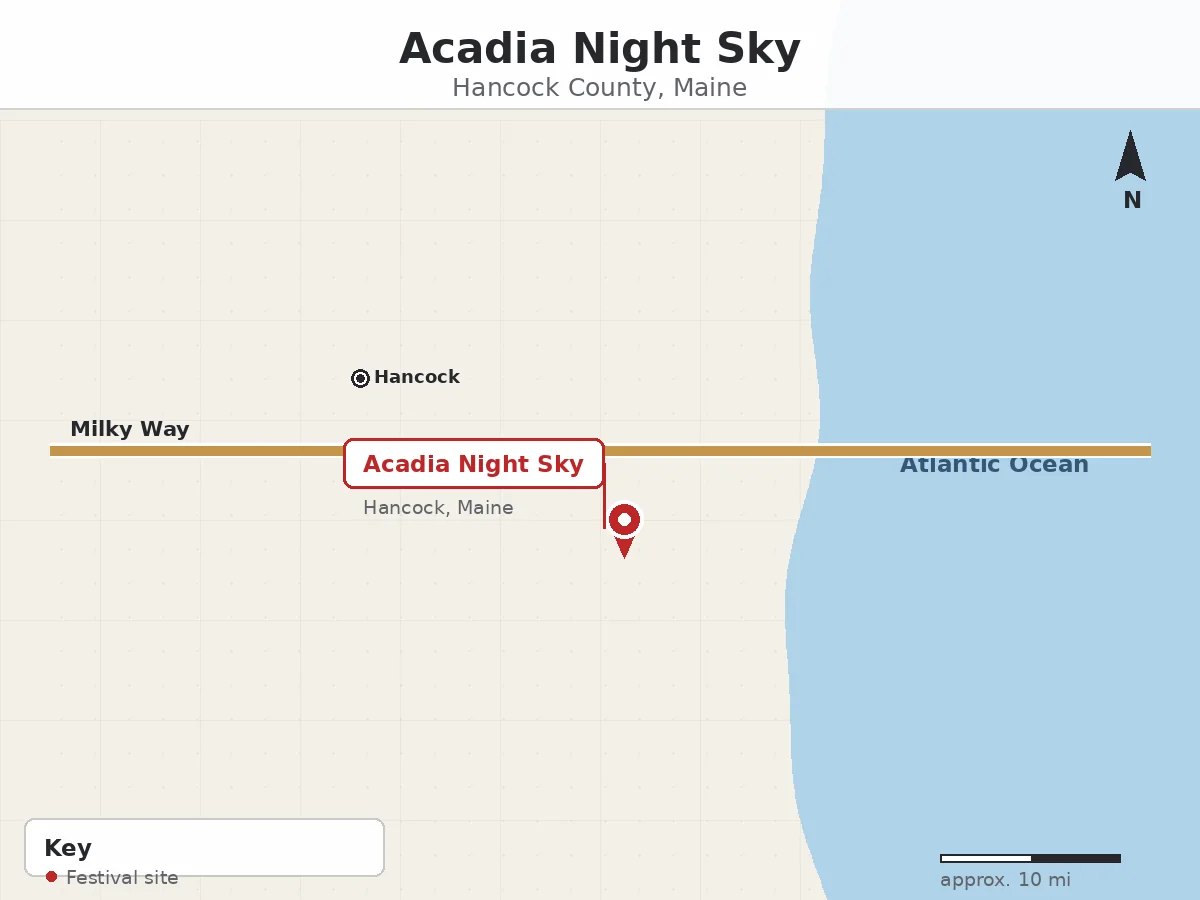
The festival’s home was Bar Harbor and the wider Mount Desert Island and Schoodic Peninsula area, all within Hancock County. Bar Harbor is not the county seat of Hancock County; Ellsworth holds that role. Bar Harbor is the town most visitors know; Ellsworth is the administrative centre a short drive inland. The festival never pretended to be a single-site event. It was not only for people who already owned telescopes. It welcomed newcomers who had never looked through an eyepiece, photographers chasing their first Milky Way image, and children seeing Saturn’s rings for the first time. September was the natural month for it: the crowds had thinned, the nights had grown long and cool, and the sky darkened early.
Quick Facts
| Item | Detail |
| Published name | Acadia Night Sky Festival |
| Host town | Bar Harbor, on Mount Desert Island |
| County seat | Ellsworth, not Bar Harbor |
| Setting | Acadia National Park and Bar Harbor |
| Key venues | Cadillac Mountain, Sand Beach, Bar Harbor |
| Organiser | Bar Harbor Chamber of Commerce plus other local organisations |
| First held | 2009, in September |
| Timing | Every September while active |
| Final status | Concluded in 2022 |
| Admission | Listed free by an events-aggregator layer |
History
The first Acadia Night Sky Festival was held in 2009, according to a festival-guide layer, and it settled into a September rhythm that it kept for the whole of its run. September suited the island: the season was winding down, the air was cooler, and the nights were longer. Its venues were fixed early: Cadillac Mountain for star parties, Sand Beach for shoreline observing, and Bar Harbor for talks and workshops. The Bar Harbor Chamber of Commerce led the organisation alongside other local organisations, and the National Park Service’s presence in Acadia gave the festival access to the park’s most dramatic viewpoints.
One dated evening stands out in the layers read. On Saturday, September 27, 2014, the festival held its Cadillac Mountain Star Party at seven in the evening, a date and time recorded by an astronomy-network layer. The star party was the festival’s signature kind of event: telescopes set up on the summit, guides pointing out constellations and planets, and a crowd that had climbed the mountain road in the dark to stand under a sky with very little light pollution. That evening captures what the festival offered at its best.
For a useful comparison, see the Hancock County Maine Bar Harbor Music Festival for another county festival.
The festival’s end is documented just as plainly as its beginning. A reference layer states that the festival is no longer active and officially concluded in 2022. The record simply shows a festival that ran every September from 2009 and then stopped after its 2022 edition. The year after the festival ended, the National Park Service held Acadia Night Sky Week in 2023, a run of free public programmes that carried some of the same spirit into the park without being the festival itself. The week of programmes was the park service’s own offering, not a revival of the festival under a new name. Some aggregator and guide listings advertise September 10–14, 2025 and September 2026 editions of the festival, but those listings conflict with the reference layer’s statement that the festival concluded in 2022, and they read as stale or generated listings. They are not treated here as real editions. The ranger-led Evening Program: Acadia’s Night Sky at Sand Beach on September 27 and 30, 2026, is likewise a park programme, not a festival edition.
What to Expect
A night at the Acadia Night Sky Festival began with the light going down. Visitors gathered at Cadillac Mountain or Sand Beach as dusk settled, and the programme unfolded as the stars came out. Star parties were the centre of it: telescopes aimed at the Moon, the planets, and the deep-sky objects that the dark island sky reveals, with guides talking visitors through what they were seeing. The guides were a mix of amateur astronomers, researchers, and photographers. The atmosphere was closer to a shared evening outdoors than to a lecture. People queued for the eyepieces, asked questions, and compared notes while the sky darkened overhead.
Workshops ran alongside the observing. Some taught visitors how to find their way around the constellations without equipment. Others were devoted to astrophotography, showing photographers how to capture the Milky Way over the coastline and how to work with long exposures in the dark. Night hikes took small groups onto park trails after dark. The venues shaped the experience as much as the programme did. Cadillac Mountain’s summit is exposed and windy, and a September night up there is cold, so the star parties had a hardy, bundled-up character. Sand Beach was lower and more sheltered, with the surf as a constant background and the headlands framing the sky. Admission was listed free by an events-aggregator layer.
Planning Your Visit
Anyone retracing the festival’s footsteps today is planning a visit to a place, not to an event. The practical questions are therefore about Acadia National Park and Bar Harbor in September rather than about festival tickets. September remains the best month for the island’s night sky: the nights are long, the crowds have thinned, and the air is cool and often clear. Visitors who want the festival’s experience should aim for the days around the new moon and check the park’s listings for ranger-led evening programmes, the closest living equivalent to the festival’s star parties.
Getting to the venues is straightforward. Bar Harbor is the island’s main town, with inns, restaurants, and shops near the waterfront. Cadillac Mountain is reached by the park’s summit road and Sand Beach by the park loop road; a vehicle is the practical way to reach either after dark, and the summit is exposed and cold on a September night. Ellsworth, the county seat, lies inland from the island, on the route most visitors take to Bar Harbor. Warm layers are essential, because a September night on Cadillac Mountain is far colder than a September afternoon in Bar Harbor. A red-light torch preserves night vision, binoculars help anyone without a telescope, and a camera with a tripod serves anyone trying astrophotography. Visitors should allow twenty minutes or more for their eyes to adjust to the dark.
Sample Itinerary
A festival weekend in September might have unfolded like this. On the first afternoon, visitors arrived in Bar Harbor and walked the waterfront while the light lasted. As dusk approached, they drove up the summit road to Cadillac Mountain for the evening’s star party, arriving early enough to find a place and to let their eyes adjust. Telescopes were set up, guides talked through the constellations, and the Milky Way rose as the sky darkened.
The second day belonged to learning. A morning workshop and an afternoon talk added depth to what they had seen. The evening could be spent at Sand Beach, where the surf and the headlands framed a different view of the same sky, or on a night hike along a park trail. The third day was for the island itself: a slow morning in Bar Harbor, a drive along the park loop road, and a final look at the places where the festival had gathered, before the trip home. The itinerary is illustrative, but its shape follows the festival’s pattern of evenings outdoors and days spent learning.
Comparison
The Acadia Night Sky Festival differed from the island’s other September attractions in that its subject was above the landscape rather than in it. Its closest relative is the National Park Service’s Acadia Night Sky Week, held in 2023 after the festival ended, which offered free public programmes with a similar spirit but under the park service’s own banner and without the festival’s chamber-of-commerce organisation.
Within the festival itself, the two main venues offered contrasting experiences. Cadillac Mountain gave height, openness, and a horizon-to-horizon view, along with wind and cold. Sand Beach gave shelter, the sound of the surf, and a framed view between headlands. Visitors who attended both in one weekend got the full range of what the island’s night sky can offer. Compared with stargazing festivals in darker, more remote parts of the country, Acadia’s festival had the advantage of a town at its doorstep: Bar Harbor’s inns and restaurants meant that a night under the stars could be followed by a warm bed and a proper breakfast, which is not a small thing after hours on a cold mountaintop in September.
Checklist
- Warm layers for a September night on Cadillac Mountain, far colder than the afternoon in town
- A red-light torch, so that night vision is preserved for everyone nearby
- Binoculars for anyone without a telescope, since they reveal far more than the unaided eye
- A camera and tripod for anyone trying astrophotography, with spare batteries kept warm
- Patience for eyes to adjust to the dark, allowing twenty minutes or more away from bright light
- A vehicle and a plan for driving the summit road and the park loop road after dark
- Knowledge of the new moon, since the darkest skies fall in the days around it
- A check of the park’s listings for ranger-led evening programmes
- An understanding that the festival itself has concluded, so no festival edition should be expected on any date
- Time in Bar Harbor itself, between nights under the stars
Beyond the Festival
The festival’s setting is worth a visit on its own. Acadia National Park covers much of Mount Desert Island and part of the Schoodic Peninsula, with carriage roads, hiking trails, and a loop road that takes in the island’s coastline. Cadillac Mountain is the park’s highest point, but its other summits, ponds, and cobble beaches all repay attention. The Schoodic Peninsula, across the bay, is quieter and wilder, with darker skies for anyone seeking solitude. Ellsworth, the county seat, is the gateway town on the mainland side of the bridge to the island. The Down East coast beyond Bar Harbor runs through fishing villages and headlands that feel a long way from the resort town. Anyone who came to the island for the festival often found that the days between the night programmes were as memorable as the nights themselves.
Why It Mattered
The Acadia Night Sky Festival mattered because it gave people a reason to value darkness. The island’s dark sky is one of the few places on the eastern seaboard where the Milky Way still shows itself in full. The festival made that darkness visible, literally, by gathering people under it and giving them the tools to understand what they were seeing. It treated the night sky as something that belonged to everyone rather than to specialists. For the island, it stretched the visitor season into September and gave Bar Harbor an autumn event unlike any other on its calendar. Its conclusion in 2022 does not erase that contribution. The festival ran for thirteen Septembers, from 2009 onward, and in that time it introduced thousands of visitors to the island’s night sky. The National Park Service’s Acadia Night Sky Week in 2023 showed that the appetite for dark-sky programming had not gone away with the festival, and the park’s ranger-led evening programmes continue to offer the public a way into the subject.
Frequently Asked Questions
Is the Acadia Night Sky Festival still running?
No. A reference layer states that the festival is no longer active and officially concluded in 2022, after a run from 2009 held every September.
How did a visitor spend a night at the festival?
Visitors attended star parties at Cadillac Mountain and Sand Beach, joined workshops on reading the sky and on astrophotography, listened to talks by speakers, researchers, photographers, and artists, and took night hikes on park trails.
What night-sky programming followed the festival’s final edition?
In 2023 the National Park Service held Acadia Night Sky Week, a run of free public programmes in the park: the park service’s own offering rather than a revival of the festival. The park also runs ranger-led evening programmes, such as the Evening Program: Acadia’s Night Sky at Sand Beach.
Can I still see the night sky at Acadia today?
Yes. The park’s ranger-led evening programmes offer a guided way to see it. Visitors should aim for the days around the new moon, dress warmly, and allow their eyes time to adjust to the dark.
What to Expect From the Next Hancock County Maine Acadia Night Sky Festival
How often is Hancock County Maine Acadia Night Sky Festival held?
The festival was held every September while it was active, from 2009 through its conclusion in 2022. It is no longer held.
When is the next Hancock County Maine Acadia Night Sky Festival?
There is no next edition. A reference layer states that the festival officially concluded in 2022, and no revival has been documented in the layers read.
Will the dates change?
Since the festival has concluded, there is no edition on the calendar and no date that could move.
The Acadia Night Sky Festival is finished, but the sky it celebrated is not. On a clear September night, the Milky Way still stretches over Cadillac Mountain and the island still goes dark enough for the stars to show themselves in full.