Hancock County Maine Acadia Birding Festival
Late May on Mount Desert Island brings a particular kind of morning. The light comes up over the water, the spruce woods fill with song, and small groups of watchers gather with binoculars before most of the island has woken. The Acadia Birding Festival is built around those mornings. Its published name is Acadia Birding Festival, and its base is Southwest Harbor, a working harbour town on the island’s quieter side. From there, the festival sends people out on warbler walks at dawn, onto the water for puffins and pelagic seabirds, and up to the breeding cliffs where peregrine falcons nest.
About
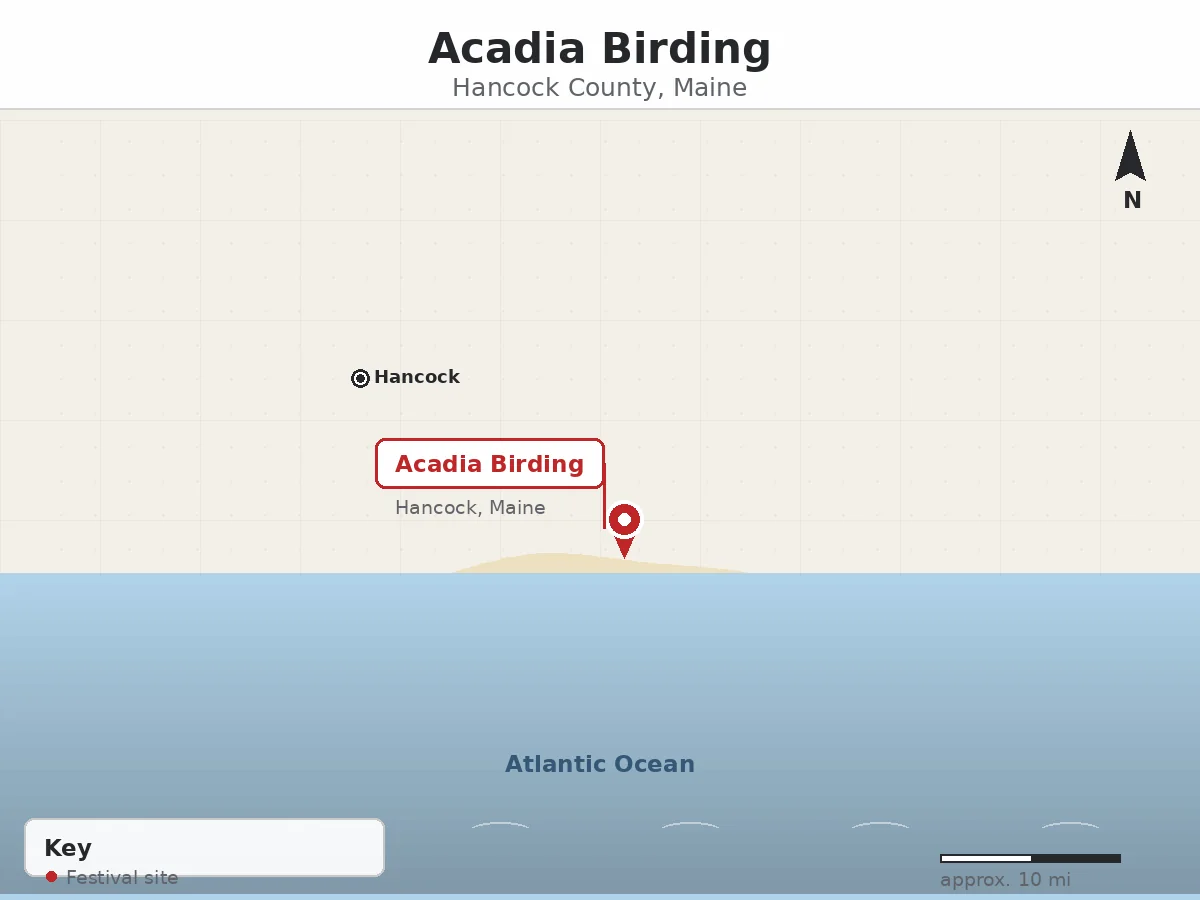
The Acadia Birding Festival is a multi-day gathering for birdwatchers on Mount Desert Island, with Southwest Harbor as its base. The sheet title adds the county and state prefix, but the name the layers print is simply Acadia Birding Festival, and that is the name the festival carries through this article. The gathering mixes early-morning field trips with talks, workshops, and social evenings, and it draws on the island’s position along the Atlantic flyway, where warblers pass through in spring and seabirds gather offshore.
The festival’s headquarters sit at the Causeway Club, known as the Red Barn, in Southwest Harbor. Socials and keynote talks gather at the Wendell Gilley Museum, also in Southwest Harbor, while field trips head into Acadia National Park. An exhibitions-listing layer names the Town Hill Village Improvement Society as an organiser, while a travel-blog layer says the festival is run by the owner of a local nature-tour company. The layers read do not give that owner’s name, so the owner is described here by role only. Southwest Harbor is the festival’s base, not the county seat; Ellsworth holds that role for Hancock County.
Quick Facts
| Item | Detail |
| Published name | Acadia Birding Festival |
| Sheet title | Hancock County Maine Acadia Birding Festival |
| Festival base | Southwest Harbor, Mount Desert Island |
| County seat | Ellsworth, not Southwest Harbor |
| Headquarters | Causeway Club (Red Barn), Southwest Harbor |
| Socials and keynotes | Wendell Gilley Museum, Southwest Harbor |
| Field trips | Acadia National Park |
| Most recent documented edition | 27th Annual, 28–31 May 2026 |
| Established | 1998 |
| Registration | Most events require pre-registration |
History
The festival was established in 1998, according to a wildlife-blog layer, and no other founding claim appears in the layers read. That single date gives the gathering a long run on Mount Desert Island, and the dated editions in the layers read show a festival that has kept returning to the same late-spring window year after year. The 16th annual edition ran 29 May–1 June, as recorded by a 2014 inn-blog layer. A Bar Harbor guide layer records a 19th Annual edition running 1–4 June. The most recent documented edition is the 27th Annual, held 28–31 May 2026, recorded by a birding-trail layer and a news layer. Each billing is carried as printed, and no founding year is worked out from the billings.
Ellsworth became the seat of Hancock County in 1838, replacing Castine, according to a reference layer. That history matters here only because it settles the geography: Southwest Harbor is the festival’s home, and Ellsworth is the county seat, and the two roles belong to different towns. The festival’s own history is a shorter story, one of a spring gathering that began in 1998 and grew into a four-day programme of walks, boat trips, talks, and paddling, all centred on the island’s birds.
For a useful comparison, see the Hancock County Maine Acadia Night Sky Festival for another county festival.
Over the years, the shape of the festival has stayed recognisable. The warbler walks come first in the morning, the boat trips carry people out to the puffins and pelagic seabirds, the falcon visits take watchers to the breeding cliffs, and the museum evenings bring the day’s sightings together over talks and socials.
What to Expect
A festival day begins before sunrise, or close to it, with an early-morning warbler walk. Small groups move quietly through the island’s woods and wetlands, listening for the warblers that pass through Mount Desert Island in late spring. The walks are the heart of the gathering, and they reward patience: the birds are small, quick, and often heard before they are seen, so the guides help watchers pick songs out of the dawn chorus and find the birds in the canopy.
Later in the day, the programme opens out. Puffin and pelagic boat trips take watchers offshore, where the seabird colonies gather and the pelagic species pass. The 2026 edition’s pelagic seabird boat trip ran on Saturday 30 May, and boat trips of this kind are among the most sought-after outings in the programme. Peregrine falcon breeding-site visits bring people to the cliffs where the falcons nest. Lectures and workshops fill the middle hours, covering identification, behaviour, and the island’s habitats, while paddling outings offer a slower way of seeing the shoreline from the water.
Evenings belong to the Wendell Gilley Museum in Southwest Harbor, where socials and keynote talks gather the festival together. The headquarters at the Causeway Club, the Red Barn, is the daytime centre, the place to check in and plan the next morning. Most events require pre-registration, though a few are open to the public, and a valid park pass is required for trips inside the national park.
Planning Your Visit
Southwest Harbor is the place to base yourself, since the festival’s headquarters at the Causeway Club and its socials and keynotes at the Wendell Gilley Museum are both in the town. The field trips head into Acadia National Park, so a valid park pass is needed for those outings. Most events require pre-registration, so planning ahead matters more here than at a walk-in gathering, though a few events are open to the public.
Registration is priced by the day, according to an older travel layer: sixty dollars for one day, one hundred twenty-five for two days, and one hundred seventy-five for three days, plus individual fees for special activities. Those registration fees are not a simple gate price, and they should not be read as one. The figures come from an older layer, so they describe the pricing as that layer recorded it, not necessarily the pricing of the most recent edition. The festival’s window sits in late May and early June, so a visit planned for that season lines up with the birds at their most active.
Pack for changeable island weather. Mornings on a warbler walk can be cool and damp, afternoons on a boat can be windy, and the island’s woods hold moisture after rain. Binoculars are essential, and a field guide helps, though the guides on the walks carry the identification load. Comfortable walking shoes matter for the woodland trails, and a waterproof layer is worth carrying even on a fair morning.
Sample Itinerary
A four-day visit built around the 2026 edition, 28–31 May, gives a good shape for the festival. Arrive in Southwest Harbor the day before it opens, settle in, and find the Causeway Club, the Red Barn, so the first morning starts without confusion.
Day one begins with an early-morning warbler walk, the festival’s signature outing. After the walk, take in a midday lecture or workshop, then spend the afternoon on a paddling outing along the shoreline. The evening belongs to the Wendell Gilley Museum, where the socials and keynote talks gather the festival together.
Day two follows a similar rhythm, with a different warbler walk in the morning and a peregrine falcon breeding-site visit in the afternoon. The evening again gathers at the museum, where the keynote talk anchors the night.
Day three, Saturday 30 May in the 2026 edition, is the day for the pelagic seabird boat trip, taking watchers out to the puffins and pelagic seabirds offshore. The evening social closes the day at the museum. Day four, the final day, is for a last early-morning warbler walk and a farewell visit to the headquarters.
Comparison
The Acadia Birding Festival differs from other birding events around the Schoodic Peninsula in its island base and its mix of walking and boating. The Schoodic Peninsula gatherings share the same coastline and many of the same birds, but they sit on the mainland side of the water, while this festival is rooted on Mount Desert Island itself, with Southwest Harbor as its base and Acadia National Park as its field-trip ground.
Within the festival itself, the outings differ in pace and demand. The warbler walks are quiet, early, and on foot, rewarding patience and a good ear. The puffin and pelagic boat trips are bigger undertakings, out on the water for hours, with the seabird colonies as the draw. The falcon visits sit between the two, a focused trip to a single dramatic location.
Compared with a general nature festival, the Acadia Birding Festival is narrower and deeper. It does not try to cover every part of the island’s natural history; it stays with the birds across four days of walks, trips, talks, and paddling, and that focus is what brings watchers back to Southwest Harbor each spring.
Checklist
- Binoculars, cleaned and adjusted before the first morning walk
- A field guide to the birds of the region, for checking songs and markings
- A valid park pass, needed for trips inside Acadia National Park
- Pre-registration confirmed for the events you plan to join, since most require it
- Waterproof layers for cool, damp mornings in the island woods
- Sun protection and a wind layer for the boat trips and paddling outings
- Comfortable walking shoes for woodland trails
- A notebook for recording sightings, songs, and locations
- Water and snacks for long mornings in the field
- Directions to the Causeway Club and the Wendell Gilley Museum, both in Southwest Harbor
Beyond the Festival
Mount Desert Island rewards a longer stay, and the festival’s base in Southwest Harbor puts a visitor close to much of it. Acadia National Park covers much of the island, and its trails, carriage roads, and coastline are worth days on their own, beyond the festival’s field trips. The park’s mountains and shoreline give the island its shape, and the birdlife the festival celebrates is part of a much larger landscape of spruce woods, granite ledges, and tidal water.
Southwest Harbor itself is a working harbour town, quieter than Bar Harbor on the island’s eastern side, and its waterfront, shops, and eateries give a visitor a gentler base than the busier resort town. The Wendell Gilley Museum, which hosts the festival’s socials and keynotes, is worth a visit in its own right, as a museum of bird carving and island natural history.
The Schoodic Peninsula, across the water from Mount Desert Island, holds its own birding country, and the layers read warn against confusing its birding events with this festival. The peninsula’s shoreline and woods are worth a visit for any birder staying on, but they belong to a different gathering, and the festival’s own programme stays on the island and in the park.
Significance
The Acadia Birding Festival matters because it has kept a spring gathering alive on Mount Desert Island since 1998, building a community of watchers around the island’s birds. From its establishment in 1998 through the 27th Annual edition in 2026, it has returned each year to the same late-May window, the same island, and the same birds.
The gathering also carries a teaching role. The warbler walks train the ear, the boat trips open up the seabird world offshore, the falcon visits show a breeding cliff at close range, and the lectures and workshops pass on identification skills that last well beyond the four days.
For Mount Desert Island, the festival is a spring marker, a sign that the warblers have returned and the seabirds are gathering. For the watchers who come, it is a chance to see the island’s birds with guides who know them, in the season when they are at their most active.
Frequently Asked Questions
What should a first-time visitor bring for an early-morning warbler walk?
Binoculars are the first essential, along with comfortable walking shoes for woodland trails and a waterproof layer for cool, damp mornings. A field guide helps for checking songs and markings, and a notebook is useful for recording sightings. The birds are often heard before they are seen, so the guides help watchers pick songs out of the dawn chorus.
Do I need a park pass for the festival’s field trips?
Yes, a valid park pass is required for trips inside the national park, according to the layers read. The festival’s field trips head into Acadia National Park, so visitors should arrange the pass before the field trip day, so the morning starts without a delay.
Which festival events can I join without registering in advance?
Most events require pre-registration, and the festival’s layers make that clear. A few events are open to the public, which gives a first-time visitor a way to sample the festival without committing to the full programme. The registration figures recorded by an older travel layer — sixty dollars for one day, one hundred twenty-five for two days, and one hundred seventy-five for three days, plus individual fees for special activities — describe the pricing as that layer recorded it, and they are not a simple gate price.
Why does the festival use two different gathering places in Southwest Harbor?
The festival’s headquarters sit at the Causeway Club, known as the Red Barn, while its socials and keynote talks gather at the Wendell Gilley Museum. Both are in Southwest Harbor, and the split gives the festival a daytime centre at the Red Barn and an evening gathering place at the museum.
What to Expect From the Next Hancock County Maine Acadia Birding Festival
How often is Hancock County Maine Acadia Birding Festival held?
The dated editions in the layers read fall in late May and early June, one edition per calendar year. The 16th annual edition ran 29 May–1 June, a Bar Harbor guide layer records a 19th Annual edition running 1–4 June, and the 27th Annual edition ran 28–31 May 2026.
When is the next Hancock County Maine Acadia Birding Festival?
The most recent documented edition is the 27th Annual, held 28–31 May 2026. The layers read carry no announcement of a later edition, so no date for a following edition is given here. A visitor planning around the festival should watch for the late-May window the festival has kept, and check the festival’s own layers for the next edition’s dates when they appear.
Will the dates change?
The calendar has shifted from edition to edition within the late-May to early-June window. The 16th annual edition ran 29 May–1 June, the 19th Annual edition ran 1–4 June, and the 27th Annual edition ran 28–31 May 2026. The exact days move, so the dates of a coming edition should be checked against the festival’s own layers.
The Acadia Birding Festival is a spring gathering built on early mornings, island woods, and open water. From the warbler walks at dawn to the pelagic boat trips offshore, it gives watchers four days with the birds of Mount Desert Island, and it invites anyone willing to rise early to share them.