Hamilton County Nebraska Fair Festival
Some county fairs announce themselves with posters, midway contracts and a ticket ladder printed months ahead. The Hamilton County Fair in Aurora announces itself differently: through paperwork. Its public trail runs through requirement charts, identification deadlines in June, a single entry form per young exhibitor in July and premium tables set out to the cent. That trail is narrower than a glossy programme, yet it describes a working fair with unusual precision, because every deadline on it belongs to a real animal and a real family.
Begin with one firm fact and several honest gaps. The firm fact is place: Aurora, the county seat, hosts the fair at its fairgrounds in the Platte valley. No fair board name, gate price or day-by-day public schedule has been published in the fair-side record gathered for this article. What follows stays inside that record and refuses to fill its gaps with guesses borrowed from other counties sharing the Hamilton name.
About the Hamilton County Fair
The published name is simply the Hamilton County Fair, and the body a visitor can actually trace is Nebraska Extension in Hamilton County, whose dedicated fair page carries the machinery of the event. That page names project superintendents, because somebody has to answer questions about each department, but superintendents are personnel rather than an organising body. No agricultural society, fair board or commission appears anywhere in the fetched fair-side sources, so this article credits none.
Extension’s role is practical rather than ceremonial. Its office publishes the requirement chart, collects the identification forms tying each animal to its young owner, receives the pre-fair entries and posts the premium tables telling families what a ribbon is worth in each department. A County Fair Kick-Off gathering even offers help with the online entry system, which shows where the fair’s centre of gravity sits in 2026: less in a grandstand announcement, more in getting hundreds of small administrative acts right before anyone reaches the grounds.
That machinery serves the 4-H programme, the documented heart of the fair. Beef cattle anchor it, joined by swine, sheep, goats, poultry and rabbits, with a bucket calf project giving newer exhibitors an animal of manageable scale and a record book of their own. Everything beyond that livestock core is unverified in the record behind this article, and none of it is claimed below.
For a useful comparison, see the Hall County Nebraska Nebraska State Fair Festival for another county festival.
Quick Facts
| Item | Detail |
| Published fair name | Hamilton County Fair |
| Fair town | Aurora |
| County seat | Aurora |
| Season | Late July into early August |
| Documented core | 4-H livestock showing across six species groups |
| Beef identification deadline | June 15, 2026, fenced to that year’s forms |
| Livestock entry deadline | July 9, 2026, one form per youth, fenced to that year |
| Organiser name | None published in the fair-side record |
| Admission price | Not published in any fair-side source |
| Fair-week camping | No offer published in any fair-side source |
History
No founding year for this fair appears in any fair-side source gathered for this article, and no edition number is published either. Its past, in the surviving modern record, is written in the recurring rhythm of its own paperwork: requirement charts reissued, identification forms due each June, entries closing each July, premiums posted department by department. A fair followed through that annual cycle plainly has continuity, even though the record never converts continuity into a date.
One claim does circulate and deserves careful handling. An older fair-guide listing describes this fair in superlative terms as the longest continuously running fair in the state. That sentence is listing copy, not a statement issued by the fair itself in any source fetched here, and it proves nothing about a founding year. Never quote it as the fair’s own billing; treat it as unverified colour rather than history.
What to Expect
The Beef Show and Its Blow and Go Rule
Beef is the department with the fullest paper trail. A requirement chart for 2026 sets out what an exhibitor and an animal must satisfy, and identification forms tying each entry to its owner were due on June 15 of that year, weeks before the fair opened. The beef show runs under published Blow and Go guidelines: cattle are shown free of adhesives, glue, paint and powder products, so the judge rewards the animal and fitting skill that needs no cosmetic help.
Premiums here are published to the cent, with a plain warning attached. A purple ribbon pays nine dollars, a blue pays seven dollars and fifty cents, a red pays four dollars and fifty cents and a white pays three dollars, with premiums payable across up to five classes plus showmanship for each member. Every figure is money the fair pays out to an exhibitor. None is a price charged to a visitor, and anyone reading the ladder backwards, as a ticket scale, will misunderstand the fair completely.
Five More Species on One Entry Form
Swine, sheep, goats, poultry and rabbits reach the fair through a single document: one livestock pre-fair entry form per young person, covering all of those species together, due at the Extension office on Thursday, July 9, 2026, with online entry preferred. A family with a pig, two lambs and a pen of rabbits files once, and the office sees the whole picture before a trailer arrives.
Showmanship is more than decoration here. Premiums attach to it in the beef department, and the judged classes reward the exhibitor who can present an animal calmly and answer for its care, grading the young person’s knowledge as openly as the animal beside them.
Companion Animals and a Different Ladder
The Extension record also carries premiums for companion-animal showing, and its figures differ from the beef table: purple at seven dollars, blue at five dollars and fifty cents, red at four dollars and white at three dollars. Two ladders, two departments, two separate bargains between a fair and its exhibitors. Merging them into one tidy scale would be a small falsehood, and small falsehoods about money are exactly how fair records get corrupted between websites.
The Bucket Calf Project
A bucket calf gives a younger exhibitor a calf raised on a bucket or bottle, a season of daily care and a record book in which that care is written down. The project scales the fair down to a size a beginner can carry: one animal, one book, one young person answerable for both. The book matters as much as the calf’s appearance, making the project a lesson in documentation as well as husbandry, and a natural doorway into the larger beef programme later.
What the Record Does Not Show
No carnival, rodeo, demolition derby or concert is verified for this fair in the sources behind this article. Read that silence precisely: those attractions are undocumented here, not declared absent. A visitor planning around a midway should confirm it with the county before travelling, because the published record promises livestock showing and nothing beyond it.
Planning Your Visit
Getting to Aurora
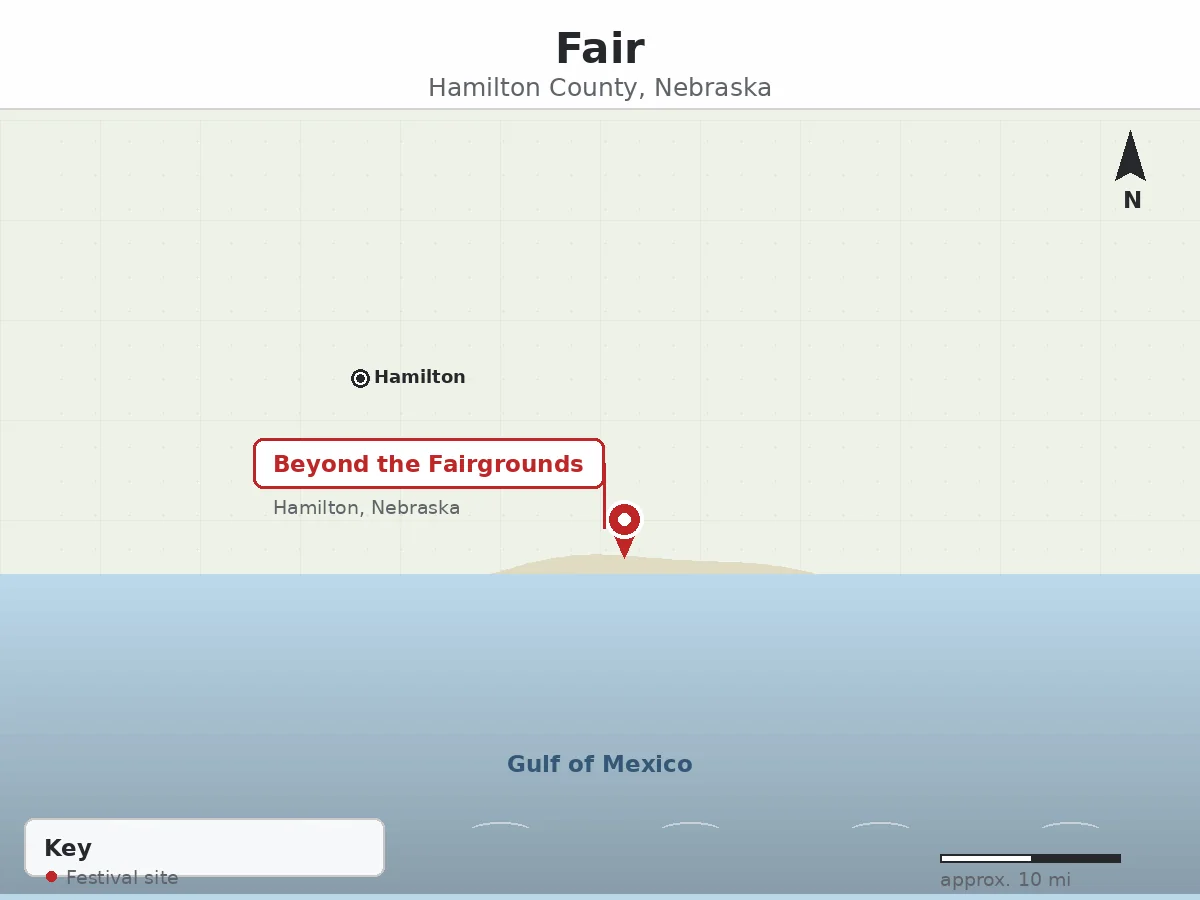
Aurora sits in the Platte valley in south-central Nebraska and serves as both fair town and county seat, removing the confusion that complicates so many county fairs in this series. One caution applies to addresses: a directory listing places the county Extension office on A Street with a fairgrounds note attached, but that is a directory office address, not a fair-side grounds address, and it is not printed here as one. Follow local fair signage within Aurora rather than navigating to an office.
What It Costs, Stated Plainly
No admission price for this fair appears in any fair-side source gathered for this article: no gate figure, season pass, parking charge or camping rate. That absence cannot be converted into a promise. An unpublished price is not evidence of a free gate, and this fair is never described as free in the record behind this article. The only money figures published are the exhibitor premiums described above, flowing from the fair to ribbon winners. Budget for food, fuel and lodging, and confirm any charge at the grounds with the county office in advance.
For Exhibiting Families
The calendar that matters most runs earlier than fair week itself. Beef identification forms closed on June 15, 2026, and the single livestock entry form closed on July 9 of the same year, with the season following at the turn of July into August. Those dates belong to that year’s machinery and are printed to show the shape of the commitment rather than as standing deadlines. Expect the same rhythm in a new year: identify animals in June, enter in July, show at the height of summer, and keep the record books current throughout.
A Day at the Aurora Fair
Begin in the beef barn while the morning is still cool, when exhibitors are washing, brushing and settling cattle before the Blow and Go show. Watch one class closely enough to follow the judge’s reasoning; a single class teaches more about the fair than an hour of wandering. Move next to the smaller-animal barns, where rabbits and poultry sit in neat rows and the exhibitors are often younger and prouder in direct proportion to the size of their animals.
By midday, find the sheep and goat pens and the swine barn, and ask an exhibitor, politely and between classes, what their project’s record book involves. During showmanship, stay for a full class: the questions put to each young person reveal how much knowledge the ribbons actually certify.
Two Kinds of Hamilton County Fairs
The comparison this fair most needs is with its own namesakes, because search results for Hamilton County fairs belong largely to other states. Hamilton County, Indiana, centred on Noblesville, publishes a substantial Purdue Extension fair book with visitor information of its own; it is a real, well documented fair, and it has nothing whatsoever to do with Aurora. Hamilton County, Iowa, at Webster City, and Hamilton County, Ohio, at Cincinnati, run fairs of their own, as do Hamilton County in Kansas and Texas and the Tennessee fair at Chattanooga.
Every figure from those fairs is excluded here deliberately. A premium table from Indiana or a gate price from Tennessee, attached to Nebraska’s fair by a careless search, would be a falsehood with a plausible face. The Nebraska record is thinner than Indiana’s polished book, and this article prefers the thin truth: Aurora’s fair is documented through Extension’s entry machinery, a statewide list entry and nothing grander.
Checklist
- Navigate to Aurora, the county seat, rather than to any other town in the county.
- Remember that no admission price is published for this fair before you travel.
- Never read the premium tables as ticket prices; premiums are paid to exhibitors.
- Keep the beef premium ladder and the companion-animal ladder apart in your mind.
- Check the current year’s identification and entry deadlines directly with the county Extension office.
- Confirm any evening entertainment with the county before planning a trip around it.
- Do not confuse this fair with the Hamilton County fairs of Indiana, Iowa, Ohio, Kansas, Texas or Tennessee.
- Treat the older guide’s superlative about this fair as unverified listing copy, not as fact.
Beyond the Fairgrounds
Aurora carries the ordinary dignities of a Nebraska county seat: a courthouse square, local cafés and stores serving the surrounding farm country, and streets that fill with familiar faces during fair week. The Platte valley setting shapes the county’s agriculture and therefore the fair itself, since the livestock in the barns comes from herds pastured and fed within a short drive of the grounds. A visitor with an extra hour does well to drive a short loop out of town, where centre-pivot circles and pasture together explain why a beef requirement chart can anchor a county’s summer.
Why This Fair Matters
A small fair documented through entry forms might look modest beside the state’s giant exhibitions, yet its function is arguably purer. This fair grades the daily work of the county’s own young people, in public, against published standards, and pays its premiums to the cent for all to see. The Blow and Go rule, the record book, the identification deadline months ahead of the show: each device insists that credit follows verifiable work. Where agriculture is not a theme but the economy itself, that insistence is a civic lesson taught once a year at the fairgrounds.
Frequently Asked Questions
Has any admission price been published for the Hamilton County Fair?
No gate, pass or parking figure appears in any fair-side source behind this article, and the fair is not described there as free either. The only published money figures are premiums paid to exhibitors. Confirm any charge directly with the county Extension office before travelling.
Who organises the Hamilton County Fair?
No fair board, agricultural society or commission name is published in the fetched fair-side record. The documented machinery is Nebraska Extension in Hamilton County’s fair programme, which publishes the requirement charts, entry forms and premium tables. Project superintendents named on that page are personnel, not an organising body.
What do the fair’s premium figures actually mean?
Premiums are prize money paid by the fair to exhibitors whose animals place. Beef premiums run from nine dollars for a purple ribbon down to three dollars for a white, while companion-animal premiums follow a separate, lower ladder. The two tables differ by department and neither one charges a visitor anything.
Which Hamilton County fair is the one in Indiana?
The Indiana event, centred on Noblesville and documented by Purdue Extension, is a separate fair in a separate state, as are the Hamilton County fairs of Iowa, Ohio, Kansas, Texas and Tennessee. This article covers only the Nebraska fair at Aurora, and none of the namesakes’ dates or prices apply to it.
What to Expect From the Next Hamilton County Nebraska Fair Festival
How often is the Hamilton County Nebraska Fair Festival held?
The fair is a yearly event in Aurora, built around its annual cycle of animal identification in June, entries in July and showing at the turn of July into August. Each year’s published forms restate that rhythm.
When is the next Hamilton County Nebraska Fair Festival?
Expect the next edition in the same late-July into early-August season at the Aurora fairgrounds. Exact dates for a coming year belong to that year’s statewide list and Extension forms, which are the places to confirm them, since no standing calendar date is published for the fair.
Will the dates change?
Dates can shift by a few days between editions as the calendar and the county’s scheduling require. The season itself, at the turn of July into August, is the stable part, and the current year’s Extension fair page remains the authority worth checking.
The Hamilton County Fair asks to be understood on its own evidence: a seat-town livestock fair in the Platte valley, documented through the honest paperwork of identification forms, entry deadlines and premium tables. Kept inside that evidence, it needs no borrowed midway, no invented board and no superlative. Aurora’s fair week belongs to the families who file the forms in June and July and lead their animals into the ring when the season turns, and that is distinction enough.