Grant County Nebraska Fair Festival
In the Nebraska Sandhills, Grant County holds its fair at Hyannis, the county seat and one of the smallest county seats in the state. The event’s published name is the Grant County Fair and Rodeo, and that name is the first honest thing about it: the rodeo is not an extra bolted onto a fair, but half of what the fair calls itself. The record behind this fair is thin, and this article stays inside it deliberately. What can be proved is a fair-and-rodeo carried on Nebraska’s statewide list year after year, a rodeo day sheet from a past edition with Hyannis riders in its draw, and an Extension office shared by four Sandhills counties. What cannot be proved — a board name, a price, a founding year — is left open.
A Fair and Rodeo Sharing One Name at Hyannis
The fair takes place at Hyannis, the seat of a ranching county whose whole population would fit inside a modest grandstand. Grant County is among the least populous counties in Nebraska, and its fair is scaled the way its county is: a gathering of neighbours, exhibitors and riders rather than a spectacle aimed at strangers. Its season is early to mid-August, when the county can spare a weekend.
The fair appears in the statewide list of Nebraska fairs in every recent year the list has been published, always at Hyannis and always under the same fair-and-rodeo name. For 2026 that list carries it across August 7 to 9. Those spans are treated here as what they are: the list’s record of each edition, not a permanent calendar. Its rodeo side is documented by a past edition’s day sheet, examined further on.
No fair board or agricultural society name for this fair is published in any Nebraska fair-side source gathered, and none is invented here. That absence matters, because other states’ Grant Counties publish boards and books in abundance — and every one of those belongs to another county, as the comparison section sets out.
Quick Facts
| Detail | What the record shows |
| Event name | Grant County Fair and Rodeo |
| County | Grant County, Nebraska, in the Sandhills |
| Fair town | Hyannis, the county seat |
| Grounds | At Hyannis; no fairgrounds street address is published |
| Season | Early to mid-August; the statewide list carries the 2026 edition on August 7 to 9 |
| Core programme | A county fair with a rodeo built into its published name |
| Rodeo evidence | A past edition’s day sheet: a Sunday performance at 5:00 p.m. Mountain Time, slack at noon |
| Organiser | No board or society name is published; the documented machinery is Nebraska Extension’s Central Sandhills Area |
| Admission | Not published in any fair-side source; never assume it is free |
| Camping | No fair-week camping offer is published |
A Past Carried by Lists, Not Anniversaries
Most county fairs arrive with a founding story attached: a year, a first exhibition, a line of descent repeated until it hardens into fact. This fair arrives with none of that. No founding year is published for it in any Nebraska fair-side source, no edition number is billed, and this article asserts neither. The word “annual” is not attached to it here either, because the record does not attach it.
For a useful comparison, see the Gosper County Nebraska Fair Festival for another county festival.
What the record does show is continuity of a quieter kind. The statewide fair list has carried the fair at Hyannis across 2023, 2024, 2025 and 2026, each year in early to mid-August. The spans move a little — three days in 2026, four in 2025, five in 2024 — and the 2023 list’s wider span reads as the machinery-inclusive layer lists sometimes carry, never as that year’s public fair days. Together, the lists describe a small fair that keeps its season and its town while its shape flexes, which is how small fairs persist.
The other surviving paper is the rodeo day sheet examined further on — the most vivid document the fair has left. Between the lists and that sheet, the fair’s history is real but unsentimental: a fixture of the Sandhills August, proved by repetition.
What to Expect
The Rodeo Is Half the Name
Begin with the name, because the name is the programme’s spine. The rodeo belongs to this fair’s identity in print, year after year, not as entertainment hired in to fill an evening. In a county where cattle work is the economy, a fair that puts rodeo in its own title is describing its community accurately. Expect the rodeo at the centre of the fair’s public life, with a county fair’s exhibit side around it.
A Sunday Performance on an Old Day Sheet
The one detailed rodeo document in the record is a day sheet from a past edition of this fair, fenced here to that edition. It shows a Sunday, August 11: slack at noon, Mountain Time, and a performance at 5:00 p.m. The card runs through bareback riding, steer wrestling, ladies breakaway roping, team roping, ladies barrel racing and bull riding, and Hyannis riders appear in the draw alongside the region’s travelling competitors.
Two cautions ride with it. The day sheet is one past edition’s paper, not the confirmed line-up or timetable of any coming fair, and nothing in it is promised for 2026. And the times are Mountain Time, because this corner of Nebraska keeps Mountain Time — a detail that has caught out travellers crossing the Sandhills on Central Time assumptions.
The Exhibit Side the Record Only Implies
A county fair is also its exhibits, and Grant County’s exhibit machinery is documented at one remove. Nebraska Extension’s Central Sandhills Area, serving Blaine, Grant, Hooker and Thomas Counties, describes its territory as including four county governments, four county 4-H councils and fairs — Grant County’s among them, with the 4-H structure that phrase implies. No Grant-specific fair book or class list was gathered, so no classes, premiums or show order are described here. The exhibition side exists within that framework; its particulars live in local channels.
What the Record Does Not Publish
The gaps deserve their own plain list. No day-by-day schedule for the modern fair is published in the sources behind this article. No gate, rodeo, pass or parking price appears anywhere in them, no fair-week camping offer, and no grounds street address. A visitor who needs those particulars should ask locally — through the Extension office or the season’s notices — rather than trusting a page that fills the silences with another state’s fair.
Planning Your Visit
Getting to Hyannis
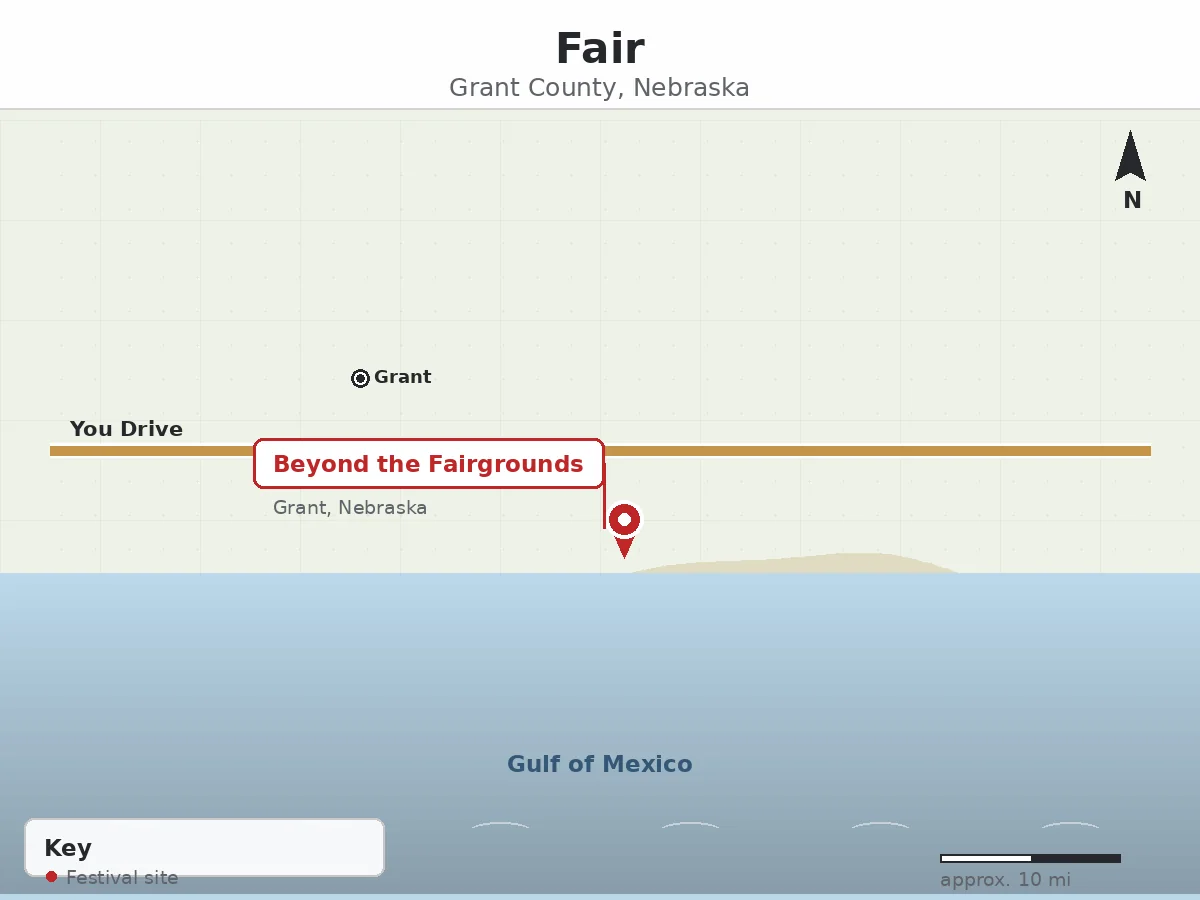
Hyannis is the county seat, set in the Sandhills of north-central Nebraska, and the fair is held there. Distances are the planning fact that matters: neighbouring towns are far apart, fuel and food are seat-town matters, and a trip to this fair is a deliberate drive rather than a detour. Set your watch the way the day sheet does, too: Hyannis keeps Mountain Time.
The Cost Question, Answered Honestly
No admission price for this fair — at the gate, at the rodeo, or for parking — is published in any fair-side source behind this article, so none is printed. Two warnings follow. First, the fair is not called free here, because nothing in its own record calls it free; an unpublished price is a gap in the paper, not a promise at the gate. Second, no figure from another Grant County may be borrowed: prices other states’ fairs publish belong to those fairs alone. Carry cash and settle the question on the ground.
Entering, Asking Ahead and Lodging
Exhibitors work through channels the record does not spell out: the four-county Extension structure is the documented route for 4-H matters, and local notice carries the rest. Visitors need the same habit of checking — confirm the current year’s days before driving, since the list’s spans have moved by a day or two between editions. For sleeping, the fair publishes no camping offer, so plan on ordinary lodging.
A Fair Weekend Built Around Sunday
Take the shape the record supports. Arrive in Hyannis on the Saturday of fair weekend and settle in slowly: walk the seat’s short streets, find the grounds, and let the county set its own pace, because a fair this size reveals itself by wandering rather than by itinerary. Give the exhibit side its due during the day, in whatever form the year’s notices present. Then let Sunday carry the weight the day sheet gives it: in the documented past edition, Sunday was the rodeo’s day — slack at noon and the performance at 5:00 p.m. under a long Sandhills evening — and a visitor who plans around that rhythm, while confirming it against the current year’s notices, plans the way this fair has actually run. Finish with the drive out across the hills at dusk, less a departure than the fair’s last exhibit.
Not the Other Grant Counties
Grant County is one of the commonest county names in America, and search results for this fair are mined with its namesakes. Three publish fuller records than Nebraska’s fair does; none of their facts belong here.
North Dakota’s Grant County, seated at Carson, publishes a complete fair book of its own — a well-documented fair that is simply not this one. New Mexico’s Grant County, seated at Silver City, has its own newspaper and ranch organisations reporting on its own fair; the coverage is colourful and entirely New Mexican. Arkansas’s Grant County, seated at Sheridan, publishes its own September fair tabloid. Nebraska’s fair has none of those counties’ machinery in its record, and importing any of it would invent a fair Hyannis does not hold. Fairs of the same county name also exist in West Virginia, Kansas, Indiana, Oklahoma and Washington. The test for any fact about the Hyannis fair is whether a Nebraska source stands behind it.
Before You Drive Into the Sandhills
- Confirm the current year’s fair days before travelling; recent editions have shifted by a day or two within early to mid-August.
- Set your watch and your plans to Mountain Time, the time the fair’s own rodeo paper keeps.
- Carry cash, because no gate, rodeo or parking price is published and none should be guessed.
- Do not budget on the fair being free; its record never says so.
- Book lodging as a separate plan, since no fair-week camping offer is published.
- Check any fact you find online against its state — a Grant County in North Dakota, New Mexico or Arkansas is a different county with a different fair.
- Look for 4-H and entry information through Nebraska Extension’s Central Sandhills Area.
- Allow generous driving time; Sandhills distances are long and services sparse.
Beyond the Fairgrounds
Hyannis itself is the first extension of the fair: a small ranching seat whose stores and courthouse square serve a county spread across hundreds of square miles of grass. The Sandhills around it are the real landscape exhibit — dune country under enormous skies, cattle on grass in every direction, roads that run straight into weather. Travellers pass ranch gates and windmills rather than attractions, and that spareness is the point: the fair makes most sense as this landscape’s own gathering, one weekend when a dispersed county converges on its seat.
Why a Small Fair’s Thin Record Still Counts
It would be easy to mistake a short paper trail for a slight event. This fair is better read the other way: a fair sustained by a county of a few hundred people, at the far end of long roads, is an organisational achievement larger counties never have to attempt. Its rodeo puts local riders on the same card as the region’s best, and its name has held its place on the statewide list without interruption across the years examined. A fair does not need a founding legend to matter; it needs to happen, in the same place, every August. This one demonstrably does.
Frequently Asked Questions
Where is the Grant County Fair and Rodeo held?
At Hyannis, the county seat of Grant County, Nebraska, in the Sandhills. Every recent statewide list places the fair there, and its past rodeo day sheet is headed with the town’s name. No fairgrounds street address is published.
Is the rodeo a separate event from the fair?
No. The rodeo is part of the event’s published name — the Grant County Fair and Rodeo — across every recent year’s statewide list. The detailed evidence for it is a past edition’s day sheet showing a Sunday performance at 5:00 p.m. Mountain Time with slack at noon; that card is fenced to its edition and is not a promise about any future year.
Has any admission price been published for this fair?
Nothing published answers that question. No gate, rodeo, parking or pass price appears in any fair-side source behind this article, and the fair is never described as free in its own record. Plan to pay what the ground asks on the day, in cash, and distrust figures attached to this fair’s name by sites writing about other Grant Counties.
Who runs the fair?
No fair board or agricultural society name is published for it in the Nebraska sources gathered, and this article invents none. The documented machinery is Nebraska Extension’s Central Sandhills Area, which serves Blaine, Grant, Hooker and Thomas Counties and describes the area as having four county 4-H councils and fairs.
What to Expect From the Next Grant County Nebraska Fair Festival
How often is the Grant County Nebraska Fair Festival held?
The fair appears on Nebraska’s statewide list year after year — across 2023, 2024, 2025 and 2026 in the record examined — always at Hyannis in early to mid-August under its fair-and-rodeo name. That unbroken run of listings is the basis for expecting it each year.
When is the next Grant County Nebraska Fair Festival?
On the pattern of the published lists, the next edition belongs in early to mid-August at Hyannis; the list carries the 2026 edition on August 7 to 9. The following year’s list is the document to trust for exact days, because spans have moved slightly between editions — three days in 2026, four in 2025, five in 2024.
Will the dates change?
They have moved within their season before, by a day or two at either end, while the town and the month stayed constant. Treat early to mid-August in Hyannis as the stable fact, and the precise span as something each year’s list settles.
The Fair at the End of the Long Road
This fair asks more of its visitors than most fairs do: a long drive, a time zone remembered correctly, and a willingness to take a small event on its own terms. What it offers in return is the thing big fairs spend fortunes imitating — a county gathered in one place, riders from the home ranches on the same card as the travellers, exhibits judged by neighbours. Its record is thin because its county is small, not because its fair is doubtful. Every August the list carries it at Hyannis, and Hyannis turns out.