Grant County Indiana Mississinewa 1812 Festival
On the first weekend of October, a piece of Grant County ground fills with canvas camps, woodsmoke and the crack of artillery, as reenactors rebuild the world of 1812 for three days. The event is Mississinewa 1812, a living history weekend organised by the Mississinewa Battlefield Society and held since 2025 on the society’s own property, a former gravel pit named Ahsenionki, between Marion and Gas City. It commemorates the Battle of Mississinewa, fought in this county in December 1812, and it has done so, with interruptions the record states plainly, since 1988. One point of naming deserves honesty at the outset: every published layer calls the event Mississinewa 1812, and none adds the word Festival to that name.
About Mississinewa 1812
Mississinewa 1812 is a living history event built around reenactment. Its published name appears in that short form on the organiser’s own site, in an encyclopedia layer and in a state tourism layer, while a state bicentennial legacy layer describes the same gathering more fully as the Mississinewa 1812 Living History Weekend, a description rather than a competing title.
The organiser is the Mississinewa Battlefield Society, whose name is printed across the layers in slightly different shapes, with and without a corporate suffix. A state tourism layer covering the 2025 edition notes that the event was sponsored by the society with the support of the Department of Natural Resources, a detail that belongs to that edition in that layer. The society is more than a presenter: since 2025 it has also been the landowner, hosting the weekend on property it bought for the purpose.
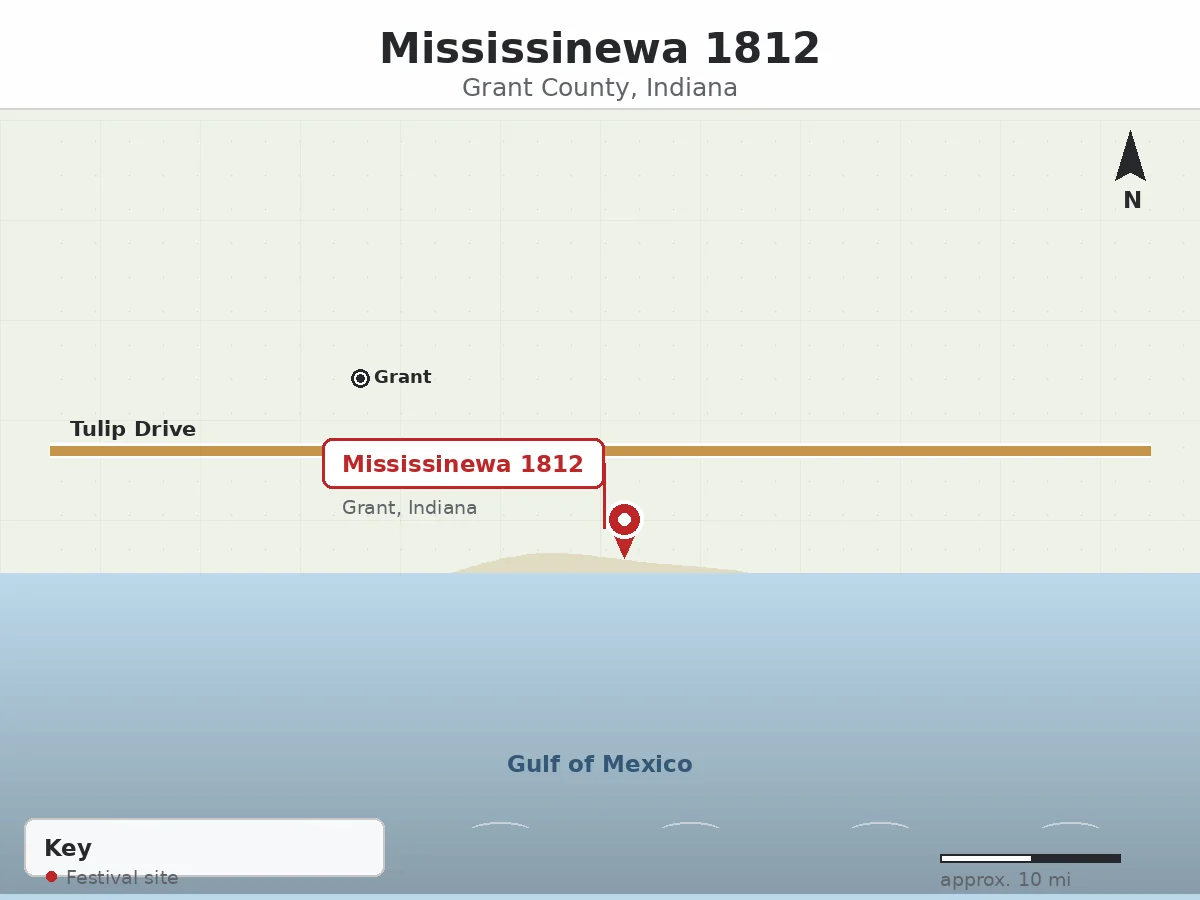
Geography needs the same care as names. Marion is the county seat of Grant County, and the organiser prints the event’s location as Marion. A visitor layer and an event-listing layer instead describe the Ahsenionki property as standing on the outskirts of Gas City, between Marion and Gas City, on East Tulip Drive. This account records the site exactly that way and does not pretend the layers agree on which side of a town line the ground sits.
Quick Facts
| Item | Detail |
| Published name | Mississinewa 1812; no published layer adds the word Festival |
| Organiser | Mississinewa Battlefield Society |
| Host county | Grant County, Indiana |
| Current site | Ahsenionki, the society’s own property on East Tulip Drive, between Marion and Gas City |
| Earlier site | Federally owned land near Marion, used from 1988 to 2023 |
| First held | 1988, according to a visitor layer citing the society and an encyclopedia layer |
| Commemorates | The Battle of Mississinewa, fought on 17 and 18 December 1812 |
| Documented recent editions | 3 to 5 October 2025 and 2 to 4 October 2026, with a further edition listed for 1 to 3 October 2027 |
| Admission | Ticketed, with dated single-entry tickets sold for 2026; no general price appears in the layers read |
| Programme | Daily battle reenactments, military encampments, a Native American village, Rivertown merchants and traditional artisans |
History
The layers agree that the event began in 1988: a visitor layer citing the society gives that year, and an encyclopedia layer’s history matches it, describing a run at the original site from 1988 to 2023. For those thirty-five years the weekend occupied federally owned land near Marion. The Battle of Mississinewa, fought in Grant County on 17 and 18 December 1812, is the historical event at the weekend’s centre; it is what the reenactment remembers, never to be confused with the modern gathering itself.
For a useful comparison, see the Gibson County Indiana Haubstadt Laufenfest Festival for another county festival.
The run at the old site was not unbroken. The encyclopedia layer records that the 2020 event was cancelled because of the COVID-19 outbreak. A second cancellation followed in 2024, this one during a land dispute that threatened the event’s home rather than merely its calendar. The response came in August 2024, when the organisers announced that they had purchased a disused gravel pit near Gas City, named the property Ahsenionki, and would host the event there. They did so from 2025, giving the society something it had never had in the Marion years: a permanent home on its own land.
Two claims about scale run through the record, and both are claims rather than measurements. The organiser bills Mississinewa 1812 as the largest War of 1812 living history event in the United States, a superlative repeated here as billing and not as an independently checked ranking. A visitor layer states that attendance has topped thirty thousand people in a single weekend, including thousands of students, and that figure likewise belongs to the layer that printed it. What the harder evidence supports is longevity: an event that began in 1988, survived two cancellations, lost one home and bought another is an institution in its county.
What to Expect
The centre of the weekend is the fighting. Daily battle reenactments, supported by artillery, restage the kind of engagement the original battle involved, and the camps around the field show how the armies lived between actions: American and British military encampments stand as separate period worlds. A Native American village presents the third presence in the story, and wilderness camps extend the picture to the edges of settlement.
Commerce and craft fill the ground between the camps. A settlement called Rivertown gathers period merchants and food purveyors, and traditional artisans demonstrate the hand trades of the era while music and storytelling run through the programme. One state bicentennial layer, describing its own edition, counted eighteen Rivertown food purveyors and thirty-five master craftspeople, naming printers, artists, gunsmiths, tinsmiths, silversmiths, soap makers, candle makers and blacksmiths among them; those counts belong to that layer’s edition, not a standing inventory. School groups get a dedicated doorway into all of this on Education Day, when demonstrations and reenactor-led interpretation are arranged for them; in 2026 that day fell on Friday 2 October, and the organiser’s page for it priced tickets at seven dollars each for students, teachers, bus drivers and chaperones, a price that applied to Education Day alone.
Planning Your Visit
Anyone arranging a trip should anchor it to the edition the organiser has actually announced, because this event’s recent history includes two cancelled years. The documented editions cluster on the first weekend of October: 3 to 5 October in 2025 and 2 to 4 October in 2026, with daily hours in the listings running from nine in the morning to four in the afternoon on Friday and Sunday and to five on Saturday. An encyclopedia layer’s dates list adds a further edition for 1 to 3 October 2027, to confirm nearer the time.
Entry is by ticket. For 2026 the organiser sold dated single-entry tickets, so a visitor chose a day and bought for that day; the one firm price in the record, seven dollars, covers only the 2026 Education Day and the school parties it names, and no general admission price appears in the layers consulted, so nobody should budget from that figure. Getting there means finding Ahsenionki on East Tulip Drive between Marion and Gas City; because the organiser prints the location as Marion while other layers place the property on the outskirts of Gas City, travellers should follow the organiser’s current directions rather than an old listing tied to the former federal site, which hosted its last edition in 2023.

A Sample Itinerary
A school party using the documented 2026 shape would build its visit around Friday. Education Day on 2 October 2026 ran inside the Friday hours of nine to four, with demonstrations and reenactor-led interpretation arranged for school groups. A class could spend that day moving between encampments and artisans with interpreters guiding the encounters, a more structured experience than a general visitor’s Saturday.
A general visitor following the same 2026 pattern might give Saturday, 3 October, the full run of its longer hours, nine to five: the battle reenactment with artillery as the day’s anchor, the American and British camps and the Native American village in the morning, then Rivertown for food and a slow circuit of the craftspeople, with music and storytelling filling the gaps. Sunday, 4 October, nine to four, suits a shorter second pass: the wilderness camps, any artisan missed the day before, and a final reenactment before the weekend closes. That rhythm is drawn from one documented edition; future editions may differ.
How It Compares
The closest comparison is also the easiest mistake to make. The Battle of Mississinewa was a real engagement fought in Grant County on 17 and 18 December 1812; Mississinewa 1812 is a modern living history weekend that commemorates it, and the two share a name, a county and little else. The battle belongs to the War of 1812’s history; the event began in 1988.
Against other War of 1812 reenactments elsewhere, the honest comparison is one of billing rather than verified ranking. The organiser presents this weekend as the largest event of its kind in the United States, and the visitor layer’s report of weekends topping thirty thousand people, students included, gives that claim some colour; but no layer independently measures this event against its counterparts, and other reenactments remain separate events with their own ground and traditions. What distinguishes Mississinewa 1812 in its own record is less size than situation: it commemorates a battle in the county where that battle was fought, and since 2025 it has done so on land its organising society owns outright.
A Visitor’s Checklist
- Confirm the current edition’s dates with the organiser, since the 2020 and 2024 editions were cancelled
- Buy the dated single-entry ticket for the specific day you plan to attend
- Head for Ahsenionki on East Tulip Drive, between Marion and Gas City, not the former site near Marion
- Allow a full day on Saturday, when the documented hours run longest
- Keep school groups to the Friday Education Day arrangements, including its own ticket price
- Leave time for Rivertown’s merchants and food purveyors between reenactments
- Seek out the artisan demonstrations, from blacksmiths to candle makers
- Treat the organiser’s largest-in-the-nation billing as a claim, not a statistic
Beyond the Festival
The record for this event keeps its geography tight. The ground itself is part of the story: Ahsenionki was a disused gravel pit near Gas City until the society bought it in August 2024 and turned it into a permanent living history site, so the land a visitor walks is the event’s newest chapter. Marion, the county seat, anchored the first thirty-five years as the town beside the federally owned land where the weekend ran from 1988 to 2023, and Gas City now stands in the listings as the community on whose outskirts the new property sits. Wider Grant County exploring is a visitor’s own to plan; the record ties this event to two towns, one battlefield landscape and one gravel pit that became a home.
Why Mississinewa 1812 Matters
Living history events are common; ones with this event’s biography are not. Mississinewa 1812 matters because it ties a specific December battle in Grant County to a recurring public act of memory, carried by a volunteer society rather than a commercial promoter. Its history shows the fragility underneath such traditions: a pandemic cancelled it in 2020, a land dispute cancelled it in 2024, and the society answered the second threat by buying land, an unusually concrete commitment for a reenactment organisation. Education Day adds a further dimension, turning the weekend into a teaching instrument for school groups, thousands of students among the crowds a visitor layer describes. An event that began in 1988, commemorating a battle from 1812, now sits on ground purchased in 2024 precisely so the commemoration can continue; that arc is the real significance.
Frequently Asked Questions
Why did the event leave its old site near Marion?
The encyclopedia layer records that the 2024 edition was cancelled during a land dispute, and that in August 2024 the organisers announced the purchase of a disused gravel pit near Gas City, named Ahsenionki. The event has been hosted on that society-owned property since 2025, after a run on federally owned land near Marion from 1988 to 2023.
Which battle does Mississinewa 1812 commemorate?
It commemorates the Battle of Mississinewa, fought in Grant County on 17 and 18 December 1812 during the War of 1812. The battle is the historical event; the weekend of reenactments, encampments and period crafts is the modern commemoration, begun in 1988.
What is Education Day, and what did it cost in 2026?
Education Day is the Friday programme arranged for school groups, offering demonstrations and reenactor-led interpretation; in 2026 it fell on Friday 2 October. The organiser’s Education Day page priced tickets at seven dollars each for students, teachers, bus drivers and chaperones. That price belonged to Education Day only; no general admission price appears in the layers read.
How big is the event, on the published evidence?
The organiser bills it as the largest War of 1812 living history event in the United States, and a visitor layer states that attendance has topped thirty thousand people in a weekend, including thousands of students. The first figure is the organiser’s billing and the second is that layer’s report; neither is an independently verified measurement.
What to Expect From the Next Grant County Indiana Mississinewa 1812 Festival
How often is Grant County Indiana Mississinewa 1812 Festival held?
The record shows a weekend staged in early October in the years it runs, beginning in 1988 and documented most recently for 2025 and 2026. It has not run without interruption: the 2020 edition was cancelled during the COVID-19 outbreak and the 2024 edition during a land dispute, so its rhythm is a recurring October fixture whose individual years depend on circumstances the organiser announces.
When is the next Grant County Indiana Mississinewa 1812 Festival?
After the documented edition of 2 to 4 October 2026 at Ahsenionki, the further date in the record is 1 to 3 October 2027, which appears in an encyclopedia layer’s list of the event’s dates. That listing is the basis for expecting an edition then; because this event has cancelled editions before, the organiser’s own announcement is the confirmation a traveller should wait for.
Will the dates change?
The early-October placement has been consistent across the documented editions, falling on the first weekend of the month in 2025, 2026 and the listed 2027 dates. The greater change in this event’s life has been place rather than timing: it moved in 2025 from federally owned land near Marion to the society’s own Ahsenionki property. Exact dates for any future year should still be taken from the organiser’s current announcement.
Closing
Mississinewa 1812 is, on the evidence of its layers, an event that refused to end. It began in 1988, ran for thirty-five years on federal land near Marion, lost a year to a pandemic and another to a land dispute, then bought itself a permanent home in a worked-out gravel pit and opened there in 2025. Its name in print is simply Mississinewa 1812, its organiser the Mississinewa Battlefield Society, and its subject a December fight in 1812 that Grant County still gathers to reconstruct each October, artillery, artisans, Rivertown and all.