Gilmer County Georgia Georgia Apple Festival
October in Ellijay belongs to the apple harvest, and the Georgia Apple Festival is the occasion the town builds around it. Across two weekends at the Ellijay Lions Club Fairgrounds it offers handmade arts and crafts, demonstrations, live music and food centred on the county’s best-known crop. Ellijay is the county seat of Gilmer County, and the festival carries the county’s name rather than the town’s. The event is run as a joint venture of the Ellijay Lions Club and the Gilmer County Chamber of Commerce, and its 2026 edition was billed as the fifty-fifth year. Guide and magazine layers state that it began in 1971 as an arts-and-crafts show tied to the local apple harvest; both stand in the published record, and this article keeps each in its own place.
About the Festival
The organiser’s own name for the event is the Georgia Apple Festival, and that is the form the state tourism office and local news layers use as well. One festival-guide site calls the same event the Ellijay Apple Festival; that wording is recorded here as that site’s form only, and it is not adopted as the festival’s name anywhere in this article.
The Ellijay Lions Club’s own page and the Chamber’s guide both describe the festival as a joint venture of the two organisations, so neither partner is treated here as a helper to the other, and neither is dropped. The fairgrounds carry the Lions Club’s name, which makes the Chamber’s equal billing worth stating plainly rather than assuming.
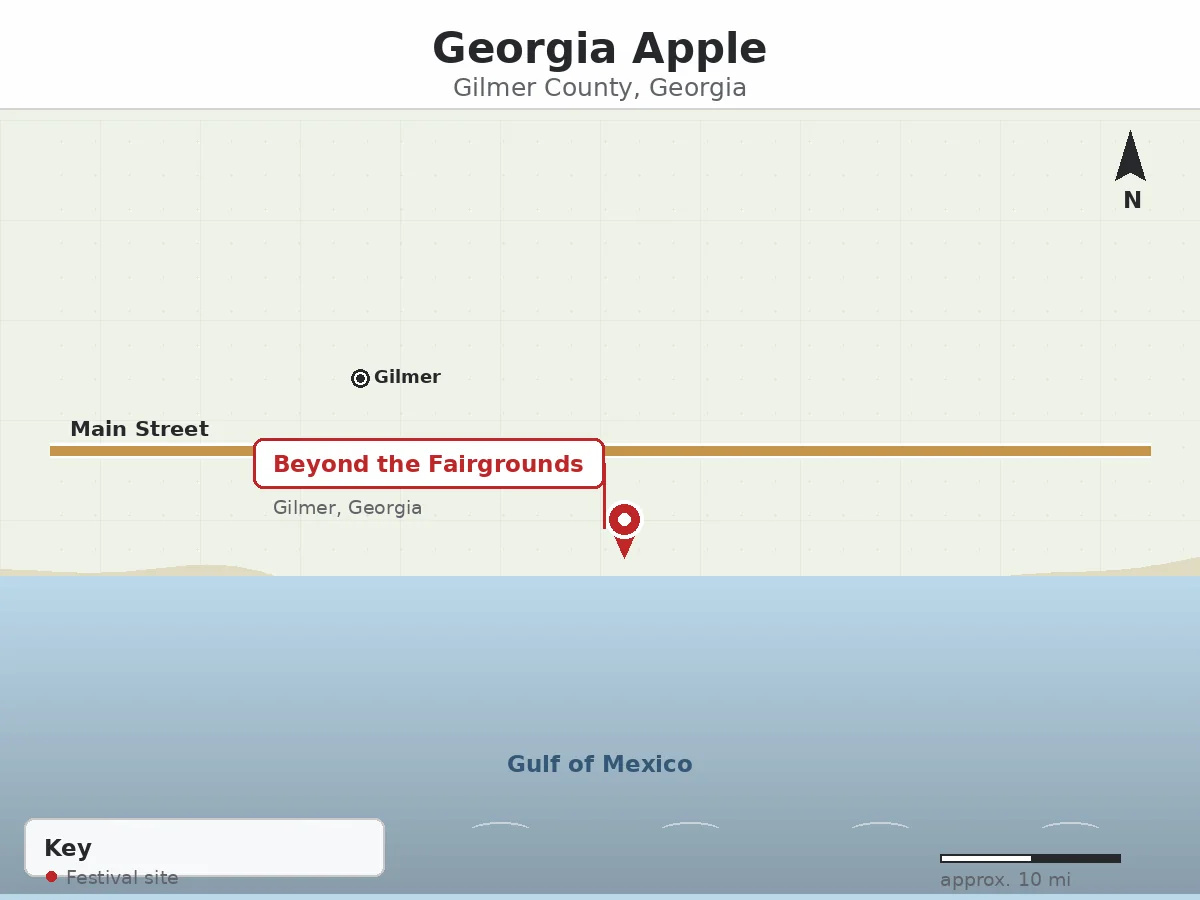
The grounds sit at 1729 South Main Street in Ellijay, printed in that spelled-out form in the organiser and Chamber layers; a local news layer prints the same address in a shortened form. One tourism layer truncates the town’s postcode in print, an error in that layer, noted here only so it is not copied. Ellijay is the Gilmer County seat, and the home ground is the fairgrounds on the town’s main street rather than a downtown street closure, a distinction that matters when the downtown sister event enters the picture.
The organiser’s own rule places the festival on the second and third weekends of October, rain or shine per the Chamber layer. In 2026 those weekends were October 10 and 11 and October 17 and 18, Saturdays 9 a.m. to 6 p.m. and Sundays 9 a.m. to 5 p.m.
For a useful comparison, see the Fulton County Georgia Georgia Renaissance Festival for another county festival.
Quick Facts
| Item | Detail |
| Published name | Georgia Apple Festival |
| Host town | Ellijay, the Gilmer County seat |
| Organisers | Ellijay Lions Club and Gilmer County Chamber of Commerce, as a joint venture |
| Venue | Ellijay Lions Club Fairgrounds, 1729 South Main Street, Ellijay |
| 2026 dates | October 10 and 11 and October 17 and 18 |
| Hours | Saturdays 9 a.m. to 6 p.m.; Sundays 9 a.m. to 5 p.m. |
| Admission, 2026 | Ten dollars per person, sold at the gate |
| Child admission | Printed inconsistently: under twelve free in some layers, twelve and under free in others |
| Billing | The 2026 edition billed as the fifty-fifth year |
| Stated start | 1971, as an arts-and-crafts show tied to the apple harvest |
History
The earliest chapter the sources offer is a modest one. A magazine layer states that the festival started in 1971 as an arts-and-crafts show connected to the local apple harvest, and a festival-guide layer states that it has been celebrated every October since 1971. This article records 1971 as the stated start in those layers and nothing more. No organiser layer tells the founding story in its own words, so the beginning rests on guide and magazine testimony.
The 2026 edition was billed as the fifty-fifth year and the fifty-fifth Annual in tourism, news and guide layers. That billing is recorded here exactly as a billing. It would be easy to run the arithmetic in either direction, from the billing back to a start year or from the stated start forward to an edition number, but the record prints the two figures in different layers for different purposes, and this article never uses one to recompute or confirm the other.
What the layers do show across the years is continuity of structure: the two-weekend October placement appears in the organiser’s own frequently asked questions as a standing rule rather than a 2026 arrangement, and both partners’ publications state the joint venture in the present tense. The fairgrounds setting, the handmade craft emphasis and the harvest timing persist through every description.
What to Expect
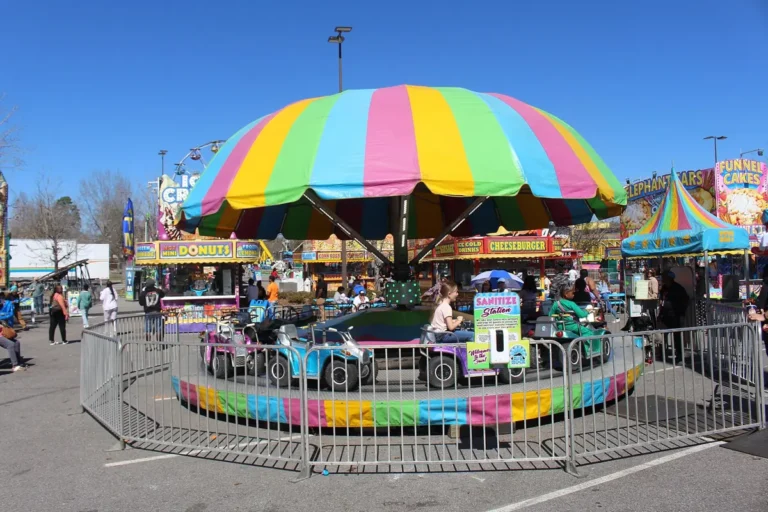
Handmade goods dominate the grounds. Tourism and news layers for 2026 put the count at more than two hundred fifty vendors of handmade arts and crafts, so the fairgrounds read primarily as a large marketplace of made goods rather than a row of resellers. Organiser-derived layers add on-site demonstrations, so visitors can watch work being made as well as buy it, and live music runs alongside the stalls.
Food is the other half of the grounds. A tourism layer lists festival food and apple goods, which in an Ellijay October means the harvest shows up on the plate too. Between the craft rows, the demonstrations and the food stands, a full day inside the gate assembles itself.
Two set pieces belong to the first weekend rather than the grounds: guide layers place a downtown parade on the first Saturday at 10 a.m. and the Georgia Apple Festival 5K road race that same morning, both away from the fairground fence. A magazine layer bills the 2026 running of that race as its fiftieth annual running; that anniversary is the race’s own billing, recorded for the race alone, and it says nothing about the festival’s age. The race also carries its own entry fee, which is a component fee for runners and is never the festival’s admission. Guide layers further list an antique car show among the festival’s attractions.
Crowd expectations need careful labelling: one travel-guide layer claims over fifty thousand visitors each year, but that figure is that layer’s claim only, not an organiser number and not a counted attendance, and no counted attendance for any edition is published anywhere in the record.

Planning Your Visit
On the headline figure the record is settled. The 2026 gate price was ten dollars per person, sold at the gate, and the organiser, Chamber, tourism and news layers agree on it. The ten dollars buys entry to the fairgrounds festival only; the road race’s entry fee is separate, and the downtown sister event described below charges nothing at all.
The child cutoff, by contrast, is genuinely unresolved in print. The Lions Club page and the Chamber guide between them print both that children under twelve are free and that children twelve and under are free; a news layer carries both forms in one item, and a tourism rate line prices ages twelve and older at ten dollars beside text freeing children under twelve. Every layer agrees on the ten dollars and disagrees about whether a twelve-year-old pays it, so a family travelling with a twelve-year-old should arrive ready for either reading at the gate.
Choosing a weekend is the second decision: the first carries the parade and the road race downtown on its Saturday morning, while the second repeats the fairgrounds festival without those set pieces in the gathered descriptions. Saturdays run longer, 9 a.m. to 6 p.m., against Sundays at 9 a.m. to 5 p.m., and the Chamber layer’s rain-or-shine wording means wet weather alone would not call a day off.
A Sample Festival Day
Runners start the first Saturday early with the road race, and spectators can follow it with the downtown parade at 10 a.m. From downtown, the day moves to the fairgrounds on South Main Street, where the gate takes ten dollars a person and more than two hundred fifty stalls of handmade work open out. Late morning suits a slow pass through the craft rows while demonstrations run, with festival food and apple goods for lunch. The antique car show and live music fill the afternoon, and the grounds stay open until 6 p.m., the longest of the four days. A Sunday visit compresses the same programme into 9 a.m. to 5 p.m.
How It Compares
The closest comparison stands a short distance away and shares the same weekends. The Apple Arts Festival is a separate event held downtown on the same two weekends, organised by the Gilmer County Chamber of Commerce alone and free to enter. The fairgrounds festival is the joint venture with the ten-dollar gate; the downtown festival is the Chamber’s own and charges nothing. Their venues, organisers and admission arrangements are kept apart here: the fairgrounds price should never be quoted as the downtown event’s, nor downtown’s free entry taken as a way into the fairgrounds.
U-pick operations in Gilmer County, and Mercier Orchards across the line in Fannin County, are a third thing again, running their own admissions and seasons. They supply the harvest the festival celebrates, but none of them is the festival and none of their charges is its gate price.
Visitor Checklist
- Decide which weekend you want, since the parade and road race fall on the first Saturday
- Carry ten dollars per adult for the fairgrounds gate
- Be ready for either reading of the child cutoff if a twelve-year-old is with you
- Treat the road race entry fee as a separate charge from festival admission
- Note Saturday hours run to 6 p.m. while Sunday closes at 5 p.m.
- Keep the downtown Apple Arts Festival and the fairgrounds festival as separate plans
- Do not expect a rain postponement, as the Chamber layer answers with rain or shine
- Remember orchard visits nearby carry their own separate admission
Beyond the Fairgrounds
The festival weekends spill into the rest of Ellijay. The parade and the road race already pull the first Saturday downtown, and the free Apple Arts Festival gives the town centre its own programme on the same days, so a weekend can move between fairgrounds and downtown streets rather than choosing one. Gilmer County’s u-pick orchards work their own harvest season alongside it, each under its own admission, and their apple-growing landscape is the reason a harvest festival anchors the county’s October.
Why the Festival Matters
For Gilmer County, the festival converts the harvest into a public occasion. A joint venture between a civic club and the county chamber, each confirming the partnership in its own publications, is sturdier than a single promoter, and the fifty-fifth-year billing for 2026 together with the stated 1971 start gives the event one of the longer published histories in the county’s calendar, each figure standing on its own layer’s authority. The vendor count above two hundred fifty shows the scale the handmade market has reached, and the travel-guide layer’s claim of over fifty thousand visitors a year, while only a claim, records how large the festival looms in descriptions of the county, counted or not.
Frequently Asked Questions
Why do the sources disagree about whether a twelve-year-old needs a ticket?
Because the layers print the child cutoff in two forms that differ by exactly that one year. Some print free entry for children under twelve, making a twelve-year-old a paying visitor, while others print free entry for children twelve and under, letting the same child in free. One news layer even carries both forms in the same item. Every layer agrees the gate price is ten dollars; only the boundary age moves. The published record contradicts itself at age twelve, and this article leaves the contradiction standing rather than picking a side.
Who actually runs the Georgia Apple Festival?
Two organisations run it together: the Ellijay Lions Club and the Gilmer County Chamber of Commerce each describe the festival in their own publications as a joint venture of the two, so the credit belongs to the partnership. That shared credit is also the cleanest way to tell this festival from the downtown Apple Arts Festival on the same weekends, which the Chamber runs by itself.
Is the downtown Apple Arts Festival part of the fairgrounds festival?
No. They are separate events sharing two October weekends and an apple theme. The Apple Arts Festival stands downtown, is organised by the Chamber alone and is free. The Georgia Apple Festival stands at the Lions Club Fairgrounds, is run by the Chamber and the Lions Club jointly and charges ten dollars at the gate. Sharing a weekend does not merge them, and neither event’s admission describes the other’s.
How should the fifty-fifth-year billing be read alongside the stated 1971 start?
As two separate statements from separate layers. Guide and magazine layers state the start as 1971, when the event began as an arts-and-crafts show tied to the harvest. Tourism, news and guide layers bill the 2026 edition as the fifty-fifth year. Both figures are part of the record, but neither is used in this article to recompute, correct or confirm the other, and no founding story from the organisers themselves appears in the gathered layers.
What to Expect From the Next Gilmer County Georgia Georgia Apple Festival
How often is Gilmer County Georgia Georgia Apple Festival held?
The organiser’s own rule, printed in its frequently asked questions, places the festival on the second and third weekends of October, giving it two weekends in its home month rather than a single long weekend. The Chamber layer’s rain-or-shine wording and the 2026 dates, October 10 and 11 and October 17 and 18, both follow that pattern.
When is the next Gilmer County Georgia Georgia Apple Festival?
No organiser-announced specific dates for a coming edition appear in the gathered record. The record offers only the standing rule of the second and third weekends of October, which says where in the month the festival is expected to land without confirming any particular year’s days. Until the organisers publish dates, any specific future weekend would be a guess dressed as a schedule.
Will the dates change?
The festival’s placement rests on a rule about weekends rather than on fixed calendar dates, so the exact days necessarily move from year to year as the October calendar shifts. What could genuinely change is the rule itself, and nothing in the gathered layers signals a move away from the second and third weekends. The hours have kept their own pattern of longer Saturdays and shorter Sundays, but those too are published edition by edition.
Closing
The Georgia Apple Festival asks little of its visitors beyond ten dollars at a fairgrounds gate and a decision about which of two October weekends to claim. In return it offers one of Georgia’s longest-running harvest gatherings on paper, a handmade market of real scale and a town whose chamber and civic club both stand in its story. Plan for the child-cutoff ambiguity if it touches your family, keep the downtown sister event as its own free pleasure, and let the apple harvest set the pace of the weekend.