Lake County Indiana Pierogi Festival
For three days each July, one downtown street in Whiting, Indiana, turns into the setting for one of the largest food festivals anywhere in its region. The event takes over 119th Street across the last full weekend of the month, and getting in costs nothing, whatever the weather decides to do. Its published name is shorter than the title at the top of this page: the organiser, the regional tourism authority and an encyclopedia article all call it Pierogi Fest, and the organiser prints that name with a trademark mark attached to it. The longer wording, with Festival spelled out in full, belongs to indexes and listings rather than to the people who actually stage the weekend. Behind the celebration stands the Whiting-Robertsdale Chamber of Commerce, and the crowds the various accounts describe are counted in the hundreds of thousands, even if those accounts cannot agree on an exact figure. Whiting is not the seat of Lake County; that honour belongs to Crown Point, a fact worth keeping straight, because this festival belongs entirely to Whiting and to the street it closes down each summer.
About Pierogi Fest
Pierogi Fest is a three-day street festival built around a single beloved food, and everything in its programme circles back to that theme. The organiser layers describe a weekend of parades, contests, dancing and eating spread along 119th Street in downtown Whiting. The name itself needs a small explanation. In the organiser’s own materials the event is Pierogi Fest, printed with a trademark symbol that this article deliberately leaves off, and the tourism authority and the encyclopedia article use the same short form. One layer prints the organiser’s name with a longer dash, Whiting–Robertsdale Chamber of Commerce, but every layer is pointing at the same chamber and the same festival. The chamber’s role is central: its own site carries the announcements, including the dates of the edition still to come, and its homepage tells the founding story in the chamber’s own words. What emerges is an event proudly local in its organisation and enormous in its draw.
Quick Facts
| Item | Detail |
| Published name | Pierogi Fest |
| Organiser | Whiting-Robertsdale Chamber of Commerce |
| Host town | Whiting, Lake County, Indiana |
| Setting | 119th Street, downtown Whiting |
| County seat | Crown Point (Whiting is not the seat) |
| Timing | Three days over the last full weekend of July |
| Hours | Friday and Saturday, eleven in the morning to eleven at night; Sunday, eleven to five |
| 2026 edition | 24 to 26 July 2026 |
| 2027 edition | 23 to 25 July 2027, announced on the organiser’s own site |
| Admission | Free, rain or shine |
History
The festival’s beginnings come with a disagreement that the sources themselves create, and honesty requires leaving it visible. The organiser’s own homepage tells the story this way: what started in nineteen ninety-three as a fifty-foot stretch of booths and one thousand two hundred pierogi grew into the present event. That single sentence gives the founding a date, a scale and a menu. Two other layers, however, tell it differently. The encyclopedia article and a regional guide layer both state that the festival was first held, or inaugurated, in nineteen ninety-four, one year later than the chamber claims. Neither side of that one-year gap can be preferred on the evidence available, so the founding year has to be reported as contested: nineteen ninety-three in the organiser’s telling, nineteen ninety-four in the encyclopedia and guide accounts. What the layers do agree on is who founded it. The organiser and the encyclopedia article name the same three founders, Marty Dybel, Tom Dabertin and Darlene Beerling, and that shared detail anchors the story even while the calendar refuses to settle. The later history has one clear interruption. The encyclopedia layer records that the twenty twenty edition was cancelled because of the pandemic, and that the festival returned in twenty twenty-one. One encyclopedia summary box also prints a status that sits oddly beside those announced editions; where currency is concerned, the organiser’s own announcements govern, and they describe a festival very much alive.
What to Expect
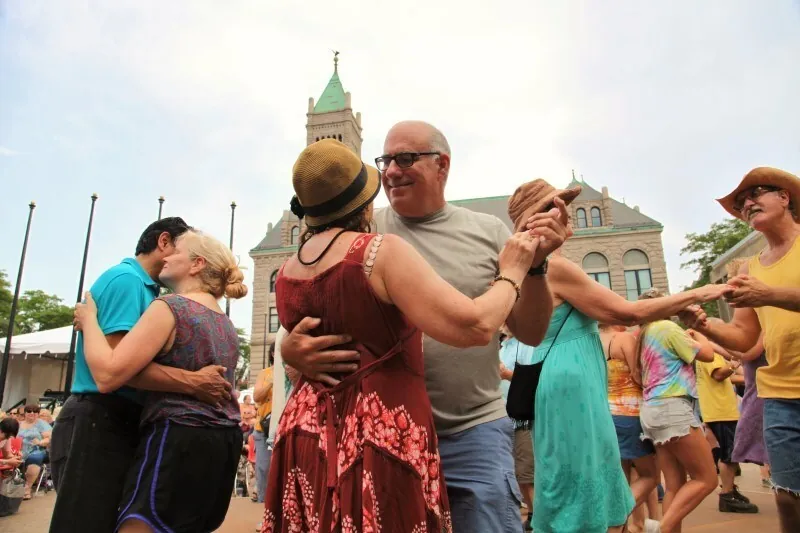
Three long days of programming fill the closed street, and the documented elements mix ceremony with cheerful absurdity. The centrepiece procession is the Polka Parade, which sets out from Forsythe Park before making its way into the festival grounds. Around it, the organiser and encyclopedia layers list a pierogi toss and a pierogi eating contest, for those who prefer competition to consumption, and a polka dance contest for those who would rather move than eat. Certain beloved fixtures return by name: the Buscias, Mr. Pierogi and the Lawnmower Brigade all appear in the programme descriptions as established characters and acts of the weekend. Live music plays on multiple stages across the three days, so the street carries a soundtrack from opening to close. Feeding the crowd is the work of dozens of food vendors, and pierogi in their many forms sit at the centre of the offer, with the surrounding stalls rounding out a full street-fair menu. Nothing in the documented programme requires a ticket or a reservation; the shape of the event is a street you wander, sampling and watching as you go.
Planning Your Visit
The practical shape of the weekend is simple to grasp. Friday and Saturday run long, from eleven in the morning until eleven at night, while Sunday is the short day, opening at eleven and closing at five. Anyone wanting the fullest version of the festival should aim for one of the two long days, and anyone who prefers a gentler pace can use Sunday’s shorter span. Admission is free, and the organiser and tourism layers both stress that the festival goes ahead rain or shine, so clothing should be chosen for the weather Lake County actually delivers rather than the weather a visitor hopes for. The twenty twenty-six edition occupies 24 to 26 July, and the organiser has already announced the next one for 23 to 25 July twenty twenty-seven, which gives planners an unusually long runway. The festival’s ground is 119th Street in downtown Whiting, a single street, which keeps navigation easy: arrive, find the street, and the event unfolds along it. Because the layers describe crowds in the hundreds of thousands, patience at the food stalls is part of the bargain, and building slack into the day is the wisest single preparation a visitor can make.
For a useful comparison, see the LaGrange County Indiana Shipshewana Antique Festival for another county festival.
A Sample Weekend Itinerary
A workable way to take in the weekend is to spread its pleasures across all three days rather than compressing them into one. Begin on Friday with a slow first pass along 119th Street, using the long eleven-to-eleven span to learn where the stages sit and which food vendors draw the longest lines. Save the deepest eating for Saturday, the festival’s other full day, and give the Polka Parade its due by positioning yourself along the route as it comes in from Forsythe Park. Saturday is also the natural day to watch the contests, the pierogi toss, the eating contest and the polka dancing, with the Buscias, Mr. Pierogi and the Lawnmower Brigade woven through the programme. Let Sunday be the farewell: the day ends at five, so a late-morning arrival still leaves hours for a final round of the stalls, one more set of live music, and a last helping of the food the whole weekend celebrates.
How It Differs From the Pennsylvania Event
Anyone searching the name will eventually meet a second pierogi festival, held in Edwardsville, Pennsylvania, and the two should not be confused. The Pennsylvania event enters the published record used here only sideways, through a trademark dispute mentioned in the encyclopedia layer, which tells its own story about how strongly the name is guarded. No details of the Edwardsville event’s programme, dates or character are borrowed in this article, because none were documented in the layers read for the Whiting festival. The distinctions that matter are plain: the festival described here sits in Whiting, Indiana, runs on the last full weekend of July, answers to the Whiting-Robertsdale Chamber of Commerce, and carries the short published name Pierogi Fest. A celebration in a Pennsylvania borough, under a similar banner, is a separate undertaking with its own organisers and its own history, and travellers planning around the Indiana weekend should make sure their plans point at the right state.
Visitor Checklist
- Confirm the dates for the year you plan to attend, since the weekend is fixed by the calendar rather than by a set date.
- Remember that Sunday closes at five, hours earlier than Friday and Saturday.
- Dress for the actual forecast, because the festival runs rain or shine.
- Arrive hungry and pace your eating across several vendors instead of one.
- Give the Polka Parade time in your day rather than treating it as background.
- Carry patience for queues, which the claimed crowd sizes make inevitable.
- Leave Sunday afternoon unhurried so the early close does not cut your visit short.
Beyond the Festival
The festival’s footprint is compact, and that compactness is part of its character. Forsythe Park serves as the parade’s starting point, so the park is woven into the weekend even though the celebration itself belongs to 119th Street. Downtown Whiting supplies the rest of the stage: a working main street that the chamber and its vendors convert, for three days, into a fairground. Visitors who want to understand the event should understand that setting, a single street in a small Lake County city, rather than a sprawling fairground complex. The contrast between the modest geography and the enormous claimed attendance is the festival’s signature. Beyond the weekend, the chamber’s own site is where the next edition takes shape in public, with dates announced well ahead. A street, a park, a chamber of commerce and a dumpling have proved to be enough.
Why It Matters
By the measures its own layers offer, this is one of the region’s largest festivals, and its significance starts with that scale arriving in a small city. A chamber of commerce in Whiting sustains a weekend that the organiser describes as drawing almost three hundred thousand visitors each year, a figure large enough to reshape how a town of Whiting’s size experiences its own downtown. The event also carries a cultural thread: the polka music, the dancing, the Buscias and the parade all celebrate a heritage that the pierogi itself announces, turning a filled dumpling into the emblem of a whole community’s story. Its survival matters too. The festival absorbed a cancelled edition in twenty twenty and returned the following year, and the organiser has already published dates for twenty twenty-seven, which speaks to an institution planning in years rather than scrambling each summer. Few street festivals anywhere can point to a founding dispute, a contested trademark and crowds claimed in the hundreds of thousands, all at once. Whiting’s can.
Frequently Asked Questions
How many visitors does Pierogi Fest draw each year?
The layers disagree, and their figures are best kept side by side as claims rather than blended into one number. The organiser says almost three hundred thousand visitors each year. A tourism layer puts it higher, at more than three hundred thousand. The encyclopedia article offers two figures of its own: more than two hundred fifty thousand in its main text, and three hundred fifty thousand in its summary box. Every version agrees the crowd is enormous; they simply never settle on how enormous.
Was the festival first held in nineteen ninety-three or nineteen ninety-four?
Both years have a source, and this article adopts neither. The organiser’s homepage describes the event as starting in nineteen ninety-three, when it was a fifty-foot stretch of booths serving one thousand two hundred pierogi. The encyclopedia article and a regional guide layer state instead that it was first held, or inaugurated, in nineteen ninety-four. The founders, at least, are not in dispute: Marty Dybel, Tom Dabertin and Darlene Beerling are named identically by the organiser and the encyclopedia.
What hours does the festival keep across its three days?
Friday and Saturday are the long days, running from eleven in the morning to eleven at night. Sunday is shorter, opening at eleven in the morning and closing at five in the afternoon. The whole event occupies the last full weekend of July, so those hours attach to whichever Friday, Saturday and Sunday close out the month.
Has the next edition already been announced?
Yes. The organiser’s own site announces the twenty twenty-seven edition for 23 to 25 July, following the twenty twenty-six edition on 24 to 26 July. Announcements on the organiser’s site are the authoritative source for the festival’s calendar, and they carry more weight than summary boxes elsewhere that have printed a status out of step with those dates.
What to Expect From the Next Lake County Indiana Pierogi Festival
How often is Lake County Indiana Pierogi Festival held?
It returns once each summer, anchored to the last full weekend of July. The organiser’s layers describe a single three-day edition every year, and the announced twenty twenty-six and twenty twenty-seven dates both follow that rhythm, sitting on the final full weekend of the month in their respective years.
When is the next Lake County Indiana Pierogi Festival?
Going by the organiser’s own site, the next edition after the twenty twenty-six weekend of 24 to 26 July is announced for 23 to 25 July twenty twenty-seven. Those dates come from the organiser directly, which makes them the firmest forward-looking detail in the whole published record.
Will the dates change?
The rhythm holds steady even while the calendar numbers shift. Because the festival is tied to the last full weekend of July rather than to fixed calendar dates, the actual days shift slightly from year to year, as the move from 24 to 26 July in twenty twenty-six to 23 to 25 July in twenty twenty-seven shows. A change of weekend would contradict everything the organiser publishes, so visitors can plan around the pattern with confidence while still checking the announced dates for their year.
Closing Thoughts
Pierogi Fest asks little of its visitors: a free street, three July days, and an appetite. In return it offers a parade that walks in from a park, contests built around its namesake food, characters its regulars greet by name, and a founding story with a one-year hole that even its own sources cannot patch. Read carefully, the record is generous but not tidy, and this account has kept its untidiness where the sources put it. What is certain is the shape of the thing: Whiting, 119th Street, the last full weekend of July, and a chamber of commerce already counting down to the next edition.