Geneva County Alabama Falling Leaves Intertribal Gathering Powwow Festival
In the small city of Samson, in the western part of Geneva County, Alabama, October brings a gathering unlike the fairs, cook-offs and pageants that fill most county calendars. The Falling Leaves Intertribal Gathering Powwow is built around Native American heritage rather than livestock, midway rides or headline concerts. Its formally documented elements are few and worth naming exactly: traditional dance and dress, food vendors and a campout, hosted by the city of Samson each October.
A word about the name is necessary before anything else. The event’s own recorded name is the Falling Leaves Intertribal Gathering Powwow, the form used by the Encyclopedia of Alabama in its entry on Samson. The longer title at the head of this article, Geneva County Alabama Falling Leaves Intertribal Gathering Powwow Festival, comes from the listing sheet that commissioned the piece; it wraps the event’s own name in the county, the state and the word Festival. The two forms describe one and the same Samson gathering.
Candour about the evidence matters more with this event than with most. Research found no organiser website, no official programme and no festival-side page for the gathering, so nothing here names an organiser, prints a venue address, quotes an admission price or offers a founding year. What can be verified is one authoritative encyclopedia description, still carried in a revision dated May 2025, together with short online videos labelled as a Samson pow wow in 2025. Everything that follows is built on that narrow but solid footing.
About the Festival
The documented core of the gathering can be stated in a single breath. Each October, the city of Samson hosts its Falling Leaves Intertribal Gathering Powwow, an event that celebrates the Native American heritage of the region through traditional dance and dress, with food vendors on hand and a campout woven into the occasion. That sentence, drawn from the Encyclopedia of Alabama, is the fullest formal description research could locate, and this article treats it as the boundary of what is known.
The word intertribal carries real information. In powwow usage it generally marks a gathering open across tribal lines, where dancers, singers and visitors from many Native nations take part side by side, rather than a ceremony closed to one community. A gathering billed that way is, by design, a meeting place, with neighbours who share the county but not the ancestry among its intended audience.
For a useful comparison, see the Franklin County Alabama Downtown Hoedown Festival for another county festival.
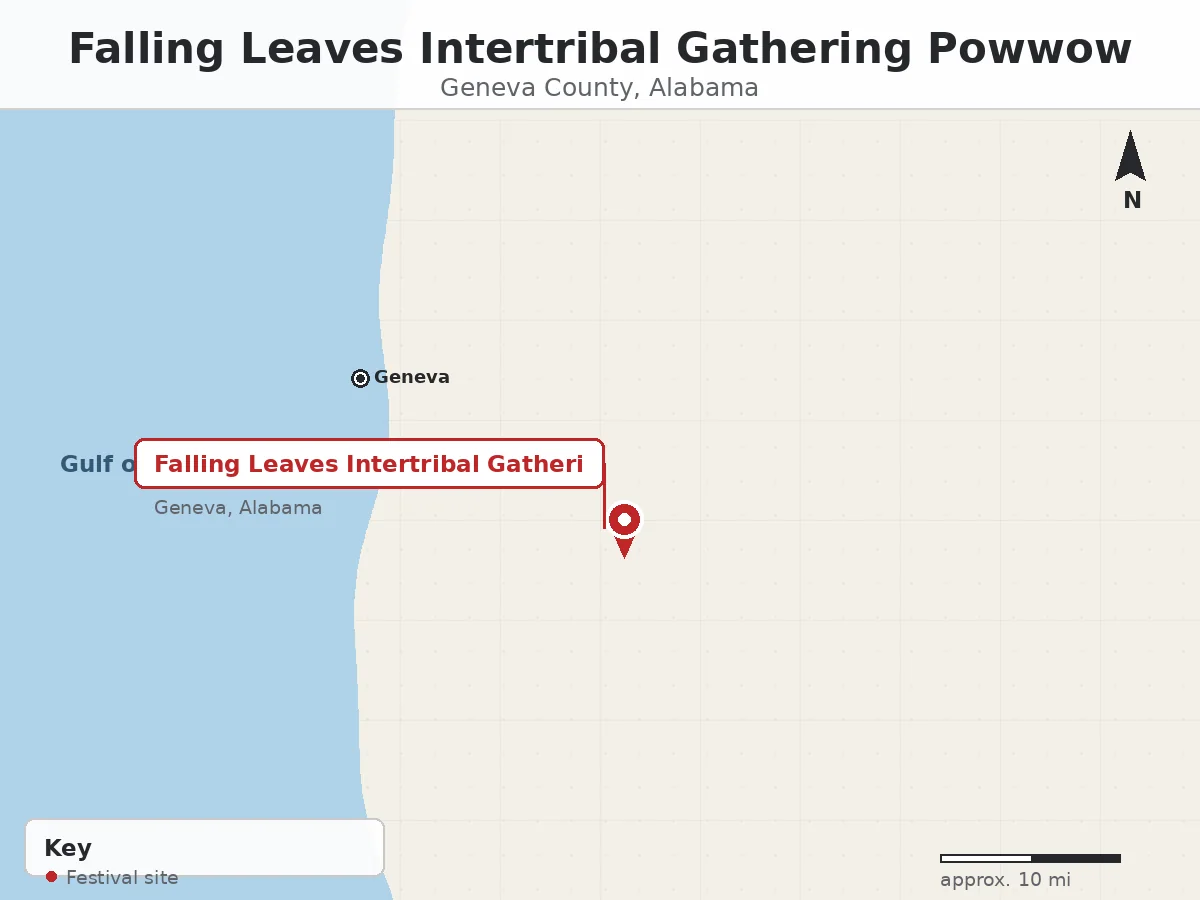
Samson itself is a small city set in the western side of Geneva County, in the Wiregrass country of southeastern Alabama. It hosts the gathering; it does not administer the county. The county seat of Geneva County is the separate city of Geneva, a distinction directory listings sometimes blur. The powwow belongs to Samson’s own calendar and to the community that turns out for it each autumn.
Quick Facts
| Detail | Record |
| Event name | Falling Leaves Intertribal Gathering Powwow |
| Host town | Samson, Geneva County, Alabama |
| County seat | Geneva; Samson hosts the event but is not the seat |
| Season | Each October |
| Purpose | Celebrating the Native American heritage of the region |
| Documented elements | Traditional dance and dress, food vendors, a campout |
| Named in print | Encyclopedia of Alabama entry on Samson |
| Organiser | Not published in any verified source |
| Venue and exact dates | Not published in any verified source |
| Admission and founding year | Not published; no founding year documented |
History
The honest history of this gathering is mostly a history of a short paper trail. The Encyclopedia of Alabama published its Samson entry in 2012, and the entry already spoke of the powwow in the present tense, as an established October fixture the city hosts each year. Wording like that tells a careful reader the event predates the entry, but it gives no first year, no founder and no founding story, and none has surfaced since.
That entry remains the anchor of the record. It was revised in May 2025, and the revision still describes the gathering in the same terms. A description carried forward through a fresh editorial revision is decent evidence the event remained a living part of the city’s calendar.
Beyond the encyclopedia, the trail thins to fragments. Short videos posted online and labelled as a Samson pow wow in 2025 suggest the gathering was held that year, which fits the picture of an event continuing on local momentum. No newspaper feature, anniversary article or organiser history could be verified, so claims about decades of history or named founding families have no place here. The gathering’s past, on present evidence, is real but unwritten.
Thin documentation is common for small-community gatherings and is not, by itself, a mark against an event; gatherings sustained by volunteers and word of mouth often leave almost nothing beyond a line in a reference work. What the record does prove is modest but genuine: a named powwow, in a named small city, returning each October in the description of the state’s own encyclopedia.
What to Expect
Dance and dress stand at the centre of the documented description, and visitors should understand what that means at a powwow. Dancing is not a stage show bolted onto a fair; at gatherings of this kind it is the main event, carried out in traditional dress that dancers have made and maintained themselves. The outfits, often called regalia, are personal and meaningful rather than costumes, and they deserve the respect due to something handmade and significant.
General powwow etiquette is worth learning before attending any gathering, this one included. Spectators watch from outside the dancing area, listen for the announcer’s guidance, and ask before taking close photographs of individual dancers, since some moments and some outfits should not be photographed at all. Those courtesies are standard at intertribal gatherings; no separate rulebook for Samson’s event has been published, so respectful attention is the visitor’s best guide.
Food vendors are the second element the record names outright. Their presence means the gathering feeds its crowd on site, and at events of this character the food stalls double as social ground where dancers, campers and day visitors mix between sessions. No menu, vendor list or price list for Samson’s gathering has been published, and this article will not invent one; the safe expectation is that eating is part of the day and visitors should arrive ready to buy from the vendors present.
The campout gives the gathering its third documented element and much of its character. An event whose description includes camping is not a programme that empties at dusk; people stay, and the social side of the powwow, the visiting and storytelling that surround the dancing, gets time to happen. For a day visitor, the practical meaning is simple: the gathering rewards a slower pace than a fairground visit, and a single hurried hour misses the point of the occasion.

Planning Your Visit
Practical planning for this gathering begins with an admission about dates. The documented pattern is October, each October, and nothing more precise has been verified: no organiser page publishes a weekend, no programme lists hours, and the short videos suggesting a 2025 edition carry no schedule a traveller could plan around. Anyone travelling a distance should therefore treat the month as the plan and the exact weekend as something to confirm through Samson community channels close to the season.
Samson sits in the western part of Geneva County, and reaching it is a drive through rural southeastern Alabama whichever direction a visitor approaches from. The city of Geneva, the county seat, is a separate community elsewhere in the county, so travellers booking rooms or following directions should be careful to aim at Samson itself. Everything is close once you arrive, but the range of lodging and restaurants is modest.
October weather in this corner of Alabama usually means warm afternoons, noticeably cooler evenings and the first real hint of autumn, which suits an outdoor gathering built around a campout. Layers are the obvious answer for anyone staying into the evening, and campers should bring full kit for cool nights rather than summer-weight gear. No facilities list, hookup information or campsite rule has been published for the gathering, so self-sufficiency is the right assumption.
Money questions deserve the same candour. Whether the gathering charges admission, charges for camping or passes a hat has never been published, and no price in words or figures appears in any verified source. Visitors should carry some cash, both for the food vendors named in the description and against the possibility of small on-the-day charges, and should not rely on card payment being accepted everywhere.
A Sample October Day Around the Gathering
Because no programme has ever been published for the gathering, the day sketched here is a shape, not a schedule, built only from the documented elements of dancing, food vendors and camping. Readers should treat its timings as illustrative and let the announcer on the day set the real order.
Arrive in Samson during the morning and settle in unhurriedly, whether that means pitching a tent for the campout or simply finding your bearings. Let the middle of the day belong to the dancing and the dress, watched properly rather than glanced at, with a break to eat from the food vendors when hunger suggests it. As the light softens, the gathering’s social side takes over; campers stay on into the cool of the evening, and day visitors, too, will feel the event change pace rather than simply end.
A Powwow Among County Fairs
Set beside the agricultural fairs and themed festivals that fill most Alabama county calendars, the Samson gathering differs first in what it celebrates. Fairs are organised around production: livestock, crops, preserves, pageants and rides. This event is organised around inheritance: the Native American heritage of a region, expressed through dance and dress rather than through competition or display of goods. The campout deepens the contrast, since a fairground empties at closing time while a powwow with camping is built to keep its people together overnight.
It differs second in how it presents itself. A typical county festival publishes dates, prices, schedules and sponsors and markets itself hard to draw visitors from three counties away. The Falling Leaves gathering does almost none of that: one encyclopedia line, revised in 2025, and a few short videos are its whole public footprint. That quietness suits an intertribal gathering whose first audience is its own community, and it asks visitors to arrive as guests rather than customers.
Planning Checklist
- Confirm the gathering’s weekend through local community channels in the weeks before travelling.
- Aim journeys at Samson itself, not at the county seat of Geneva.
- Pack layers for warm afternoons and genuinely cool October evenings.
- Bring complete camping kit if joining the campout, since no facilities list is published.
- Carry cash for food vendors and any small on-the-day costs.
- Bring a chair and settle in to watch the dancing properly.
- Ask before photographing dancers at close range, and follow the announcer’s lead.
- Keep expectations flexible, because no programme or running order is published.
Beyond the Gathering
A trip to the powwow is also a trip to a part of Alabama many travellers pass through without stopping. Samson is a small Wiregrass city whose centre can be taken in at walking pace, and the surrounding western Geneva County landscape is farmland, pine and small communities, handsome in October when the heat breaks. Visitors with time around the gathering can treat the county seat at Geneva as a separate call on the same trip, keeping the two cities distinct in the itinerary.
Samson’s contribution to that wider autumn circuit is not spectacle but depth: an October occasion where the region’s oldest heritage is the headline, and where staying overnight at the campout belongs to the experience.
Why the Falling Leaves Gathering Matters
The gathering matters first because of what it keeps visible. Native American heritage in a rural Alabama county can easily become a paragraph in a history book and nothing more; an October powwow, returning in the state’s encyclopedia as a living fixture of Samson’s year, keeps that heritage in the present tense, worn, danced and cooked rather than merely remembered. The intertribal framing widens the point: the heritage on show belongs to many nations, honoured here as something shared and continuing.
Frequently Asked Questions
What does the word intertribal mean in the gathering’s name?
In powwow usage, intertribal generally describes a gathering open across tribal lines, where dancers and visitors from many Native nations take part together. Applied to Samson’s powwow, it signals an event presented publicly rather than a ceremony restricted to a single community.
Which details of the Samson powwow are actually confirmed in print?
The confirmed list is short: the gathering happens each October in Samson, the city hosts it, it celebrates the region’s Native American heritage, and its elements are traditional dance and dress, food vendors and a campout. Dates, venue, organiser, admission and founding year remain unpublished in any verified source.
Is Samson the county seat of Geneva County?
No. The county seat is the city of Geneva, a separate community in the same county. Samson, in the county’s western side, is the powwow’s host city, and confusing the two is the easiest planning mistake a visitor can make.
How can a visitor confirm arrangements for the next gathering?
No organiser page or official listing for the gathering could be verified, so confirmation has to travel the old way: through Samson community channels, local notice and word of mouth as October approaches. The short videos labelled as a Samson pow wow in 2025 are reassuring evidence of continuity, but they are not a schedule.
What to Expect From the Next Geneva County Alabama Falling Leaves Intertribal Gathering Powwow Festival
How often is Geneva County Alabama Falling Leaves Intertribal Gathering Powwow Festival held?
The only frequency statement in the verified record is the encyclopedia’s own: the city of Samson hosts its powwow each October. No organiser publishes a formal calendar, so October, recurring, is as precise as the evidence allows.
When is the next Geneva County Alabama Falling Leaves Intertribal Gathering Powwow Festival?
October is the documented month, and references to a Samson pow wow in 2025 suggest the gathering continued into that year, so an October edition is the reasonable expectation. Its exact dates have not been published by any verified source and should be confirmed locally before travel.
Will the dates change?
There is no published fixed weekend for the dates to change from. Each year’s arrangements appear to rest with local organisation rather than a public calendar, so any specific weekend a visitor hears should be treated as provisional until Samson sources confirm it.
Small, quiet and documented in a handful of lines, the Falling Leaves Intertribal Gathering Powwow asks to be taken on its own terms. It returns to Samson each October with dancing, dress, food and a campout, carrying the region’s Native American heritage in public view. For the visitor willing to plan loosely, confirm locally and watch respectfully, that is more than enough.