Gallatin County Kentucky Warsaw River Days Festival
On the first weekend of July in two thousand twenty-six, Warsaw celebrated Independence Day in the way its riverfront makes possible: a parade down Main Street in the early afternoon, live music and food at the riverfront park, and fireworks over the Ohio River after nightfall. The gathering behind those details is printed in the record as Warsaw River Days, presented by the City of Warsaw, and it is the event this article documents. A festival-guide layer gives the same celebration a longer name, Warsaw Kentucky River Days Celebration, and an event-hub layer adds that local people also call it Riverfest. The county-and-state title at the top of this page appears in no layer read; it is a catalogue construction, while the shorter printed forms are the names used in and around the town itself. Everything that follows stays inside that modest record: two documented July editions five years apart, a riverfront setting, and the particulars the layers actually agree on.
About
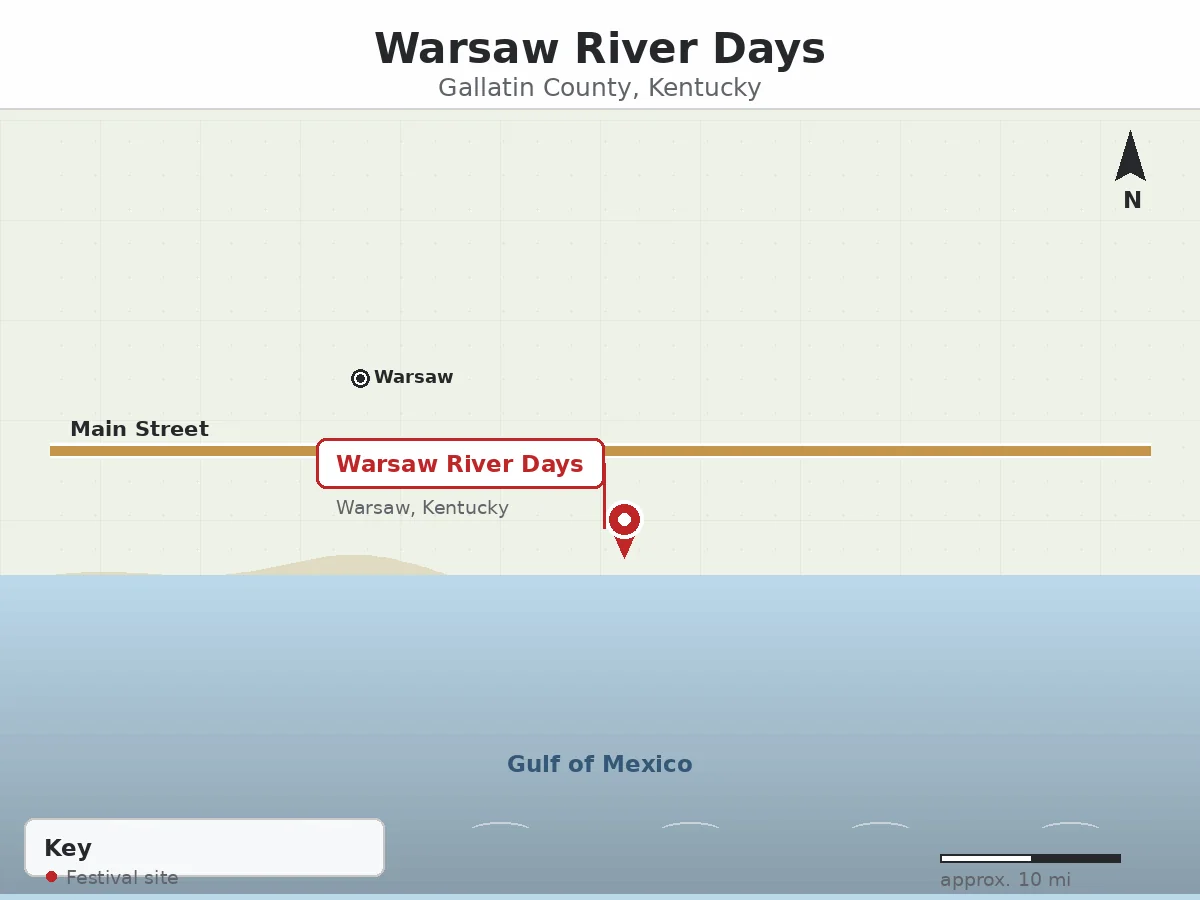
Warsaw River Days is a summer celebration held in Warsaw, the county seat of Gallatin County, at Warsaw Riverfront Park on the Ohio River in the downtown part of town. A state reference layer confirms Warsaw as the seat, and the event-hub layer states the same, so the festival’s home ground is settled even though much else about it is thinly documented. The event-hub layer, which carries the fullest account and appears to draw on city sources, presents the weekend as a City of Warsaw production. A school-district layer treats the Warsaw City Building as the place to direct questions, which fits the picture of a municipally run community event rather than a commercial promotion. The layers divide the naming among themselves: the event-hub layer, a local newspaper calendar layer and the school-district layer all print Warsaw River Days, the festival-guide layer prints the longer Warsaw Kentucky River Days Celebration, and only the event-hub layer mentions the Riverfest alias. None of those forms is merged into another here, because each belongs to the layer that printed it. One further source, a local services marketing layer, also mentions River Days at the park, but it was set aside during the research behind this article and nothing written here rests on it.
Quick Facts
| Item | Detail |
| Published name | Warsaw River Days |
| Longer published form | Warsaw Kentucky River Days Celebration |
| Local alias | Riverfest |
| Host town | Warsaw, Kentucky |
| County position | Warsaw is the seat of Gallatin County |
| Venue | Warsaw Riverfront Park, on the Ohio River |
| Presented by | The City of Warsaw |
| Documented editions | Early July in two thousand twenty-one and two thousand twenty-six |
| Signature moment | Fireworks over the river after a Main Street parade |
History
The deepest historical claim in the record comes from a single source. The event-hub layer calls the festival a summer tradition going back to nineteen eighty-two, and that sentence is carried here strictly as that layer’s own claim; no second layer read confirms the date, and nothing in this article treats it as established fact. The first edition the record can actually pin down is the two thousand twenty-one gathering, which the festival-guide layer lists under the longer Celebration name across the first, second and third of July. A school-district layer independently places the festival in July of that year and remembers fireworks on the third, which gives the twenty twenty-one edition two separate supports. Between that summer and the next documented one, the layers fall silent: no edition for the intervening years is particularised anywhere read. That five-year quiet says as much about how thinly small-town celebrations are published as it does about the festival itself, and it is reported here as a gap in the record rather than as proof that the gathering ever paused. The record resumes in two thousand twenty-six, when the celebration returned to print with a two-day shape on the third and fourth of July and a patriotic frame supplied by the nation’s two-hundred-fiftieth birthday. That birthday framing, including the America 250 branding the event-hub layer uses, belongs to the twenty twenty-six edition alone and forms no part of the festival’s name in any year.
What to Expect
Fireworks anchor the celebration in both documented editions, and the river is their stage. In two thousand twenty-one the school-district layer records fireworks on the third of July, while the two thousand twenty-six programme, as the event-hub layer lays it out, builds toward a fireworks finale at dusk billed Here Comes the BOOM above the Ohio River at the riverfront park. Before the sky show, the local newspaper community calendar for twenty twenty-six puts an Independence Day parade on Main Street at one in the afternoon on the fourth of July, with nightfall fireworks following at the park. Live music and local food vendors fill out the event-hub layer’s account of the weekend, and the parade, music, food and fireworks together make up the whole of the documented programme; the layers name no headline performer, no contest and no midway. Visitors should therefore picture a compact municipal celebration rather than a large fair: a hometown parade, an afternoon and evening gathered at the riverfront, and a dusk finale over the water as the centrepiece of the day. The birthday framing of two thousand twenty-six coloured that edition’s presentation without altering its basic ingredients, which remained the same parade, music, food and fireworks the earlier edition had already shown.
Planning Your Visit
Two July editions, five years apart, are the fixed points a visitor has to plan around: the first to the third of July in two thousand twenty-one, and the third to the fourth of July in two thousand twenty-six. Anyone travelling for a future edition should confirm the current year’s dates before setting out, because the layers read print no standing schedule and no announced recurrence rule. On cost, precision matters. The event-hub layer describes the two thousand twenty-six edition as free, and that statement is fenced to that layer and that year in this article; no layer read gives an admission position for two thousand twenty-one, so the free entry of one summer is not projected onto any other. For questions, the school-district layer points people toward the Warsaw City Building, and it prints a telephone number for that building which is noted here by existence only and never reproduced. The documented geography is simple enough to hold in mind: the parade uses Main Street, the gathering ground is Warsaw Riverfront Park downtown on the Ohio River, and the finale comes at dusk, so an arrival timed before the early-afternoon parade and a stay through nightfall covers everything the record describes.
For a useful comparison, see the Fulton County Kentucky Banana Festival for another county festival.
A Sample Itinerary
A shape for the day can be drawn honestly from the documented programme alone. Begin downtown in the late morning, when the town is gathering for the parade, and find a place along Main Street before the procession steps off at one in the afternoon. Once the parade has passed, drift with the crowd toward Warsaw Riverfront Park, where the event-hub layer places the live music and the local food vendors, and let the afternoon run at the pace of a small river town celebration. Eat from the vendors during the music rather than leaving the park and returning, because the day’s climax belongs to the same ground. As evening settles, position yourself facing the Ohio River. The finale billed Here Comes the BOOM is a dusk event, so the last hour of light is the time to be settled rather than still arriving. Nothing in this outline requires a ticket strategy or a second venue; its whole logic is parade first, park second, fireworks last.
How the Two Documented Editions Compare
Set side by side, the two editions the record holds differ in shape as much as in date. The two thousand twenty-one edition spreads across three days, the first through the third of July, carries the longer Celebration name in the festival-guide layer, and enters the record mainly through its third-of-July fireworks. The two thousand twenty-six edition compresses into two days, the third and fourth of July, answers to the shorter Warsaw River Days name in the newspaper calendar, and arrives with far richer particulars: a timed parade, a named fireworks billing and the America 250 frame. The comparison cuts the other way on sourcing, though. The earlier edition is corroborated by two independent layers, the guide and the school district, while the later one’s fullest detail rests on the single event-hub layer, with the newspaper calendar confirming its dates, parade and fireworks but not its billing or its birthday framing. A careful reader holds both truths at once: twenty twenty-six is the better-described edition, and twenty twenty-one is, proportionally, the better-corroborated one.

A Checklist for the Day
- Confirm the current year’s dates with the city before travelling, since the record prints no standing schedule.
- Reach Main Street ahead of the one in the afternoon parade rather than during it.
- Dress for a full July day outdoors in a river town.
- Carry whatever food money the vendor stalls might call for, even though the documented twenty twenty-six admission was free.
- Stay at the riverfront through dusk so the fireworks finale is not missed.
- Keep the school-district layer’s pointer in mind: questions go to the Warsaw City Building.
Beyond the Riverfront
The festival’s setting does quiet work for it. Warsaw is a small Ohio River town that doubles as the seat of Gallatin County, and its riverfront park gives the celebration a natural amphitheatre: open ground for the crowd, a main street close at hand for the parade, and a wide river for the fireworks to reflect on. The layers read do not turn the weekend into a touring holiday, and this section will not invent one; they name no companion attractions, no historic homes circuit and no second venue. What they do show is a county seat folding its civic business into its celebration, with the City of Warsaw presenting the event and the City Building serving as the public’s point of contact in the school-district layer. For a visitor, the honest extension of the day is the town itself at parade pace: Main Street before the procession, the riverfront after it, and the river at nightfall.
Why River Days Matters
A city-presented festival that survives in print across five separate years carries a weight larger than its programme. For Warsaw, the celebration binds the county seat’s civic identity to the national holiday on its own ground, using the river that defines the town as the backdrop for its biggest communal moment. The event-hub layer’s claim of a tradition reaching back to nineteen eighty-two, repeated here only as that layer’s claim, at least shows how the town’s own presentation of the festival understands it: not as a novelty but as an inheritance. Even the fenced and partial record supports that reading in outline, because two July editions half a decade apart, each built from a parade, music, food and river fireworks, describe a community returning to the same ritual shape rather than reinventing its holiday every year.
Frequently Asked Questions
By what name do most of the layers call the celebration?
Warsaw River Days is the form used by the event-hub layer, the local newspaper calendar layer and the school-district layer, so it is the name with the widest support in the record. The festival-guide layer’s longer Warsaw Kentucky River Days Celebration and the event-hub layer’s Riverfest alias refer to the same event and are worth trying as alternates.
What is the Here Comes the BOOM billing about?
It is the name the event-hub layer gives the fireworks finale of the two thousand twenty-six edition, a dusk display over the Ohio River at Warsaw Riverfront Park that closed the documented programme. The billing appears only in that layer’s account of that year and is not presented anywhere as a permanent title for the fireworks.
Was getting into the two thousand twenty-six weekend free of charge?
The event-hub layer states that the two thousand twenty-six edition was free, and this article records the statement exactly that way, attached to its layer and its year. No layer read settles admission for the two thousand twenty-one edition, so the free entry documented for one summer should not be assumed for any other.
How can someone ask the organisers a question?
The school-district layer directs questions to the Warsaw City Building, which sits consistently with the event-hub layer’s statement that the City of Warsaw presents the festival. That layer prints a telephone number for the building; following this project’s rules, the number’s existence is recorded and its digits are never reproduced here.
What to Expect From the Next Gallatin County Kentucky Warsaw River Days Festival
How often is Gallatin County Kentucky Warsaw River Days Festival held?
The layers document July editions in two thousand twenty-one and two thousand twenty-six, each wrapped around Independence Day, but they print no year-by-year run in between and no stated recurrence rule. The truthful summary is a July celebration evidenced at those two points, claimed by one layer as a long-running summer tradition, rather than a confirmed annual sequence.
When is the next Gallatin County Kentucky Warsaw River Days Festival?
Nothing read for this article carries dates beyond the third and fourth of July in two thousand twenty-six, so any future edition’s timing has to come from the city itself when it is announced. The school-district layer’s habit of sending questions to the Warsaw City Building is the best guide the record offers for where that announcement would surface.
Will the dates change?
They already have, in small ways: the two thousand twenty-one edition ran from the first to the third of July, while the two thousand twenty-six edition occupied the third and fourth. Both stayed inside the Independence Day window, so a future move would most plausibly shuffle days within that same early-July frame rather than abandon it.
Closing Thoughts
Warsaw River Days is documented the way many small-town celebrations are: warmly, briefly and by a handful of local layers rather than a press campaign. Held to what those layers prove, the festival is a city-presented Independence Day gathering at a riverfront park, with a Main Street parade, music, food vendors and fireworks over the Ohio River, seen clearly in two thousand twenty-one and in richer detail in two thousand twenty-six. That is a complete and honest portrait of the record as it stands, and it leaves the next chapter exactly where it belongs, with the city and its riverfront.