Fairbanks North Star Borough Alaska World Ice Art Festival
Every winter, as Fairbanks settles into the deep cold of February and March, sculptors from around the world gather to carve enormous blocks of harvested ice into works of art that will stand only until the spring thaw. The event at the heart of that gathering is the World Ice Art Championships, the competition produced by the nonprofit Ice Alaska as the centrepiece of its winter festival. The longer wording at the top of this page is a filing label for the county series; the championship itself has always gone by its own name, and that distinction matters, because the championships and the wider festival around them are two related but different things.
About the World Ice Art Championships
Ice Alaska’s own frequently asked questions page draws the line clearly. In its wording, Ice Alaska is the name of the ice festival that runs each winter from mid-February through the end of March, while the initials W.I.A.C., standing for World Ice Art Competition, mark out the competition part of the event. So the festival is the whole season-long celebration, and the championships are the competitive contest staged inside it, where artists work against the clock and the cold to turn raw ice into finished sculpture.
Around the competition grounds sits an ice art park that turns the visit into far more than spectating. Published descriptions of the park list a sculpture trail winding among the finished pieces, ice slides, a maze, a skating rink and a dedicated kids’ park, so families can spend hours on site between looking at the carvings and playing on structures made from the same material. The championships draw more than one hundred ice artists from around the globe, and the scale of their raw material is industrial: over four million pounds of ice, branded “Arctic Diamond,” is harvested from a pond along the Old Richardson Highway.
The governance of the event comes in layers that sources record side by side. A reference layer describes the championships as put on by Ice Alaska, a non-profit corporation started in 1989. Ice Alaska’s own FAQ, however, calls the World ICE Association “the governing body that produces Ice Alaska and the World Ice Art Championships.” Both forms stand in the record unmerged.
Quick Facts
| Item | Details |
| Event’s own name | World Ice Art Championships, the competition staged within the Ice Festival produced by Ice Alaska |
| Host city | Fairbanks, the seat of the Fairbanks North Star Borough |
| Producer | Ice Alaska, a non-profit corporation; its own FAQ names the World ICE Association as the governing body |
| Season | Each winter from mid-February through the end of March |
| 2026 edition | Park open February 16 to March 31, 2026, noon to 10 p.m. daily; competitions February 16 to March 13, 2026 |
| 2027 edition | February 15 to March 31, 2027, weather permitting |
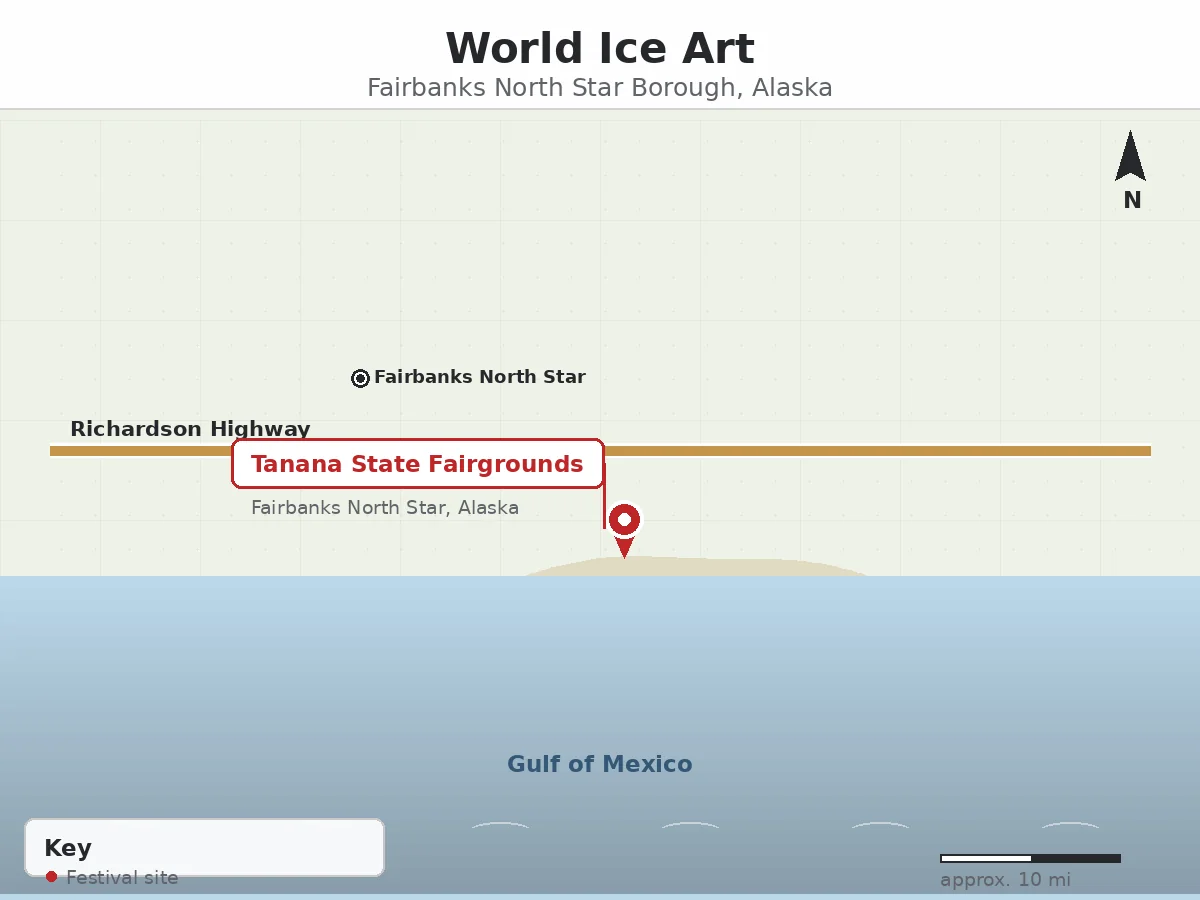
| Venue as published | Tanana State Fairgrounds, Tanana Valley Fairgrounds and Tanana Valley State Fairgrounds, all at 1800 College Road |
| History as published | One layer says held annually since 1988; another says Ice Alaska started in 1989 with its first championship in 1991; the layers are not reconciled |
| Admission as published | Twenty dollars for adults and ten dollars for children in the 2026 visitor-guide layer and the 2027 visitor-authority layer |
| Ice supply | Over four million pounds of “Arctic Diamond” ice harvested from a pond along the Old Richardson Highway |
History
The early history of the championships survives in layers that do not agree with one another, and honesty requires leaving them unmerged. A visitor-authority blog published in 2017 describes the event as held annually since 1988. A reference-derived layer tells a slightly different story: it says Ice Alaska, the non-profit corporation behind the event, was started in 1989, and that the corporation put on its first ice art championship in 1991. Those two accounts cannot both be a single clean founding year, and no source gathered for this page settles the question, so the record here carries both statements as their publishers made them.
For a useful comparison, see the Fairbanks North Star Borough Alaska Midnight Sun Festival for another county festival.
The grounds have moved as the event grew. The same reference-derived layer records that through 2011 the championships sat on a twenty-acre site across the Chena River from Pioneer Park, on land leased from the Alaska Railroad. In 2012 the event moved to the George Horner Ice Art Park. That park belongs to the event’s history; current layers do not present it as the venue.
What is not in dispute is the shape the modern event has taken. The championships have become the competitive core of a festival season that now runs for roughly six weeks, with the park staying open well after the carving contests end so visitors can walk among the finished sculptures. The sponsor-era billing, the BP World Ice Art Championships, survives only as a historical name form in older travel layers.
What to Expect
The competitive programme is divided into classes that test artists at very different scales. The visitor authority lists the Single Block Classic, the Double Block Classic, the Multi-Block Classic, the Fairbanks Open Classic and the Youth Classic. The starting material alone explains the drama: a block for the Single Block competition weighs around 7,200 pounds, while Multi-Block sculptures can reach twenty tons and tower more than twenty-five feet into the air. Watching a team raise, join and finish pieces of that size, in Fairbanks winter temperatures, is the central spectacle.
Timing within the season shapes what a visitor sees. In 2026 the competitions ran from February 16 to March 13, while the park itself stayed open from February 16 through March 31, with hours of noon to 10 p.m. daily. Come during the competitive window and the grounds are a worksite of chainsaws, chisels and scaffolding; come later and the same grounds become a quiet gallery of completed work. That year the season stretched further than planned, extending into April because of an unusually cold winter, a reminder that the calendar is always partly written by the weather.
Away from the competition blocks, the ice art park fills the rest of the visit. The sculpture trail lets visitors wander among finished pieces at their own pace, while the ice slides, maze and skating rink turn the outing into something children can take part in rather than simply watch. Because the park stays open into the evening, the sculptures can be seen both in flat winter daylight and after dark, when the carved ice takes on a different character.
Planning Your Visit
The first decision is which part of the season to aim for. Visitors who want to watch artists at work should target the competition dates; in 2026 those ran February 16 to March 13. Visitors who prefer finished sculpture without the worksite bustle can come any time the park is open, which in 2026 meant every day from February 16 to March 31, noon to 10 p.m. The following year’s edition was published as February 15 to March 31, 2027, weather permitting, and that qualification deserves respect: the 2026 season was extended into April by unusual cold, so published end dates are plans rather than promises.
Finding the grounds requires a little care with names, because the venue is published in three forms that this page does not merge. Ice Alaska’s official FAQ gives a physical address of Tanana State Fairgrounds, 1800 College Road, Fairbanks, Alaska 99709. The state tourism body lists Tanana Valley Fairgrounds at the same street address, while a visitor-authority blog calls it Tanana Valley State Fairgrounds, again on College Road. The street address is consistent across all three; only the fairgrounds name varies. The same organiser FAQ also carries a “venue to be announced” line, an internal conflict on the organiser’s own page, so checking the current listing shortly before a trip is wise. The postal box in the FAQ is a mailing address, not the venue.
On cost, the published figures are fenced to their editions and should not be treated as permanent. A visitor-guide layer gives twenty dollars for adults and ten dollars for children for 2026, and a visitor-authority blog gives the same figures for 2027. Ice Alaska’s own FAQ points visitors to its tickets page and notes that tickets are treated as donations to the not-for-profit.
A Sample Day at the Championships
A competition-day visit might begin at the noon opening, heading first to the blocks where teams are mid-carve, when the day’s progress is easiest to follow. Mid-afternoon suits the sculpture trail, walking among pieces finished in earlier rounds while the light is still good. Children can burn off energy on the ice slides and in the maze before the cold bites harder. As evening comes on, the skating rink and the finished sculptures reward those who stay, and a second pass along the trail after dark shows the carvings in a completely different mood before the 10 p.m. close.
How the Championships Compare
Plenty of winter festivals build a snow sculpture or two; the Fairbanks event is distinguished by being a genuine world championship, with named competitive classes and more than one hundred artists travelling in from around the globe. The scale of the material sets it apart as well: few events anywhere harvest over four million pounds of ice for a single season, or ask artists to raise sculptures of twenty tons. The event also differs from a one-weekend fair in its shape, since the festival runs from mid-February to the end of March and the park outlasts the contests by weeks. Its history is murkier than most, though, with published layers placing its beginnings in 1988, 1989 or 1991 without agreement.
Planning Checklist
- Decide whether to visit during the competition window or after it, when only the finished park remains.
- Recheck the current venue listing before travelling, since the organiser’s own page carries conflicting venue lines.
- Budget using the published twenty-dollar adult and ten-dollar child figures, while expecting them to change.
- Dress for standing outdoors in deep Fairbanks cold for several hours at a stretch.
- Plan an evening return to the sculpture trail to see the finished work after dark.
- Allow time for the ice slides, maze, skating rink and kids’ park if children are coming along.
- Build flexibility around the closing date, because the season can stretch or shrink with the weather.
Beyond the Ice Park
The championships sit in a Fairbanks winter that rewards a longer stay. The festival season overlaps the darkest, coldest part of the year, when the city leans into winter rather than hiding from it, and the event’s earlier home across the Chena River from Pioneer Park placed it beside one of the city’s best-known heritage attractions.
Why the Championships Matter
For Fairbanks, the World Ice Art Championships turn the hardest weeks of the year into a reason to gather outdoors. The event sustains a serious competitive tradition, with classes that let youth artists and world-class teams work in the same programme, and it channels visitor spending into a nonprofit whose tickets are treated as donations. Just as importantly, the championships make art out of impermanence: every piece is made in full knowledge that the spring thaw will take it, and that fleeting quality is a large part of why people come.
Frequently Asked Questions
What is the difference between Ice Alaska and the World Ice Art Championships?
Ice Alaska is the name of the winter festival itself, which runs from mid-February through the end of March, and the World Ice Art Championships are the competition held within it. Ice Alaska’s own FAQ makes the split explicit, explaining that W.I.A.C., the World Ice Art Competition, is the competition part of the event, while the wider festival includes the ice art park with its sculpture trail, slides, maze, rink and kids’ park.
Why do the published histories give different starting years?
Because the sources genuinely disagree and no gathered source settles it. A visitor-authority blog from 2017 describes the event as held annually since 1988, while a reference-derived layer says Ice Alaska was started in 1989 and held its first ice art championship in 1991.
Which fairgrounds name should visitors search for?
Any of the three published forms should lead to the same College Road address: Tanana State Fairgrounds in Ice Alaska’s official FAQ, Tanana Valley Fairgrounds in the state tourism listing, and Tanana Valley State Fairgrounds in a visitor-authority blog. All three give 1800 College Road in Fairbanks. Checking the organiser’s current page before a trip is wise, because the same FAQ also carries a venue-to-be-announced line.
How big are the sculptures at the championships?
The starting blocks for the Single Block Classic weigh around 7,200 pounds each. At the other end of the scale, Multi-Block sculptures can reach twenty tons and stand more than twenty-five feet tall. Supplying all of this takes over four million pounds of “Arctic Diamond” ice, harvested from a pond along the Old Richardson Highway, and the carving is done by more than one hundred artists from around the globe.
What to Expect From the Next Fairbanks North Star Borough Alaska World Ice Art Festival
How often is Fairbanks North Star Borough Alaska World Ice Art Festival held?
The championships are staged every winter as the competition inside the Ice Alaska festival season, which runs from mid-February through the end of March. The published editions gathered here confirm the pattern: competitions and an open park in 2026, and a further edition already published for February 15 to March 31, 2027.
When is the next Fairbanks North Star Borough Alaska World Ice Art Festival?
On the layers gathered for this page, the next edition after the 2026 season is the one published by the state tourism body and the visitor authority for February 15 to March 31, 2027, weather permitting. The 2026 edition ran from February 16, with competitions ending March 13 and the park open to March 31, before an unusually cold winter stretched the season into April.
Will the dates change?
They can, and the record shows it. The 2026 season was extended into April because the winter stayed unusually cold, and the published 2027 dates carry an explicit weather-permitting qualification. The broad shape of the season, mid-February through the end of March, has been consistent in the published layers, but exact opening and closing dates should always be confirmed against the organiser’s current listing before travel. In the end, the championships ask something unusual of their audience: to travel into the coldest part of an Alaskan winter to admire art that cannot last. The layers of its history may never be reconciled, and its venue may keep answering to three names, but the essential facts are plain enough — over a hundred artists, millions of pounds of harvested ice, and a city that has made a celebration out of the season everyone else endures. For anyone willing to dress for it, there is nothing else quite like it.