DeKalb County Georgia Decatur Book Festival
Decatur, Georgia, has a habit of slowing people down. The county seat of DeKalb County sits inside a metro region of more than three-quarters of a million residents, yet its downtown still moves at the pace of a town square — shaded, walkable, and full of people who seem to nod at one another out of habit rather than obligation. Add a book festival to that setting and the effect sharpens. For a few days each late summer, the DeKalb County Georgia Decatur Book Festival turns sidewalks, lawns, storefronts, and church steps into one long, informal reading room, and the town’s ordinary rhythms quietly become the festival’s staging.
What makes this gathering distinctive is not a single headline venue but the way it dissolves into the place. There is no distant fairground to drive to and no gate that separates the festival from the town. Readers wander in and out of bookshops, restaurants, and shaded side streets between events, and the boundary between “attending the festival” and “spending a day in Decatur” barely exists at all. For anyone who loves books, and for anyone who simply loves a Southern courthouse town in the heat of late summer, that blur is the whole point.
Late Summer in DeKalb: Why the Season Suits a Book Town
Timing matters more than most festival guides admit. DeKalb County spreads across roughly 271 square miles on the eastern edge of the Atlanta region, and by late summer its tree canopy has grown heavy and dark green. Afternoon light comes in low and sideways through the oaks around the square. Mornings are still bearable, and the long Georgia dusk stretches far enough that an evening panel or a poetry reading can happen outdoors without anyone squinting into the sun.
That season also shapes the crowd. Late summer is when families are squeezing the last weeks out of school break, when college students are drifting back toward campus, and when local readers are looking for something to do that involves shade and a chair. A book festival slots neatly into that mood. It is not a beach weekend and it is not yet a football Saturday — it is a slow, bookish pause before autumn arrives.
And the setting does real work. Decatur’s downtown is compact enough to cover on foot, which means the festival’s footprint reads less like a convention floor and more like a neighborhood that happens to be hosting something wonderful. Authors appear close to where people eat lunch. Children’s programming sits within sight of the farmers-market crowd. The rail station at the edge of downtown puts the whole thing within reach of the wider metro without requiring anyone to hunt for a parking space in a stadium lot.
Decatur Book Festival Basics: Town, County, and Timing
| Town | Decatur, Georgia |
| County | DeKalb County, Georgia |
| County seat | Decatur |
| County population | 764,382 (2020 Census) |
| Region | Atlanta metro region |
| County land area | About 271 square miles |
| Typical timing | Late summer, traditionally built around Labor Day weekend |
| Admission | General admission is typically free, with some individual events possibly ticketed |
| Setting | Walkable downtown Decatur — square, sidewalks, storefronts, and shaded green space |
| Organizer | Decatur-based literary and civic partners |
The Character of the Decatur Book Festival in DeKalb County
The DeKalb County Georgia Decatur Book Festival is best understood as a town-wide literary weekend rather than a fenced event. Programming tends to fan out across multiple small venues: indoor stages for author conversations, outdoor spots for readings and music, and storefronts that host signings simply because they are there. Because so much of it happens in the open air and along public sidewalks, a visitor can drift from a panel on Southern fiction to a children’s story hour to a poetry reading without ever showing a badge or passing through a checkpoint.
That structure creates an unusual mix of audiences. Serious readers come for the author conversations. Families come because the kids’ programming is genuinely good and the square gives children room to move. Neighbors come because it is their downtown and something is happening in it. Tourists come because Decatur is an easy rail ride from the rest of metro Atlanta and a pleasant place to spend a Saturday. All of these groups end up standing in the same lines for iced coffee.
It is also, importantly, a free-flowing experience. Rather than asking attendees to commit to a full day of scheduled sessions, the festival rewards wandering. You might arrive intending to hear one author and leave having discovered three you had never heard of, simply because a tent was on the way back to the station. That accidental-discovery quality is what longtime attendees describe when they try to explain the appeal.
How Decatur Became a Labor Day Weekend Book Town
The festival did not appear out of nowhere. Decatur already had the ingredients: a county seat with a real civic identity, a downtown that never hollowed out the way so many did, an independent bookstore culture, and a population that treats reading as a normal part of public life rather than a niche hobby. When local booksellers, librarians, and civic organizers began imagining a street-level literary event, they were building on ground that had been prepared for decades.
The early editions were modest by design. Organizers leaned on the town’s walkability and on the goodwill of downtown businesses, staging conversations in whatever spaces could hold a crowd. Authors came because the setting was charming and the audiences were attentive. Readers came because the event felt personal, closer to a large neighborhood gathering than to a trade show.
Over time, the weekend grew into a recognized fixture on the region’s cultural calendar, and the timing settled into late summer — a window that let the festival close out the season rather than compete with the busier autumn arts schedule. Growth brought more authors, more stages, and more visitors, but the organizing principle held: keep it outdoors where possible, keep it walkable, and keep it woven into the life of the town rather than sealed off from it.
The result is a festival that feels both established and unhurried. Decatur residents will tell you it is simply what their town does at the end of summer. Visitors tend to describe it as something they stumbled into and did not want to leave. Both descriptions are accurate.
What a Festival Day in Decatur Actually Feels Like
Expect a day measured in blocks rather than hours. You will walk more than you planned, hear at least one author you had never encountered before, and probably buy a book you did not intend to buy. The atmosphere is friendly and a little sweaty, the way late-summer Georgia gatherings always are.
Food: Street Eats and Decatur’s Restaurant Row
Food is one of the festival’s quiet advantages. Because the event unfolds downtown, attendees are never far from Decatur’s restaurants, cafes, bakeries, and coffee shops — a mix that ranges from quick counter service to sit-down Southern cooking. Festival days typically bring additional street-level food options and pop-up vendors near the busiest programming areas, which means you can eat without ever leaving the festival footprint.
Practical advice: eat early or late. The lunch window on a busy festival Saturday is when every table downtown is contested, and the lines at popular spots can stretch well past the point of patience. A mid-afternoon meal, or an early one right when programming begins, is far more pleasant. Bring a refillable water bottle as well — hydration is not optional in Georgia in late summer, and you will be on your feet for hours.
Music and Entertainment: Readings, Stages, and Street Energy
Beyond the author conversations, the weekend typically includes live music and performance scattered across downtown, giving the festival a soundtrack that shifts as you walk. A singer-songwriter on one corner, a poetry reading in a shaded courtyard, a panel discussion spilling out of an open doorway — the programming is designed to reward curiosity rather than strict scheduling.
The literary lineup itself leans toward variety: novelists, poets, historians, journalists, children’s authors, and illustrators, often in conversation with one another rather than delivering solo lectures. Many sessions include audience questions, and signings usually follow. If you have a strong interest in one genre, check the schedule in advance; if you do not, simply follow whatever crowd looks most engaged.
Family Activities: Kid Zones and Young Reader Programming
Families are a core part of the audience here, and the festival generally reflects that with dedicated children’s and young-reader programming. Expect story times, illustration demonstrations, and activities aimed at keeping younger kids engaged while older siblings browse. Strollers are manageable on Decatur’s sidewalks, though the busiest blocks get crowded during peak hours.
The square and surrounding green spaces give children somewhere to run between events, which matters on a warm day. A sensible family strategy is to plan around two or three kid-focused sessions, then let the rest of the day be unstructured. Bring sunscreen, hats, and a change of clothes for anyone prone to getting wet at a splash-friendly moment.
Planning a DeKalb County Weekend Around the Festival
Getting There: Rail, Roads, and Walkable Blocks
Decatur’s biggest logistical gift is its rail access. The station at the edge of downtown puts the festival within a short walk of the main programming area, which makes transit the smartest option for anyone coming from elsewhere in the Atlanta region. Trains run frequently enough that you can treat the schedule casually, and you avoid the entire question of where to put a car.
Driving is workable but requires patience. Decatur sits close to major highways serving DeKalb County, and the approach into downtown is straightforward, but festival-weekend traffic concentrates in a small area. If you do drive, arrive earlier than you think you need to, and be prepared to walk several blocks from wherever you eventually park.
Where to Stay in and Around Decatur
Lodging inside Decatur itself is limited, and festival weekends fill what exists well in advance. Booking early is the single most important planning decision if you want to stay within walking distance of the programming. Otherwise, the wider Atlanta region offers an enormous range of hotels, and the rail connection makes a stay farther out entirely reasonable — you trade a train ride for much more choice and often a lower rate.
Parking Around Downtown Decatur
Downtown parking exists in decks and surface lots, but on a festival Saturday it behaves like parking anywhere popular: the good spaces go early and the rest require circling. Do not plan on finding a spot directly beside your first event. Park once, accept a short walk, and leave the car where it is for the rest of the day — moving it between sessions is a guaranteed way to lose an hour.
Admission and What a Weekend Costs
General admission to the festival’s outdoor and open programming is typically free, which is a large part of why the crowds are so mixed and so large. Some individual events, special sessions, or ticketed conversations may carry a charge, and books, food, and drinks are obviously additional. Budget for the book you will inevitably buy — that is the real cost of the weekend for most attendees.
Late-Summer Georgia Weather and How to Dress
Expect heat and humidity, with a real chance of an afternoon thunderstorm. Dress light, wear shoes you can stand in for hours, and carry a compact rain layer or umbrella. A wide-brimmed hat and sunscreen are not optional extras. Venues with air conditioning become valuable mid-afternoon refuges, and it is worth identifying a couple of them in advance as cooling-off points.
A Sample Saturday and Sunday on Decatur’s Square
Saturday morning. Arrive by rail or park early and start with coffee near the square. Pick up a schedule and orient yourself on foot before the crowds build. Choose one morning author conversation — ideally something outside your usual reading habits — and let the walk there introduce you to the layout.
Saturday midday. Eat before noon or after two. Spend the peak hours drifting between outdoor stages, browsing vendor tables, and ducking into air-conditioned venues when the heat peaks. This is the best window for stumbling onto something unexpected.
Saturday evening. As the light softens, the square becomes the most pleasant place in DeKalb County. Stay for music or an evening reading, then have dinner downtown once the day-trippers have thinned out. Bookshops are quieter and staff have time to talk.
Sunday morning. Come back early. Sunday is gentler, with shorter lines and a more local crowd. This is the right time for the children’s programming, for signing lines you skipped the day before, and for a slow second look at anything you talked yourself out of buying.
Sunday afternoon. Wrap up with a walk beyond the immediate festival blocks. Decatur rewards a wander, and ending the weekend with a quiet street and a new book is a better finale than fighting traffic.
Decatur Compared with Nearby Festival Towns and Counties
Versus Atlanta. A large literary convention in Atlanta offers scale — bigger names, bigger halls, more sessions at once. Decatur offers intimacy. You will not see everything, but you will be close enough to the people on stage to feel like part of a conversation rather than an audience member in a cavernous hall.
Versus Marietta and Cobb County. Marietta’s historic square hosts its own lively calendar of street festivals, and the comparison is instructive. Both towns trade on walkable historic downtowns, but Decatur’s version is built tightly around books and reading rather than general entertainment, which gives the weekend a different, quieter center of gravity.
Versus Stone Mountain and the rest of DeKalb County. Elsewhere in DeKalb, the draw is outdoor recreation and open parkland. The Decatur Book Festival inverts that: the attraction is a dense, shaded, pedestrian grid where the programming is intellectual rather than athletic. For a county with 271 square miles of variety, it is a useful reminder that DeKalb’s cultural life is as strong as its green space.
Packing and Prep List for a Decatur Book Weekend
Bring a tote bag that can hold more than you expect to buy, a refillable water bottle, sunscreen, a hat, and a light rain layer. Wear broken-in walking shoes. Charge your phone the night before and consider a small battery pack, since you will be checking schedules and taking photos all day. Carry a physical schedule if one is available — paper does not overheat.
Before you go, decide on a meeting point in case your group splits up, since cell service can get sluggish in crowded blocks. Set a rough budget for books and food. Check the day’s programming in advance but leave at least two open hours unplanned. If you are bringing children, pack snacks, wipes, and a stroller you can fold quickly.
One more item: patience. A free, popular, walkable festival in a small downtown will have crowded sidewalks and full restaurants. That is the price of the format, and it is a reasonable one.
Beyond the Book Stalls: Decatur and DeKalb County Year-Round
If the festival leaves you wanting more of Decatur, the town rewards a return visit. Independent bookshops, record stores, and small restaurants line the downtown blocks, and the square is a genuine gathering place rather than a decorative one. The area around the rail station connects easily to the rest of the Atlanta region, making a second trip simple.
Wider DeKalb County adds considerably more. The county’s 271 square miles include parkland, historic neighborhoods, and a diverse food scene shaped by decades of immigration and growth. Stone Mountain and its surrounding park anchor the eastern side of the county. Between the county seat’s urban village feel and the county’s open spaces, there is enough here to fill several weekends beyond the one that brought you.
Why a Book Festival Still Anchors Decatur’s Community Life
A county of 764,382 people contains a lot of different lives, and most of them never intersect. A downtown book festival is one of the few things that pulls librarians, booksellers, teachers, students, retirees, and young families into the same few blocks at the same time, on purpose, with something to talk about.
That matters in a place like Decatur, where the county seat identity is real and civic life is taken seriously. The festival gives local institutions — shops, libraries, schools, community groups — a shared project and a shared stage. It also gives DeKalb County a cultural signature within a metro region that is often defined by traffic and growth rather than by reading. For a few late-summer days, the county’s seat becomes the region’s living room.
Where the Decatur Book Festival Sits in DeKalb County
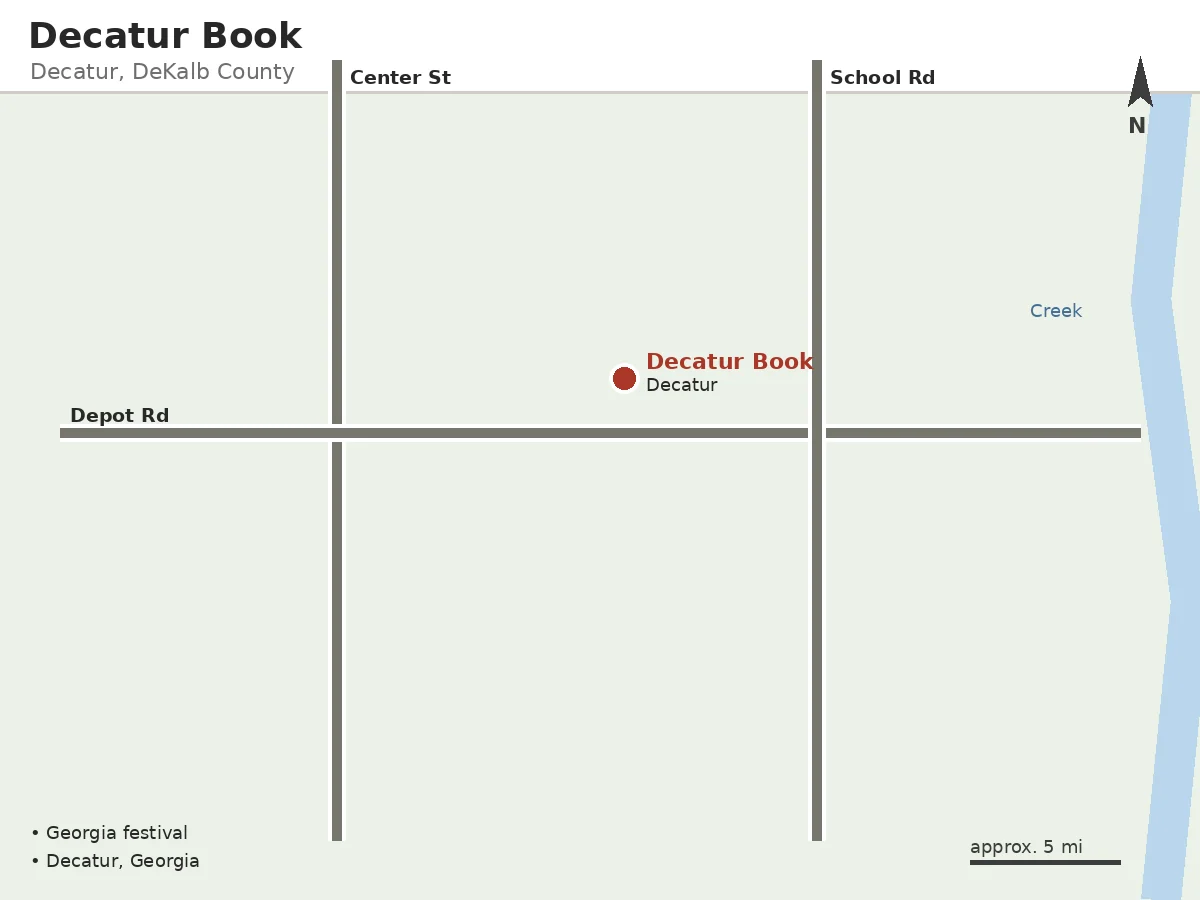
The festival takes place in downtown Decatur, the county seat of DeKalb County, Georgia, within easy walking distance of the city’s rail station and the surrounding square.
Decatur Book Festival Questions from First-Time Visitors
When does the Decatur Book Festival usually take place?
It is traditionally held in late summer, built around Labor Day weekend. Exact dates shift from year to year, so confirm the current schedule before booking travel or making plans around a specific day.
Is admission free?
General admission to the festival’s open and outdoor programming is typically free, which is central to its accessible, come-and-go character. Certain individual events or special sessions may require tickets, so check the specifics of anything you particularly want to attend.
Do I need to reserve anything in advance?
For most of the open programming, no. Advance planning matters most for lodging, which fills quickly on festival weekends, and for any ticketed sessions. If you are traveling from outside the area, book a room well ahead of time.
Is the festival good for children?
Yes. Family and young-reader programming is a consistent part of the weekend, and the walkable downtown setting makes it easy to move between activities with kids in tow. Plan around a few kid-focused sessions and leave room for unstructured time on the square.
Should I drive or take transit to Decatur?
Transit is usually the easier choice if you are coming from elsewhere in the Atlanta region, since the rail station sits a short walk from the main programming. If you drive, arrive early and expect to park several blocks from the center of the action.
What should I bring for a late-summer festival day in Georgia?
Water, sunscreen, a hat, comfortable shoes, and a light rain layer. Afternoon storms are common this time of year, and you will be outdoors and on your feet for long stretches. A tote bag for books is also a good idea.
How much of the festival can I realistically see in one day?
You can cover the downtown footprint comfortably in a day, but you will not attend everything. The festival rewards choosing a handful of sessions and letting the rest of the day unfold on foot, rather than trying to sprint between every event on the schedule.
Is Decatur worth visiting outside festival weekend?
Absolutely. The downtown has bookshops, restaurants, and a genuinely active square, and it connects easily to the rest of DeKalb County and the Atlanta region. Many festival-goers end up making a second trip simply to explore the town without the crowds.
The Next Chapter for the Decatur Book Festival
Like most literary festivals, this one faces the familiar questions of the coming years: how to keep a free, open, walkable event sustainable as downtown grows busier; how to balance big-name draws with the local booksellers, librarians, and independent presses that give the weekend its character; and how to keep the programming relevant to a county as large and varied as DeKalb.
The ingredients that made it work in the first place remain intact — a compact, shaded downtown, strong local institutions, rail access, and a genuine appetite for books among residents of Decatur and the surrounding county. As long as those hold, the festival’s late-summer weekend on the square should continue to be one of the region’s most welcoming cultural traditions.
Last updated: October 2026
If you go, go slowly. The DeKalb County Georgia Decatur Book Festival is not a thing to be conquered in a single sweep of the schedule; it is a place to spend a warm end-of-summer day among people who like books, in a town that has made room for them. Bring a tote bag, wear your most comfortable shoes, and let the afternoon take you wherever the next open door happens to lead.



One Comment