Dallas County Alabama Bridge Crossing Jubilee Festival
Each March, the city of Selma gathers at the foot of the Edmund Pettus Bridge to remember one of the defining moments of the American civil rights movement. The gathering is known on its own materials as the Selma Bridge Crossing Jubilee, and the county-named title at the head of this article, Dallas County Alabama Bridge Crossing Jubilee Festival, refers to that same annual commemoration in Dallas County, Alabama. Selma is the county seat of Dallas County, and the bridge that gives the Jubilee its name stands within the city.
The Jubilee is not a festival in the county-fair sense. Its programme blends solemn remembrance with teaching, worship, music, awards and open celebration, spread across several days rather than a single afternoon. People travel to Selma from across the United States to walk the bridge route, hear surviving foot soldiers speak, and connect a violent morning in 1965 with voting rights today. The weekend rewards preparation, because its most meaningful moments are also its most crowded.
About the Festival
The Selma Bridge Crossing Jubilee exists to commemorate Bloody Sunday, the events of March 7, 1965, when voting-rights marchers setting out on the first Selma to Montgomery march were beaten by law enforcement at the Edmund Pettus Bridge. That attack, broadcast nationally, helped galvanise support for federal voting-rights legislation, and the bridge has remained the emotional centre of Selma’s commemorative calendar ever since. The Jubilee turns that memory into a structured multi-day gathering, with dozens of separate events rather than one central show.
A metropolitan newspaper, in its edition of February 25, 2026, described the organiser as Selma Bridge Crossing Jubilee, a nonprofit 501(c)(3) organisation. The organisation’s own website and press materials carry the name in that form, so schedules and tickets appear under the Selma name rather than the county title used here.
Who founded the Jubilee is recorded with unusual inconsistency, and this article keeps those records apart rather than merging them. A law journal, writing on March 25, 2026, named the founders as Hank and Rose Saunders, describing both as lawyers. The Jubilee’s own 2026 press contact, reported by a county newspaper on February 18, 2026, instead listed Hank Sanders and Faya Rose Touré. The Jubilee’s official song page uses a third form, crediting Faya Ora Rose Touré, Esq., as Coordinator of the Selma Bridge Crossing Jubilee.
For a useful comparison, see the Dale County Alabama Oktoberfest Festival for another county festival.
Quick Facts
| Item | Detail |
| Event’s own name | Selma Bridge Crossing Jubilee |
| Host city | Selma, the county seat of Dallas County, Alabama |
| Organiser | Selma Bridge Crossing Jubilee, a nonprofit 501(c)(3) organisation |
| What it commemorates | Bloody Sunday, March 7, 1965, at the Edmund Pettus Bridge |
| Usual timing | The first weekend of March each year |
| 2026 core dates | Thursday, March 5 to Sunday, March 8, 2026 |
| 2026 billing | The 61st anniversary of Bloody Sunday |
| 2026 theme | All Boots on the Bridge |
| Admission pattern | Dozens of events, almost all free; a small number ticketed |
| Centrepiece | The commemorative march across the Edmund Pettus Bridge |
History
The history the Jubilee protects begins on March 7, 1965. Civil rights campaigners had been organising in Selma and Dallas County for voting rights, facing arrests and violence, and on that Sunday a column of marchers set out toward Montgomery, the state capital. At the Edmund Pettus Bridge they were met by law enforcement and beaten back in an attack that left marchers bloodied on the roadway. Images of the assault travelled around the world, and the day entered history as Bloody Sunday.
Two further attempts followed, and the third march finally reached Montgomery later that month under federal protection. Within months, Congress passed the Voting Rights Act of 1965. Selma’s bridge, named for a Confederate general and former United States senator, had become instead a symbol of the right to vote, and the city began marking the attack’s anniversary with commemorations that drew veterans of the movement back to the bridge.
The annual observance grew into the organised Jubilee described in this article, adding educational programmes, church services, award ceremonies and children’s events around the core act of walking across the bridge. The founders credited with building it into its modern form appear under the differing name forms set out above, each fenced to its own source instead of being merged.
One caution matters for anyone reading Jubilee publicity. The 2026 edition was billed as the 61st anniversary of Bloody Sunday, and that count runs from the 1965 attack itself. It is not a statement about when the festival began, and no founding year for the Jubilee should be inferred from it.
What to Expect
The 2026 programme opened on Thursday, March 5, and culminated on Sunday, March 8, according to a county newspaper reporting the Jubilee’s news conference at the foot of the bridge. Opening day included the Voting Rights History Bowl for students, a Freedom Overture featuring the Original SNCC Freedom Singers, and the Annual Mass Meeting, held at 7:00 in the evening at Tabernacle Baptist Church.
Music runs through the 2026 edition deliberately. Its theme, All Boots on the Bridge, reported by the metropolitan newspaper, is also the title of the Jubilee’s official song, performed by Faya Ora Rose Touré, and it points toward the weekend’s centrepiece: ordinary people putting their feet on the roadway where marchers were attacked in 1965.
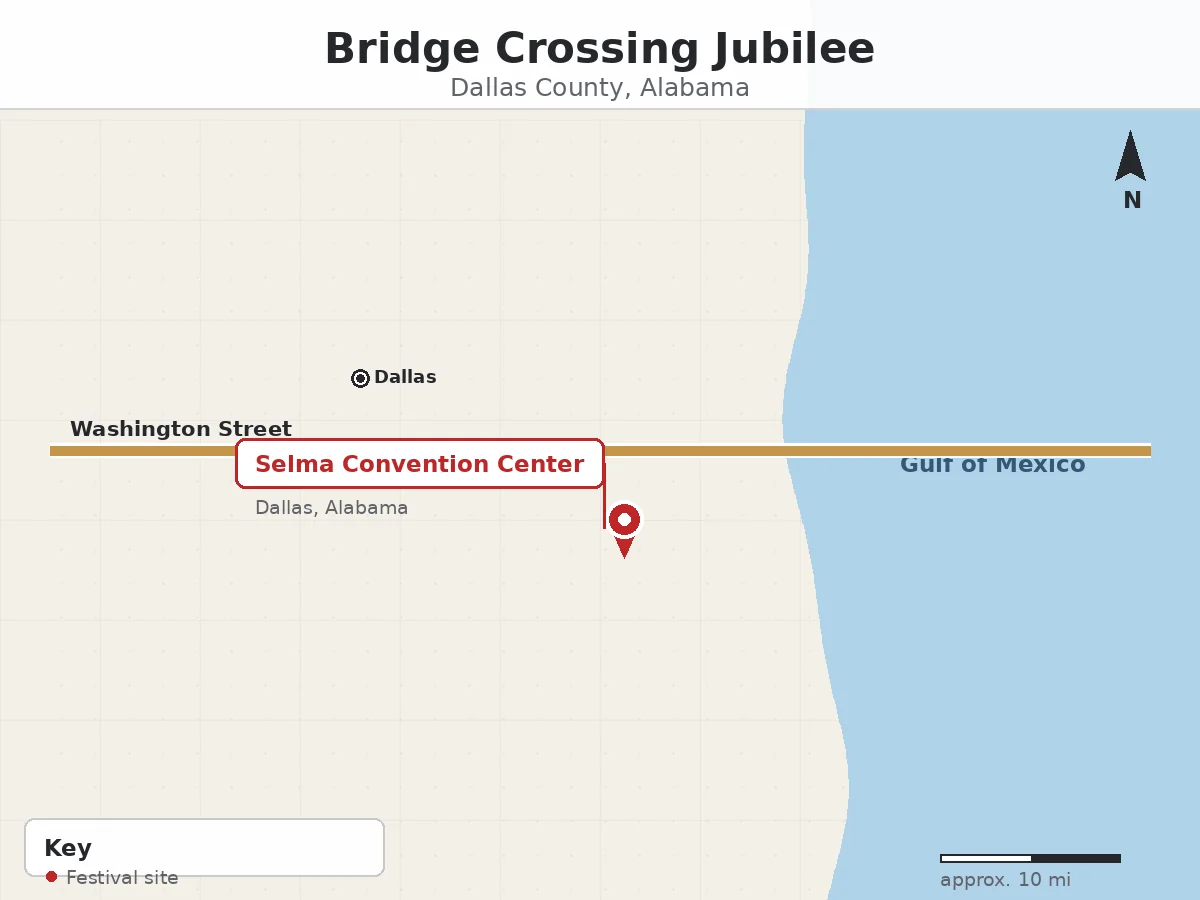
Saturday evening belonged to the Freedom Flame Awards Gala, held at 7:00 p.m. on March 7, 2026, at the Selma Convention Center, 211 Washington Street, Selma, Alabama 36703. Sunday opened early with the Martin & Coretta King Unity Breakfast at 7:00 a.m. at Hangar 251 at Craig Field Airport & Industrial Authority in Selma, whose 2026 award recipients were Attorney Fred Gray, Reverend Bernard Lafayette, and Minnesota Attorney General Keith Ellison.
Later on Sunday came the moment most visitors travel for: the commemorative march across the Edmund Pettus Bridge, walking from Brown Chapel AME Church and Water Avenue to the site of the Bloody Sunday attack. A law journal reported that about two thousand people marched in 2026, while a Selma news outlet, writing on March 9, 2026, put overall attendance in the thousands. Younger participants had their own set piece in the Children’s Sojourn, the Children’s Silence Remembrance March across the bridge, while the Selma Jubilee Street Festival on Water Avenue offered a lighter counterpoint to the ceremonies.
On cost, the Jubilee states that it offers dozens of events, almost all free to the public. Individual events such as the Unity Breakfast and the Freedom Flame Awards Gala were nevertheless ticketed through the Jubilee site in the published 2026 schedule, so a realistic budget reserves money for those two alone.
Planning Your Visit
Begin with the shape of the weekend. The Jubilee’s core ran from Thursday, March 5, to Sunday, March 8, in 2026, but partner organisations published wider windows around those dates: a voters’ league listed March 6 to March 10, 2026, and a workers’ circle delegation listed March 5 to March 9, 2026. Those separate layers, recorded here unmerged, matter practically, because Selma accommodation fills across the whole span, not just the core four days.
The single fixed point to organise around is the Sunday bridge crossing, which draws the largest crowd and anchors the weekend’s meaning. Build outward from it: the Unity Breakfast beforehand if you hold a ticket, the street festival on Water Avenue for a slower hour, and the Saturday gala if formal ceremonies appeal. Thursday’s History Bowl, Freedom Overture and Mass Meeting reward anyone arriving before the weekend crowds.
Practical preparation is mostly about comfort and patience. Selma in early March can swing between cool mornings and warm afternoons, so layered clothing and shoes suited to standing and walking on pavement make a real difference. Expect road closures and slow movement near the bridge on Sunday, arrive at gathering points earlier than feels necessary, and carry water even though the route is short. Sessions featuring foot soldiers fill first, so check the published schedule closely.
With almost all events free, a trip’s main costs are travel, lodging, food and the two flagship ticketed events, and booking rooms early matters because Selma’s hotel supply is modest beside anniversary demand.
A Sample Selma Weekend
A first-time visitor might start on Thursday afternoon with the Voting Rights History Bowl, hearing students test their knowledge of the movement, then stay for the Freedom Overture’s music and finish at the Annual Mass Meeting in Tabernacle Baptist Church. Friday suits slower orientation: walking Water Avenue, visiting the bridge in quiet hours, and absorbing the street festival atmosphere.
Saturday can go to scheduled sessions and ceremonies, keeping the evening clear for the Freedom Flame Awards Gala at the Selma Convention Center. Sunday then becomes a single arc: an early start at the Unity Breakfast, the walk to Brown Chapel AME Church, and the commemorative crossing itself.
How the Jubilee Differs From Other March Commemorations
Selma is not the only city that marks the voting-rights struggle each spring, but the Jubilee’s character sets it apart. Where some commemorations are essentially conferences, and others single ceremonial walks, the Jubilee combines both forms and adds church services, student competitions, an awards gala and a street festival under one organisational roof. The result feels less like a parade and more like a homecoming, with movement veterans treated as honoured elders.
Its geography also distinguishes it. The commemoration happens on the actual ground of the 1965 attack, and its central ritual simply repeats the original act: walking over the bridge from Selma toward Montgomery. Few American commemorations let participants perform, in their own bodies, the precise movement their predecessors were beaten for attempting.
Planning Checklist
- Decide which core days you can attend, noting that partner organisations run events on wider windows around them.
- Book Selma accommodation early, because rooms are scarce against anniversary demand.
- Reserve tickets in advance for the Unity Breakfast or the Freedom Flame Awards Gala if either appeals.
- Plan Sunday around the bridge crossing, arriving well before the march steps off.
- Pack layered clothing and comfortable shoes for long periods of standing and walking.
- Carry water, and expect road closures and slow traffic near the bridge on march day.
- Check the published schedule for foot soldier talks and student events, which fill quickly.
- Leave room in the budget for meals and fuel, even though most events are free.
Beyond the Bridge
A Jubilee trip can extend naturally into the wider story of the route. The march that finally succeeded in 1965 continued from Selma to Montgomery, and visitors with extra days often follow that highway corridor, reflecting on the distance the original marchers covered on foot. Montgomery’s own civil rights sites pick up the narrative where the bridge leaves off.
Within Selma itself, time away from the headline events is rarely wasted. Water Avenue and the downtown streets around the bridge carry the everyday life of a small Alabama city holding an outsized place in national history. Travellers who eat in local restaurants and listen more than they photograph tend to leave with the fullest understanding of what the Jubilee means to its hosts.
Why the Jubilee Endures
The Jubilee’s significance rests on a simple fact: the events it commemorates are still within living memory, and some of the people beaten on the bridge in 1965 have returned to cross it in peace. Each annual gathering therefore works simultaneously as memorial, school and reunion. Students compete in a history bowl about a struggle their grandparents witnessed, children cross in silence, and elders receive awards named for freedom’s flame.
It also insists that remembrance is a civic act rather than a spectator sport. The theme of boots on the bridge, the official song and the march itself all push visitors to participate physically instead of watching from the kerb. For Dallas County, the weekend brings thousands of guests and national attention; for the country, it renews a public argument about voting rights where that argument once turned violent. That double role, local homecoming and national touchstone, keeps the first weekend of March in Selma unlike any other date on the commemorative calendar.
Frequently Asked Questions
Does the Jubilee mark the anniversary of the march or the founding of the festival?
The headline number refers to Bloody Sunday itself. The 2026 edition was billed as the 61st anniversary of the March 7, 1965 attack, and the count runs from that year, not from any founding year of the festival. Nothing in the sources used here states when the Jubilee began, so this article gives no founding year.
Which parts of the weekend carry a ticket price?
Only a small number of individual events. The Jubilee states that it offers dozens of events, almost all free to the public, and the published 2026 schedule showed ticketing for occasions such as the Unity Breakfast and the Freedom Flame Awards Gala, handled through the Jubilee site. The bridge crossing, church gatherings and street festival fall within the free majority.
Why do the founders’ names appear in different forms?
Because the sources genuinely disagree, and tidying them up would misrepresent the record. A law journal named the founders as Hank and Rose Saunders. The Jubilee’s own 2026 press contact listed Hank Sanders and Faya Rose Touré, while the official song page credits Faya Ora Rose Touré as Coordinator. Each form is therefore reported with its source attached.
What should a first-time visitor prioritise if time is short?
The Sunday commemorative march across the Edmund Pettus Bridge is the heart of the weekend, and a Selma news outlet confirms the Jubilee is held every year on the first weekend of March, so the pattern is dependable. If you can add one more event, the Thursday Mass Meeting offers the movement’s church tradition in concentrated form, while the Saturday gala suits visitors preferring a formal evening.
What to Expect From the Next Dallas County Alabama Bridge Crossing Jubilee Festival
How often is Dallas County Alabama Bridge Crossing Jubilee Festival held?
The commemoration returns every year. A Selma news outlet described it as held every year on the first weekend of March, and the 2026 edition followed that pattern with core events running from Thursday, March 5, to Sunday, March 8.
When is the next Dallas County Alabama Bridge Crossing Jubilee Festival?
On the established pattern, the next edition should fall on the first weekend of March, following the 2026 gathering of March 5 to March 8. Exact dates, the anniversary billing and the theme are announced by the Jubilee itself, and partner organisations may again publish wider windows around the core days.
Will the dates change?
The first-weekend-of-March pattern is long established and the safest planning assumption available. Individual elements can shift, however: partner organisations listed different surrounding windows in 2026, and event times are set by each year’s published schedule. Confirm core dates and ticketed event times against the Jubilee’s own announcements before booking travel.
The bridge at Selma has carried traffic for generations, but on one weekend each year it carries something heavier: memory, argument and hope, all moving on foot. Whether you come to honour the foot soldiers or to understand a turning point in American democracy, the Jubilee repays the journey.

One Comment