Dakota County Nebraska Dakota-Thurston County Fair Festival
Most Nebraska county fairs answer to one county, one agricultural society and one set of grounds. This one answers to two of almost everything. The Dakota-Thurston County Fair fills the fairgrounds in South Sioux City for a full week at the turn of July into August, owned jointly by Dakota County and Thurston County and governed by an executive board drawn from both counties’ agricultural societies. From the Dakota County side, the twist is pleasing: the grounds stand on Dakota County soil, in its largest city on the Missouri River, while the county seat at Dakota City hosts no part of the fair. The fair’s own published terms are disarmingly simple — free entrance, free parking, and an asterisk the fair prints itself beside a few inside events. Its motto, published on its own site, is “Where Traditions Meet” — for once, the slogan is also a plain description of the governance.
The Dakota Side of a Fair With Two Owners
Read from Dakota County, this is a home fair that happens to be shared. The Dakota County Agricultural Society is one of the fair’s two owning bodies, Dakota County exhibitors fill its barns and its exhibit hall, and the fairgrounds sit inside Dakota County, at the southern edge of South Sioux City. What Dakota County does not do is run the fair alone. The fair book records a Dakota-Thurston County Fair Executive Board and a Board of Directors drawn from the Dakota County Agricultural Society and the Thurston County Agricultural Society together — and keeps the two societies distinct while doing so: each keeps its own officers, its own identity and its own county behind it. Nebraska Extension in Dakota County publishes the fair’s show days, the fullest window into how the week is built. Nothing in the fair’s own record supports calling this Dakota County’s fair by itself. It is the Dakota half of a joint institution, written from the side where the grounds stand.
Quick Facts
| Item | The published record |
| Fair | Dakota-Thurston County Fair |
| Fair town | South Sioux City, Nebraska |
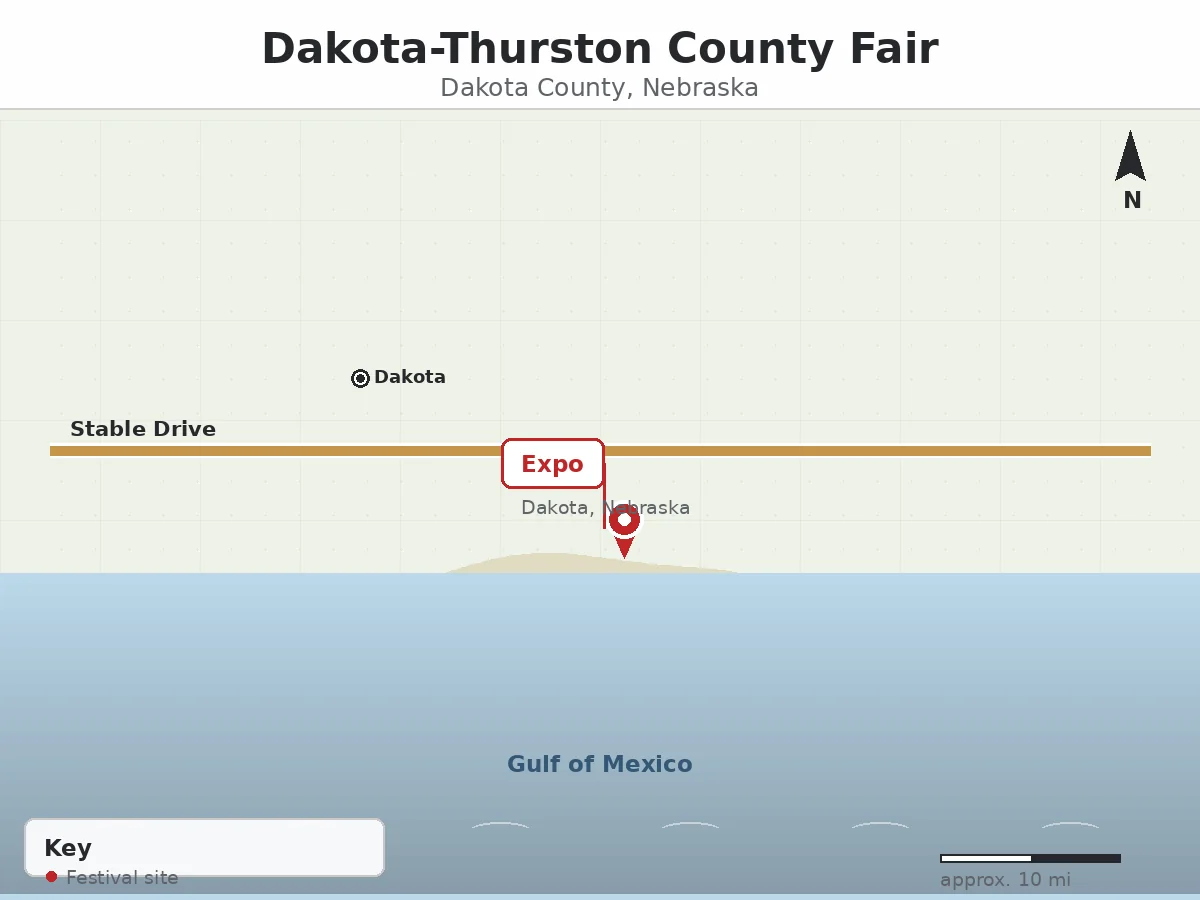
| Fairgrounds | 1547 Stable Drive, South Sioux City |
| County seats | Dakota City for Dakota County and Pender for Thurston County; neither hosts the fair |
| Organisers | The Dakota County Agricultural Society and the Thurston County Agricultural Society, under the Dakota-Thurston County Fair Executive Board |
| Season | Late July into early August; the 2026 edition ran July 26 to August 2, as the fair published it |
| Admission | Free entrance, on the fair’s own published terms |
| Parking | Free, on the same terms; some inside events carry fees noted on the fair’s schedule |
| Exhibit home | The Expo Center holds the static exhibits |
| Motto | “Where Traditions Meet” |
A Partnership the Record Never Dates
Ask when the two counties joined their fairs and the published record, honestly read, declines to answer. No founding year for the joint fair appears in the fair’s own material, no edition number is published, and no start date for the shared arrangement is documented. That silence deserves to be left as it stands. What the record does preserve is structure instead of chronology: a fair book that seats an executive board above two agricultural societies, and two societies that still list their own officers rather than dissolving into a single body. Agricultural societies are the old machinery of Nebraska county fairs, and this arrangement reads like two sets of it bolted together without either being scrapped. The joint fair’s history, on its own paper, is the partnership itself: two counties deciding that a shared fair in a third community, a city that is neither county’s seat, served both better than two small separate fairs would have. Any source that gives the joint fair a birthday is going beyond what the fair publishes about itself.
What to Expect
A Show Week That Unfolds Species by Species
The documented shape of the fair is a livestock week with a deliberate rhythm, published for the 2026 edition by Nebraska Extension in Dakota County. Sunday opens the run with the cat, dog and companion animal shows. Tuesday belongs to the rabbits. Thursday pairs poultry with swine, Friday pairs beef with sheep, and Saturday closes the animal programme with the horse show. Around that spine, the static exhibits run in the Expo Center all week, so the halls are full on days when the barns are quiet. Read the pattern as the 2026 edition’s arrangement rather than a fixed promise: show days are set edition by edition, and the fair’s own current schedule governs any given year.
The Expo Center and the Week’s Quiet Half
Not everything at this fair has hooves. The static exhibits — the judged projects that fill the Expo Center — give the fair a second, quieter half that runs the whole week rather than a single day. For Dakota County families, that hall is where much of the fair happens: entries checked in, ribbons pinned, projects on display while the animal shows rotate outside. When the week ends, the exhibits come down in an orderly rush, because release is tied to the fair’s closing machinery on Saturday.
For a useful comparison, see the Custer County Nebraska Fair Festival for another county festival.
The Bonus Auction Finish
The fair’s documented ending is a sale. Exhibits are released after the Bonus Auction, at about half past five on Saturday, which makes the auction the hinge the whole week swings shut on. Only when it is done does the fairgrounds begin to empty in earnest. Be there for that last hour on Saturday, when the showing is finished, the selling is done and eight days of work are loaded for home.
The Asterisk, in the Fair’s Own Words
The fair publishes its entrance as free and its parking as free, and then it qualifies itself: some events within the fairgrounds have admission fees, noted on the schedule. The record behind this article neither names nor prices them, so this article does not either. The same honesty applies to the big-tent attractions many readers will look for. No concert, carnival or rodeo is documented for the 2026 edition in the fair’s fetched record, and none is promised here. What is documented is a full week of shows, a busy exhibit hall and a closing auction — a fair built on exhibitors rather than on a midway.
Planning Your Visit
Finding 1547 Stable Drive
Aim for South Sioux City, in Nebraska’s northeastern corner on the Missouri River, and not for either courthouse town. Dakota City, the Dakota County seat, lies a short drive south and hosts no part of it; Pender, Thurston County’s seat, lies well to the southwest and hosts none either. The address the fair itself publishes is 1547 Stable Drive, and its office answers at 402-494-5522. Getting the town right matters more than any other planning step: the fair’s name points at two counties and neither of their seats.
What the Gate Costs, and What the Asterisk Means
On the fair’s own published terms, walking in and parking both cost nothing. The sensible budget is therefore a modest one: money for food and drink during a long day, and money in reserve for the inside events the fair’s schedule marks as fee events, since their prices appear on that schedule rather than in advance publicity. Check the current schedule on arrival, note which events carry the fees, and the asterisk stops being a surprise. Families used to paying a gate elsewhere should not assume the free terms leak into everything inside the fence — the fair itself draws that line.
Staying Over
The fair’s published record offers no fair-week camping, and none should be assumed: no pitch, hookup or camping price appears in the material behind this article. Plan on ordinary lodging in South Sioux City or across the river, and ask the fair office directly about camping rather than arriving with a trailer and a hope. Exhibitor families work to the fair’s own arrangements, a separate matter from anything offered to the visiting public.
A Saturday at the Fair
Start at the horse show, Saturday’s headline in the barns, while the day is still cool. Cross to the Expo Center late in the morning and walk the static exhibits slowly — Saturday is the last chance to see the hall complete. Take the middle of the day at an exhibitor’s pace — a second pass through the barns, a look at the beef and sheep strings shown the day before, and time in the shade. Be back for the Bonus Auction in the late afternoon, and stay through it: at about half past five the exhibits are released, the fair exhales, and the grounds turn from exhibition to departure. No other hour of the week shows the joint fair’s machinery working so visibly.
Two Owners, Weighed Against the One-County Pattern
The ordinary Nebraska county fair is a pyramid: one county, one society, one board, one grounds. The Dakota-Thurston County Fair is a bridge instead — two county societies holding one fair between them, with an executive board spanning the joint. The gains are written into this article’s facts: a full eight-day published span, every animal show, a staffed exhibit hall and a closing auction, sustained by two counties’ exhibitors rather than one. The cost of the model is the confusion this article keeps correcting — a fair that belongs fully to two counties can look, from a distance, like it belongs to neither. One more distinction matters for searchers: Dakota County, Minnesota, holds a fair of its own at Farmington — a different county’s fair in a different state, and nothing about it applies in South Sioux City.
Before You Head to Stable Drive
- Navigate to South Sioux City, not Dakota City or Pender; neither county seat hosts it.
- Use the address the fair itself publishes: 1547 Stable Drive.
- Expect no charge at the entrance or the car park, on the fair’s own published terms.
- Carry some cash or card for food, and for the inside events the schedule marks as fee events.
- Read the current schedule on arrival; the fee events are identified there.
- Do not count on fairgrounds camping; the fair’s record publishes no camping offer.
- Time a Saturday visit to end at the Bonus Auction, when exhibits are released at about half past five.
- Credit the fair to both counties; it is never Dakota County’s alone.
Beyond the Fairgrounds
South Sioux City repays a little time away from the fairgrounds. The Missouri River is the city’s organising fact, with Iowa on the far bank and the wider Sioux City community across the state line, so a fair trip can stretch into riverfront walks and an evening across the river without going far. Dakota City, a short drive south, is worth the detour for what it is — the working county seat, courthouse and all. And the drive in from Thurston County is part of the fair’s meaning: half the institution travels to reach its own fairgrounds, and the road between the two counties is the fair’s front corridor.
Why a Shared Fair Matters on the Dakota Side
For Dakota County, the joint fair solves a problem of scale. A county of Dakota’s size, carrying a fair alone, might manage a long weekend; sharing the institution with Thurston County produces a full week — eight published days, every major species shown, an exhibit hall with real depth and a proper auction at the end. The Dakota County Agricultural Society remains a living body with its own officers, because the partnership never required it to disappear; and Dakota exhibitors show on grounds inside their own county, which keeps the fair home in the ways that matter most. The free gate, asterisk and all, completes the picture: an institution confident enough in its exhibitor core that it charges nothing to walk in and watch.
Frequently Asked Questions
Where exactly does this fair sit, and whose is it?
It sits at 1547 Stable Drive in South Sioux City, inside Dakota County, and it belongs jointly to Dakota County and Thurston County. Neither county seat hosts it — Dakota City is Dakota County’s seat and Pender is Thurston County’s — and the two counties’ agricultural societies own it together under a shared executive board.
How can entrance and parking both be free?
Because the fair publishes them that way: its own site states free entrance and free parking, with one qualification it prints itself — some events within the fairgrounds carry admission fees, noted on the fair’s schedule. The free terms cover getting in and parking; they were never published as covering every event inside, and the fee events’ prices are not stated in the record behind this article.
Which society actually runs the fair?
Both of them, jointly, and the distinction matters. The fair book records a Dakota-Thurston County Fair Executive Board and a Board of Directors drawn from the Dakota County Agricultural Society and the Thurston County Agricultural Society. Each society keeps its own officers. There is no single merged society, and the fair is never the Dakota County Agricultural Society’s event alone.
Can a visitor camp at the fairgrounds during fair week?
Nothing in the fair’s published record offers it: no pitch, hookup or price appears in the fair’s material, so visitors should not plan around camping at the grounds. The practical course is lodging in South Sioux City or the wider Sioux City area — and a direct question to the fair office for anyone who needs a definitive answer.
What to Expect From the Next Dakota County Nebraska Dakota-Thurston County Fair Festival
How often is the Dakota County Nebraska Dakota-Thurston County Fair Festival held?
It is an annual fair, held once each year in late summer. The joint arrangement is a standing institution, not a one-off experiment: two county societies, one executive board and one set of grounds.
When is the next Dakota County Nebraska Dakota-Thurston County Fair Festival?
The next edition belongs in the same window the fair already occupies — late July and the turn into August — with exact days the fair’s to announce. The 2026 edition ran from July 26 to August 2 on the fair’s own publication, which is the pattern to plan around, not a promise. Confirm the dates against the fair’s own announcements before fixing travel.
Will the dates change?
Individual days can move between editions, because the span is set afresh each year and show days are arranged around it. The season itself is the stable part: the fair is a turn-of-August fixture, and a shift of a few days is likelier than a shift of season. Any change will appear first in the fair’s own announcements.
The Dakota-Thurston County Fair is an argument made in fairgrounds form: that two small counties sharing one institution can put on a fair bigger than either would manage alone, and that a gate can be free without the fair being simple. From Dakota County’s side of the line, it is also a home fair in the fullest sense — Dakota soil, Dakota exhibitors, a Dakota society with its name in the fair book — with a partner across the county line, exactly as its motto says.