Coles County Illinois Five Mile House Fall Festival
On a Sunday afternoon in October, the grounds of a restored nineteenth-century house just south of Charleston fill with a working past: a blacksmith’s hammer, wool being spun, cider being pressed, and visitors drifting between demonstrations the Five Mile House Foundation stages as the high point of its living-history year. The gathering is small and short, running a single afternoon in most documented years. The published name is the site’s own, the county-and-state prefix in this article’s title appears in no published layer, and even the house’s age and crossroads are questions the layers answer in more than one way. What holds the occasion together is place: a house whose name measures its distance from the courthouse, kept by a foundation formed to buy and restore it, and opened each autumn for crafts, cooking, music and tours.
About the Five Mile House Fall Festival
The festival is the autumn gathering of the Five Mile House, a historic site just south of and outside Charleston in Coles County, Illinois. A radio listing layer from 2018 and local news layers call it the Five Mile House Fall Festival, while university newspaper layers from 2012, 2015 and 2026, along with a tourism newsletter layer from 2025, shorten the billing to Fall Festival. Those two forms stand side by side here, never merged, because the layers themselves use both. The Five Mile House Foundation organises the event, according to university newspaper layers from 2012 and 2015, and a bank community-release layer describes that same foundation as the body that owns and operates the historic site. Its programme grows out of the domestic and farm skills a household on that spot would once have needed, and its editions are documented as Sunday afternoons in October, with one two-day exception in 2025 standing apart from the pattern.
Quick Facts
| Item | Documented detail |
| Published name forms | Five Mile House Fall Festival and Fall Festival, printed by different layers and left unmerged |
| Host community | Charleston, with the site standing just south of and outside the town |
| County seat | Charleston is the seat of Coles County, its downtown square holding that role since eighteen thirty-five |
| Organiser | The Five Mile House Foundation, which owns and operates the historic site |
| Meaning of the name | The house stands exactly five miles from the Coles County Courthouse |
| Venue forms | Illinois Route 130 and Westfield Road in most layers; Illinois Routes 16 and 130 in a 2012 news layer |
| Documented shape | A single Sunday afternoon, one to four, in most editions; two days, 4 to 5 October, in 2025 |
| Admission on record | Priced as free in the 2018 radio listing; no other layer publishes a charge |
| Crowd size on record | No attendance figure appears in any layer examined for this article |
History of the House, the Foundation and the Festival
Three separate timelines meet at this festival, and keeping them apart matters. The oldest belongs to the house, whose construction date is a conflicted record: layers place the building in the 1830s or in the mid-1840s, another form says around 1840, and another says circa 1837. Those four statements stand unresolved, because the house’s dating is the house’s record, not the festival’s. The Five Mile House Foundation was formed in 1998 to buy and restore the house, a date marking the rescue of a building, nothing more. It is never presented here as the festival’s first year, because no layer examined gives the festival a founding year at all. The festival’s own trail begins in print rather than in a founding claim. A university newspaper layer covering the 2012 edition bills that gathering as the second-annual Fall Festival, recorded strictly as a billing; turning it into a calculated first-edition year would manufacture a date the layers never state. What the 2012 layer documents concretely is disruption: the edition was first scheduled for 14 October, then rain and high winds forced a move to the following Sunday, still in the one-to-four afternoon window. The 2015 layer bills its gathering on Sunday 11 October 2015 as annual, the 2018 radio listing records Sunday 7 October 2018, the 2025 tourism newsletter describes a two-day weekend form, and an October 2026 photo story shows the festival again on a Sunday afternoon, proving continuity across at least fourteen autumns while leaving the true first edition unclaimed.
What to Expect at the Five Mile House Fall Festival
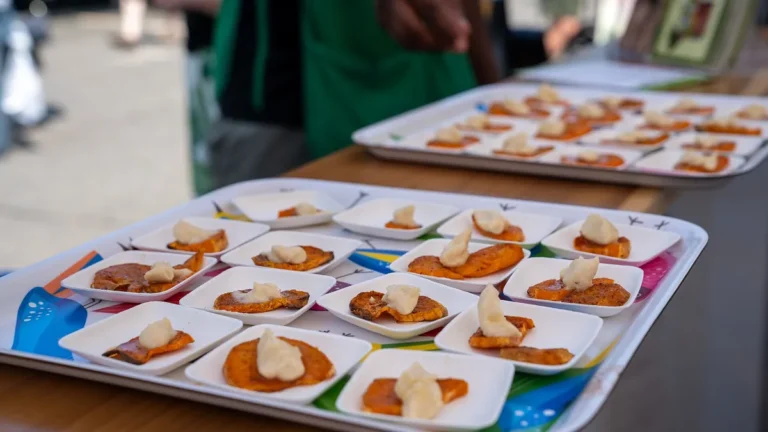
Demonstrations rooted in household work anchor every documented edition, though each year’s list belongs to that year alone. The 2012 programme was described by its university newspaper layer as a culmination of the site’s living-history activities, and its elements were yarn spinners, cooking over an open hearth, a blacksmith, a wooden bucket maker, and tours through the house. The 2015 edition layered a different set over that base: apple cider making, blacksmithing again, a phrenologist, an animal-farm petting zoo, cornhusk-doll making, and vendors selling kettle corn, soap and homemade beeswax products. By 2018 the radio listing described live music alongside crafts, a petting zoo, cooking, blacksmithing, weaving, knitting and apple cider pressing. Blacksmithing is the one thread in all three lists, while the phrenologist appears only in 2015 and live music only in 2018, so neither should be assumed for an unpublished programme. The house tours documented in 2012 give the afternoon its centre of gravity, letting visitors step inside the building the foundation exists to preserve. An October 2026 photo story adds a quieter confirmation, showing the festival on a Sunday afternoon with vendors on site, suggesting the vendor presence documented in 2015 remained part of its texture eleven years later.
Planning Your Visit
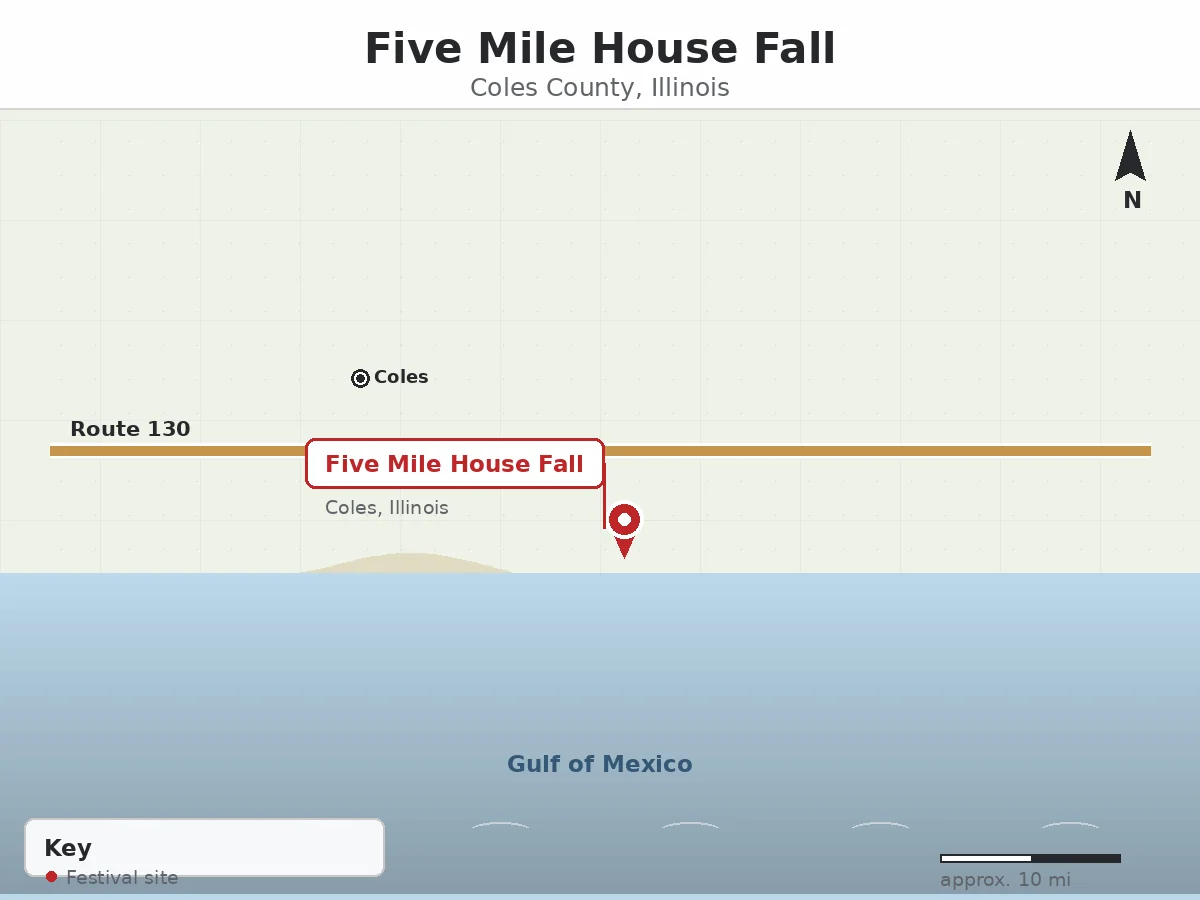
Reaching the house means reckoning with a disagreement in the layers. Most layers place the site at Illinois Route 130 and Westfield Road, and another form describes the spot as five miles south of Charleston on Highway 130. A 2012 news layer, however, locates the house at the intersection of Illinois Routes 16 and 130. Both versions stand as published, neither corrected into the other, so a first-time visitor should confirm the crossroads against the foundation’s current directions before setting out. The name itself offers the surest orientation: the house stands exactly five miles from the Coles County Courthouse, stated by a 2012 university newspaper layer and repeated by a city tourism layer. Charleston, just north of the site, is the seat of Coles County, its downtown square holding that role since eighteen thirty-five. Documented editions occupy a single Sunday afternoon from one to four, leaving little room for a late arrival, and the 2012 postponement shows severe weather can move the gathering by a week. Cost carries a firm fence: a 2018 radio listing prices the event as free, stating there is no charge to attend, and that statement belongs to 2018. No other layer examined publishes an admission price, so the only documented price is none at all, attached to one named year.
For a useful comparison, see the Coles County Illinois Mattoon Lightworks Festival for another county festival.
A Sample Sunday Afternoon Itinerary
This itinerary is built from the single-Sunday form recorded in 2012, 2015 and 2018: one afternoon, one to four, framed as a model rather than a promise. Arriving near one o’clock puts a visitor on the grounds as demonstrations settle into their rhythm, and the house tour is a sensible first stop, since the interior explains the outdoor work. The middle hours suit the craftspeople, moving from the blacksmith toward whichever fibre and food demonstrations that year’s programme includes. A final circuit before four can take in the vendors and any animals on site that year. This itinerary deliberately does not borrow the 2025 two-day form: the weekend of 4 to 5 October 2025 differs from the single-Sunday pattern, and blending the two shapes would misrepresent both. The 2026 photo story’s Sunday afternoon fits the older model, which is why the single-afternoon frame remains the fairest template for a visit.
How This Festival Compares With the Site’s Other Programming
Comparison here stays inside the fence line: this festival against the Five Mile House’s own separate events. The site also runs summer open houses under the banner of Living History Sundays, along with an annual barbecue and auction, a spring school programme and lunch-and-learn events, all documented in layers between 2015 and 2022. Those gatherings are separate site programming and form no part of this festival. The Living History Sundays spread interpretation across the summer in a recurring series, while the Fall Festival gathers comparable skills into one concentrated October afternoon that its 2012 layer called a culmination of the season’s living-history activities. The barbecue and auction serves the foundation’s upkeep in a way the festival, documented as free in 2018, does not attempt, and the spring school programme addresses pupils rather than the general Sunday visitor. Choosing between the site’s offerings is really choosing a format: a summer Sunday at a gentler spread, or one autumn afternoon when demonstrators, vendors and tours converge.
A Checklist for the Afternoon
- Confirm the crossroads before travelling, since published layers give both Illinois Route 130 and Westfield Road and the intersection of Illinois Routes 16 and 130
- Recheck the date close to the weekend, remembering that rain and high winds moved the 2012 edition by a full week
- Plan around a one-to-four window, because most documented editions last only that single afternoon
- Put the house tour early in the visit so the demonstrations outside have their context
- Look for blacksmithing, the one programme element named in 2012, 2015 and 2018 alike
- Treat every other attraction as year-specific until the current programme is published
- Carry no expectation of a gate charge based on other years, since the free statement belongs to the 2018 listing alone
- Leave the summer Living History Sundays, the barbecue and auction, the spring school programme and the lunch-and-learn events for their own separate dates
Beyond the Festival Afternoon
Beyond the afternoon, the record supports only a few directions. One is the town five miles north: Charleston’s downtown square, the seat of Coles County since eighteen thirty-five, holds the courthouse from which the house takes its name, so a festival trip pairs naturally with the square that anchors the measurement. Another is the site’s own calendar, where the summer open houses and Living History Sundays, the annual barbecue and auction, the spring school programme and the lunch-and-learn events continue the foundation’s work in other seasons, each separate from the festival itself. The October 2026 photo story also shows the festival still drawing vendors and visitors, evidence it remains a living fixture rather than a one-era experiment. No layer examined describes partner festivals elsewhere or a regional circuit, and inventing such connections would stretch a deliberately local record past its edges.
Why This Small Gathering Matters
The significance of this festival lies in proportion. One foundation owns and operates one house, opening its grounds each documented autumn for three hours of spinning, forging, cooking and cider work. Inside that modest frame sit several instructive tensions: a house whose construction year four different statements place anywhere from circa 1837 to the mid-1840s, a venue whose crossroads two published versions describe differently, a festival whose second-annual billing tempts a founding calculation the evidence cannot honour, and a body whose 1998 formation is documented while its festival has no stated beginning. The gathering also preserves skills that survive mainly by being practised in public: making a wooden bucket, cooking over an open hearth, pressing cider, shaping cornhusk dolls.That no attendance figure appears anywhere fits the event’s character, an occasion measured in demonstrations given and rooms toured rather than crowd totals. For Coles County, the festival keeps a courthouse-measured landmark in active use, and a landmark in use is far harder to lose than one merely fenced and photographed.
Frequently Asked Questions
Who looks after the house and runs this autumn gathering?
The Five Mile House Foundation organises the festival, according to university newspaper layers from 2012 and 2015, and a bank community-release layer describes it as the site’s owner and operator. The foundation was formed in 1998 to buy and restore the house, a fact about the building’s rescue rather than a festival founding date.
Why is the house called the Five Mile House?
Because of distance. A university newspaper layer from 2012 and a city tourism layer both explain that the house stands exactly five miles from the Coles County Courthouse in Charleston, and that measured gap is the published explanation of the site’s name.
Which demonstrations might a visitor actually see?
Only a specific year’s programme can answer that, because the lists change. Yarn spinners, open-hearth cooking, a wooden bucket maker and house tours belong to 2012; a phrenologist, cornhusk-doll making and an animal-farm petting zoo belong to 2015; live music, weaving, knitting and apple cider pressing are named in 2018. Blacksmithing appears in all three lists.
What happened when bad weather struck the 2012 edition?
Rain and high winds forced a postponement. The edition was first scheduled for 14 October 2012, and a university newspaper layer records that it was moved to the following Sunday, keeping the same one-to-four afternoon hours. That disruption is worth remembering, since the whole festival occupies one short afternoon weather can displace entirely.
What to Expect From the Next Coles County Illinois Five Mile House Fall Festival
How often is Coles County Illinois Five Mile House Fall Festival held?
The documented editions gather on an October Sunday afternoon, in layers for 2012, 2015, 2018 and an October 2026 photo story, with the 2025 tourism newsletter describing a two-day form that differs from that pattern and stands unmerged beside it. Each year’s gathering therefore rests on its own published announcement.
When is the next Coles County Illinois Five Mile House Fall Festival?
No layer examined names a future date. The latest coverage is the photo story dated 7 October 2026, showing the festival on a Sunday afternoon with vendors on site but not printing the exact Sunday date in the text read. Following the documented pattern, the next edition would fall on an October Sunday afternoon, and only a fresh announcement from the foundation can fix the day.
Will the dates change?
They have changed before, in two ways. Weather moved the 2012 edition from 14 October to the following Sunday, and the 2025 edition departed from the single-Sunday shape by running across 4 and 5 October. A future date could therefore shift or widen in format, so any announced day is provisional until the weekend arrives.
Closing Thoughts
The festival asks little of its visitors: one October Sunday afternoon, a drive of five miles south from the courthouse square, and a willingness to watch old skills done slowly and well. In return it offers an event whose gaps and disagreements remain visible in its own record, kept by the foundation formed in 1998. That combination makes the gathering worth the short road south.