Chatham County Georgia Weeping Time Festival

Savannah has built a worldwide reputation on hospitality: the fountain squares, the riverfront crowds, the slow parade of carriage tours. The Chatham County Georgia Weeping Time Festival is a different kind of draw altogether. It is a commemoration rooted in one of the hardest chapters of this county’s past, and it rewards visitors who plan like travelers rather than tourists — who read the schedule in advance, book a room before the spring rush, know where they are parking, and leave room in the day to sit quietly with what they have just heard.
That is the spirit of this guide. Not a hype sheet, but a working plan: what the Weeping Time observance is, why it is held where it is held, how to move through Savannah and the surrounding county without wasting a morning circling for parking, and how to be a good guest at a gathering that is equal parts memorial, classroom, and family reunion. If you are coming from Atlanta, Jacksonville, or Charleston for the weekend, the logistics below are the difference between a rushed check-the-box visit and something you will still be thinking about on the drive home.
Savannah’s Weeping Time: The Details Worth Knowing Before You Go
| Town / host city | Savannah |
| County | Chatham County, Georgia |
| County seat | Savannah |
| County population | 295,291 |
| Region | Coastal Georgia / the Georgia Lowcountry |
| Typical timing | Late winter into early spring, timed near the early-March anniversary of the 1859 sale |
| Admission | Generally free to attend; some related talks and programs may ask for advance registration |
| Setting | West Savannah near the former Ten Broeck race course site, with related programs at historic venues around the city |
| Signature features | Commemorative ceremony, historical interpretation, music and spoken word, educational programming, community reflection |
| Organizer | Community and historical organizations based in Savannah |
What the Weeping Time Commemoration Actually Is
Start with the name. “Weeping Time” refers to a two-day auction held in early March 1859, when more than 400 enslaved people from the Butler family plantations were sold at a race course just outside Savannah. Rain fell through much of the sale — the story carried down through descendants describes the sky itself weeping — and the phrase stuck. It is one of the largest single sales of enslaved people documented in the United States, and it happened here, in what is now Chatham County.
The modern observance is not a festival in the funnel-cake sense, even though it appears on community calendars alongside them. There is no midway, no ticketed headline concert, no vendor row selling souvenir tumblers. What you get instead is a gathering: a commemorative ceremony, historical interpretation led by researchers and descendants, music and spoken word, youth-focused educational sessions, and a lot of unhurried conversation. Some years the programming leans toward public ceremony; other years it leans toward lectures, church-hosted reflections, and walking or driving routes that trace the sites connected to the sale.
Because the observance is built around an anniversary rather than a fixed commercial calendar, the shape of any given year can shift. That is the single most important planning fact in this article: check the current schedule before you book anything nonrefundable. What stays constant is the intent — to name the people who were sold, to place them in a specific landscape rather than a vague historical fog, and to invite the wider public into that remembering.

From the Ten Broeck Track to Chatham County Memory: The History
Chatham County itself is older than the state’s inland boom towns. It was founded in 1777 and named for William Pitt, the British statesman who lent his title, Earl of Chatham, to the county. Savannah has served as its county seat from the beginning, and by the mid-nineteenth century the city was the commercial anchor of the Georgia coast — a port economy built substantially on the labor of enslaved people.
By 1859, the Butler plantations along the Georgia coast were deep in debt. To settle those obligations, hundreds of enslaved men, women, and children were assembled and brought to the Ten Broeck race course on the western edge of Savannah. Over two days in early March, they were sold in lots. Families were divided. Buyers came from across the region. Rain fell, and the site turned to mud.
What makes the Weeping Time unusual in the historical record is not only its scale but the paper trail it left. Newspaper advertisements, sale records, and the recollections of people who survived it — including accounts passed down orally through descendant families — allow researchers to reconstruct names, ages, and family groupings to a degree that is rare for sales of this size. That reconstruction work is what gives the modern observance its texture. It is one thing to say “more than 400 people were sold.” It is another to read a name, an age, and a mother listed beside her child.
The site itself changed over the following century, as Savannah’s western edge industrialized and the old track disappeared into the fabric of the city. Recognition came slowly. Historical markers, descendant research, and community advocacy eventually pulled the story back into public view, and the annual observance grew out of that effort — part memorial service, part research report, part family gathering for people whose ancestors were scattered by a single week’s transactions.
On the Ground in Savannah: What a Visitor Sees and Hears
Expect a mix of formats across the weekend. Ceremonial moments — the reading of names, the pouring of libations, the placing of flowers — tend to be quiet and structured. Educational sessions are more conversational, often with scholars and descendants in the same room. Musical and spoken-word elements carry the emotional weight that straight historical narration sometimes cannot.
Food and Drink Around the Commemoration
Food is not the centerpiece here, which is worth knowing if you are traveling with people who plan their day around meals. Plan to eat before or after programming rather than during it. Savannah’s strength is Lowcountry cooking — shrimp and grits, red rice, fried fish, collards, crab, and oyster houses along the riverfront and out toward the islands. Downtown, the area around City Market and the Historic District gives you the densest cluster of options within walking distance of one another. If you are staying near the westside commemoration site, you will likely drive a short distance for a real meal, so build that into your timeline rather than assuming something will be open on the corner.
For a full day of programming, the practical move is a substantial breakfast, a light midday snack carried with you, and a proper dinner afterward. Bring water. Savannah in late winter and early spring can be warm and humid by afternoon even when the morning starts cool.
Music, Spoken Word, and Historical Programming
The artistic side of the observance tends toward gospel, spirituals, choral work, drumming, and poetry — forms that can hold grief and celebration in the same breath. These performances are usually integrated into the ceremony rather than staged as separate concerts, so arriving late means missing something that does not repeat. Historical programming typically includes presentations on the 1859 sale, the Butler plantations, and the genealogical research that has connected contemporary families to specific names on the sale lists.
If you are a visitor rather than a descendant, this is the part to prepare for. The material is heavy. Sessions may run longer than announced because speakers take questions and families share. Give yourself permission to step away, and do not treat the schedule as a contract.
Family and Youth Activities in Savannah
Children are welcome, and the observance generally includes age-appropriate elements — storytelling, art or craft activities tied to remembrance, and youth readings. That said, this is not a playground event. Parents should talk with kids beforehand about what they are going to hear, in plain and honest terms. Older children and teenagers often get the most out of the educational sessions, where names, dates, and maps make an abstract chapter concrete.
If you are traveling with younger children and need a pressure valve, plan an afternoon break at one of Savannah’s squares, the waterfront, or a museum. Splitting the group for part of the day is a legitimate strategy, not a failure of commitment.
Getting It Right: Logistics for Chatham County Visitors
Getting to Savannah and the Commemoration Sites
Savannah is served by its own airport and sits directly on Interstate 16 and Interstate 95, which makes it an easy drive from Atlanta, Charleston, Jacksonville, and the South Carolina Lowcountry. Chatham County covers 632 square miles, so “Savannah” and “the Savannah area” are not interchangeable when you are planning a morning. Confirm the exact address of each program you intend to attend, then map the distance between them. The westside commemorative site and the Historic District are not a casual stroll apart.
If you are flying in, plan on a rental car or rideshare for at least part of the weekend. Downtown Savannah is famously walkable, but the commemoration’s geography is wider than downtown, and rideshare availability can thin out around large gatherings.
Where to Stay Across Chatham County
Three zones make sense. The Historic District puts you within walking distance of restaurants, squares, and several related venues, at the highest price point. Midtown and the areas around the malls and medical district offer chain hotels, easier parking, and quick access to the interstates. The islands and the beach communities east of the city trade convenience for space and quiet.
Book early. Savannah’s spring calendar is crowded with weddings, conferences, and other events, and the Weeping Time observance falls in the same window. A refundable rate is worth the small premium when the schedule can shift.
Parking and Moving Between Venues
Downtown Savannah parking is metered, enforced, and competitive. Use a city garage and walk rather than hunting for street space. Near the westside commemorative site, expect limited on-street parking and follow any directional signage or volunteers on the day; arrive twenty to thirty minutes early if you want a stress-free start.
Keep your itinerary geographically honest. Group westside activities together, then group downtown activities together. Crossing the city twice in one day in search of parking is the single most common way visitors lose an hour they meant to spend listening.
Admission, Costs, and What Is Actually Free
The core commemoration is generally free to attend, which is deliberate — a memorial should not have a ticket gate. Some affiliated lectures, receptions, or fundraising events may request registration or a donation. Beyond that, budget for the ordinary costs of a Savannah weekend: lodging, meals, parking, and fuel or rideshare. Bring a little cash for donation buckets and any vendor or church auxiliary tables you want to support.
Savannah Weather and What to Pack
Late winter and early spring on the Georgia coast are unpredictable. Mornings can be genuinely cold, afternoons mild to warm, and rain is always a possibility — which carries particular weight at an observance whose name comes from the weather. Layers, a compact rain jacket, comfortable walking shoes you do not mind getting muddy, and a refillable water bottle cover most scenarios. A folding chair helps at outdoor ceremonies where seating is limited, and sunscreen is not a joke in Savannah even in March.
A Two-Day Sample Weekend Around the Weeping Time
Friday. Arrive by mid-afternoon and check in. Spend an hour orienting yourself: drive past the westside site so you know the route and the parking situation before the crowd arrives. Dinner downtown, ideally somewhere you can walk to. Turn in early; tomorrow starts sooner than you think.
Saturday morning. Breakfast near your hotel, then head to the main commemorative gathering. Arrive 30 minutes early. Expect ceremony, name-reading, music, and remarks. Stay for the whole thing if you can — the closing moments are often the most powerful.
Saturday afternoon. Break for lunch and a genuine pause. Then attend a historical or genealogical session. If the day has left you wrung out, swap the session for a walk in a downtown square and come back for the evening program instead.
Saturday evening. Dinner, and a low-key evening. Many visitors use this slot to talk through what they heard, especially if they came as a family or group.
Sunday. If a church-hosted reflection or community service is part of the weekend, attend it — this is often where the observance feels most like a living community rather than a public event. Afterward, eat a long lunch and spend the afternoon on the wider county: the waterfront, a museum, or a drive out toward the islands. Head home late or stay a third night if you can manage it.
How the Weeping Time Sits Beside Other Coastal Georgia Gatherings
Savannah’s calendar is full of large, festive events — the multi-week concert programming of the Savannah Music Festival, the jazz celebration that fills venues across the city, and food-and-music weekends that draw heavy crowds. Those are built for volume, with ticketed headliners and packed streets.
The Weeping Time is the inverse. It is smaller, quieter, and free at its core, and it asks for attention rather than offering distraction. Visitors who arrive expecting a street festival are often caught off guard; visitors who arrive expecting a memorial service with scholarly and artistic layers usually leave moved.
For a fuller weekend, pair it with something nearby and different in tone. Richmond Hill, just down the coast, hosts community seafood and heritage events that show off the Lowcountry’s more celebratory side. Tybee Island offers beach time and a completely different rhythm. And the Historic District itself — with its museums, churches, and preserved architecture — is the natural complement, provided you go in with the understanding that much of that beauty was built on the same economy that produced the 1859 sale.
A Practical Checklist for a Respectful Savannah Visit
Confirm the current year’s schedule and locations before booking anything nonrefundable. Reserve lodging with a cancellable rate. Map the distance between the westside site and any downtown venues you plan to attend. Decide in advance whether you will drive or rideshare, and identify a garage or lot for each zone. Charge your phone and bring a portable battery. Pack layers, rain gear, and shoes that can handle wet ground. Carry water and a folding chair. Bring cash for donations. Read one credible account of the 1859 sale before you go, so the names you hear land with context. Talk with your children beforehand about what they will experience. Plan a real meal before and after programming, not during. And leave one unscheduled hour in the weekend for silence.
Beyond the Commemoration: The Rest of Chatham County
Chatham County is more than its county seat. Beyond downtown Savannah you have the islands — Tybee’s beach, the marsh-edged communities to the south and east, the causeways that make the county’s coastal geography legible. The Historic District rewards a slow morning: churches, house museums, and squares that function as outdoor rooms. Forts and maritime sites along the river speak to the county’s strategic role across three centuries.
For descendants and researchers, the more meaningful extension of the weekend may be the records themselves. Local libraries, archives, and historical organizations hold materials connected to the coastal plantations and the 1859 sale, and staff can often point you toward collections that are not obvious from a web search. If genealogy is part of your reason for coming, email ahead and ask what is available and what hours apply. That one message can turn a vague afternoon into a genuinely productive one.
And eat well while you are here. The Lowcountry table — shrimp, oysters, rice, okra, greens — is a living inheritance, and supporting local kitchens is part of participating in the place rather than just passing through it.
Why the Weeping Time Still Matters in Savannah and Chatham County
A county founded in 1777 and named for a British earl has a long story, and not all of it is comfortable. Chatham County’s 295,291 residents live in a place whose prosperity was built partly on the sale of human beings, and the Weeping Time puts a date, a location, and a set of names on that fact. That specificity is the point. Memorials that stay abstract are easy to walk past; a name read aloud on a wet March morning is not.
The observance also does quieter work. It gives descendant families a place to gather and a reason to compare research. It gives teachers and students a local anchor for national history. It gives visitors — including visitors who came to Savannah for the architecture and the food — an honest encounter with the city they are enjoying. And it strengthens the institutions that keep the work going: churches, historical societies, archives, and neighborhood groups whose budgets are never generous.
Where the Commemoration Sits on the Savannah Map
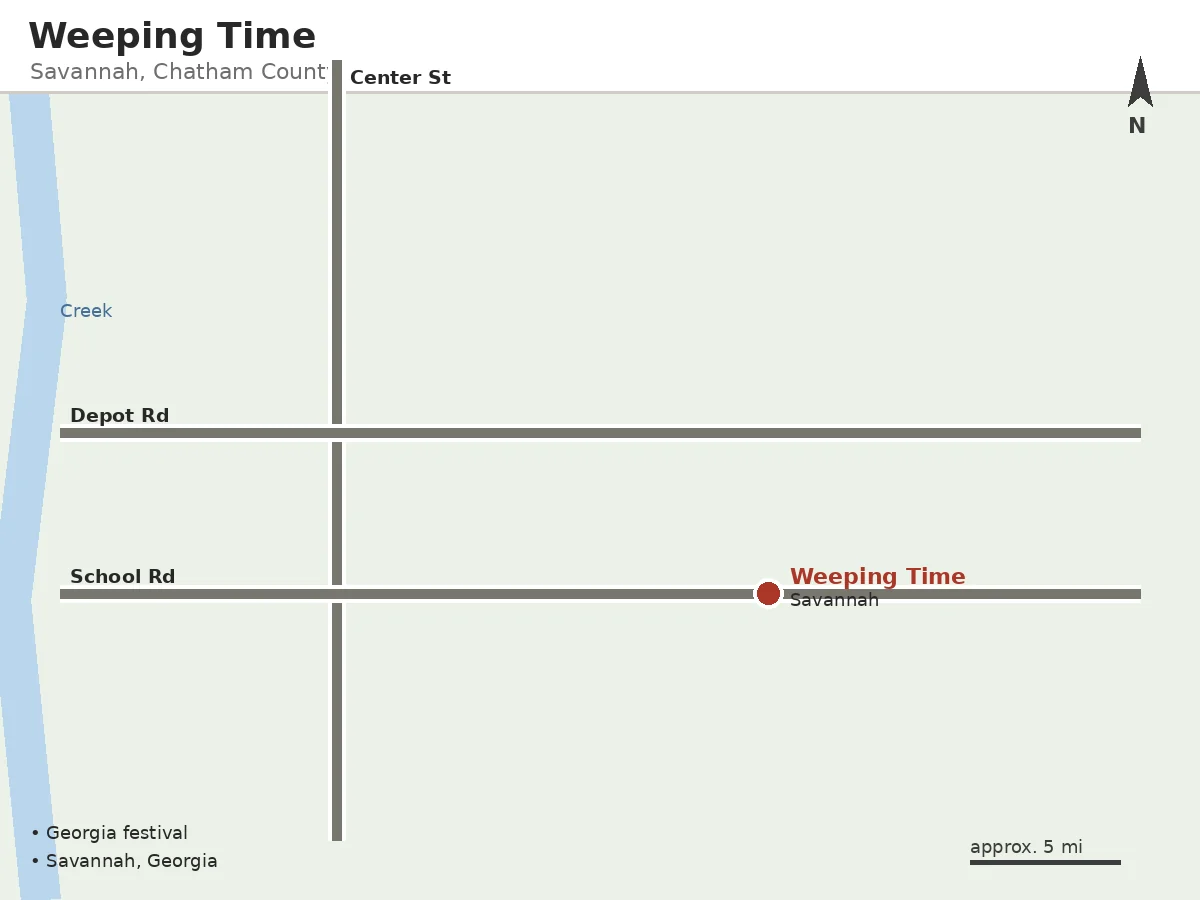
The observance centers on the westside of Savannah in Chatham County, Georgia, near the site associated with the former Ten Broeck race course, with related programs held at historic venues across the city.
Straight Answers for First-Time Weeping Time Visitors
Is the Weeping Time observance free to attend?
The core commemoration is generally free, and that is intentional. Certain affiliated events — lectures, receptions, or fundraisers organized by partner groups — may ask for registration or a suggested donation. Check the current schedule for the specifics of the year you plan to visit.
When does the observance usually take place?
It is typically scheduled in late winter or early spring, near the early-March anniversary of the 1859 sale. Because the date is tied to an anniversary and shaped by the organizations producing the program, confirm the current year’s timing before you book travel or lodging.
Is this appropriate for children?
Yes, and many programs include youth-oriented elements such as storytelling, readings, and hands-on activities. The subject matter is heavy, so prepare younger children with a simple, honest explanation before you arrive, and be ready to step away if they need a break.
Do I need to be a descendant to attend?
No. The observance is public and welcomes visitors, researchers, students, and anyone willing to engage seriously with the history. Descendants are central to the gathering, and visitors should be mindful of that — this is a family and community space as much as a public event.
How should I behave at the ceremony?
Quietly, and with your phone silenced. Avoid photographing people without permission, especially during prayer, name-reading, or moments of visible emotion. Follow the lead of organizers and descendants. If you are unsure whether something is appropriate, the safest answer is to watch and listen rather than participate.
Where should I stay in Savannah for the weekend?
Choose based on how you want to spend your non-programming hours. The Historic District is walkable and expensive; midtown offers easier parking and interstate access; the islands offer space and quiet. Wherever you choose, book a refundable rate early, because Savannah’s spring calendar fills up.
Will I need a car?
For at least part of the weekend, yes. Downtown Savannah is genuinely walkable, but the commemoration’s geography stretches across the city and Chatham County’s 632 square miles, and rideshare coverage can thin out around large gatherings. A rental car or a planned mix of driving and walking will save you real time.
What should I read before I come?
Anything that gives you a clear account of the 1859 sale, the Butler plantations, and the practice of family separation in the domestic slave trade. Arriving with context turns a moving but confusing hour into something you can carry home. Local archives and historical organizations can point you toward deeper material once you are in town.
The Next Chapters for Savannah’s Weeping Time Observance
The trajectory for this observance points toward more research, more public history, and better physical recognition of the site where the sale took place. Genealogical work continues to connect descendant families with names and records, and each year’s programming tends to fold in whatever new findings have surfaced. Educational partnerships — with schools, archives, and universities — are the likeliest area of growth, because the story works best when it is taught rather than only commemorated.
For visitors, that means the experience will keep evolving. Formats may shift, venues may change, and the balance between ceremony and scholarship may tilt from year to year. What will not change is the reason people gather: more than 400 human beings were sold in this county over two days in 1859, and the community that lives here now has decided not to look away. Plan your trip with the flexibility that decision requires — check the schedule, book what you can cancel, and arrive ready to listen.
Last updated: October 2026
Come to Savannah for the Weeping Time and you will find a city that is far more interesting than its postcard — a place where the architecture and the history are the same story told from different angles, and where an annual gathering in early spring asks visitors to hold both at once.




One Comment