Alpena Michigan Michigan Brown Trout Festival
For ten days in the middle of July, the edge of Alpena where the festival grounds meet the boat harbor becomes a working tournament village, with boats heading out onto Thunder Bay before daylight and crowds drifting back toward the tents by evening. The gathering at the centre of it is printed, in full, as the Michigan Brown Trout Festival, and a downtown events layer bills the 2026 running as its fifty-second year, held from Friday 17 to Sunday 26 July. Fishing sits at the heart of the week, but the grounds carry far more than weigh-ins: nightly concerts, sailboat racing, wine tasting and an art fair folded into the opening weekend all share the same stretch of waterfront.
Shorter versions of the name circulate alongside the full one. Guide and downtown layers also call the event the Brown Trout Festival or the Alpena Brown Trout Festival, while an organiser-linked layer reduces it to the initials MBTF. None of those forms replaces the others here; each is kept as its own layer prints it. Alpena itself is the only city in Alpena County and serves as the county seat, according to a reference layer, so the festival unfolds in the town that anchors the whole county.
About
The festival belongs to its own organisation. The organiser’s own layer lists a board of directors and officers for the event, and an organiser-linked layer points to a Board of Directors page prepared for 2027, which suggests the planning never really pauses between editions. Two working roles recur in the layers: a festival president and a fishing tournament director, both of whom are referred to by their roles rather than named here. Around them, a downtown layer credits the whole production to volunteers, which fits the picture of a community-run tournament that has lasted half a century.
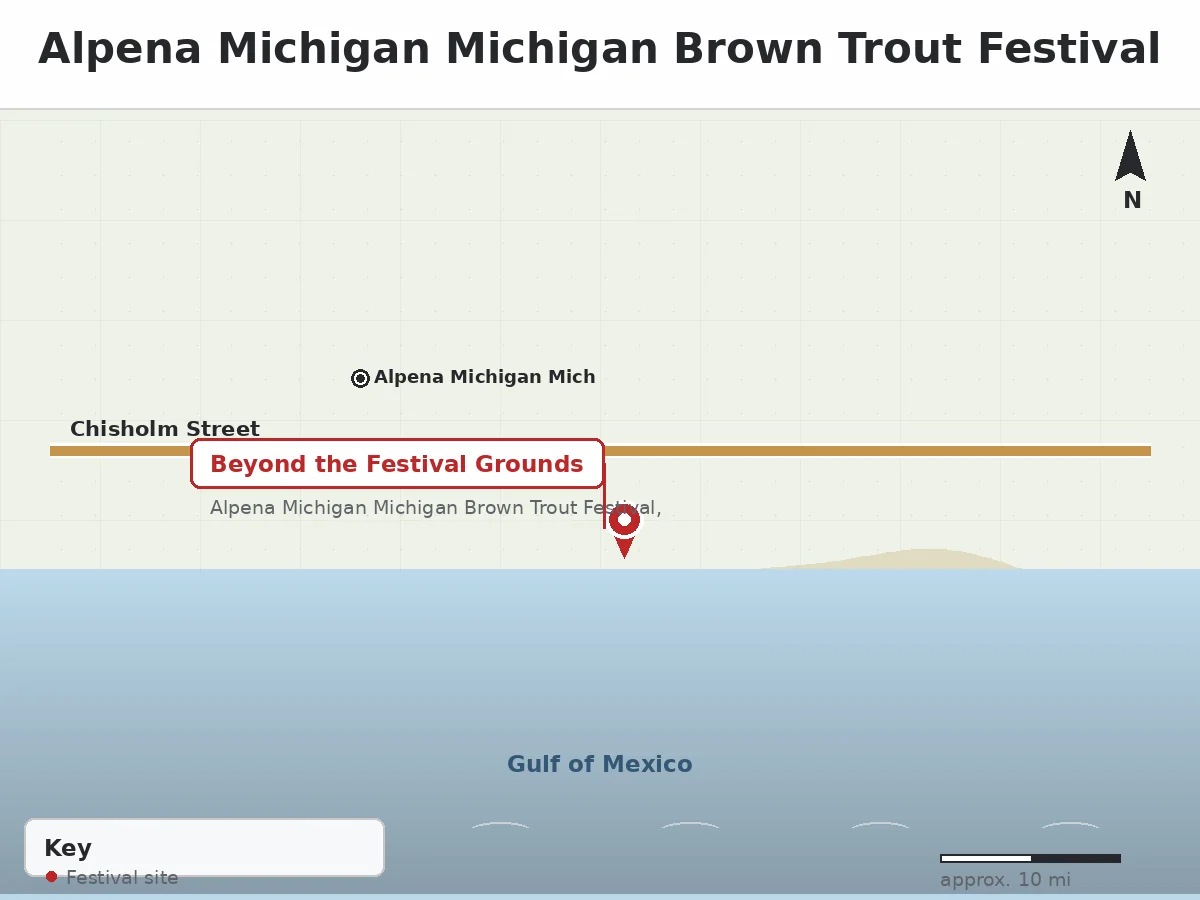
The physical footprint splits between land and water. Schedule layers place a big-tent stage and a small-tent stage on the festival grounds, and a listing layer locates those grounds on East Chisholm Street. The rules layer, meanwhile, fixes the official weigh-in station at the Alpena City Boat Harbor, so the competitive side of the festival is anchored at the marina while the social side gathers under canvas a short walk away.
Four recent editions give the event its documented shape. A downtown events layer sets the 2026 festival across 17 to 26 July and records a headline concert on the opening Friday, 17 July. A listing layer shows the 2024 edition opening on Friday 19 July with a printed daily schedule. A television news layer describes the 2023 running, billed as the forty-ninth annual, as a ten-day festival held from 14 to 23 July. A health-system newsletter layer gives the forty-eighth annual as 15 to 24 July 2022. Taken together, the layers describe a mid-July fixture that stretches across two weekends.
For a useful comparison, see the Allegan Michigan Michigan Fiber Festival for another county festival.
Quick Facts
| Item | Detail |
| Published name | Michigan Brown Trout Festival |
| Shorter printed forms | Brown Trout Festival; Alpena Brown Trout Festival |
| Initials form | MBTF, in the organiser-linked layer |
| Host town | Alpena, Alpena County, Michigan |
| County seat status | Alpena is the county seat of Alpena County |
| Venue | Festival grounds and the Alpena marina and boat harbor area |
| Weigh-in station | Alpena City Boat Harbor, per the rules layer |
| 2026 dates | Friday 17 to Sunday 26 July 2026 |
| First held | 1975 |
| Organiser | The festival’s own organisation, led by a board of directors |
History
The layers are unusually direct about the beginning: the festival has been held in Alpena since 1975. The same accounts tie that start to a period when the local brown trout population was thriving, which explains why this particular fish, rather than any other Lake Huron species, gave the event its name and its purpose. What began as a celebration of a strong fishery settled into an annual tournament tradition on the Thunder Bay shore.
Descriptions attached to the festival carry two large claims, and both belong to their layers rather than to settled fact here. It is described as the longest-running freshwater fishing tournament in the Great Lakes, and separately as Michigan’s oldest continuous fishing festival. Those superlatives travel with the coverage of the event, and they help explain the pride Alpena takes in it, but they are repeated as the layers phrase them, not as independently settled records.
The annual billings printed across recent coverage — forty-eighth, forty-ninth, fiftieth, fifty-second, fifty-third — are simply recorded as they appear. No founding year is worked out from that arithmetic, because the layers already state the 1975 start outright. A downtown layer adds that the festival has been run by volunteers, a detail that matters for understanding how a ten-day tournament survives for five decades in a small city: the labour behind it is local, donated and renewed each summer.
One storyline from 2026 shows how the tradition renews itself. A public-radio news layer reported that the festival’s tagged feature fish was caught on Monday 20 July during that year’s running, and noted that the capture was only the second in the festival’s entire history. A single fish, released and hunted across fifty years of tournaments, had been landed just twice.
What to Expect
Tournament fishing dominates the programme, and it comes in several distinct formats rather than one long contest. Listing layers name a two-day Super Tournament, a Ladies Classic and a separate high-stakes tournament among the events spread across the ten days. Anglers therefore arrive with different ambitions: some fish a single weekend event, while others pace themselves through the full run of competitions.
The tagged fish gives the whole fleet a shared target. The tagged brown trout, nicknamed the Big Brownie, is released into Lake Huron and Thunder Bay, and a design layer prints a large cash prize attached to its capture. That prize belongs to the contest, not to admission, and the 2026 capture reported by the public-radio layer turned the standing challenge into the summer’s biggest story on the grounds. Most years the fish simply stays at large, which keeps the legend alive for the next fleet.
Music fills the grounds once the boats come in. Schedule layers put live performances on nightly in the big tent and the small tent, so an evening crowd can move between stages without leaving the festival footprint. Guide and newsletter layers add sailboat races and a wine tasting to the mix, broadening the week beyond angling. Art on the Bay, an art fair, runs inside the first weekend according to a downtown layer; it is an element within the festival’s opening days rather than a separate event wearing the festival’s name.
Planning Your Visit
A ten-day span rewards visitors who choose their days deliberately. The opening weekend carries the first tournaments and, in the 2026 documentation, the headline concert on Friday 17 July, while the middle of the run offers a quieter rhythm of daily competition and evening music. The closing weekend brings the tournaments to their conclusions, when the weigh-in station at the city boat harbor draws its largest crowds.
Anyone hoping to watch the fishing should plan around the harbor as much as the grounds. Boats leave early, and the weigh-in is where the day’s results become visible, so a spectator’s afternoon is best split between the marina and the tents. Because the grounds sit on East Chisholm Street in the listing layer’s account, the whole festival stays compact enough to cover on foot once you are in the downtown and waterfront area.
The layers say surprisingly little about the price of simply showing up. No general gate price for attending appears in the credible layers read. The fees that do appear in the rules layer attach to tournament registration and competition entry, which are charges on the anglers taking part, not a documented admission price for the public. Visitors should therefore treat any claim about entry costs, in either direction, as unverified unless the festival’s own current material states it.
Practical preparation is mostly about July weather on Lake Huron. Mornings on the water and evenings by the harbor can feel cool even in midsummer, so layers of clothing earn their place in a bag alongside sunscreen. The organiser’s own layers carry contact routes for vendors, acts and membership, noted here only so readers know those channels exist.
A Sample Ten-Day Itinerary
An angler entering the full run might fish the opening weekend’s early tournaments, take the quieter middle days for the smaller events, and save energy for the closing competitions. A spectator travelling in for the first weekend could catch the opening concert, watch the Saturday weigh-ins, browse Art on the Bay while it runs inside the festival, and still see the fleet return on Sunday. Someone arriving midweek would find the nightly tent music and the daily tournament rhythm without the weekend crowds. A final-weekend visitor gets the resolution: last weigh-ins, the closing concerts and the announcement of results after ten days of competition.
How It Compares
Measured against a single-weekend fair, this festival behaves more like a short season. Its ten days allow separate tournaments with their own fields and formats, something a two-day event could not stage. The tagged-fish storyline also sets it apart from ordinary derbies: a named individual fish, a printed prize and a capture history stretching back decades give spectators a narrative to follow even if they never pick up a rod. The volunteer base and the 1975 start place it among the longer-lived community fishing events on the Great Lakes shore, by its own layers’ description.
A Visitor’s Checklist
- Decide whether you are attending as an angler, a spectator, or both
- Check the current daily schedule before choosing which days to attend
- Allow time at the Alpena City Boat Harbor for the weigh-in
- Pack warm layers for mornings and evenings near the water
- Plan an evening around the big-tent and small-tent music stages
- Look for Art on the Bay if your visit falls on the first weekend
- Confirm any tournament entry requirements directly with the festival
- Keep the Big Brownie storyline in mind while watching the results board
Beyond the Festival Grounds
Alpena’s wider waterfront gives the trip a second layer. Thunder Bay is the working backdrop to everything the festival does, and the marina area stays active outside tournament hours. The town’s position as the county’s only city means its downtown, its harbor and its services all sit within the same small compass, so a festival day can stretch naturally into an evening meal or a walk along the shore. Visitors with extra days can treat the festival as a base rather than a single destination, returning to the grounds each evening after exploring the bay.
The surrounding events calendar also helps a visitor place this festival correctly. June in Alpena belongs to a different celebration, the Flower Festival, which is a separate occasion entirely and shares nothing with the July tournament beyond the town itself. Likewise, the Northern Michigan Fiber Festival, also associated with Alpena, is its own event and should not be confused with the brown trout gathering. Keeping those boundaries clear matters because local coverage sometimes discusses the town’s festivals in a single breath, and only the July event, with its weigh-in station and its tents, is the one documented here.
Why the Brown Trout Festival Matters
Fifty years of continuous running have made the festival part of how Alpena explains itself. It began because the brown trout were thriving, and it kept going because volunteers kept rebuilding it each summer. The superlatives attached to it in coverage — the longest-running freshwater fishing tournament in the Great Lakes, Michigan’s oldest continuous fishing festival — are claims from the layers, but the longevity underneath them is documented in edition after edition. The second-ever capture of the tagged fish in 2026 gave the town a reminder that the story is still being written, one July at a time.
Frequently Asked Questions
Which printed names does the festival use?
The full form Michigan Brown Trout Festival is printed exactly, and guide and downtown layers also use Brown Trout Festival and Alpena Brown Trout Festival. An organiser-linked layer shortens the name to the initials MBTF. Each form is kept as its own layer prints it.
What is the Big Brownie?
The Big Brownie is the nickname given to a tagged brown trout released into Lake Huron and Thunder Bay as the festival’s feature fish. A design layer prints a large cash prize for catching it, and a public-radio news layer recorded only the second capture in the festival’s history during the 2026 edition.
What entry cost is documented for spectators?
No general gate price for attending appears in the credible layers read. The rules layer’s fees concern tournament registration and competition entry for anglers, so they do not establish what a spectator pays, and no free or paid position is assumed here.
How many days does each edition span?
Recent editions run for ten days across two weekends in mid-July. The 2026 edition ran from Friday 17 to Sunday 26 July, the 2023 edition from 14 to 23 July, and the 2022 edition from 15 to 24 July, each as its own layer reports it.
What to Expect From the Next Alpena Michigan Michigan Brown Trout Festival
How often is Alpena Michigan Michigan Brown Trout Festival held?
Editions arrive every summer, with documented runnings in 2022, 2023, 2024 and 2026 all occupying the same mid-July territory. The board material already referenced for 2027 in the organiser-linked layer points to the cycle continuing on its established yearly rhythm.
When is the next Alpena Michigan Michigan Brown Trout Festival?
No specific dates for the next edition are fixed in the layers read. Following the pattern of recent years, it would fall across ten days in mid-July, but readers should confirm the actual dates through the festival’s own current material rather than relying on the pattern alone.
Will the dates change?
The documented editions have shifted by a few days from year to year while staying inside the same mid-July window, so small movements are part of the festival’s normal behaviour. A larger change is not indicated in any layer read.
After fifty years on the Alpena waterfront, the festival’s appeal rests on a simple combination: serious tournament fishing by day, music under the tents by night, and one famous tagged trout still swimming somewhere in Thunder Bay. Whether the Big Brownie is caught again soon or keeps its freedom for another decade, the boats will keep launching each July, and the weigh-in crowds will keep gathering at the harbor to see what the lake gives up.