Bristol Massachusetts New Bedford Folk Festival
For twenty-five editions, one midsummer weekend in downtown New Bedford belonged to acoustic guitars, fiddles, close harmonies and the working waterfront that framed them. The event catalogued here under the sheet title Bristol Massachusetts New Bedford Folk Festival was known to its audiences by the shorter published name New Bedford Folk Festival, and that is the name printed across its listings, posters and news coverage throughout its life. Its story is now a completed one rather than a continuing one. The twenty-fifth annual edition, held across Saturday 9 and Sunday 10 July 2022, turned out to be the last, and an announcement reported in February 2023 confirmed that the festival had ended, worn down by rising costs and the heavier expenses that followed the pandemic. What follows is a record of how the festival worked, what it offered its audiences and why its absence still registers in the Massachusetts summer calendar.
About
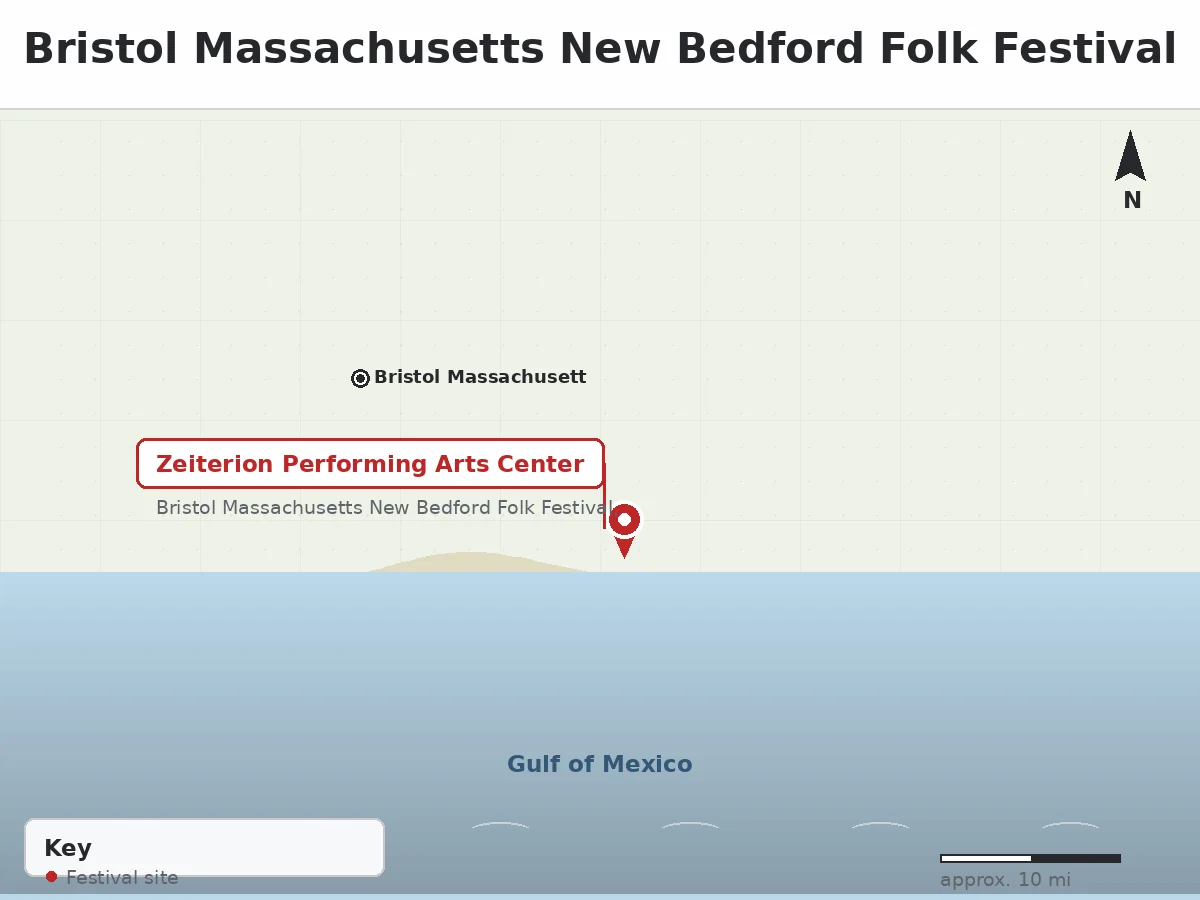
The New Bedford Folk Festival occupied downtown New Bedford in and around the New Bedford Whaling National Historical Park, turning a district built on whaling heritage into a compact open-air music campus for one weekend each year. New Bedford sits in Bristol County, although the county seat is Taunton, the shire town, so the festival’s home city never doubled as the seat of county government. In its final documented shape the event ran seven stages. The Zeiterion Performing Arts Center held the main stage, while the National Park Garden Stage, the “Meet the Performer” area at the Seamen’s Bethel, Custom House Square and a Southcoast Stage spread the programme across the park district, with the remaining stages completing the seven. Stewardship changed hands across the run. During the earlier decades the festival was produced by its own founders, who worked with various fiscal sponsors, and an archived festival layer also names early hosts that included the City of New Bedford, the Whaling National Historical Park, the Whaling Museum, a community foundation and an economic development council. Those early host forms belong to the founding era and sit apart from the later arrangement, under which the Zeiterion Performing Arts Center produced the festival from 2016 and remained the name attached to the announcement that the event had concluded. One naming point deserves care: the full sheet title, carrying its county and state prefix, never appears in the festival’s own materials, because every source prints the core name standing on its own. A box-office telephone contact and a festival web address existed in the layers, recorded here by existence only.
Quick Facts
| Item | Detail |
| Published name | New Bedford Folk Festival |
| Earlier published names | Summerfest and Greater New Bedford Summerfest |
| Host city | New Bedford, Bristol County, Massachusetts |
| County seat | Taunton, the shire town; New Bedford itself is not the seat |
| Final edition | Twenty-fifth annual, Saturday 9 to Sunday 10 July 2022 |
| Setting | Downtown blocks in and around the Whaling National Historical Park |
| Main stage | Zeiterion Performing Arts Center |
| Producer in the final years | Zeiterion Performing Arts Center, from 2016 |
| Admission at the final edition | Fifty dollars for the weekend, or forty dollars for a single day |
| Status | Concluded after the 2022 edition |
History
A music-museum layer gives the fullest account of the beginnings. It states that the event opened under the name Summerfest, that its opening year was 1996, and that it carried the Summerfest name until a renaming in 2013 recast it as the New Bedford Folk Festival, the title it kept for the remainder of its life. The fuller billing Greater New Bedford Summerfest also survives from that earlier period. The museum layer credits a founding couple as the original coordinators and musical directors of the event, and it says the founders produced the festival through its first twenty years, assisted by fiscal sponsors, before the Zeiterion Performing Arts Center took over during 2015 and 2016. Not every layer agrees on the starting line. A festival-tracking layer gives the run as 1997 to 2022, one year later than the museum account, and that disagreement is best left exactly where the layers leave it rather than smoothed into a single figure. A weaker content-farm page pushes the founding back to 1995, a claim the credible layers do not support. By either credible count the festival accumulated twenty-five editions before it closed. Its later years are documented in concert-listing layers, including the weekend of 6 and 7 July 2019, billed as the twenty-fourth year, and the weekend of 7 and 8 July 2018. The ending arrived in February 2023, when news layers carried the conclusion announcement: after the 2022 edition the festival would not return, because rising costs and post-pandemic expenses had outgrown what the event could carry.
What to Expect
Music ran almost without pause at the final edition. Seven stages carried continuous performances from eleven in the morning until nine at night across both days of the 2022 weekend, adding up to nearly seventy-five performances inside a single edition. The sound ranged across folk, Americana, blues and Celtic traditions, and the printed performer list for that closing year was a long one, with Tom Rush, John Gorka, Cheryl Wheeler and Susan Werner among the established names and the Celtic group RUNA also on the bill. Sunday night closed with a Celtic Extravaganza that drew the weekend’s Celtic energy together into one final set. The workshops behaved differently from the stages. In the song-swap sessions, musicians who in some cases had never met before shared a platform and traded songs, so audiences heard collaborations that existed only for that hour and would not be repeated. Away from the listening areas, a juried artisans’ marketplace brought ninety vendors in 2022, an International Bazaar added goods with a global flavour, and a food court and beer garden served the crowds in the open areas between venues. The Southcoast Stage gave local performers their own platform, and in 2022 it stood out as the only stage a visitor could watch without holding a ticket. The “Meet the Performer” sessions at the Seamen’s Bethel added a quieter counterweight to all of this, giving audiences the chance to hear artists talk about their material at close quarters between the louder stage sets.
Planning Your Visit
Because the festival has ended, sensible planning advice belongs to the record of how a visit worked rather than to any future trip. At the final edition, a specialist music-news layer priced admission at fifty dollars for the whole weekend or forty dollars for one day, and those figures belong to 2022 alone. Earlier editions worked out cheaper for some visitors: a crowdfunding layer from an earlier year put ticketed shows between fifteen and twenty-five dollars, with some shows offered free, and that earlier pattern should not be blended with the closing prices. A visitor in 2022 could also spend part of the day without paying anything at the gate, because the craft blocks, the food court and the Southcoast Stage all stood in non-ticketed areas. The compact footprint helped as well, since the stages clustered in and around the historical park, and a day could be organised around drifting between nearby venues instead of crossing the city. Anyone researching the festival today should treat surviving pages with care: at least one content-farm page advertises an invented edition for 2026, complete with fabricated headliners and an August date, and no such edition exists in any credible layer.
For a useful comparison, see the Berkshire Massachusetts Berkshire Pride Festival for another county festival.
A Sample Day at the Final Edition
A Saturday at the 2022 edition could begin shortly before eleven, when the first sets started across the stages, with an early performance on the National Park Garden Stage before the crowds thickened. Late morning suited a song-swap workshop, where the pairings were unpredictable and the conversation between musicians formed part of the appeal. Midday belonged to the food court and a slow pass through the juried marketplace and the International Bazaar, when the ninety vendors were all open and the beer garden offered a pause between sets. The afternoon invited a longer commitment to the main stage inside the Zeiterion Performing Arts Center, balanced by a session at the Seamen’s Bethel, where the “Meet the Performer” format put artists within talking distance of their audience. Early evening worked well at Custom House Square, and the day could close either with headline sets running toward nine or, for anyone without a ticket, at the Southcoast Stage, where local performers played in the open area. Sunday followed the same rhythm and finished with the Celtic Extravaganza.
Standing Apart From Its Neighbours
Several nearby events are easy to confuse with this one, and the distinctions matter. The Lowell Folk Festival and the Green River Festival are separate Massachusetts folk festivals in other communities, with their own histories, and neither has any organisational connection to the New Bedford event. Closer to home, a successor summer festival was launched in July 2023 with the stated aim of keeping the city’s folk-weekend tradition alive after the Folk Festival ended; well-intentioned as that effort is, it is a different event under different management, not a continuation of the festival described here. The sharpest contrast, though, is with the fabricated version of the festival that circulates on low-quality pages, which imagines the event still running in 2026 with an August date and invented headliners. Against that fiction, the documented festival was a ticketed, park-centred weekend that ran for twenty-five editions and closed, openly and on the record, in the summer of 2022.
A Checklist Drawn From the Final Editions
- Weigh the fifty-dollar weekend admission against the forty-dollar single day before choosing, using the prices documented for 2022
- Give at least one song-swap workshop a place in the day, since those pairings happened only once
- Reserve an unhurried hour for the juried artisans’ marketplace and the International Bazaar
- Build in time at the non-ticketed areas, including the food court and the Southcoast Stage, if the budget is tight
- Stay through Sunday evening for the Celtic Extravaganza that closed the weekend
- Walk the historical park district between sets rather than treating the venues as isolated stops
Beyond the Stages
The festival’s setting did half the storytelling. Its venues sat inside the New Bedford Whaling National Historical Park, so a day of music unfolded among the preserved streets and buildings of the city’s whaling era. The Seamen’s Bethel, long associated with the city’s maritime past, doubled as an intimate festival room, while Custom House Square placed performances in open public space a short walk from the waterfront. The Zeiterion Performing Arts Center anchored the weekend as its main stage and largest indoor room. Visitors who came for the music therefore spent their day inside a working historic district rather than a fenced field, and the gaps between sets naturally filled with the park’s own atmosphere. That marriage of place and programme was central to the festival’s identity: folk songs about work, travel and the sea were being sung in a port city whose older streets had been built by exactly those pursuits.
Why the Festival Mattered
Twenty-five editions is a long life for a regional music festival, and the New Bedford event earned its place in that span. It gave nationally recognised performers a stage in a mid-sized port city, and it gave local musicians the Southcoast Stage and the workshop rooms, where reputations could grow in front of listening audiences. Its song-swap format treated collaboration as the point rather than a bonus, pairing artists who might never otherwise have shared a stage. The festival also tied contemporary folk music to the historical park that hosted it, so each edition quietly argued that the district’s heritage was a living setting and not only a preserved one. Its ending carries a lesson of its own: the reasons given, rising costs and post-pandemic expenses, are the same pressures that have closed or shrunk many mid-sized festivals, and the New Bedford record shows how quickly a quarter-century tradition can conclude once those pressures compound. The surviving layers also preserve an unusually honest picture of how such an event gets made, showing founders, fiscal sponsors, civic hosts and a producing arts centre each carrying the festival through a different stretch of its life.
Frequently Asked Questions
When did the festival hold its final edition?
The twenty-fifth annual edition ran across Saturday 9 and Sunday 10 July 2022 in downtown New Bedford. An announcement reported in February 2023 then confirmed that the festival had ended, so the 2022 weekend stands as the last one documented in credible layers.
Which performers appeared on the closing weekend’s bill?
The printed list for 2022 included Tom Rush, John Gorka, Cheryl Wheeler and Susan Werner, together with the Celtic group RUNA, across nearly seventy-five performances on seven stages. The weekend finished with a Celtic Extravaganza on the Sunday night.
What did admission cost at the last edition?
A specialist music-news layer priced the 2022 edition at fifty dollars for the weekend or forty dollars for a single day. Parts of the site, including the craft blocks, the food court and the Southcoast Stage, could be entered without a ticket that year.
What prompted the decision to end the festival after 2022?
The conclusion announcement, as reported in February 2023 news layers, pointed to rising costs and the heavier expenses that followed the pandemic. After twenty-five editions, the producing organisation judged that the event could no longer carry those combined pressures.
What to Expect From the Next Bristol Massachusetts New Bedford Folk Festival
How often is Bristol Massachusetts New Bedford Folk Festival held?
Across its lifetime the festival returned once each summer, settling into a July weekend in its later years and reaching a twenty-fifth annual edition in 2022. That annual rhythm belongs to its history now, because the run has finished.
When is the next Bristol Massachusetts New Bedford Folk Festival?
There is no next edition to mark on a calendar. The festival concluded after July 2022, and the announcement reported in February 2023 made the ending plain, so anyone searching for a future date will find only the record of editions already held.
Will the dates change?
Dates can only shift for an event still being planned, and this festival’s planning ended with its conclusion. Its final weekend, Saturday 9 and Sunday 10 July 2022, is fixed in the record, and the July pattern of its later editions is now simply part of its history.
The New Bedford Folk Festival left behind a tidy, well-documented legacy: a quarter-century of summer weekends in which a whaling-era district filled with living folk music, workshops that paired strangers into temporary bands, and stages that welcomed national names and neighbourhood performers alike. A successor event now carries the city’s folk-weekend hopes in a new form, but the festival itself, under its own name, belongs to the record between its Summerfest beginnings and its final choruses in July 2022.