Bristol Massachusetts Working Waterfront Festival
For one late-September weekend at a time, the piers of New Bedford opened themselves to people who normally only watch the fishing fleet from the shore. The Working Waterfront Festival turned an industrial harbour into a public celebration of commercial fishing, inviting visitors aboard working vessels, down to the contests where crews showed off the skills of their trade, and into tents filled with stories, music and seafood. The layers gathered for this article bill New Bedford as the largest commercial fishing port in the United States, and the festival was built around that standing: it treated the fleet, the gear and the people who work both as the main attraction. Sources print the event under three forms of its name, the Working Waterfront Festival, the New Bedford Working Waterfront Festival and the Massachusetts Working Waterfront Festival, while the county-and-state-prefixed title used on this page is a catalogue form that appears in none of them. The fullest picture comes from the tenth annual edition in 2013, with a later edition documented in 2017.
About the Festival
The festival belonged to New Bedford, a port city in Bristol County, Massachusetts. Taunton, not New Bedford, serves as the seat of Bristol County, so the host city carried the event on the strength of its harbour rather than any administrative role. Its setting was the working waterfront itself: Fisherman’s Wharf and three working piers, among them Steamship Pier, together with waterfront parks appear in the layers covering the tenth annual edition, while one listing layer places activity around the State Pier area as well. That geography mattered to the character of the weekend, because the audience walked the same surfaces the fleet uses through the working year. Interestingly, the gathered layers never settle on one consistent name for whoever stood behind the event. A news layer quotes a festival director in that working capacity, and later material from a fishing-heritage centre in the city concerns a different, successor celebration rather than the management of this festival, so no organising body is credited here beyond what the sources support. What the layers do make plain is the festival’s purpose. It celebrated commercial fishing culture in a port whose landings are dominated by high-value catches such as scallops, and it did so on the fleet’s own ground rather than in a park or a fairground borrowed for the occasion. Decks, docks and gear formed the scenery, and the people demonstrating the work were, in many cases, the people who perform it for a living through the rest of the year. That grounding in a real workplace separated the event from a generic seafood fair: the harbour was not dressed up to look nautical, because it had never stopped being a working waterfront in the first place.
Quick Facts
| Item | Detail |
| Sheet title | Bristol Massachusetts Working Waterfront Festival |
| Published name forms | Working Waterfront Festival; New Bedford Working Waterfront Festival; Massachusetts Working Waterfront Festival |
| Host town | New Bedford, Massachusetts |
| County | Bristol County, whose seat is Taunton |
| Setting | Fisherman’s Wharf, Steamship Pier and neighbouring working piers |
| Best-documented edition | Tenth annual edition, 28 and 29 September 2013 |
| Theme in 2013 | Sustainability and Safety at Sea |
| Admission in 2013 | Free, according to a community-listing layer and a museum layer |
| Latest documented edition | September 2017 |
| First held | 2004, according to a news layer |
History
A news layer states that the festival was first held in 2004, and the 2013 gathering was billed as both the tenth annual edition and the festival’s tenth year. That billing is reproduced here exactly as the sources print it; it sits comfortably alongside the stated 2004 beginning, although the arithmetic of anniversaries is not treated in this article as proof of the start date on its own. By the tenth edition the programme had grown into a two-day harbour-wide occasion with a chosen theme, Sustainability and Safety at Sea, which tied the entertainment to the real hazards of earning a living offshore. A personal blog account of a further edition held on 27 and 28 September survives as well; it is used here only as supporting colour for the late-September pattern, not as the foundation for any claim. The trail continues to a further edition in September 2017, documented by a food-festival reference layer carrying the same commercial-fishing programme of deck tours, fresh seafood, net mending and a rescue demonstration. The persistence of those same elements across the 2013 and 2017 accounts suggests a formula the organisers trusted: open the boats, feed people well, stage the contests and let the fleet speak for itself. After 2017 the dated record gathered here runs out. Readers should also treat glossy destination pages that describe the festival in undated, present-tense generalities with caution: those content-farm pages offer no editions, no dates and nothing checkable, so they are given no weight in this account.
What to Expect
Visitors to the documented editions stepped straight into the routines of a fishing port. Vessel tours let the public walk the decks of working boats, and the 2017 account lingers on the experience of crossing the deck of a scalloper. Contests gave the weekend its competitive flavour: a net-mending contest on the Saturday and a scallop-shucking contest on the Sunday of the 2013 edition, each carrying cash prizes, with the amounts left unstated in the layers. Food ran through the programme in the form of a seafood cook-off, cooking demonstrations and fresh seafood served on the piers. On the water there were whaleboat rides, and a live rescue demonstration showed how crews are recovered from the sea; the 2017 edition likewise featured a Coast Guard rescue demonstration. The Fish Tales tent hosted storytelling and author readings, maritime and ethnic music played across the site, and children had their own scheduled events from eleven in the morning until five on both days of the 2013 edition. Net-mending demonstrations rounded out a programme in which nearly every element doubled as an introduction to the trade. The pacing of the two days was part of the appeal. Saturday in 2013 ran a full ten hours, long enough to drift between a cook-off heat, a deck tour and a reading without hurrying, while Sunday’s shorter span concentrated the shucking contest and the remaining rides and demonstrations into a single busy afternoon. Adults could follow the rescue demonstration and the safety theme with genuine interest, and younger visitors were never far from an activity pitched at their level, which kept the piers feeling like a shared day out rather than an industry open day with families tolerated at the edges.
Planning Your Visit
Because the dated editions gathered here belong to 2013 and 2017, anyone hoping to attend a future running should first confirm whether the festival has been revived, since the material behind this article documents no edition after 2017. The historical pattern is nevertheless clear enough to plan around if the event ever returns: a late-September weekend on the New Bedford waterfront, with long hours on the Saturday — eight in the morning to six in the evening in 2013 — and a shorter Sunday running from eleven to five. Working piers are uneven, busy surfaces, so flat, closed footwear suits the ground far better than anything dressy, and a layer for harbour weather is wise even in early autumn. Families found the children’s programming concentrated in the middle of the day, and anyone keen on the contests benefited from checking which day held which event, since the net-mending and scallop-shucking competitions were deliberately split across the Saturday and the Sunday.
For a useful comparison, see the Bristol Massachusetts New Bedford Folk Festival for another county festival.
A Sample Day on the Piers
A Saturday shaped by the 2013 programme might begin soon after the gates opened at eight, with a vessel tour taken while the light was good and the decks still quiet. Late morning suits the cooking demonstrations and an early taste of the seafood cook-off entries. The net-mending contest anchors the afternoon, with the Fish Tales tent offering a seated break for stories and readings between spells on the wharves. A Sunday visitor, working to the shorter eleven-to-five hours, could head first to the scallop-shucking contest, then fit in a whaleboat ride and the rescue demonstration before a final wander through the children’s activities and the parks along the waterfront.
How It Compares
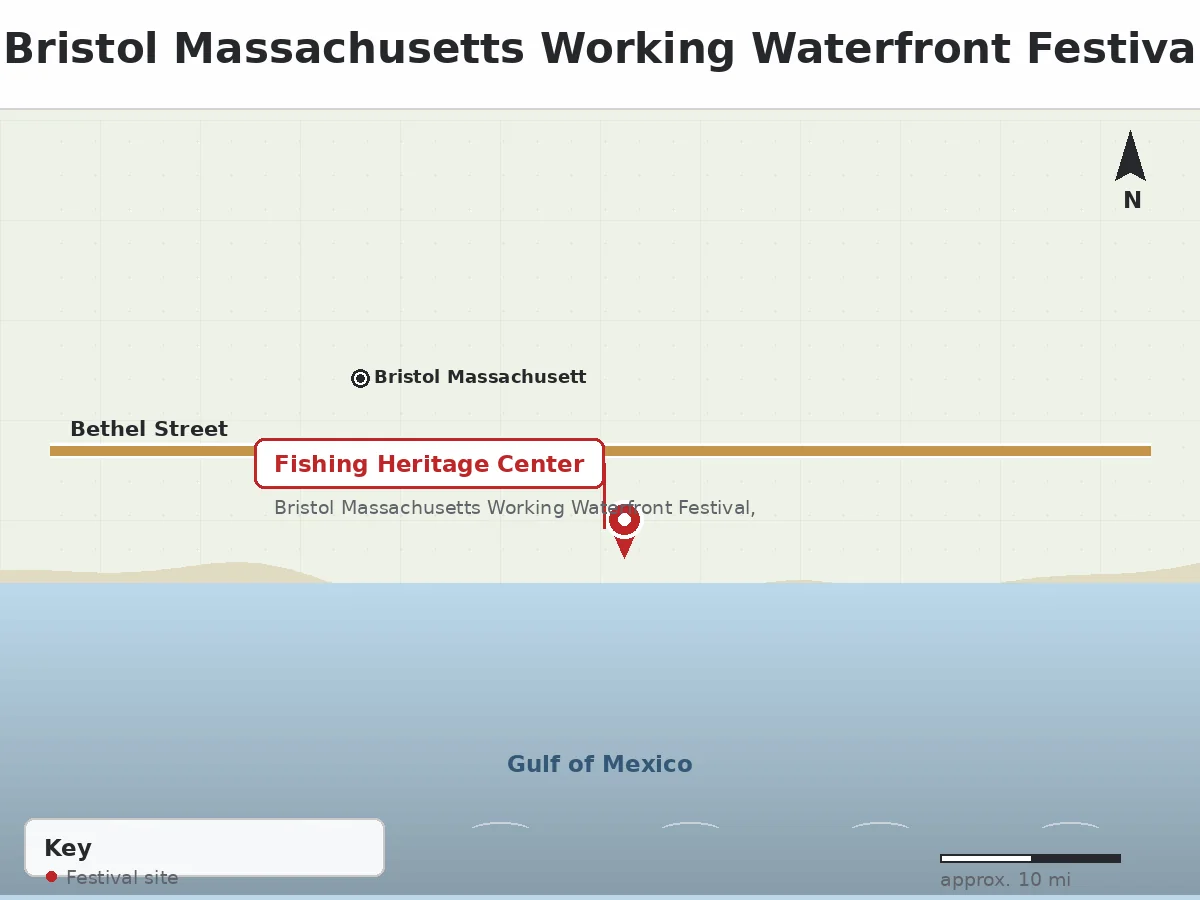
New Bedford sustains several well-known festivals, and this one is easily confused with its neighbours. The New Bedford Folk Festival builds its weekend around music stages, the Whaling City Festival is a separate city celebration, and the Feast of the Blessed Sacrament centres on Portuguese food and faith; the Working Waterfront Festival differed from all three by making the commercial fleet itself the subject. Its closest relative is Big Boats, Little Boats, held on Saturday 28 September 2019 and presented by the city’s Fishing Heritage Center around Bethel Street, Steamship Pier and City Pier 3. That gathering was a smaller successor celebration in the same spirit, not a continuation under the festival’s own name, and the distinction matters when reading later waterfront coverage.
Checklist
- Confirm the festival’s current status before making any travel plans, because the documented editions end in 2017.
- Dress for working piers, with flat closed shoes and a warm layer for harbour wind.
- Pick your day by the contests: net mending on a Saturday, scallop shucking on a Sunday, following the 2013 pattern.
- Leave time in the middle of the day for the children’s events, which ran from eleven to five.
- Treat undated destination pages about the festival as background colour rather than evidence of a coming edition.
Beyond the Festival Grounds
A trip built around the waterfront can stretch well past the piers. New Bedford’s maritime identity reaches back through its whaling era as well as its modern fishing fleet, and the waterfront parks used by the festival reward a slower walk once the contests end. Even on an ordinary weekend the harbour repays attention: vessels loading ice and fuel, crews mending gear on deck, and the comings and goings of a fleet that works in all seasons. Visitors who came for the festival often found the everyday spectacle of the port nearly as absorbing as the programmed events, and the city makes a natural base for exploring the wider Bristol County coast, from its smaller harbour towns to the beaches further south, before returning to Taunton’s county-seat streets inland. Elsewhere in the city, the festival calendar continues through the year with the folk festival, the Whaling City Festival and the Feast of the Blessed Sacrament, each drawing a different crowd to a different corner of the city. Even without an edition running, the harbour itself remains the essential sight: a working fleet landing real catches, in a port whose scale the festival existed to explain.
Why the Festival Mattered
Most harbour towns keep their commercial piers fenced off and purely functional. This festival argued, for a weekend at a time, that the fleet was also a piece of public culture worth boarding, questioning and celebrating. Its 2013 theme of sustainability and safety at sea gave the entertainment an honest edge, acknowledging that the skills being applauded in contests were the same ones that keep crews alive offshore. For fishing families it offered recognition; for visitors it offered understanding of where their seafood comes from and what it costs in labour. That exchange between a working port and its public is the festival’s real legacy in the record. There is also a quieter achievement worth noting: the festival taught a landsman’s vocabulary. People who arrived unable to tell a scallop dredge from a trawl door left knowing how nets are mended, how shellfish are shucked at commercial speed and why a rescue at sea is rehearsed rather than improvised. A port city that can explain itself that clearly strengthens the bond between the fleet and the community that eats its catch, and the affection in the surviving accounts suggests the lesson landed.
Frequently Asked Questions
Which edition of the festival is described in the greatest detail?
The tenth annual edition, held on Saturday 28 and Sunday 29 September 2013, is by far the fullest. News, sponsor and museum layers together preserve its theme, its hours, its contests, its children’s schedule and its admission position, while the 2017 edition survives mainly through a single food-festival reference layer.
What could visitors actually do aboard the boats?
They could tour working vessels and walk their decks, including the deck of a scalloper in the 2017 account. The tours sat alongside whaleboat rides on the water and demonstrations on the piers, so the boats were exhibits you could board rather than scenery behind a fence.
Did the 2017 edition carry the same free entry as the tenth annual?
Free entry is stated only for the 2013 edition, where a community-listing layer and a museum layer both describe admission as free. The reference layer documenting the 2017 gathering says nothing about admission either way, so this article leaves that year’s position open instead of carrying the earlier statement across.
What appeared on the waterfront calendar after this festival faded from the record?
In September 2019 the city’s Fishing Heritage Center presented Big Boats, Little Boats, a smaller celebration around Bethel Street, Steamship Pier and City Pier 3. It shared the festival’s spirit and some of its ground, but it was a successor under a new name rather than another edition of the Working Waterfront Festival.
What to Expect From the Next Bristol Massachusetts Working Waterfront Festival
How often is Bristol Massachusetts Working Waterfront Festival held?
Across its documented life the festival kept a yearly rhythm in late September: a news layer dates the first running to 2004, the tenth annual edition fell in 2013, and a further edition is documented in 2017. Nothing gathered for this article shows the pattern continuing beyond that year.
When is the next Bristol Massachusetts Working Waterfront Festival?
No coming edition is documented in the material behind this article, whose dated trail ends with September 2017. The smaller successor celebration of 2019 was a separate event under another name, so it cannot be read as this festival returning.
Will the dates change?
The editions on record cluster in late September, with the tenth annual on the final weekend of that month in 2013 and the 2017 edition on 23 September. Any revival would be free to set fresh dates, and until one is announced there is no confirmed date to report.
In the end, the Working Waterfront Festival survives in the record as a portrait of a port at ease with itself: decks open, nets mended in public, stories told in a tent a few steps from the fleet. Its documented decade and more of Septembers gave New Bedford a way to show visitors that the harbour was not a backdrop but a workplace, and a workplace worth celebrating.