Berkshire Massachusetts Berkshire International Film Festival
For four days at the end of May, the southern Berkshires turn their attention to the screen. The Berkshire International Film Festival, known to its regulars by the short form BIFF, holds its twentieth annual edition from Thursday 28 to Sunday 31 May 2026, split between Great Barrington and Lenox. One layer counts seventy-five films drawn from twenty-seven countries, while the organiser-side layer breaks the programme down as thirty-one documentaries, twenty-nine narrative features, and twenty-nine short films and animated shorts, figures carried here exactly as their layers state them rather than blended into a single tally.
The weekend is built around people as much as pictures. Opening night at the Mahaiwe Performing Arts Center pairs a documentary portrait with the presence of its subject in the room, a Saturday tribute night honours an actress, and the closing night brings a documentary back to the Mahaiwe with its director attending. Between those set pieces sit filmmaker question-and-answer sessions, parties, a student film competition in its second year, and free programmes for children. The sheet title adds the county and state ahead of the festival’s name; the name itself, printed again and again in the layers, is simply the Berkshire International Film Festival.
About
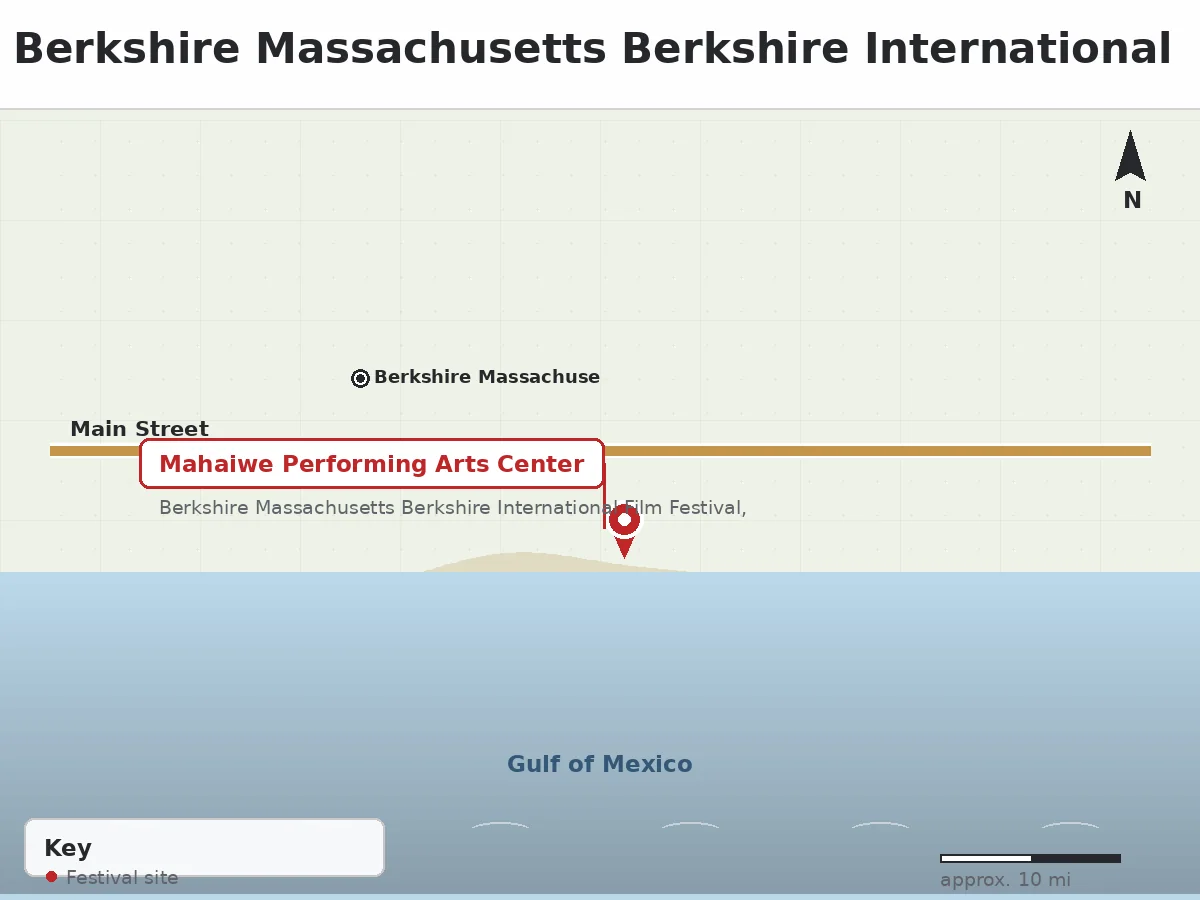
Great Barrington hosts the festival in Berkshire County, and the town shares the 2026 edition with Lenox, a few miles north. A reference layer names Pittsfield as the county seat of Berkshire County, so Great Barrington is a host town rather than the seat. In Great Barrington the screens sit at the Mahaiwe Performing Arts Center and the Triplex Cinema, and in Lenox the programme reaches Lenox Town Hall and a learning centre venue in the town. Earlier editions also used venues in Pittsfield, which belongs to the festival’s history rather than to its 2026 pattern.
No presenting organisation stands between the audience and the event: the festival presents itself under its own name and under the short form BIFF. Its founding, though, is a documented fact with a person attached in the layers, its founder and first artistic director, whose creation of the festival in 2006 the history section below takes up. The 2026 edition opened socially as much as cinematically, with a Taste of the BIFF gathering held behind Great Barrington Town Hall before the screenings settled into their rhythm.
The edition that came just before gives a sense of scale. The nineteenth festival wrapped on Sunday 1 June 2025, closing with seventy-five films and more than sixty filmmakers attending, according to the organiser’s wrap account of the following day. The twentieth keeps that shape and adds a second town, a tribute evening, and a competition strand still young enough to be called new.
For a useful comparison, see the Berkshire Massachusetts Berkshires Arts Festival for another county festival.
Quick Facts
| Item | Detail |
| Sheet title | Berkshire Massachusetts Berkshire International Film Festival |
| Published name | Berkshire International Film Festival |
| Short form | BIFF |
| Host town | Great Barrington, Berkshire County, with 2026 events also in Lenox |
| County seat | Pittsfield, not Great Barrington |
| 2026 edition | Twentieth annual, Thursday 28 to Sunday 31 May 2026 |
| Great Barrington venues | Mahaiwe Performing Arts Center; Triplex Cinema |
| Lenox venues | Lenox Town Hall; a Lenox learning centre venue |
| 2026 programme scale | Seventy-five films from twenty-seven countries, per one layer |
| Admission | Passes and single tickets sold for 2026; no prices stated in the layers read |
History
Multiple layers tell the same origin story. The festival was founded in 2006 by its documented creator, who served as its first artistic director, and the first edition was a compact affair: about forty films screened over three days at the Triplex Cinema in Great Barrington. Growth came quickly. In its second year the young festival added the Mahaiwe Performing Arts Center, the town’s grand old stage house, and the pairing of an intimate cinema with a landmark theatre has shaped its character ever since.
Across the years documented in the layers, the festival’s map has widened and settled more than once. Pittsfield venues appear in accounts of earlier editions, a reminder that the event once spread further north in the county before the 2026 pattern concentrated on Great Barrington and Lenox. Panel discussions and tea-talk conversations feature in the earlier layers too, evidence that the festival has long treated conversation as part of the programme rather than decoration around it. By 2025 the edition had reached seventy-five films with more than sixty filmmakers in attendance, and the twentieth annual billing for 2026 marks two decades from that single-screen beginning at the Triplex.
The recent record is unusually well dated. The organiser’s wrap release of 2 June 2025 fixed the nineteenth edition’s close on the previous day, a small administrative detail that lets the 2026 dates be read with confidence: the twentieth festival follows the nineteenth at exactly a year’s remove, same season, same Thursday-to-Sunday span. Continuity of that kind is itself a historical fact, the sign of an event whose organising rhythm survived the move between venues and the addition of a second town without breaking stride.
What to Expect
Screenings run across the whole weekend in both towns, and the programme divides along three broad lines: narrative features for viewers who come for storytelling, documentaries for those who come for the real world, and short films and animated shorts gathered into their own blocks. The organiser-side layer counts thirty-one documentaries and twenty-nine narrative features for 2026, alongside twenty-nine short films and animated shorts, so no single strand dominates the schedule. Filmmaker question-and-answer sessions follow many screenings, giving audiences the chance to hear how a film was made while it is still fresh in the mind.
The evenings carry their own ceremonies. Opening night at the Mahaiwe centres on a documentary portrait whose subject attended in person, an arrangement that turns a screening into an encounter. Saturday brings the tribute night, honouring an actress whose body of work the festival chose to celebrate, and the closing night returns to the Mahaiwe for a documentary screened with its director in attendance. Around those anchors, parties and special events fill the gaps, and the student film competition, in its second year in 2026, gives younger filmmakers a judged strand of their own. Children are not left to the margins either: free children’s programmes sit inside the programme as elements in their own right.
Timing shapes the weekend in quieter ways too. The Taste of the BIFF gathering opens the social side of the festival before the first full day of screenings, and the habit of placing question-and-answer sessions directly after films means many afternoons end in conversation rather than in the street. Earlier editions folded panel discussions and tea talks into the schedule, and their presence in the layers suggests a festival audience that expects to talk about what it has seen, not simply to file past it.
Planning Your Visit
Two towns mean a little geography to settle before the first screening. Great Barrington carries the weight of the weekend, with the Mahaiwe and the Triplex anchoring the schedule, while Lenox Town Hall and the Lenox learning centre venue host the northern share of events. Anyone basing themselves in one town should still scan the other’s listings each day, because a film’s only screening may sit across the county line of their lodging. The Taste of the BIFF opening event, held behind Great Barrington Town Hall, doubles as an easy first gathering point for newcomers finding their bearings.
Admission works on commitment. The organiser’s layers describe passes on sale for 2026 and single tickets released in stages, going to members first and then opening to the general public. No prices appear in the layers read, so this article puts no figure on either route; what can be said is that the pass rewards those planning to live at the festival for four days, while single tickets suit viewers dropping in for one or two titles. Families should note the free children’s programmes, which are part of the programme rather than the admission structure, and worth timing a day around. Arriving a day early also helps, since late May in the Berkshires fills inns quickly once a festival weekend is announced.
A Sample Itinerary for the Four Days
Thursday belongs to arrival and atmosphere. Settle into Great Barrington during the afternoon, collect passes or tickets, and let the Taste of the BIFF gathering behind Town Hall serve as the weekend’s soft opening before the opening-night screening at the Mahaiwe, where the documentary portrait and its attending subject set the tone. Keep the evening unhurried; the days ahead are dense.
Friday suits a full screening rhythm: a morning documentary at the Triplex, a narrative feature after lunch, and one of the question-and-answer sessions before an early night. Saturday is the day to divide between the towns, catching Lenox Town Hall or the learning centre venue for part of the programme, then returning south for the tribute night. Sunday closes the loop with the student competition’s remaining work or a shorts block in the day and the closing-night documentary at the Mahaiwe, its director present, as the final word of the twentieth edition.
Two Ways Through the Same Programme
A pass and a pocket of single tickets buy the same films but different weekends. The pass holder drifts, sampling a shorts block because the room is near and staying for a panel because a seat is saved by habit, while the single-ticket viewer plans tightly around two or three chosen titles and treats the rest of the town as the day’s entertainment. Neither route is the lesser one; the festival’s four-day spread rewards drifting, and its members-first, then general, release of single tickets means planners on either route should move early.
The two towns offer a gentler contrast. Great Barrington gives the festival its ceremony, the Mahaiwe’s stage framing opening and closing nights, while Lenox gives it breathing room, with Town Hall and a learning centre carrying the quieter strands. A visitor who only attends in one town has still attended the festival, but the fuller picture of its twentieth year lies in the shuttling between them.
A Festival Checklist
- Choose between a pass and single tickets before the general release, since members buy first
- Mark the opening-night and closing-night screenings at the Mahaiwe as fixed points
- Leave one day partly open for the Lenox venues at Town Hall and the learning centre
- Build a question-and-answer session into at least one screening choice
- Note the Saturday tribute night so it is not lost among ordinary screenings
- Time a family visit around the free children’s programmes
- Catch one block of short films and animated shorts alongside the features
- Keep Sunday evening free for the closing documentary and its attending director
Beyond the Screening Rooms
The festival sits inside a county that rewards wandering between films. Great Barrington’s Main Street holds the Triplex and the Mahaiwe within an easy stroll of cafés and bookshops, so the hours between screenings fill themselves. Lenox, the weekend’s second stage, adds its own village calm, and the road between the two towns runs through the soft green country that gives the Berkshires their late-spring reputation.
Two things nearby deserve a clear fence. The festival’s own year-round screening series, which brings anniversary and environmental-series screenings to Great Barrington and Lenox in November 2026, is the organiser’s off-season programme and forms no part of the May edition described here. Likewise, the Williamstown and Chatham film festivals named in an old layer are separate festivals with their own towns and dates, cousins in the region’s film calendar rather than branches of this one.
Why the Festival Matters
Twenty editions in, the festival has become one of the fixtures by which the southern Berkshires mark their year. It began in 2006 with about forty films in a single cinema, founded by a creator who also directed it artistically at the start, and it has grown into a four-day, two-town event screening seventy-five films from twenty-seven countries without losing the habits that made it: directors in the room, subjects on the stage, conversations after the credits. The student competition, only in its second year, points the other way in time, giving the region’s young filmmakers a first audience. For Great Barrington especially, the festival is proof that a small town can hold an international programme and still keep it at walking pace.
Frequently Asked Questions
Which screens host the festival during the 2026 edition?
In Great Barrington the programme plays at the Mahaiwe Performing Arts Center and the Triplex Cinema, and in Lenox it reaches Lenox Town Hall together with a learning centre venue in the town.
How did the twentieth edition open its weekend?
An event billed as Taste of the BIFF gathered behind Great Barrington Town Hall, and opening night at the Mahaiwe screened a documentary portrait with the film’s subject attending in person.
What honours are built into the 2026 programme?
The Saturday of the festival carries a tribute night honouring an actress, and the programme also includes a student film competition that reached its second year in 2026.
How were tickets released for the 2026 edition?
Passes were on sale through the organiser’s layers, and single tickets were released in stages, offered to members first and then opened to the general public, with no prices stated in the layers read.
What to Expect From the Next Berkshire Massachusetts Berkshire International Film Festival
How often is Berkshire Massachusetts Berkshire International Film Festival held?
The billing of the 2026 edition as the twentieth annual, one year after the nineteenth wrapped on 1 June 2025, shows a festival that returns on a yearly cycle, each edition numbered in sequence from the 2006 founding.
When is the next Berkshire Massachusetts Berkshire International Film Festival?
The layers read document the festival through its twentieth edition, which closed on Sunday 31 May 2026, and carry no confirmed dates beyond that weekend, so readers should watch for the festival’s own announcements rather than treat any later weekend as settled.
Will the dates change?
The festival’s recent pattern is a late-May weekend, Thursday to Sunday, as both the 2025 close and the 2026 edition show, but the layers offer no promise that the slot is fixed, and weather or venue needs could always move a future weekend.
What endures from the twentieth edition is a sense of proportion: seventy-five films, four days, two towns, and a programme that still leaves room for a director to stand in front of a screen and answer for the work. The Berkshire International Film Festival has travelled a long way from three days and forty films at one cinema, yet its centre of gravity has not moved. It remains a festival where the people who make films, and the people films are made about, share the room with the people who came to watch.