Calcasieu Parish Louisiana Marshland Festival
The marsh does not announce itself the way a parade does. It spreads out in shallow water and tall grass. The Marshland Festival grew out of that same patience. It is a two-day gathering of Cajun and zydeco music and food in Lake Charles, and it raises money for fifteen community, educational and religious organisations. Its roots, though, sit a short drive south in Hackberry, in Cameron Parish, where the event began at a community center more than thirty years ago.
The published name is Marshland Festival, and one regional events layer also prints the longer form Marshland Cajun & Zydeco Festival. The sheet title, with its parish prefix and trailing word, is never printed as the event’s name, so the body of this article uses the published forms and says so plainly. The festival’s home in recent years is the Lake Charles Event Center, a building formerly styled the Lake Charles Civic Center.
About
The Marshland Festival is a two-day celebration of Cajun and zydeco music and food held in Lake Charles, the parish seat of Calcasieu Parish. It is a fundraiser first and a concert second, though a visitor would be forgiven for thinking the order the other way around once the music starts. The proceeds support fifteen community, educational and religious organisations, a spread that tells its own story about how the event is woven into civic life. Rather than benefiting one cause, the festival spreads its support across the community, educational and religious groups that hold a parish together.
Lake Charles sits on the edge of the marsh country, and the festival’s name is a reminder of that geography. Cajun music, with its fiddles and accordions, and zydeco, with its washboard and driving beat, are both dance musics before they are listening musics, and the festival is built around that fact. The floor matters as much as the stage.
The venue gives the festival room to breathe. The 2016 edition took place at the Lake Charles Civic Center, and the 2026 edition was scheduled for the Event Center, the same building under its newer name. No organiser name form is documented in the layers read for this festival.
For a useful comparison, see the Calcasieu Parish Louisiana Crawfish Festival for another county festival.
Quick Facts
| Detail | Information |
| Published name | Marshland Festival |
| Longer published form | Marshland Cajun & Zydeco Festival |
| Host town | Lake Charles, the parish seat of Calcasieu Parish |
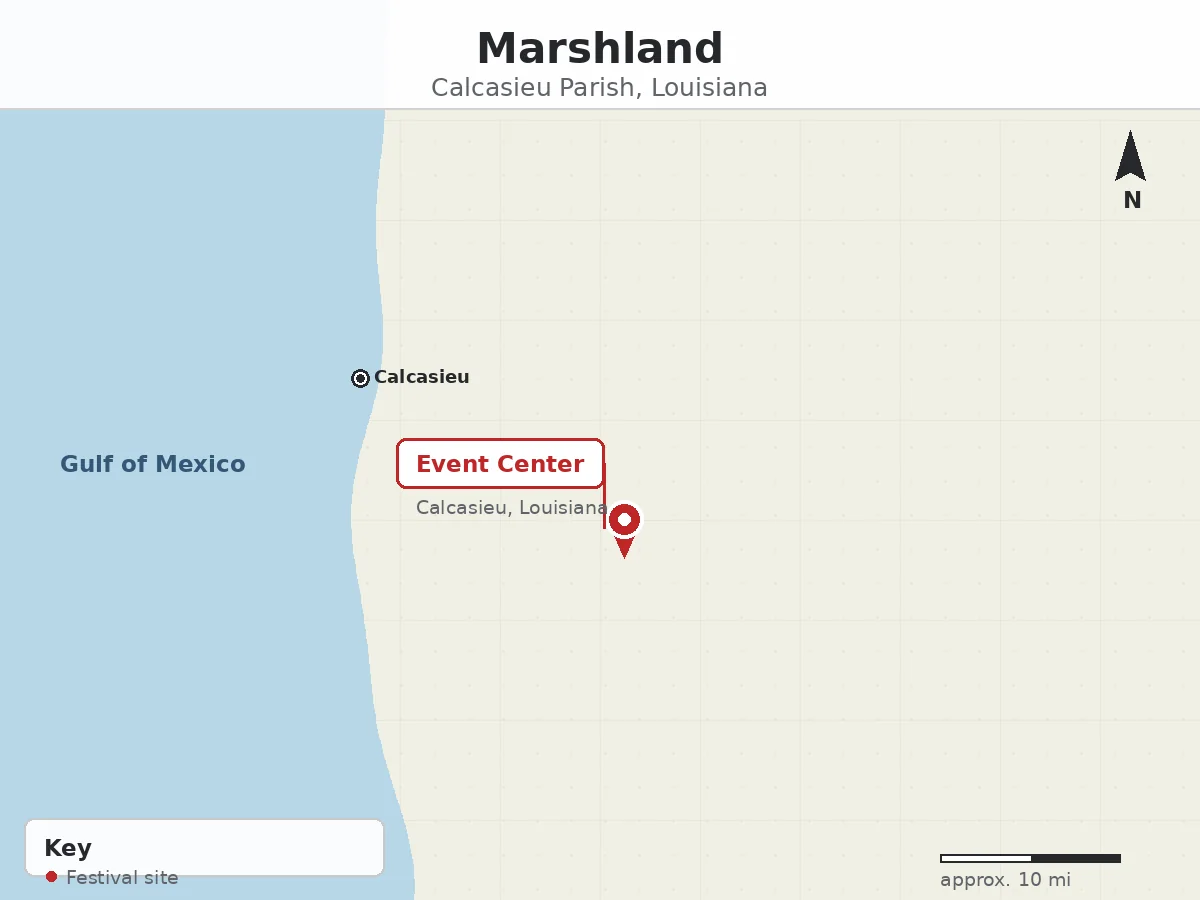
| Venue | Lake Charles Event Center, formerly styled Lake Charles Civic Center |
| Length | Two days |
| Music | Cajun and zydeco music |
| Food | Festival food, with Cajun cooking at its heart |
| Beneficiaries | Fifteen community, educational and religious organisations |
| Latest dated edition | July 30–31, 2026 |
| Admission | Ticketed; no general price fenced in the layers read |
History
The Marshland Festival began in Hackberry, in Cameron Parish, at the community center there, more than thirty years ago. That origin is easily lost, because the festival now takes place in Lake Charles and a careless retelling could plant its beginnings in the parish seat. The visitors-bureau layer is clear on the point: the festival originated in Hackberry and began at the community center there. Hackberry is a small community in the marsh country south of Lake Charles, and the festival started there, among the people who live and work in the marsh, before it grew large enough to need a bigger hall.
One content-farm layer prints a conflicting claim, an early 1990s founding in Lake Charles. That claim is disowned here. The AI-generated festival-listing layers that carry invented lineups and dates for this event are likewise disowned wholesale.
What the credible layers do document is a steady run of editions. The 2016 edition took place at the Lake Charles Civic Center, with the festival already established in its Lake Charles home. The 2019 edition came at the end of July, with advance tickets on sale, which shows the event had settled into a late-July slot and was ticketed rather than open-gated. The 2026 edition was dated July 30–31, 2026, at the Lake Charles Event Center. Three dated editions across a decade, all in the same late-July window, all in the same hall: that is the shape of the festival’s recent history.
The move from Hackberry to Lake Charles is not dated in the layers read, and no date is invented for it here. What can be said is that the festival outgrew its beginnings, as community events often do, and that the parish seat offered the hall and the audience to match its size. The move did not change the event’s character. The name stayed with the marsh even as the hall moved to the city.
What to Expect
A visitor should expect a hall full of music, food and dancing, with the emphasis firmly on the dancing. Cajun and zydeco are dance musics, and the festival floor is where the event comes alive. The bands play fiddles, accordions and washboards, and the crowd answers with two-steps and waltzes, with dancers of all ages moving together. The best way to enjoy it is to step onto the floor rather than stand at the edge. A first visit is best spent on the floor, learning the two-step from the dancers around you.
Food is the festival’s other anchor. Cajun cooking is the heart of the menu, and a visitor should expect the dishes that define the region’s tables: slow-cooked, richly seasoned, and served in generous portions. The food stalls and the music stages share the same hall, so a plate of food and a dance are never far apart.
The two days share the same shape: music through the day, food alongside it, and a crowd that builds as the afternoon turns to evening. A visitor who can spare both days will get the fuller picture, but a single day is enough to understand the event. The hall is indoors, and the atmosphere is that of a community gathering rather than a concert.
One thing a visitor should not expect is a printed lineup carried over from a listing site. The AI-generated festival-listing layers that circulate for this event carry invented lineups and dates, and they are disowned wholesale here. The credible layers document the festival’s music in general terms and do not name the bands for any edition. A visitor who wants to know who is playing should check the event’s own listings close to the date.
Planning Your Visit
Lake Charles is the parish seat of Calcasieu Parish, and it is the natural base for a visit to the Marshland Festival. The city offers the hotels, restaurants and services that a visitor needs. A traveller from outside the parish should stay in Lake Charles itself, which keeps the festival hall within easy reach.
The festival takes place at the Lake Charles Event Center, and the hall’s former styling as the Lake Charles Civic Center is worth knowing for anyone following older directions or older memories. The building is the same; only the name on the sign has changed.
Admission is ticketed, and advance tickets were on sale for the 2019 edition, which suggests that buying ahead is the sensible course. No general price is fenced in the layers read, so a visitor should check the event’s own listings for the current ticket price.
The festival’s dated editions all fall at the end of July — the 2019 edition at the end of July, and the 2026 edition on July 30–31. A visitor planning ahead should therefore look to the last days of July, while remembering that no date is guaranteed until the event itself announces it.
Sample Itinerary
A two-day visit to the Marshland Festival can be paced to match the event’s own rhythm. Arrive in Lake Charles on the morning of the first day and settle into the city before heading to the Lake Charles Event Center in the afternoon. Spend the first hours listening: find a seat near the stage and get a plate of food from one of the stalls.
As the afternoon turns to evening, step onto the dance floor. Cajun and zydeco dancing is welcoming to newcomers, and the crowd’s easy rhythm makes it simple to follow. Dance a set, rest with a plate of food, and dance again. The evening is the festival’s best hours, when the hall is fullest and the music is at its warmest.
On the second day, return to the hall in the late morning and take the day more slowly. The second day is for the details missed on the first: the food stalls, a conversation on the dance floor, and the fifteen organisations the festival supports. Leave the hall in the afternoon with time to see something of Lake Charles itself before heading home.
Comparison
The Marshland Festival sits in a crowded field of Louisiana music festivals, and its character is best understood by contrast. A large outdoor festival offers scale: multiple stages, a sprawling site, and a lineup that draws visitors from across the country. The Marshland Festival offers something different — a single hall, two days, and a crowd that knows the music because it dances to it every week.
Within Calcasieu Parish itself, the festival’s late-July slot and its indoor hall set it apart from the outdoor events that fill the parish’s calendar. An outdoor festival depends on the weather and spreads across a field; the Marshland Festival depends on a hall and gathers its crowd into a single room. That gathering is the point.
The festival’s fundraising purpose is another point of contrast. Many festivals raise money for a single cause or for their own survival. The Marshland Festival spreads its proceeds across fifteen community, educational and religious organisations, which makes it a different kind of event: a community chest with a dance floor attached.
Checklist
- Check the event’s own listings for the next edition’s dates and ticket price before travelling, since no price is fenced in the layers read.
- Bring comfortable shoes for dancing; the floor is the heart of the festival.
- Come hungry; Cajun cooking is the festival’s other anchor.
- Remember the venue’s former styling, the Lake Charles Civic Center, when following older directions to the Lake Charles Event Center.
- Allow time for Lake Charles itself, and for a drive south toward Hackberry, where the festival began.
- Treat any lineup found on a listing aggregator with suspicion.
- Leave room in the schedule for a second day; the festival runs for two days and the second day rewards a slower pace.
Beyond the Festival
Lake Charles is a city built on the edge of the marsh, and a visit to the Marshland Festival is a good reason to see more of it. The waterfront is the natural place for an evening walk after a day in the hall. The lakefront at dusk, with the water catching the last light, is a quiet counterpoint to the noise of the hall. The city’s restaurants carry the same Cajun cooking that fills the festival’s stalls, and a meal in town after the festival is a fitting way to close the visit.
South of the city, the marsh country opens out. Hackberry, where the festival began, is a small community in Cameron Parish, and the drive there runs through the landscape that gave the event its name. Seeing the community center where the festival started is the honest way to understand its origins.
Significance
The Marshland Festival matters because it keeps a community’s music, food and fundraising in the same room. Cajun and zydeco music are living traditions in southwest Louisiana, not museum pieces, and the festival is one of the places where they are played for dancers rather than for an audience. The music is not performed at the crowd but with it, and the crowd’s dancing is as much a part of the performance as the band’s playing. That shared work is what keeps the festival alive year after year.
The festival’s origin in Hackberry matters too, because it roots the event in the marsh country rather than in the city. A festival that began at a community center in a small marsh town and grew into a two-day event at the parish seat’s civic hall has kept its purpose through its growth.
Frequently Asked Questions
What kind of music will I hear at the Marshland Festival?
Cajun and zydeco music, played for dancing. The bands use fiddles, accordions and washboards, and the crowd dances two-steps and waltzes on the hall floor.
Where did the Marshland Festival begin?
The festival originated in Hackberry, in Cameron Parish, and began at the community center there more than thirty years ago. It now takes place at the Lake Charles Event Center in Lake Charles. A claim of an early 1990s founding in Lake Charles appears in a content-farm layer and is disowned; the credible record places the origin in Hackberry.
Is the Marshland Festival free to attend?
No general price is fenced in the layers read, so no figure is given here. The festival is ticketed — advance tickets were on sale for the 2019 edition — and a visitor should check the event’s own listings for the current ticket price before travelling.
How long does the Marshland Festival last?
Two days. The dated editions share a late-July window, with the 2026 edition dated July 30–31, 2026, at the Lake Charles Event Center, and the 2019 edition at the end of July.
What to Expect From the Next Calcasieu Parish Louisiana Marshland Festival
How often is Calcasieu Parish Louisiana Marshland Festival held?
The festival is a recurring two-day event with dated editions documented in 2016, 2019 and 2026, all in a late-July window. The layers do not print an annual schedule, so the pattern is drawn from the editions themselves.
When is the next Calcasieu Parish Louisiana Marshland Festival?
The layers read carry no announcement of a following edition. The most recent dated edition is July 30–31, 2026, at the Lake Charles Event Center, and the festival’s dated editions share a late-July window. A visitor should check the event’s own listings for the next announced dates.
Will the dates change?
The festival’s dated editions have all fallen at the end of July, which suggests a stable late-July window, but no date is guaranteed until the event itself announces it. The venue has changed its styling, from the Lake Charles Civic Center to the Lake Charles Event Center, while remaining the same building.
The Marshland Festival is a small event with a large purpose: two days of Cajun and zydeco music and food in Lake Charles, raising money for fifteen community, educational and religious organisations, and carrying the name of the marsh country where it began. A visitor who comes for the dancing and stays for the food will leave understanding why the festival has lasted more than thirty years.