Tuscaloosa County Alabama Sakura Festival
Each spring, Tuscaloosa greets the cherry blossom season with a celebration that looks across the Pacific. The Tuscaloosa Sakura Festival is the University of Alabama’s long-running festival of Japanese culture, built around blossoms, poetry, demonstrations and a sister-city friendship with Narashino, in Chiba Prefecture, Japan. It is not a county fair and it is not run by the city: every solid record ties it to the university, its Japan Program and its Capstone International Center, with support from Tuscaloosa Sister Cities International and from faculty, staff and student volunteers.
The festival’s own site introduces it with the line “Since 1987, Tuscaloosa’s Annual Sakura Festival,” and its 2026 festival page speaks of a “40 year connection” built between Tuscaloosa and Japan. Those are the festival’s own words about itself, kept here exactly as that. What the dated record does show is a spring event that has changed shape over time: month-long programmes of lectures and exhibits in the early 2000s, and single-day gatherings at city venues in the 2020s, with the haiku contest running through both eras.
About the Tuscaloosa Sakura Festival
Sakura is the Japanese word for cherry blossom, and blossom time is the heart of this festival’s identity. The celebration honours the bond between Tuscaloosa and Narashino City, formalised in a sister city agreement signed in 1986. The festival’s own page places that signing in the period when Alabama was inviting Japanese companies to the state and Japan Victor Company, known as JVC, opened manufacturing plants in Tuscaloosa. Out of that civic courtship grew a cultural tradition that has outlasted the headlines: a spring festival where an Alabama university city celebrates Japanese arts, language and seasonal ritual.
According to the Capstone International Center’s current festival page, the festival was initiated by Dr. Marilyn Emplaincourt of the University of Alabama’s Japan Program. The same page credits its continuation to Tuscaloosa Sister Cities International and dedicated university faculty, staff and student volunteers, and closes with a promise from the Center to continue the Sakura Festival tradition. Older university news releases name the organising body differently; those forms appear in the Quick Facts below exactly as each source gave them, because the name on the letterhead changed across the decades even though the festival’s home inside the university did not.
Quick Facts
| Item | Detail |
| Festival name | Tuscaloosa Sakura Festival |
| County | Tuscaloosa County, Alabama |
| Host city | Tuscaloosa, the county seat |
| Organiser, as published in 2001 and 2002 | The University of Alabama Japan Program |
| Organiser, as published in 2009 | UA Capstone International Center Japan Program |
| Sister city honoured | Narashino, Chiba Prefecture, Japan, linked by an agreement signed in 1986 |
| Season | Spring; dated editions fall in March |
| Recent venues | Tuscaloosa River Market in 2022; Mildred Westervelt Warner Transportation Museum in 2024; no single permanent venue |
| Admission | Not stated for recent editions; university news in 2001 and 2002 said most events were free to the public |
| Signature elements | Haiku contest, cherry blossoms, uchiwa fans, cultural demonstrations |
History
The roots of the festival lie in the sister city agreement signed between Narashino City and Tuscaloosa in 1986. The festival site presents that agreement as the foundation of everything that followed, and its own introductory line dates the annual festival from 1987. The surviving paper trail begins a little later. University news releases document a 15th annual festival running from March 1 to April 20, 2001, under the theme “kizuna,” meaning bonds, with lectures, exhibits, demonstrations, a haiku contest and an art contest. The following year brought a 16th annual festival from March 1 to April 11, 2002, themed “nozomi,” meaning hope, and including a “Matsuri in the Mall” element. A 23rd annual edition followed in March 2009, running the whole month under the theme “ame,” meaning rain. Those ordinals are recorded here only as they were billed; this article does not work backwards from them to declare a founding year.
For a useful comparison, see the Tallapoosa County Alabama Alexander City Fall Festival for another county festival.
Two traditions recorded on the festival’s own history pages fill out the middle years. The uchiwa fan tradition began in 2005, using fans designed in Narashino, and fan calligraphy has been provided by Eihaku Iba since 2014. The blossoms have local roots too: cherry trees at Denny Chimes were donated by a Narashino businessman, and a Narashino Grove stands off Lurleen Wallace Boulevard. In the 2020s the documented shape became a single spring day. The 2022 edition was billed as the 36th annual, held on Saturday, March 26, 2022, from 9 in the morning until noon at the Tuscaloosa River Market. The 2024 edition was billed as the 38th annual, on Saturday, March 23, 2024, from 11 in the morning until 2 in the afternoon at the Mildred Westervelt Warner Transportation Museum, under the theme “Uketsugu,” meaning preserve, with haiku contest entries closing on March 15. The 2026 page carries the theme “Mirai e no yakusoku,” meaning promise, and bills a “40th Annual Sakura Festival and Haiku Contest,” though it publishes neither a date nor a venue for that edition.
What to Expect
What a visitor actually meets depends on the edition, because the programme has always been assembled year by year. The early-2000s editions, documented in university news, spread lectures, exhibits and demonstrations across several weeks, and included a tea ceremony alongside the contests. The haiku contest and the art contest both appear in the 2001 and 2002 records, and the haiku contest clearly endured: it is named in the 2024 billing and again in the header of the 2026 page. Recent editions have compressed the celebration into a single late-March day, built around the day’s scheduled activities and the blossom displays.
Across every era, some elements stay constant. The Narashino-designed uchiwa fans, a tradition the festival site dates to 2005, connect the event physically to its sister city, and Eihaku Iba’s calligraphy has decorated them since 2014. The cherry trees are the other constant: blossom viewing is the festival’s reason for existing, and the trees at Denny Chimes and the Narashino Grove off Lurleen Wallace Boulevard keep the celebration present in the city even outside festival weekend. Expect a gentle, culture-first event rather than a midway.
Planning Your Visit
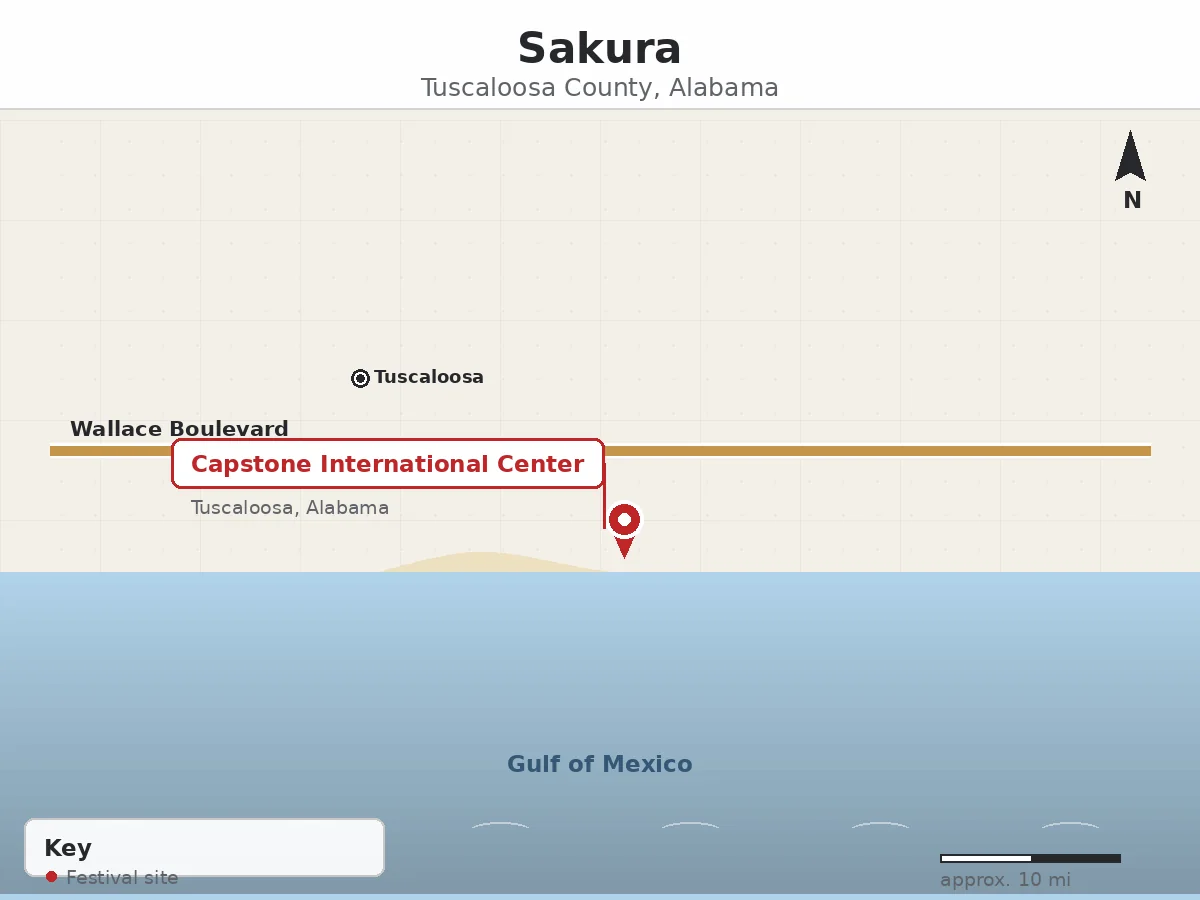
Practical planning starts with one honest warning: the Sakura Festival has no fixed home and no permanently fixed date. The 2022 edition used the Tuscaloosa River Market at 1900 Jack Warner Parkway, the 2024 edition used the Mildred Westervelt Warner Transportation Museum at 1901 Jack Warner Parkway, Tuscaloosa, Alabama 35401, and earlier editions were spread across the university campus and the city. Because the venue moves, the only reliable approach is to read the current festival page from the Capstone International Center before travelling and plan around the venue announced for that year.
Timing follows the same pattern. Every fully dated edition in the record falls in March or runs from the start of March into April, and the most recent documented editions were single Saturdays in late March lasting about three hours: 9 in the morning until noon in 2022, and 11 in the morning until 2 in the afternoon in 2024. Arriving near the start is therefore the difference between seeing the programme and catching its tail. On admission, the record is narrow and should not be stretched. University news from 2001 and 2002 said most events were free to the public, but no source checked for this article states an admission policy for recent editions, so confirm the current position rather than assume either way.
A Sample Festival Morning
A visit shaped like the documented 2024 edition might run as follows. Arrive shortly before the late-morning start, so you are settled before the programme begins rather than walking in mid-demonstration. Spend the first stretch with the scheduled cultural presentations, since those run to the day’s timetable and cannot be revisited once they finish. Then give the haiku contest entries a slow look; the contest is the festival’s longest-running thread, documented in 2001 and still headlined in 2026, and the poems reward unhurried reading.
Later, seek out the fans. The Narashino-designed uchiwa, lettered by Eihaku Iba since 2014, are the festival’s most distinctive craft object and its most direct link to the sister city. If blossom is out, finish outdoors among the cherry trees at Denny Chimes and the Narashino Grove off Lurleen Wallace Boulevard, a fitting end to the morning once the indoor programme closes in the early afternoon.
How It Compares
Most festivals in this series are county events, run by civic groups, agricultural societies or fair boards, rooted in one place and returning to the same grounds each year. The Sakura Festival inverts nearly all of that. It belongs to a university, not a county. It celebrates another country’s culture rather than local produce or local history. It has no permanent grounds, moving between a river market, a museum and campus venues as each edition requires. And its deepest loyalty is to a relationship with Narashino, a city in Chiba Prefecture that most visitors will never see.
Its changing shape is the other contrast worth noting. Many long-running festivals settle into a fixed format early and repeat it for decades. The Sakura record shows the opposite journey: sprawling weeks of lectures and exhibits in 2001 and 2002, a month-long edition in 2009, then compact single-day editions in 2022 and 2024. The constants that survived the compression, the haiku contest above all, tell you what the organisers value most.
Planning Checklist
- Read the current festival page before travelling, because the venue changes between editions
- Confirm the date for the year in question rather than relying on past March dates
- Arrive near the published start time, since recent editions lasted only about three hours
- Check the haiku contest deadline separately, as it falls before the festival day
- Leave time to see the cherry trees at Denny Chimes after the indoor programme
- Do not assume an admission policy; recent editions publish none in the record checked
Beyond the Festival
The festival’s themes spill into a small blossom trail across Tuscaloosa that can be visited whether or not a festival day is running. The cherry trees at Denny Chimes, donated by a Narashino businessman according to the festival site, bring the sister-city story onto the university campus itself. The Narashino Grove, standing off Lurleen Wallace Boulevard, gives the relationship a named piece of ground in the city. Together they mean the connection the festival celebrates is not packed away when the event ends; it is planted, literally, in two public places.
The recent venues are worth a look in their own right as well. The Tuscaloosa River Market hosted the 2022 edition, the Mildred Westervelt Warner Transportation Museum hosted in 2024, and both sit along Jack Warner Parkway within a few numbers of each other, in a city that has folded a Japanese friendship into its spring calendar.
Why This Festival Matters
Plenty of American cities signed sister city agreements in the 1980s, and plenty of those agreements faded into plaques and paperwork. Tuscaloosa’s link with Narashino produced something more durable: a recurring public celebration, documented across a quarter of a century of university news and festival pages, that keeps introducing new students and residents to Japanese culture each spring. The festival site’s own phrase for the result is a “40 year connection,” and the dated record beneath that phrase shows a relationship maintained by small repeated acts, the contests, the fans and the donated trees, rather than by ceremony alone.
The festival also matters as a record of how cultural events survive. It has changed the name on its own letterhead, shrunk from weeks to hours, moved venues repeatedly and still kept its identity intact, because that identity was never a place or a programme. It is the friendship itself, renewed every blossom season.
Frequently Asked Questions
Why does an Alabama university city hold a Japanese blossom festival?
Because of Narashino. Tuscaloosa signed a sister city agreement with Narashino City in Chiba Prefecture in 1986, in the period when Japan Victor Company opened plants in the city, and the festival grew out of that relationship as the University of Alabama’s spring celebration of Japanese culture and cherry blossoms.
Who organises the Sakura Festival in Tuscaloosa?
The record names the university in changing forms: university news in 2001 and 2002 credits The University of Alabama Japan Program, a 2009 release uses UA Capstone International Center Japan Program, and the current page says the festival was initiated by Dr. Marilyn Emplaincourt of the Japan Program and continues with support from Tuscaloosa Sister Cities International and university volunteers. It is a university event, not a city-run one.
What happens to the haiku contest entries each year?
The record’s firm details are about timing: the haiku contest appears in the 2001 and 2002 programmes alongside an art contest, it is named again in the 2024 billing, and it shares the headline of the festival’s 2026 page. For the 2024 edition, entries closed on March 15, ahead of the March 23 festival day, so would-be entrants should always check the current deadline rather than the festival date.
Do the cherry trees in Tuscaloosa really come from the Narashino connection?
According to the festival site’s own history layers, yes. The cherry trees at Denny Chimes were donated by a Narashino businessman, and the Narashino Grove off Lurleen Wallace Boulevard carries the sister city’s name. The same site records that the festival’s uchiwa fans have been designed in Narashino since the fan tradition began in 2005.
What to Expect From the Next Tuscaloosa County Alabama Sakura Festival
How often is Tuscaloosa County Alabama Sakura Festival held?
The festival’s own site calls it “Tuscaloosa’s Annual Sakura Festival,” and the dated billings support a yearly rhythm: a 15th annual in 2001, a 16th in 2002, a 23rd in 2009, a 36th in 2022, a 38th in 2024 and a 40th billed on the 2026 page. Those numbers are the organisers’ own billings, recorded as published.
When is the next Tuscaloosa County Alabama Sakura Festival?
Honesty requires a gap to be named here: the festival’s 2026 page, as fetched for this article, publishes a theme and a 40th annual billing but no date and no venue. Every fully dated edition in the record falls in March, and the two most recent were single late-March Saturdays, so March is the month to watch on the Capstone International Center’s festival page.
Will the dates change?
They already have, repeatedly. Early editions ran for weeks, from March 1 into April in 2001 and 2002 and across the whole of March in 2009, while recent editions settled on one Saturday. Day count, venue and exact date have all shifted between editions, so change is this festival’s historical norm rather than an exception.
The Sakura Festival asks something unusual of its visitors: to look at an Alabama spring through a friendship with a city in Chiba Prefecture, and to find that the view improves for it. Whether the next edition fills a month or a single March morning, its heart is already planted in Tuscaloosa, in the trees at Denny Chimes and the grove carrying Narashino’s name.
One Comment