Wicomico County Maryland Salisbury Festival
For thirty-two years, late April in downtown Salisbury belonged to one gathering above all others. The Salisbury Festival filled Main Street and the Riverwalk with music, market stalls, carnival rides and crowds drawn from across Wicomico County, and it did so in the heart of the county seat itself. Its story is now a finished one. The thirty-second annual edition ran from 25 to 27 April 2014, and in January 2015 the Salisbury Area Chamber of Commerce announced that the event would not return, retiring a concept that had grown from a small arts gathering in the nineteen eighties into the town’s signature spring weekend. What follows is an honest account of a concluded festival: what it was, how it grew, what its final editions offered, and why its long run still matters to the downtown it once animated.
About the Salisbury Festival
The published name was simply Salisbury Festival, printed in exactly that form, and the event belonged to the Salisbury Area Chamber of Commerce, which organised it throughout the years the layers describe. Salisbury is the county seat of Wicomico County, and the festival made full use of that civic centre, taking over downtown streets rather than a fenced fairground. Main Street carried the heart of the action, the Riverwalk gave the weekend a waterside edge, and a municipal parking lot was given over to the carnival rides and games. A local history layer records that entry to the festival itself carried no charge, which fitted its character as an open downtown celebration rather than a gated show. Across its three days it mixed live music with local artisans, shopping, food, a car show, a flea market and a farmers’ market, so the weekend served residents running ordinary errands and visitors hunting entertainment in equal measure. The balance was deliberate-looking: nothing in the programme demanded specialist knowledge or deep pockets, and a family could fill a whole day without once leaving the downtown blocks. Artisans and market traders gave the streets a browsing rhythm through the morning, the rides and games claimed the afternoon, and the music and evening attractions carried the crowds toward dark. That mixture, repeated each spring, turned the last weekend of April into a fixture that locals planned around and that visitors could drop into without preparation.
Quick Facts
| Item | Detail |
| Sheet title | Wicomico County Maryland Salisbury Festival |
| Published name | Salisbury Festival |
| Host town | Salisbury, Maryland |
| County seat | Salisbury is the seat of Wicomico County |
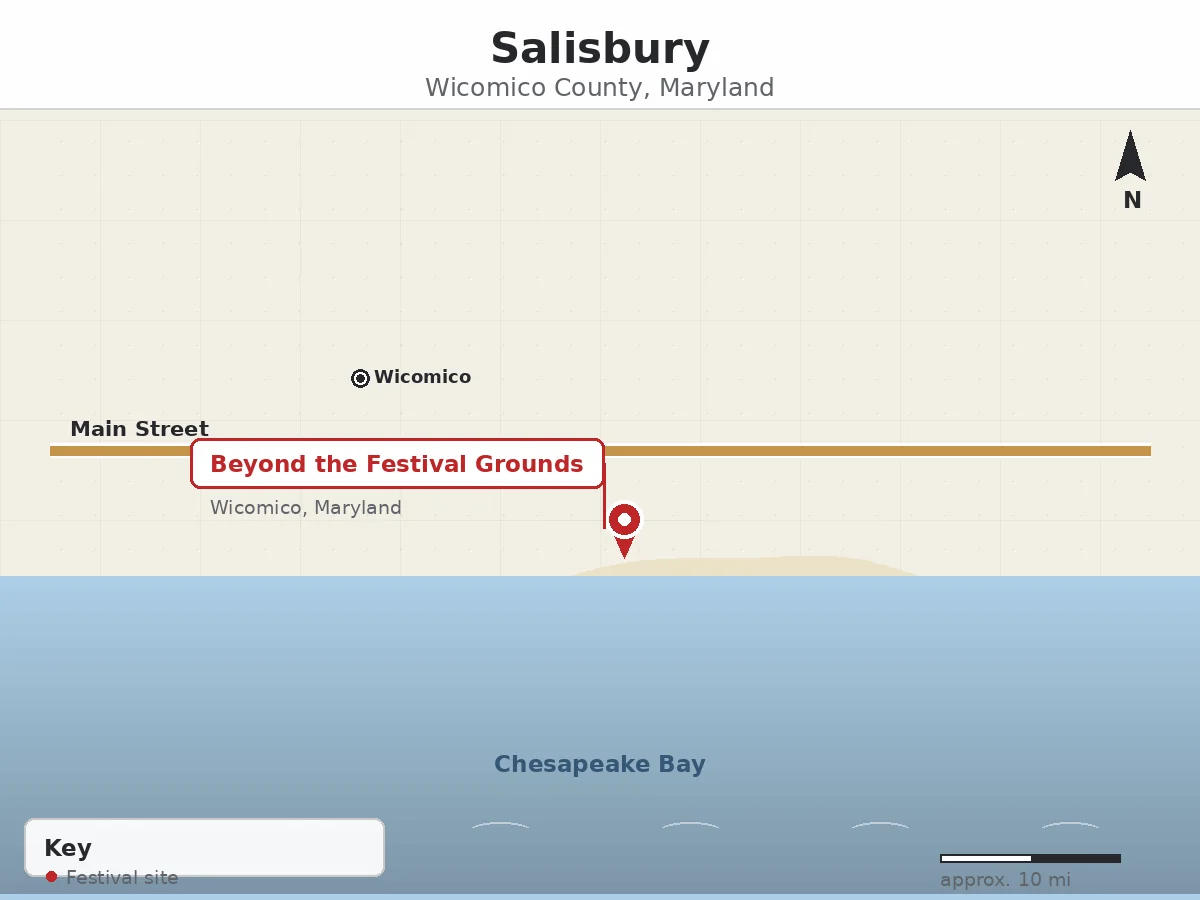
| Venue | Downtown Salisbury: Main Street, the Riverwalk and a municipal parking lot |
| Organiser | Salisbury Area Chamber of Commerce |
| Earlier name | Dogwood Festival |
| Final edition | Thirty-second annual, 25–27 April 2014 |
| Admission | Festival entry free; the International Beer Festival ticketed separately |
| Status | Retired; the Chamber announced in January 2015 that it would not return |
History
The festival’s roots reach back to the nineteen eighties, when it began under an earlier name, the Dogwood Festival. It grew out of an event called Arts on the Plaza, mounted by the Salisbury Wicomico Arts Council to put downtown Salisbury in the spotlight, and that origin in an arts showcase never entirely left it: artisan stalls and live painting remained part of its programme to the very end. Over the decades the gathering broadened well beyond its arts beginnings, absorbing carnival rides, a car show, markets and big evening attractions until it stood as a general spring festival for the whole county. The two fullest-documented editions are its last two. The thirty-first annual festival ran from 26 to 28 April 2013, and the thirty-second annual followed from 25 to 27 April 2014, opening with a Friday Night Block Party on 25 April that ran from four to ten in the evening, and featuring an International Beer Festival on the Saturday afternoon. In January 2015 the Chamber announced that the event would not return, closing a run of thirty-two years. No later edition appears anywhere in the layers read, and the festival should be understood as a completed chapter rather than a paused one.
The growth from Arts on the Plaza matters because of what it reveals about the town itself. An arts council showcase is, at heart, an argument that a downtown is worth gathering in, and the Salisbury Festival spent three decades making that argument at ever larger scale. Each added element, from the farmers’ market to the carnival lot, widened the circle of people who had a reason to attend, until the weekend belonged as much to shoppers, car enthusiasts and families chasing rides as to the art lovers who had inspired it. The Dogwood Festival name faded as the event outgrew its beginnings, but the original purpose, putting downtown Salisbury on display, survived every change of name and programme.
What to Expect
Anyone reconstructing the festival from its documented editions meets a crowded, varied downtown weekend. Music ran through the programme, with live performances anchoring the street atmosphere, while local artisans sold their work and shops joined the general air of shopping that a closed, crowd-filled Main Street encourages. Families gravitated to the carnival rides and games set up on the municipal parking lot and to the children’s activities woven through the schedule. The car show drew its own loyal audience, the flea market rewarded browsers, and the farmers’ market tied the weekend back to the agricultural county around the town. Food ran throughout. Two set pieces stood out in the final edition: the Friday Night Block Party, which opened the 2014 weekend from four to ten in the evening, and the International Beer Festival on Saturday 26 April, running from four to eight in the evening as a separately ticketed event. A live-painting Art War competition, run by the university art galleries, added a spectacle of artists working against the clock in front of a crowd. The Friday Night Block Party deserves particular note, because it shows the festival reaching beyond daytime crowds. An evening street party on the opening night turned the weekend into a three-part occasion, with Friday belonging to adults and night owls, Saturday shared between the markets, the rides and the ticketed beer tasting, and Sunday left for a slower final pass through the stalls. The International Beer Festival, running for four hours on the Saturday afternoon, gave the programme a grown-up centrepiece without displacing the family elements around it. Taken together, the editions describe a festival that tried to give every age group and every taste a reason to come downtown.
For a useful comparison, see the Wicomico County Maryland Pork in the Park Festival for another county festival.
Planning Your Visit
There is, plainly, no future edition of this festival to plan around, and any guide that pretended otherwise would mislead its readers. What planning meant in the festival’s own day is still worth recording. Because the grounds were downtown streets and entry carried no charge, a visit centred on simply arriving in the centre of Salisbury and wandering Main Street and the Riverwalk. The one piece of spending that rewarded forethought was the International Beer Festival, which in 2014 cost twenty-five dollars in advance against thirty dollars at the door, so committed visitors saved money by booking ahead. Today the same streets remain the natural starting point for anyone exploring the county seat, and downtown Salisbury has hosted later gatherings of its own; the Maryland Folk Festival, a separate and later downtown event, belongs to a different story and is covered on its own terms elsewhere. A reader who finds an old Salisbury Festival listing should treat it as a historical record of the 2013 and 2014 editions, not as an invitation for a coming spring. The honest way to use this article now is as a guide to what Salisbury’s downtown can hold: the same Main Street frontages, the same Riverwalk and the same civic spaces that absorbed crowds of festival visitors for thirty-two years still shape any large gathering in the county seat today. Anyone planning a spring trip to Salisbury should look to the town’s current calendar for living events, while keeping this festival in mind as the benchmark those events are measured against.
A Sample Day at the Final Edition
Saturday 26 April 2014, the middle day of the thirty-second annual festival, shows how the pieces fitted together. A visitor could begin among the farmers’ market and flea market stalls while the streets were still fresh, then drift to the car show and the artisan rows along Main Street before lunch from the food vendors. The early afternoon suited the carnival rides on the parking lot and the children’s activities, and the live-painting Art War offered a fixed point of spectacle as artists raced to finish their canvases. As four in the afternoon approached, ticket holders turned toward the International Beer Festival, which ran until eight in the evening, while everyone else could stay with the music, the markets and the Riverwalk as the light faded. The day captures the festival’s balance: markets and rides for the morning, art and cars for the afternoon, and a ticketed tasting to carry the evening.
How It Stood Beside Other Salisbury Events
Two neighbouring events are easily confused with this one, and the distinctions matter. Pork in the Park occupied Winterplace Park on the third weekend in April, a barbecue-centred gathering in a park setting; the Salisbury Festival, by contrast, belonged to downtown streets, charged nothing for entry, and spread its appeal across music, markets, rides and cars rather than a single culinary theme. The Maryland Folk Festival came later to downtown Salisbury and is sometimes assumed to be this festival under a new name; it was not a continuation, but a separate event that arrived after the Chamber had already retired the Salisbury Festival. Readers tracing Salisbury’s festival history should keep the three apart: a park barbecue gathering, a concluded downtown spring festival, and a later downtown folk event, each with its own organisers, venues and years.
Beyond the Festival Grounds
The festival’s setting was itself the attraction beyond any single stall or stage. Main Street gave visitors the commercial heart of the county seat, and the Riverwalk offered a quieter counterpoint, a place to step away from the crowds beside the water before plunging back in. Because Salisbury serves as the seat of Wicomico County, a festival weekend also put visitors among the civic buildings and everyday institutions of the county, a reminder that this was a working town dressing up rather than a purpose-built resort. The municipal parking lot that hosted the rides made the same point from the other direction: for one weekend, ordinary infrastructure became fairground, and the transformation was part of the pleasure. Visitors who stayed longer found a town that rewards unhurried wandering, where the walk between the Riverwalk and the far end of the market stalls passes shopfronts, eating places and the everyday machinery of a county seat going about its business. The festival never walled itself off from that life; it borrowed the town, filled it, and handed it back on the Monday morning.
Why the Salisbury Festival Mattered
Thirty-two years is a long life for a local festival, and the run gave Salisbury a dependable spring ritual that tied the town’s identity to its downtown at a time when many centres were losing ground. Its growth out of an arts council showcase into a broad community weekend shows how a modest idea, repeated and enlarged year after year, can become an institution. Its ending carries a lesson of its own: even established festivals depend on the organisations behind them, and when the Chamber retired the concept in 2015, the tradition ended with its organiser’s decision. The documented editions of 2013 and 2014 preserve the festival at full stretch, and they remain the fairest measure of what the town lost when the announcement came.
Frequently Asked Questions
When did the Salisbury Festival hold its final edition?
The last edition was the thirty-second annual festival, held from 25 to 27 April 2014 in downtown Salisbury. Its programme included a Friday Night Block Party on the opening evening and an International Beer Festival on the Saturday.
Why does the festival no longer appear on Salisbury calendars?
The Salisbury Area Chamber of Commerce, which organised the event, announced in January 2015 that it would not return, and retired the concept after a run of thirty-two years. No revival or successor under the same name is documented in the layers read.
What could visitors do during a festival weekend downtown?
The documented editions offered live music, local artisans, shopping, carnival rides and games, children’s activities, food, a car show, a flea market and a farmers’ market, together with the live-painting Art War competition run by the university art galleries.
What did it cost to walk the festival streets in its last years?
A local history layer records that the festival itself was free to enter. The one notable ticketed element was the International Beer Festival, priced in 2014 at twenty-five dollars in advance or thirty dollars at the door.
What to Expect From the Next Wicomico County Maryland Salisbury Festival
How often is Wicomico County Maryland Salisbury Festival held?
The festival belongs to the past tense now, its run closed by its organiser’s decision. During its life it returned each spring, reaching a thirty-first annual edition in 2013 and a thirty-second in 2014, but the run ended when the Chamber retired the concept, and no edition has taken place since.
When is the next Wicomico County Maryland Salisbury Festival?
No next edition exists or is documented. The Chamber announced in January 2015 that the event would not return, and nothing in the layers read records a later date, a revival or a replacement carrying the Salisbury Festival name.
Will the dates change?
The question no longer applies in the ordinary way, because the festival closed with its April 2014 edition and its organiser’s announcement the following January. Should any future body ever revive the name, entirely new dates would have to be announced afresh; nothing of that kind appears in the record.
The Salisbury Festival deserves to be remembered as it was at its best: a free, crowded, downtown weekend that grew from an arts showcase in the nineteen eighties into thirty-two years of spring tradition, sustained by a chamber of commerce, a corps of artisans and traders, and a town willing to hand its main street over to a party every single year without fail. Its streets have seen other gatherings since, but the particular mix of markets, rides, music and small-town ceremony that filled Main Street each late April belongs to a concluded era, and this account leaves it there, documented and complete.