St. Joseph County Indiana Dia de Muertos Family Festival
Anyone searching South Bend for a single event published under this exact name will not find one, and that fact shapes everything honest that can be written here. The city’s Día de los Muertos observance is real, recurring and documented across the better part of a decade, yet it lives under its published Spanish names and belongs to no one producer. Instead of a lone festival with a gate and a grounds map, South Bend marks the Day of the Dead through a loose family of celebrations, concerts and community gatherings, each hosted by a different organisation. The sheet title trims the word los from the published name and adds the word Family, a description that suits the gatherings without matching any South Bend billing. What follows describes the observance as the city actually holds it: altars in galleries and community rooms, an orchestra performing works by Mexican composers, a parish procession in traditional dress, and a library turning its shelves toward the holiday, all clustered around the first and second of November.
About
South Bend is the county seat of Saint Joseph County, Indiana, and its Día de los Muertos observance is spread across the city rather than gathered on one site. Its principal venues in the layers are the Morris Performing Arts Center on North Michigan Street, the community centre of La Casa de Amistad on South Michigan Street, and a shifting set of downtown and west side rooms, galleries and parish spaces. No single organiser stands behind the whole of it. A newspaper account of the twenty twenty-six observance names Equity in the Arts, the South Bend Symphony Orchestra, the South Bend Museum of Art and La Casa de Amistad as the bodies that year’s celebration brought together. A library account of the twenty twenty-two season lists a wider circle of partners: the symphony, the South Bend Civic Theater, spelled Theater in one layer and Theatre in another, the Saint Joe County Public Library, the Indiana University South Bend Civil Rights Heritage Center, La Casa de Amistad, the South Bend Community School Corporation and the Morris Performing Arts Center itself. The symphony’s contribution belongs to its Shein Trust Community Series, presented by the Shein Family Trust in one layer and the Shein Trust in another. Parishes and university rooms add pieces in other years, so the roster changes while the observance continues.
Quick Facts
| Item | Detail |
| Published name | Día de los Muertos, also printed Día de Muertos |
| Host city | South Bend, Indiana |
| County | Saint Joseph County |
| County seat | South Bend is the county seat of Saint Joseph County |
| Principal concert venue | Morris Performing Arts Center, on North Michigan Street |
| Community venue | The community centre of La Casa de Amistad, on South Michigan Street |
| Organiser | No single organiser; several organisations host component events |
| Season | Around the first and second of November, stretching from late October into early November |
| Admission | Documented concerts and celebrations are stated free in their layers |
| Documented years | Twenty eighteen through twenty twenty-six in the layers read |
History
The local newspaper describes the holiday as a time when families of Mexican heritage welcome the souls of deceased relatives back for a brief reunion, marked with food, drink and celebration, and the county public library dates the belief days to the first and second of November each year. South Bend’s own observance enters the record already running: a university layer presents the second of November twenty eighteen gathering as an annual community celebration, yet no layer assigns the local tradition a first year or a founder under any name. The symphony’s billing for its twenty twenty-four concert, the third annual Día de los Muertos celebration, belongs to that concert series as the trade layer states it, and counting backwards from the word third to declare a beginning for the wider observance would be invention. From twenty eighteen onward the documented run is steady: a downtown celebration in twenty nineteen, a multi day celebration in twenty twenty-two, a parish procession and fiesta in twenty twenty-five, and a twenty twenty-six observance closing with a concert on the eighth of November.
What to Expect
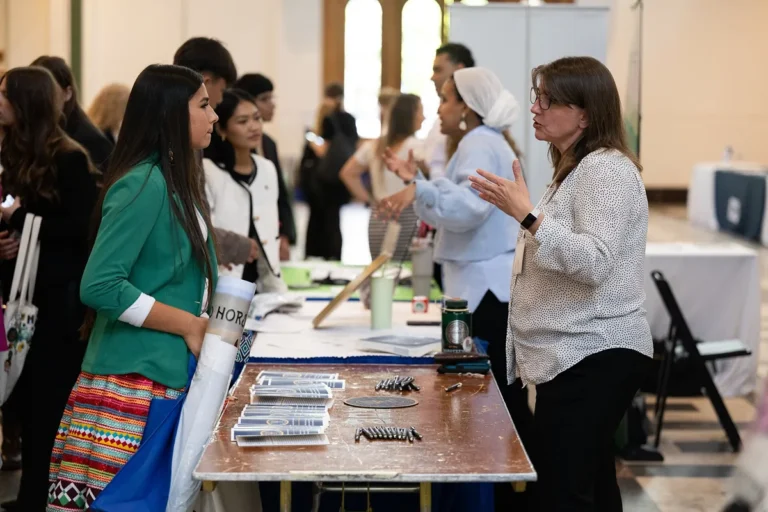
Nothing here arrives as one packaged production, so a visitor assembles the observance from its parts. Its most visible element is the ofrenda, the altar raised to honour deceased family members and friends. In twenty twenty-six the museum and the Equity in the Arts programme coordinated five ofrendas across the city, among them collaborative student work built with linocut, monoprinting, collage, cyanotype, tin embossing and paper quilling, and one altar extending its remembrance to pets. In twenty nineteen the altars stood at the Crossroads Gallery and the Civil Rights Heritage Center, raised by local artists and organisations, with music, dancing, children’s educational activities and complimentary pan de muertos, hot chocolate and champurrado. Music carries equal weight. The symphony’s Morris concerts present works by Mexican composers alongside mariachi and folklorico performers: a guest conductor, a mariachi singer, a trio and a local ballet folklorico company in twenty twenty-four; the music director and a composer speaking before the concert in twenty twenty-six. The diocesan account of twenty twenty-five adds a procession in traditional Mexican attire between the two churches of SS. Casimir and Adalbert Parish, led by the dance group Danza de Matlachines ‘Nuestra Morenita’ and followed by food, games and music for families and an indoor fiesta with information tables. The library contributed its own strand in twenty twenty-two, with live mural painting, a bilingual storytime and book displays.
Planning Your Visit
Planning begins with accepting the shape of the thing: several hosts, several venues and several dates gathered loosely around one holiday, whose anchor days are the first and second of November although the documented seasons run wider. The twenty twenty-two celebration stretched from the eighth of October to the first of November, and the twenty twenty-six observance did not conclude until a concert on the eighth of November, so arriving only on the holiday itself risks missing both an early opening and a late finale. Each organisation announces its own piece, so planning means checking the symphony, the museum, the library, the parishes and La Casa de Amistad separately rather than hunting for one master schedule. Admission, where the layers speak of it, is welcoming: the twenty eighteen celebration and the twenty twenty-six Morris concert were free, and the twenty twenty-four Morris concert was free with tickets required, worth confirming in advance because a free seat at that hall may still need reserving. Downtown holds the Morris on North Michigan Street and, facing each other across West Washington Street, the Crossroads Gallery and the Civil Rights Heritage Center, while La Casa de Amistad anchors the community celebration on South Michigan Street.
For a useful comparison, see the St. Joseph County Indiana Enshrinement Festival for another county festival.
A Sample Itinerary From Documented Years
Because no two documented years share one programme, the honest itinerary is a pair of shapes rather than a single day’s timetable. The twenty nineteen shape, as the university museum layer records it, is a downtown day: begin among the ofrendas at the Crossroads Gallery, cross West Washington Street to the Civil Rights Heritage Center, stay for the music and dancing, let children join the educational activities, and take the complimentary pan de muertos, hot chocolate and champurrado. The twenty twenty-six shape, as the newspaper records it, spreads across two weekends. Its heart is the community celebration at La Casa de Amistad on the first of November, running from two to six in the afternoon, and its finale is the free symphony concert at the Morris on the eighth of November, conducted by the orchestra’s music director with a composer speaking beforehand. Read together, the two shapes show the observance’s rhythm: a neighbourhood afternoon of food, altars and gathering near the holiday, and a formal concert hall evening that can fall a week later.
How It Compares
The nearest naming trap sits one county away. The Elkhart County Historical Museum in Bristol publishes a Día de los Muertos Family Celebration, billed as that museum’s third annual family event, held from one to four in the afternoon on the first of November with its own music groups and a bakery’s donated pan de muerto. Its name comes closer to this article’s sheet title than anything in South Bend does, yet it belongs to Elkhart County and contributes no facts to the observance described here. Within South Bend, the Familia Fun Fest, held by the city’s parks department in October for Hispanic Heritage Month, also deserves separating out: it references the holiday, but the layers treat it as its own parks event, not part of this observance. At the other extreme, university only student gatherings and parish Masses sit inside the observance as components rather than rival festivals.
Checklist
- Confirm which organisations are hosting events this year
- Check whether the Morris concert requires free tickets
- Allow a window from late October into early November rather than a single day
- Note the anchor days of the first and second of November
- Plan for more than one venue across downtown and the west side
- Look for ofrendas at galleries, the heritage center and community spaces
- Expect each host to publish its own times and arrangements
- Remember that no single office speaks for the whole observance
Beyond the Observance
The documented footprint reaches past the holiday weekend into the city’s ordinary cultural life. The library’s part in twenty twenty-two, bilingual storytime and book displays alongside live mural painting, kept the observance before families who might never attend a concert. The museum’s coordination of student ofrendas in twenty twenty-six, built from printmaking and paper crafts, turned remembrance into a skill shared between generations. The Civil Rights Heritage Center, facing the Crossroads Gallery across West Washington Street, gives the celebration a home in a building devoted to the city’s struggles for fairness. Even the parish fiesta’s information tables point outward, connecting a feast day to the practical life of the neighbourhoods around it.
Why It Matters
Much of a city’s Mexican heritage is marked privately, in homes and parish halls. What the South Bend record shows is that heritage also carried jointly and publicly by the city’s largest institutions: its symphony and art museum, its public library and school corporation, its university heritage center, its parishes and its Latino community centre. No single body owns the observance, and that shared custody appears to be its strength, since the documented run survives changes in roster, venue and emphasis across those years. The layers also show an observance that costs its audience nothing at the door, with concert hall seats, gallery altars and community celebrations alike described as free. For a county seat full of single producer festivals, this loose, cooperative marking of the first and second of November stands apart as a tradition held in common.
Frequently Asked Questions
Is there one South Bend festival published under this exact title?
No layer read prints the name Dia de Muertos Family Festival for a South Bend event. The published forms are Día de los Muertos and Día de Muertos, attached to celebrations, concerts and community events hosted by several organisations; the sheet title drops the word los and adds the word Family.
Which organisations take part in the South Bend observance?
There is no single organiser. The twenty twenty-six newspaper layer names Equity in the Arts, the South Bend Symphony Orchestra, the South Bend Museum of Art and La Casa de Amistad, while the twenty twenty-two library layer adds the South Bend Civic Theater, the Saint Joe County Public Library, the Indiana University South Bend Civil Rights Heritage Center, the South Bend Community School Corporation and the Morris Performing Arts Center, and the twenty twenty-five diocesan layer centres on SS. Casimir and Adalbert Parish.
What does the symphony contribute to the observance?
The South Bend Symphony Orchestra performs Día de los Muertos concerts at the Morris Performing Arts Center within its Shein Trust Community Series, presenting works by Mexican composers with mariachi and folklorico performers. The twenty twenty-four concert was billed as the third annual celebration and was free with tickets required, and the twenty twenty-six concert closed that year’s observance on the eighth of November, with the orchestra under its music director and a composer speaking beforehand.
Are the documented South Bend celebrations free to enter?
Every concert and celebration the layers describe is presented as free: the twenty eighteen community celebration, the twenty twenty-six Morris concert, and the twenty twenty-four Morris concert, which was free and open to the public although tickets were required. Admission details belong to each edition and its host, so a future visitor should confirm arrangements with the presenting organisation.
What to Expect From the Next St. Joseph County Indiana Dia de Muertos Family Festival
How often is St. Joseph County Indiana Dia de Muertos Family Festival held?
The observance returns every year around the first and second of November in the layers read, although it returns as a set of celebrations by different hosts rather than as one recurring production. Documented editions appear in twenty eighteen, twenty nineteen, twenty twenty-two, twenty twenty-four, twenty twenty-five and twenty twenty-six, each announced by the organisations taking part that year.
When is the next St. Joseph County Indiana Dia de Muertos Family Festival?
The layers point to the days around the first and second of November, with individual events falling anywhere from early October to a week past the holiday, as the twenty twenty-six closing concert did on the eighth of November. No single office publishes a combined schedule, so the next observance will take shape host by host, its dates coming from separate announcements rather than one festival calendar.
Will the dates change?
The anchor cannot move, because the library layer ties the belief days to the first and second of November each year, and every documented South Bend edition gathers around them. The surrounding dates plainly can shift, and have: one season opened on the eighth of October, another ended on the eighth of November, and the parish, gallery and concert events have each kept their own timing within that frame.
Closing
South Bend’s Día de los Muertos is best understood not as a festival that failed to find a single name, but as an observance that never needed one. Held in common by an orchestra, a museum, a library, parishes and a community centre, documented year after year around the first and second of November, and offered freely at every documented door, it asks a visitor to do what its own hosts do: show up in several places, honour the dead, and let the city assemble the celebration around them.