St. Clair County Alabama Little Tomatina Festival
On one October evening each year, a lakeside campground in Ashville turns into an arena of flying fruit. Alabama’s Little Tomatina is a tomato food fight staged at Greensport RV Park and Marina on Neely Henry Lake, where participants gather inside a ring of hay bales and fencing to throw ripe tomatoes at one another for the simple fun of it. The 2026 copy bills the gathering as “Alabama’s Third Annual Little Tomatina” and calls it “Alabama’s own version of La Tomatina,” a nod to the famous Spanish festival that inspired it. It is a small, home-grown Saint Clair County event with an agricultural heart: the ammunition comes from a working tomato farm on nearby Chandler Mountain, the host ground is a family farm held for eight generations, and even the leftovers are offered up for somebody’s kitchen once the throwing stops.
About the Festival
Alabama’s Little Tomatina is an annual tomato fight held at Greensport RV Park and Marina in Ashville, in Saint Clair County, Alabama. The lake magazine that featured the event describes it as “now entering its third year,” and regional coverage of the 2026 edition repeats that billing, calling it the third edition of the fight. The centrepiece is the fight itself: a purpose-built arena of hay bales and fencing where the crowd pelts one another with soft, ripe tomatoes while live music plays. Around that messy core, the evening takes the shape of a relaxed outdoor gathering, with food trucks serving the crowd and a Bloody Mary bar pouring tomato-based drinks for the adults watching or taking part. Nothing about the event pretends to be a grand production. It is a campground festival in the truest sense, dreamed up by local people, supplied by a neighbouring farm, and finished within a single autumn evening.
Quick Facts
| Item | Detail |
| Event name | Alabama’s Little Tomatina |
| Billing in 2026 | Alabama’s Third Annual Little Tomatina |
| Host town | Ashville |
| County seat status | Ashville is one of two Saint Clair County seats, alongside Pell City |
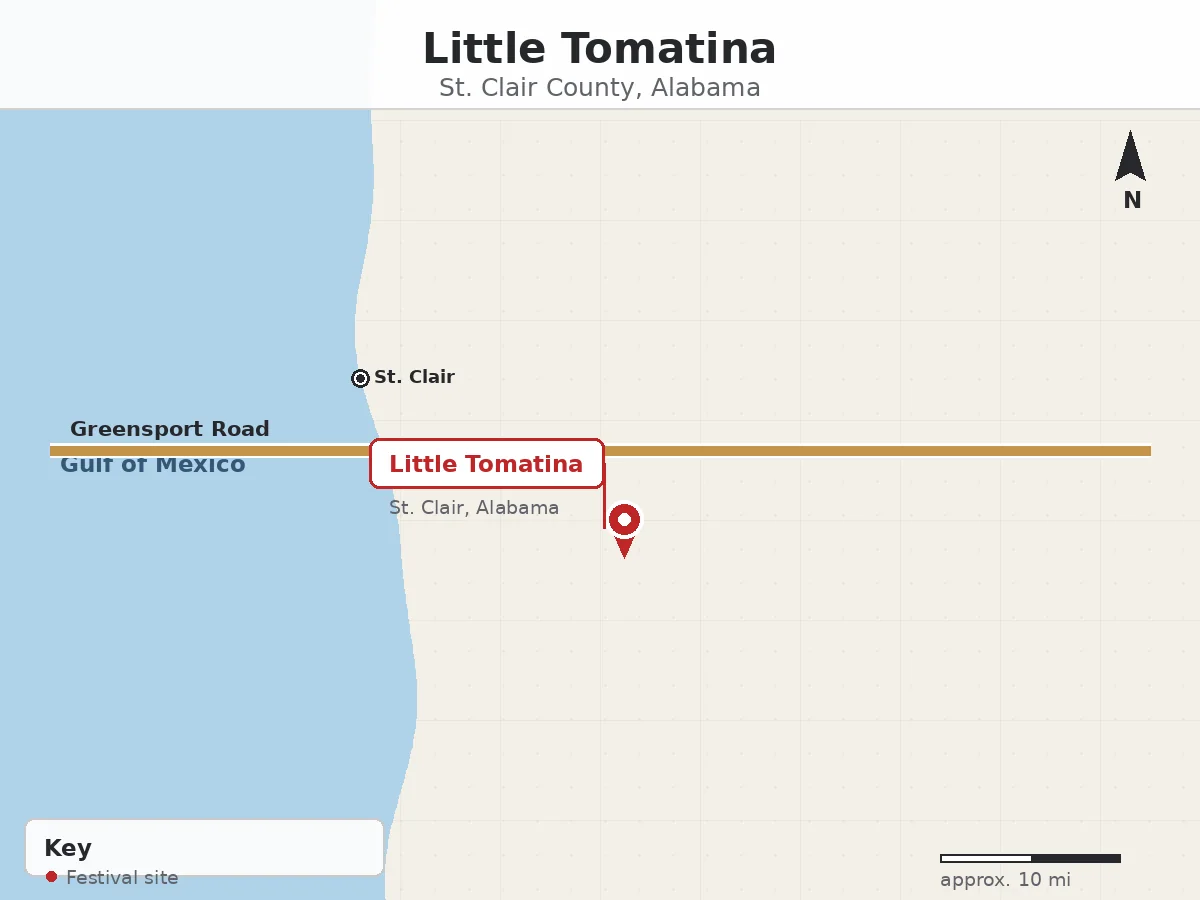
| Venue | Greensport RV Park and Marina, on Neely Henry Lake |
| Address as published | 130 Greensport Road, Ashville, AL 35953; the park’s own listings print 130 Greensport, Ashville, AL 35953 |
| 2026 date and time | Saturday, October 3, 2026, from 7 p.m. to 10 p.m. |
| Host of record | Greensport RV Park and Marina |
| Admission | No price published in any source checked |
| Throwing tomatoes | Donated by Smith Tomato Farm on Chandler Mountain |
History
The ground beneath the festival carries a longer story than the fight itself. Greensport RV Park and Marina is a family farm and campground that has stayed in the same family for eight generations, and it carries the designation of an Alabama Bicentennial Farm. That farming inheritance matters to how the event began. A lake-magazine feature on the third edition credits Beth Evans, a sister-in-law within the park family, with talking about having a tomato festival together with the neighbouring Chandler Mountain community. Chandler Mountain is farming country, known locally for tomatoes, and the conversation joined the park’s campground setting to the mountain’s crop. A park-side voice named Stephanie is quoted throughout that feature, speaking for the family as the idea took shape. A separate park layer names the Greensport1820 Foundation, Inc. as helping the park “honor the agricultural heritage of our state,” which is recorded here exactly as published; that foundation layer is not merged into any claim about who organises the festival itself, and the host of record remains the park. What can be said plainly is that the fight grew out of a farming family and a farming community rather than out of a promoter or a town council. The “Third Annual” billing attached to the 2026 edition stands as billed only. No founding year is stated in the sources, and none should be worked backwards out of the ordinal. The documented trail is short and recent: an idea shared between a campground family and a tomato-growing community, a first arena of hay bales, and a third edition that drew regional attention in the autumn of 2026. The feature coverage treats that family continuity as the festival’s foundation, presenting the fight as something the park grew into gradually rather than something booked in from elsewhere.
What to Expect
Expect an evening that builds toward one gloriously messy hour-by-hour release. The 2026 edition ran from 7 p.m. to 10 p.m. on Saturday, October 3, with the tomato fight set to live music inside the fenced arena of hay bales. Food trucks were on hand, and the Bloody Mary bar gave the night a second, slower way to enjoy the harvest. Every tomato thrown in the arena came from a single source: Smith Tomato Farm on nearby Chandler Mountain donated all of the throwing tomatoes for the third consecutive year, a detail that ties the spectacle directly to the county’s working farms. The fruit is chosen for throwing, ripe enough to burst rather than bruise, and the fence line keeps the chaos contained to willing participants inside the bales. When the fight winds down, the festival keeps its agricultural manners. Tomatoes that survive in good enough shape for cooking are offered to anyone interested in canning them or turning them into meals, so part of the harvest ends the night in kitchens rather than on the ground. Spectators who prefer to stay clean can watch from outside the fencing, eat from the trucks, and listen to the music while the arena turns red. The scale is part of the character. This is one arena, one evening, and one crop, and the crowd mixes campers staying at the park, Ashville neighbours, and visitors who drove in for the novelty of a sanctioned food fight. Nobody needs a programme to follow it; the whole event can be taken in from a single spot beside the fence, and the throwing is easy to read even for a first-timer who has never seen a tomato fight before.
Planning Your Visit
Build your plan around the evening hours and the lakeside setting. The documented 2026 edition occupied a single Saturday night, October 3, from 7 p.m. to 10 p.m., at Greensport RV Park and Marina. One wrinkle deserves attention before you set out: a festival-guide annual listing printed “10/2*” for Alabama’s Little Tomatina at Greensport, its asterisk marking that date as unconfirmed, while the same guide’s weekend post listed 10/3. The organiser-side and regional-news layers support October 3, and that is the date recorded throughout this article, but the disagreement is a good reason to confirm the evening against the park’s own listings before travelling. Admission needs the same honest caution. No admission price is published in any source checked, so this article neither calls the event free nor names a cost; check with the park when you confirm the date. Dress for the mess if you mean to enter the arena: tomatoes burst, juice travels, and old clothes you can rinse or retire are the sensible uniform. If you are camping at the park or staying nearby on Neely Henry Lake, the short trip back to a shower is part of the pleasure. Arrive with time to eat first, because the food trucks and the music are half the evening for anyone who throws only a handful of fruit. Because the event sits inside a working campground, part of the audience is built in: campers can stroll from their sites to the arena, while day visitors should allow a little extra time to park, find the fencing, and get their bearings before the light fades and the throwing begins.
For a useful comparison, see the St. Clair County Alabama Oktoberfest Festival for another county festival.
A Sample Evening at the Fight
- Late afternoon: settle in at Greensport, walk the grounds by Neely Henry Lake, and find the hay-bale arena before the crowd thickens.
- Around 7 p.m.: the evening opens, music starts, and the food trucks begin serving while participants drift toward the fencing.
- Early evening: take a turn at the Bloody Mary bar, watch the first volleys, and decide whether your clothes are joining the fight.
- The main fight: step inside the bales when you are ready, throw Smith Tomato Farm’s donated harvest, and expect to leave the arena a different colour than you entered it.
- After the fight: change into something dry, claim any cooking tomatoes on offer for canning, and close the night with music by the lake.
How the Little Tomatina Compares
The obvious comparison is the Spanish festival that inspired it, and the honest way to make that comparison is to keep Spain in its place: inspiration only. No fact about the Spanish original is used anywhere in this article, because none belongs to Ashville. What the Alabama event borrows is a single joyful idea, a communal tomato fight, and what it adds is entirely local: a hay-bale arena on a family farm, an evening rather than a day, a campground crowd, and a supply line running straight up Chandler Mountain to Smith Tomato Farm. Measured against the county’s more traditional fall gatherings, the Little Tomatina is also the unruly cousin. A harvest festival celebrates produce by displaying and selling it; this event celebrates the tomato harvest by throwing it, then sends the survivors home for canning. That blend of waste and thrift, spectacle and agriculture, is what separates it from every sit-down food festival in the region.
Your Planning Checklist
- Confirm the date against the park’s own listings, remembering the unconfirmed asterisked listing for the day before.
- Wear clothes and shoes that can survive a full soaking of tomato juice.
- Bring a complete change of clothes and a bag for the soaked set.
- Carry a towel for the trip back to your campsite or car.
- Arrive hungry enough to give the food trucks a fair trial.
- Ask at the park about admission on the day, since no price is published in advance.
- Plan a shower or a lake-camp cleanup before driving anywhere afterwards.
- If you can or cook, stay after the fight and claim leftover tomatoes fit for the kitchen.
Beyond the Tomato Fight
The setting rewards anyone who lingers. Greensport RV Park and Marina sits on Neely Henry Lake, so the festival evening comes with water at the edge of the grounds and the ordinary pleasures of a campground: boats, shoreline, and a night sky once the music stops. The host ground itself is worth a slow look in daylight, a family farm of eight generations carrying an Alabama Bicentennial Farm designation, which puts the tomato fight inside a much older story of working land. Chandler Mountain, the farming community across the way, is part of the festival’s identity even for visitors who never drive up it, because its tomatoes are the festival. Ashville, the host town, adds its own quiet distinction: it serves as one of Saint Clair County’s two county seats, a role it has held since the county’s early years, sharing the duty with Pell City since 1907. A visitor who comes only for the fight and leaves before dark the next day has still brushed against lake, farm, and courthouse history in a single short trip.
Why the Little Tomatina Matters
Small festivals usually matter because they keep a tradition alive; this one matters because it started one and rooted it in the county’s real economy. The throwing tomatoes are not a gimmick bought in from outside. They are donated, three years running, by Smith Tomato Farm on Chandler Mountain, which means the harvest of a specific farming community is the festival’s raw material and its headline at the same time. The host is not a hired venue but a family farm and campground in its eighth generation, and the park layer that names the Greensport1820 Foundation, Inc. speaks of honouring the agricultural heritage of the state. Even the aftermath carries the theme: fruit still fit for cooking goes home with anyone who wants to can it, so the festival feeds people after it finishes entertaining them. For Ashville and Saint Clair County, the event turns an ordinary crop into a reason for neighbours and visitors to gather on an October night, and it does so without borrowing glory from anywhere else.
Frequently Asked Questions
What actually happens inside the hay-bale arena?
Participants step inside a ring built from hay bales and fencing and throw ripe tomatoes at one another while live music plays. The fencing keeps the throwing contained, and the tomatoes are donated by Smith Tomato Farm on Chandler Mountain, chosen ripe enough for a messy burst.
Why does Ashville share county seat duties with Pell City?
Because Saint Clair County has two county seats. Ashville was the sole seat from 1821 to 1907, and Pell City was established as a second seat in 1907. Ashville remains a county seat today, but it has never in the modern era been the only one, and this article does not describe it as such.
Who came up with the idea for a tomato festival at Greensport?
The lake-magazine feature credits Beth Evans with talking about having a tomato festival together with the neighbouring Chandler Mountain community. Her sister-in-law Stephanie is the park-side voice quoted through that feature, and the event is hosted at and by the family’s park and campground.
What becomes of the tomatoes once the throwing stops?
Any tomatoes still suitable for cooking are offered to anyone interested in canning them or preparing meals from them. The rest have done their work in the arena. It is a fitting ending for a festival supplied by a working tomato farm.
What to Expect From the Next St. Clair County Alabama Little Tomatina Festival
How often is St. Clair County Alabama Little Tomatina Festival held?
The event is billed as an annual one, and the 2026 edition was presented as its third annual running. That billing comes from the festival’s own coverage layers; each year’s date still needs confirming against the park’s listings when it is announced.
When is the next St. Clair County Alabama Little Tomatina Festival?
Nothing in the sources checked publishes a date for the coming edition. The documented pattern points to an October Saturday evening, following the 2026 edition on October 3, but the unconfirmed asterisked listing that appeared for 2026 is a reminder to wait for the park’s own announcement rather than circle a date early.
Will the dates change?
They can, and the record shows why caution is wise: for 2026, one festival-guide listing printed an asterisked, unconfirmed date a day earlier than the October 3 date carried by the guide’s own weekend post and by regional coverage. Treat any early listing as provisional until Greensport confirms it.
Greensport’s tomato fight is proof that a festival does not need a century behind it to belong to a place. A family farm, a mountain of tomatoes, a ring of hay bales, and one October evening have given Ashville an event that is already part of how Saint Clair County celebrates its harvest, mess and all.