Sedgwick County Kansas Great Plains Renaissance and Scottish Festival
Wichita gives its Renaissance weekend a double identity. Twice each year, Sedgwick County Park fills with armoured fighters, falconers, pipers and caber throwers, as the Great Plains gathering pairs a Renaissance fair with a full Scottish festival on the same grounds. The combination is the point: a visitor can watch a joust in one hour and a hammer throw in the next, moving between a Viking encampment and a procession of tartan clans without leaving the park. The event belongs to the county seat and runs on a spring and autumn rhythm that the organiser, state tourism and a visitors bureau all describe the same way. This article sets out what those layers document: the name the festival actually publishes, the fall weekends on record for two thousand twenty-five and two thousand twenty-six, the programme the organiser lists, and the points where the record stays quiet, including admission. Where the layers disagree or fall silent, the article says so rather than filling the gap.
About
The name deserves attention before anything else, because the sheet behind this article spells the combined title with the word “and”, and no layer consulted prints that exact form. The organiser’s own site, a state tourism layer, a visitors-bureau layer and a state liquor-licensing layer all give the combined name as Great Plains Renaissance & Scottish Festival, with an ampersand where the sheet uses a word. Alongside it, the organiser’s own site and directory layers also use the shorter Great Plains Renaissance Festival. Both printed forms are carried through this article unmerged, because they are the names the festival itself publishes.
The festival is held in Wichita, and general reference layers confirm Wichita is the county seat of Sedgwick County. Its ground is Sedgwick County Park, a venue the organiser’s site, the state tourism layer and the state liquor-licensing layer name in agreement. The licensing layer prints Great Plains Renaissance Festival as the event sponsor, and the event’s own site presents the festival under that name, so the organising identity the record offers is the festival name itself rather than a separate company or society.
Structurally, the event is two festivals sharing one weekend and one park: a Renaissance fair of jousting, falconry and artisan craft, and a Scottish gathering built around the Wichita Highland Games. It happens twice a year, once in spring and once in fall.
Quick Facts
| Item | Detail |
| Published combined name | Great Plains Renaissance & Scottish Festival |
| Shorter published name | Great Plains Renaissance Festival |
| Host city | Wichita, the county seat of Sedgwick County |
| Venue | Sedgwick County Park, Wichita |
| Sponsor as printed | Great Plains Renaissance Festival, in a state liquor-licensing layer |
| Yearly rhythm | Two weekends, one in spring and one in fall |
| Fall weekend on record | The twenty-seventh and twenty-eighth of September, two thousand twenty-five |
| Fall weekend announced | The twenty-sixth and twenty-seventh of September, two thousand twenty-six |
| Highland Games hours | Ten in the morning to five in the afternoon, both days |
| Admission in the layers | No gate price printed; games competitors register to compete |
History
Two layers speak to the festival’s beginnings, and they speak as claims rather than as a founding document. A reference list of Renaissance fairs gives the Wichita festival a start in two thousand four, and a festival-guide layer states plainly that it was founded in two thousand four. Those two statements are recorded here as their layers make them, side by side and unmerged; no layer read for this article supplies a founding charter, a first-weekend programme or the name of a founder to test them against.
For a useful comparison, see the Sedgwick County Kansas Tallgrass Film Festival for another county festival.
The organiser adds a billing of its own. Its site billed the fall weekend of two thousand twenty-five as the twenty-fifth Annual Fall Great Plains Renaissance and Scottish Festival. That wording is the organiser’s own way of counting its fall editions, and this article records it as a billing only, without converting it into a founding year and without reconciling it against the two thousand four claims set out above.
What the record shows more firmly is continuity. The same combined name appears in the organiser’s material, in state tourism and visitors-bureau listings, and in a state liquor-licensing layer, across the fall weekends of two thousand twenty-five and two thousand twenty-six, always at the same park. A fair-directory layer lists both a spring and a fall edition, matching the twice-yearly pattern the tourism and bureau layers describe. The Scottish half has its own anchor in that continuity: the Wichita Highland Games belong to the weekend itself rather than standing as a separate fixture, and the Parade of Scottish Clans gives the clans a formal place in the programme.
What to Expect
Combat opens the programme the organiser publishes. The organiser’s own site and the state tourism layer describe jousting and armoured combat as headline elements, with royal falconry displays bringing trained birds of prey into the schedule. Fencing demonstrations add a quieter kind of blade work, and a Viking encampment gives the early medieval world a camp of its own inside a festival that also celebrates a later century’s Scotland.
Music runs through the weekend in Celtic and Scottish forms, and comedy takes a piratical turn in the pirate comedy the organiser lists. Artisan demonstrations show crafts being worked rather than merely sold, which suits a fair where many visitors come as much to watch the making as to buy the finished thing.
The Scottish half of the weekend is anchored by the Wichita Highland Games. The events named in the record are the caber toss, the hammer throw, the sheaf toss and the stone throw, and the games ran from ten in the morning until five in the afternoon on both days of the fall weekend documented for two thousand twenty-five. A Parade of Scottish Clans brings the clan societies into the programme in procession. Competitors in the games register to compete through the organiser, a detail the organiser’s site states, and one that matters to anyone planning to throw rather than watch.
The spring weekend offers a second chance at the same combination of field sports, craft and pageantry, although the layers read here document the fall weekends in far greater detail than the spring one.

Planning Your Visit
Pick your season first. Because the festival occupies two weekends a year, the earliest planning decision is spring or fall. The fall weekend is the better documented of the two: the twenty-seventh and twenty-eighth of September two thousand twenty-five are on record with the Highland Games hours published, and the twenty-sixth and twenty-seventh of September two thousand twenty-six are carried by a visitors-bureau layer for the same park.
Admission needs an honest note. No gate price appears in the organiser’s material, the tourism and bureau listings or the licensing record gathered for this article, and no layer states that entry is free either. Visitors should therefore check the organiser’s current material before travelling rather than budgeting on either assumption. The one arrangement involving entry that the record does describe sits on the competitor side: Highland Games athletes register to compete, which is an arrangement for participants, not a spectator ticket price.
The setting is a county park, so the day is an outdoor one, and sun, weather and the walking distances between the combat field, the encampment and the games ground all shape the visit. The games’ published hours, ten in the morning to five in the afternoon, give a natural frame for the day, and arriving near the start leaves room for both the Renaissance programme and the Scottish events. The state tourism layer and the state licensing layer print an event contact name and a telephone number; those details exist in the record but are not reproduced here, and the organiser’s own site is the natural first stop for current information.
A Sample Day at the Festival
Arrive early in the morning and walk the grounds once before choosing where to settle, noting where the combat field, the falconry displays and the Viking encampment sit in relation to the games ground. Give the late morning to the Highland Games, whose heavy events reward a close place at the boundary, and stay for the Parade of Scottish Clans when the clans process. Take the middle of the day for artisan demonstrations and the music, when the combat programme eases, and try the pirate comedy for a change of pace. Return to the games for the afternoon throws, then close the day with a final pass through the encampment and the artisan rows before the games end at five in the afternoon. Visitors with a second day can reverse the order, leading with the Renaissance programme and saving the games for later.
How It Compares
Directory layers place this festival alongside other Renaissance fairs, and the comparisons clarify what is distinctive here. The Kansas City Renaissance Festival, which appears in the same directory layers, is a different event in a different city and is not connected to the Wichita weekend; the same applies to Renaissance fairs in other states that directories list beside it. What sets the Wichita gathering apart in the record is the formal marriage of its two themes. The Scottish element is not a themed corner of a Renaissance fair but a named half of the festival’s own published title, complete with its own games, its own clan parade and its own published hours. The twice-yearly rhythm is also unusual in the record, giving one festival both a spring and a fall edition rather than a single annual run.
A Checklist for the Day
- Choose spring or fall before anything else, since the festival runs one weekend in each season
- Confirm the current weekend dates and hours on the organiser’s own site before travelling
- Plan the day around the Highland Games hours, ten in the morning to five in the afternoon
- Register in advance through the organiser if you intend to compete in the games
- Bring sun protection and water for a full outdoor day in a county park
- Carry payment for artisans and food without assuming any particular entry price
- Leave time for both halves of the programme, the Renaissance field and the Scottish games ground
- Check the Wichita weather on the morning of the visit and dress for changing conditions
Beyond the Festival Grounds
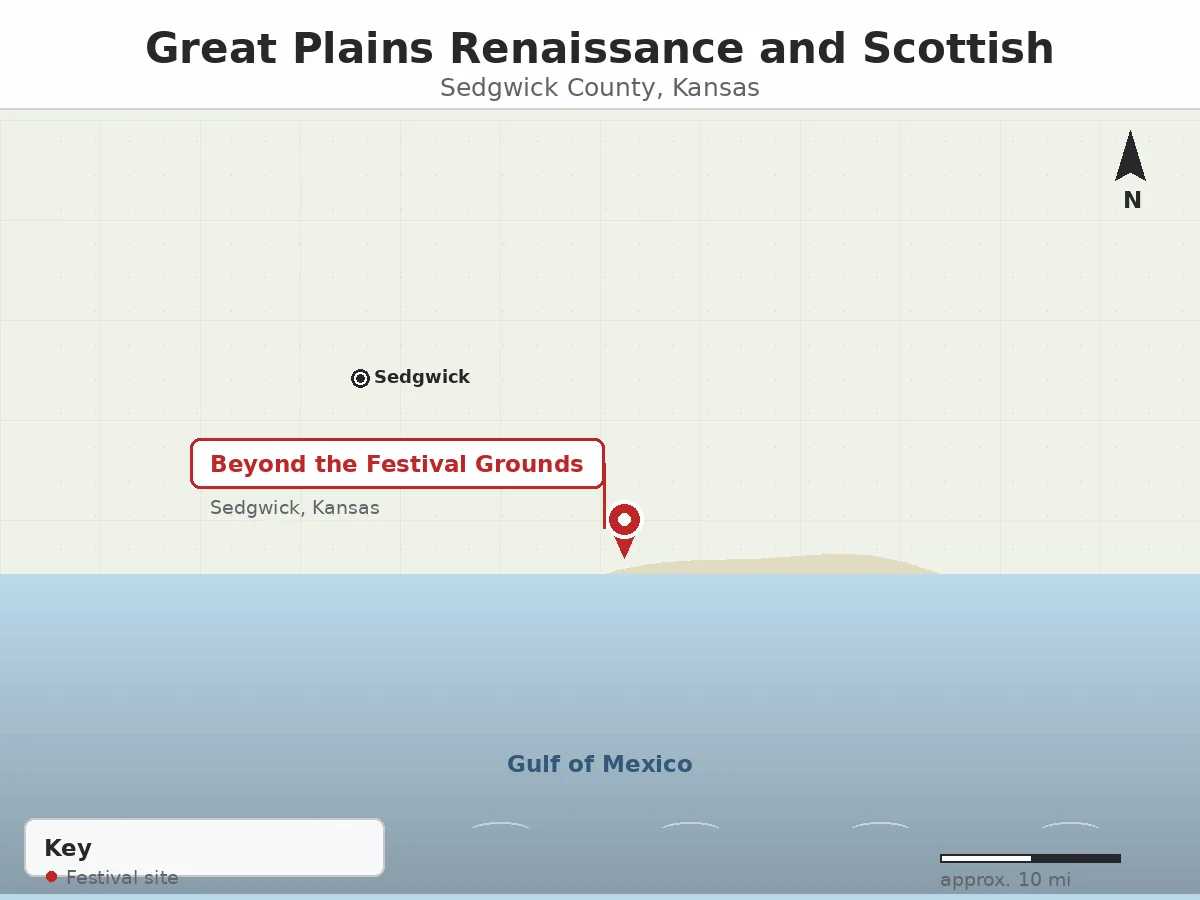
Wichita itself is the natural extension of the trip. The festival sits in the county seat, so a visitor already stands in the middle of Sedgwick County’s largest city, with the rest of what the city offers within the same journey. The record behind this article does not tie the festival to any other particular attraction, and none is invented here; the honest point is simpler. A twice-yearly festival rewards return visits, and the spring weekend offers a reason to see the city in a different season from the fall one.
Why the Festival Matters
The festival’s significance in the record is the partnership written into its published name. Renaissance fairs are common in directory listings; a Renaissance fair that formally shares its title with a Scottish festival, and runs its Highland Games as a named component with published hours, is a rarer thing. For Wichita, the event anchors two heritage communities, the re-enactment and artisan world and the Scottish clan societies, in one county park on the same weekend, twice a year. The continuity across the fall weekends of two thousand twenty-five and two thousand twenty-six, documented independently by the organiser, a visitors bureau and a state licensing layer, points to an established fixture rather than an experiment, whatever the exact year of its founding turns out to be.
Frequently Asked Questions
Why does the festival’s name join two different celebrations?
Because the event genuinely is two celebrations in one. The published combined name, Great Plains Renaissance & Scottish Festival, gives the Scottish half equal billing with the Renaissance half, and the programme bears that out: jousting and falconry share the weekend with the Wichita Highland Games and a Parade of Scottish Clans.
Is the spring weekend a separate festival from the fall one?
No. The spring and fall weekends are two editions of the same festival in the same park. A state tourism layer, a visitors-bureau layer and a fair-directory layer each describe the event as running twice a year, once in spring and once in fall.
What can a spectator watch at the Highland Games?
The games named in the record are the caber toss, the hammer throw, the sheaf toss and the stone throw, with the Parade of Scottish Clans processing as part of the programme. On the documented fall weekend of two thousand twenty-five, the games ran from ten in the morning until five in the afternoon on both days.
How do the games handle people who want to compete?
Competitors register to compete through the organiser, as the organiser’s own site describes. That registration is an arrangement for athletes taking part in the games; it is not a spectator admission price, and the layers read for this article print no gate price for visitors.
What to Expect From the Next Sedgwick County Kansas Great Plains Renaissance and Scottish Festival
How often is Sedgwick County Kansas Great Plains Renaissance and Scottish Festival held?
It is held twice a year. The state tourism layer, the visitors-bureau layer and a fair-directory layer all describe one weekend in spring and one weekend in fall, both at Sedgwick County Park in Wichita.
When is the next Sedgwick County Kansas Great Plains Renaissance and Scottish Festival?
The next fall weekend carried in the layers read falls on the twenty-sixth and twenty-seventh of September, two thousand twenty-six, at Sedgwick County Park, according to a visitors-bureau layer. The spring weekend’s dates do not appear in the layers gathered here, so the organiser’s own site is the place to confirm them.
Will the dates change?
Dates are set edition by edition, and the two fall weekends on record, in two thousand twenty-five and two thousand twenty-six, both landed late in September without being identical. Nothing in the record promises a fixed weekend, so each edition’s dates should be confirmed against the organiser’s current material before travel plans are made.
Closing Thoughts
The Great Plains weekend asks visitors to hold two histories at once: knights and falcons in one field, cabers and clans in the next. The record behind it is unusually consistent about where it happens, how often it happens and what it contains, and unusually quiet about what it costs to walk in. Both halves of that record deserve respect. Go for the joust, stay for the hammer throw, and let the ampersand in the festival’s real name tell you what kind of day to expect.