Rowan County Kentucky Rudy Fest Festival
Bluegrass carried across Poppy Mountain for a quarter century, and the crowds who climbed that hill in Morehead came back year after year because the music never hurried and the campground never felt crowded in the wrong way. Rudy Fest grew into one of the longest-running bluegrass gatherings in eastern Kentucky, a five- or six-day stretch of picking, singing, camping and fireworks that turned a hillside campground into a small temporary town. Its final edition arrived in the summer of two thousand twenty-six, billed as the twenty-fifth year, and a few months later the organisers announced that the festival was closing. The record that survives is a strong one: regional newspaper coverage, local news reporting and genre-news layers document the dated editions, the move from Grayson to Morehead, the ticket prices of the last edition and the closing announcement itself. What follows keeps every dated claim inside the layer that printed it, and it keeps the two published spellings of the name apart, because the layers never merged them.

About the Festival
Rudy Fest was a bluegrass festival held at Poppy Mountain Campground in Morehead, the county seat of Rowan County. The layers print the name in two forms, and the two forms are carried here exactly as they appear: “Rudy Fest” in the organiser’s own statements as carried by a genre-news layer, a regional newspaper layer and a local news layer, and “RudyFest” in an older tourism-listing layer. The sheet title adds the word Festival at the end, and that trailing word is the sheet’s own pattern rather than a form any layer prints as part of the name. The festival was created by Rudy Burchett, a name the layers print as the documented creator, and the organising body appears in the layers in two unmerged forms, “Rudy Fest, LLC” in the organiser’s own closing statement as carried by a local news layer and “Rudy Fest LLC” in a genre-news layer.
The gathering ran for twenty-five years, according to the layers, and its character stayed remarkably steady across that span. National touring bluegrass acts played across five or six days, campers settled into six hundred camping spots on Poppy Mountain, fireworks lit the sky on three nights, and crowds were described by a genre-news layer as consistently around five thousand people. A band competition joined the programme in the later years, and the first annual running of that contest, billed “Bull of the Bluegrass”, arrived with the two thousand twenty-five edition. The festival was ticketed, and the only prices the layers print belong to the final edition: a five-day adult pass at one hundred seventy-five dollars and single-day adult passes from thirty dollars, as printed by a regional newspaper layer. No price is stated for earlier editions in the layers read, and none is assumed here.
Quick Facts
| Detail | Fact |
| Festival name as printed | Rudy Fest, also printed as RudyFest in an older tourism-listing layer |
| Host town | Morehead, the county seat of Rowan County |
| Venue from two thousand eighteen | Poppy Mountain Campground, Morehead |
| Earlier venue | Carter County Fairgrounds, Grayson |
| Created by | Rudy Burchett, as printed by a regional newspaper layer |
| Organiser forms as printed | Rudy Fest, LLC and Rudy Fest LLC, unmerged |
| Final edition | June twenty to twenty-seven, two thousand twenty-six, billed as the twenty-fifth year |
| Programme | Bluegrass from national touring acts, band competition, camping, fireworks |
| Camping | Six hundred camping spots at Poppy Mountain, per a genre-news layer |
| Status | Closed, announced October thirteen, two thousand twenty-six, after twenty-five years |
History
The history of Rudy Fest is a history of a gathering that outlasted most of its peers and then chose its own ending. The layers state that the festival ran twenty-five years and was created by Rudy Burchett, and the two annual billings the layers print sit comfortably beside that account: a university newspaper layer calls the two thousand twenty-five edition “The 24th Rudy Fest”, and a regional newspaper layer documents the two thousand twenty-six edition as the twenty-fifth-year edition. Those billings are recorded here exactly as printed, and no founding year is derived from them, because no layer states one.
The earliest dated edition the layers document in detail is the two thousand eighteen gathering, held from June nineteen to twenty-three at Poppy Mountain in Morehead, with five full days of bluegrass. That edition matters because it was the first at the new home, and the move itself was forced by weather. A flash flood struck the Carter County Fairgrounds site in Grayson in June two thousand seventeen, and the festival could not return to ground that had been damaged. A relief festival followed in Olive Hill in October two thousand seventeen, a bridge between the old home and the new one, and the next summer the gathering settled onto Poppy Mountain, where it would remain for the rest of its run.
For a useful comparison, see the Rowan County Kentucky Pride of Morehead Festival for another county festival.
The final edition arrived in two thousand twenty-six, documented by a regional newspaper layer as a six-day festival running from June twenty to twenty-seven, with a five-day adult pass at one hundred seventy-five dollars and single-day adult passes from thirty dollars. It was billed as the twenty-fifth year, and the billing sits in the record as printed, alongside the twenty-fourth-year billing of the year before. Then, on October thirteen, two thousand twenty-six, the organisers announced the festival’s closure after twenty-five years, retiring from Rudy Fest, LLC. A local news layer and a genre-news layer both carry the announcement, and the creator announced it alongside two colleagues, each referred to here by role only. The closure was not a cancellation of a single edition or a pause for a season; the layers present it as the end of the festival itself, and this article presents it the same way.
Two other events must be kept apart from this record. The Poppy Mountain Music Festival, held in September at the same campground, is a separate festival, and a genre-news layer expressly distinguishes the two, so nothing from its record is imported here. The organisers’ separate August festival at a Flemingsburg farm is likewise a different event, and it plays no part in this account. The festival’s own identity rests on its bluegrass programme, its campground home and its twenty-five-year run, and the fence around it is drawn exactly where the layers draw it.
What to Expect
A visitor arriving at Poppy Mountain during a Rudy Fest week would have found a campground transformed into a working festival village. The music was the centre of the week, with national touring bluegrass acts playing across five or six days, and the band competition added a newer thread to the programme in the final years, giving unsigned and rising bands a stage beside the established names. The first annual running of that contest, “Bull of the Bluegrass”, arrived with the two thousand twenty-five edition, and it gave the later editions a competitive edge that the earlier ones had not carried.
Planning Your Visit
Anyone retracing a Rudy Fest week should begin with the campground, because the venue shaped every practical decision the festival’s visitors made. Poppy Mountain Campground sits in Morehead, the county seat of Rowan County, and it was the festival’s home from two thousand eighteen onward, after the earlier editions at the Carter County Fairgrounds in Grayson. The campground’s six hundred spots, as printed by a genre-news layer, were the festival’s real capacity, and the week-long rhythm of the gathering meant that arriving early in the run mattered more than arriving early on any single day.

A Sample Itinerary
A week at Rudy Fest, as the documented editions describe it, unfolded slowly rather than all at once. The first day belonged to arrival and settling in: campers found their spots among the six hundred on Poppy Mountain, neighbours introduced themselves, and the first sets of bluegrass drifted across the hillside in the afternoon and evening. The opening day set the tone for the week, unhurried and outdoors, with the campground itself doing much of the work of welcome.
The closing days brought the week to its end without hurry. The final sets played, the competition reached its conclusion in the years it ran, and campers packed up across the hillside they had lived on for the better part of a week. The two thousand twenty-six edition, the twenty-fifth year, closed this pattern for the last time, and the closure announced on October thirteen of that year means the itinerary now belongs to memory rather than to any coming summer.
How Rudy Fest Compared
Rudy Fest stood apart from the other gatherings on its own campground. The Poppy Mountain Music Festival, held in September at the same campground, is a separate festival, and a genre-news layer expressly distinguishes the two, so the comparison here is one of separation rather than similarity: the same hillside hosted two different gatherings, and Rudy Fest’s identity was its bluegrass programme, its multi-day camping week and its twenty-five-year run. The organisers’ separate August festival at a Flemingsburg farm is likewise a different event, and it shares nothing with Rudy Fest beyond the people who ran it.
Checklist for the Festival Week
- Settle into a campsite early in the week, since the six hundred spots on Poppy Mountain filled the grounds for the full run.
- Plan around five or six days of music rather than a single headline day, because the programme spread national touring acts across the whole week.
- Leave evenings open for the fireworks, which a genre-news layer places on three nights of the festival.
- Follow the band competition in the later editions, where the first annual “Bull of the Bluegrass” contest ran in two thousand twenty-five.
- Remember the venue history: Poppy Mountain from two thousand eighteen, the Carter County Fairgrounds in Grayson before that, and the Olive Hill relief festival in October two thousand seventeen.
- Carry the ticket figures only for two thousand twenty-six, a five-day adult pass at one hundred seventy-five dollars and single-day adult passes from thirty dollars, since no earlier price is printed.
- Keep the Poppy Mountain Music Festival separate in any plan, since a genre-news layer expressly distinguishes it from Rudy Fest.
- Treat the closure as final: the organisers announced the end on October thirteen, two thousand twenty-six, after twenty-five years.
Beyond the Festival Grounds
Morehead, the county seat of Rowan County, was the festival’s town for the whole of its Poppy Mountain years, and the campground’s place in that town gave visitors a base beyond the festival fence. The earlier geography of the festival reaches into Grayson, where the Carter County Fairgrounds hosted the editions before the flood, and into Olive Hill, where the relief festival followed the flood in October two thousand seventeen. Those three places together map the festival’s movement: a fairgrounds home lost to weather, a relief gathering that kept the community together, and a campground home that held the festival for its final eight years.
Why Rudy Fest Mattered
A festival that runs for twenty-five years earns its place in a county’s calendar by outlasting fashion, and Rudy Fest did that in a part of Kentucky where bluegrass is not a novelty but a living tradition. The gathering gave national touring acts a hillside stage in Morehead and gave campers a week in which the music never stopped for long, and the crowds a genre-news layer describes as consistently around five thousand suggest a following that returned rather than merely passed through. The six hundred camping spots on Poppy Mountain were not a backdrop; they were the festival’s real community, the place where the week was lived between sets.
Frequently Asked Questions
What made Rudy Fest different from the other festival at Poppy Mountain?
The Poppy Mountain Music Festival, held in September at the same campground, is a separate festival, and a genre-news layer expressly distinguishes the two. Rudy Fest was the bluegrass gathering that ran for twenty-five years at the campground, with national touring acts, camping and fireworks, while the September festival is a different event with its own record.
Where was Rudy Fest held?
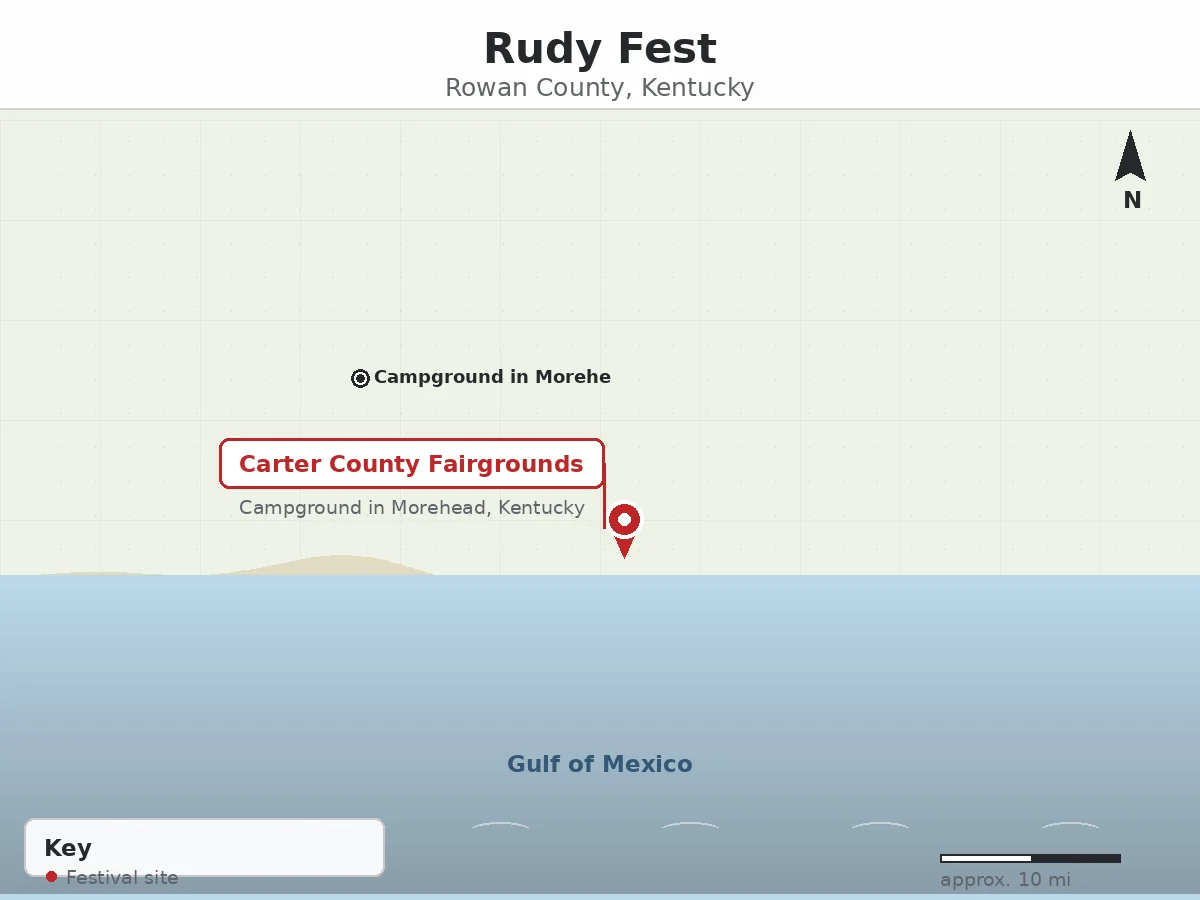
Poppy Mountain Campground in Morehead was the festival’s home from two thousand eighteen onward. Earlier editions were held at the Carter County Fairgrounds in Grayson, and a relief festival followed the June two thousand seventeen flash flood in Olive Hill in October two thousand seventeen. Morehead is the county seat of Rowan County.
How long did Rudy Fest run, and when did it end?
The layers state that the festival ran twenty-five years. The two thousand twenty-five edition was billed as the twenty-fourth, and the two thousand twenty-six edition, held from June twenty to twenty-seven, was billed as the twenty-fifth year. The organisers announced the festival’s closure on October thirteen, two thousand twenty-six, retiring from Rudy Fest, LLC.
What did it cost to attend Rudy Fest?
The only prices the layers print belong to the two thousand twenty-six edition: a five-day adult pass at one hundred seventy-five dollars and single-day adult passes from thirty dollars, as printed by a regional newspaper layer. No price is stated for earlier editions in the layers read, and none is assumed in this article.
What to Expect From the Next Rowan County Kentucky Rudy Fest Festival
How often is Rowan County Kentucky Rudy Fest Festival held?
The festival is not held any longer. It ran for twenty-five years and the organisers announced its closure on October thirteen, two thousand twenty-six, so there is no recurring schedule to describe and no annual pattern that continues past the final edition.
When is the next Rowan County Kentucky Rudy Fest Festival?
There is no next edition. The final edition was held from June twenty to twenty-seven, two thousand twenty-six, billed as the twenty-fifth year, and the closure announced that October brought the festival to its end.
Will the dates change?
There are no dates to change, because the festival has closed. The documented dates belong to the past: June nineteen to twenty-three in two thousand eighteen, June twenty-one to twenty-eight in two thousand twenty-five, and June twenty to twenty-seven in two thousand twenty-six.
Rudy Fest closed as it had lived, on its own terms and after a full run, and the record it leaves behind is a clear one: a bluegrass gathering created by Rudy Burchett, moved by flood from Grayson to Poppy Mountain, carried for twenty-five years by campers and crowds in Morehead, and retired in October two thousand twenty-six. The hillside keeps the memory, and the layers keep the dates.