Prairie County Montana Fair Festival
The Biggest Little Fair, Taken at Its Word
Prairie County bills its fair, in the county’s own policy language, as “The Biggest Little Fair in All of Eastern Montana,” and the phrase earns a second look rather than a smile. This is a county of barely a thousand people, spread across dryland farms and ranch country in Montana’s far east, yet its fair carries a full open class book across six departments and more, a 4-H programme the county paper follows from spring to sale day, and judging serious enough to name sweepstakes winners and a Fairboard Exhibitor of the Year. Small, here, describes the population, not the ambition.
The event’s published name is the Prairie County Fair, held each year in early August at the Prairie County Fairgrounds in Terry, the county seat. The documented 2026 edition placed its 4-H exhibits across August 6 to 9, a span published in advance by the county paper. In a town this small, fair week is not one attraction among many but the gathering itself.
About the Prairie County Fair
The fair is organised by the Prairie County Fair Board, working alongside Prairie County 4-H and the Montana State University Extension office for Prairie County. The board carries the event and its honours, including the Fairboard Exhibitor of the Year award named among the fair’s own results. The 4-H programme supplies much of the livestock and indoor project work. Extension describes interview judging at All-Events Day and at the Prairie County Fair as the culmination of its youth programme year: not an interruption to the project year, but its finish line.
The grounds are the Prairie County Fairgrounds in Terry. No street address was published in the fair-side record, so none is invented here; in a town of Terry’s size, the fairgrounds are a known local landmark. The county treats the grounds as a year-round public asset, and events held there outside fair week belong to the grounds’ wider community life, not to the fair itself. What belongs to the fair, on the record, is its exhibiting core: livestock, indoor projects judged with interviews, and an open class competition open to the wider county.
This fair publishes no fair book or gate price in the material available, and its entries run locally rather than through a national entry system. A reader who wants precision beyond this article will find it the local way, through the fair board, the Extension office and the county paper in the weeks before August.
For a useful comparison, see the Powell County Montana Fair Festival for another county festival.
Quick Facts
| Item | Detail |
| Fair name | Prairie County Fair |
| Town | Terry, the Prairie County seat |
| Venue | Prairie County Fairgrounds, Terry (no street address published in the fair-side record) |
| Organisers | Prairie County Fair Board, with Prairie County 4-H and Montana State University Extension, Prairie County |
| Season | Early August |
| Documented 2026 edition | 4-H exhibits across August 6 to 9, 2026, as previewed by the county paper |
| County billing | “The Biggest Little Fair in All of Eastern Montana,” as carried in the county’s own growth policy |
| Exhibiting core | 4-H livestock and indoor projects, plus a deep open class book |
| Admission | No gate, pass or parking price published in the fair-side record |
| Fair-week camping | No fair-week camping offer published in the fair-side record |
A History Carried in Results, Not in a Founding Year
No founding year and no edition number for this fair appears in the fair-side record, so this article offers neither. Inventing an anniversary would be a disservice to a fair whose genuine history is visible in a better form: in results, published in full, year after year, by the county paper.
Those published results are the fair’s archive. The open class results for the 2025 edition run through Departments A to F and beyond, class by class, naming sweepstakes winners, Judge’s Choice honours and special awards supported by local businesses. A fair that prints its results at that depth is telling its county that the judging mattered. The Fairboard Exhibitor of the Year award sits in the same record, honouring sustained excellence across the book, not only a single winning entry.
The billing tells the other half of the history. A county does not write “The Biggest Little Fair in All of Eastern Montana” into its own growth policy on a whim. That sentence, carried as billing and as nothing more, records how Prairie County regards the fair: as a point of pride disproportionate to its size. Together, results and billing give this fair a documented past without a single invented date.
What to Expect
Livestock Raised Across a Season, Shown in August
The livestock side of the fair is the end of a story the county paper starts months earlier. Its preview coverage follows market steer, swine and lamb exhibitors through the feeding, fitting and daily handling that turn a spring project animal into an August show animal. By the time those animals reach the fairgrounds in Terry, the young people leading them have already done most of the work the fair exists to recognise.
At the fair, the 4-H livestock projects are shown and then sold, and the sale carries a purpose beyond the ribbon. For many exhibitors, the proceeds help fund what comes next, whether further education or the following year’s project. A visitor watching the show ring is watching two things at once: a judging contest, and the financing of the county’s next generation of exhibitors.
Indoor Projects and the Interview
Not every project at this fair walks on four legs. Prairie County 4-H members also bring indoor projects, and Extension’s record places interview judging at the centre of how those projects are assessed, both at All-Events Day and at the fair itself. The object on the table matters, but so does the exhibitor’s ability to explain what was attempted, what went wrong, and what was learned.
For a visitor, the indoor exhibits reward a slower look. Read the project alongside the result it earned, and the fair becomes a record of young people learning to make things and account for their own work in front of a judge. It is quieter than the livestock ring, and no less central to what the board and Extension mean by a fair.
An Open Class Book as Wide as the County
The open class competition is where this fair most clearly outgrows the word little. The published results structure runs across Departments A to F and beyond, covering livestock alongside agronomy, horticulture, floriculture and culinary classes, with sweepstakes awards, Judge’s Choice honours and special awards from local businesses layered over the placings. Open class belongs to everyone, not only to enrolled youth exhibitors, and Prairie County’s book takes that invitation seriously.
The agronomy classes deserve particular attention because they show what this county actually grows. Sheaf forage, cereals and chickpeas appear in the judging alongside the garden and kitchen entries, exactly right for a dryland farming county on the northern plains. Seeing chickpeas judged as exhibits connects the fair directly to the fields a visitor drives past on the way into Terry. The department structure described here comes from the published 2025 results, carried as the fair’s standing shape, not as a promised schedule for any single later year.
The Shape of Fair Week
Within the documented early-August span, expect the fair’s energy to concentrate on its exhibiting core rather than on a sprawling midway programme, because no such programme is part of the fair-side record. The days turn on judging. Visitors who arrive expecting a county showing its work will find exactly that, done thoroughly.
Planning Your Visit
Getting the Timing Right
Plan for early August, and confirm the current year’s span before travelling, because each edition’s dates are published for that year. The documented 2026 edition placed the fair’s 4-H exhibits from August 6 to 9, and early August is the stable guide for planning. Exhibitor families work to an earlier rhythm, since projects are prepared across spring and summer and entries are handled locally through the board and Extension rather than through an online entry portal.
Admission and Money, Stated Plainly
No admission, pass or parking price appears in the fair-side record, so no figure is quoted here. That silence must not be converted into a claim that entry is free, because the record does not say that either. Carry ordinary cash flexibility and confirm any charge locally on arrival. The livestock sale, likewise, is exhibitor business with its own arrangements, not a priced visitor attraction.
Staying Over Without Assuming Fair Camping
No fair-week camping offer at the fairgrounds appears in the fair-side record, so none should be assumed. Separate public camping exists in the countryside northwest of Terry, but it is a distinct public-land facility with nothing to do with the fair or its board. Settle lodging and camping in advance: Terry is a small town and fair week is one of its busiest stretches.
Practical Notes for a Small-Town Fair
Terry serves a large, thinly populated county, and distances here are measured in long drives rather than short hops. Arrive with fuel and essentials in hand. Early August on the northern plains is hot and dry, so water, shade and a hat belong in the plan. Give the judging unhurried time: at a fair built on entries rather than attractions, the value is in watching careful work assessed carefully.
A Sample Day at the Fair
Begin in the morning at the livestock showing, while the air is still cool, and watch how the young handlers present animals they have raised across the season. Move on to the indoor exhibits late in the morning and take the interview-judged projects slowly. After a midday break in town, return for the open class departments, working from the agronomy sheaves and chickpeas through the horticulture and floriculture to the culinary entries. Close the day back at the livestock side of the grounds, where the sale and its purpose, funding education and next year’s projects, give the week its meaning.
How This Fair Compares
Against Montana’s large fairs, with their published gate ladders, grandstand concerts and midway programmes, Prairie County’s fair is a deliberately smaller instrument. Its distinction is depth per person. Few fairs publish open class results across six departments and more for a county of barely a thousand residents, and fewer still have a county paper that follows its market livestock exhibitors from spring preparation to August showing. Other counties in other states share the Prairie County name and hold fairs entirely their own; those events are separate in every particular and lend this fair nothing. On its own record, Terry’s fair competes on thoroughness, and holds its ground.
Your Fair Checklist
- Put the early-August window in the calendar and confirm the current year’s span before travelling
- Plan the visit around the exhibiting core: livestock showing, interview-judged indoor projects and the open class departments
- Read the agronomy entries closely, especially the sheaf forage, cereals and chickpeas that show what the county grows
- Carry cash flexibility, since the record publishes no gate or parking price to plan around
- Arrange lodging or camping independently and early, as no fair-week camping offer is published
- Pack for heat and distance, with water, shade and a full fuel tank sorted before arrival
- Allow unhurried time in the exhibit areas, not a quick stop
Beyond the Fairgrounds
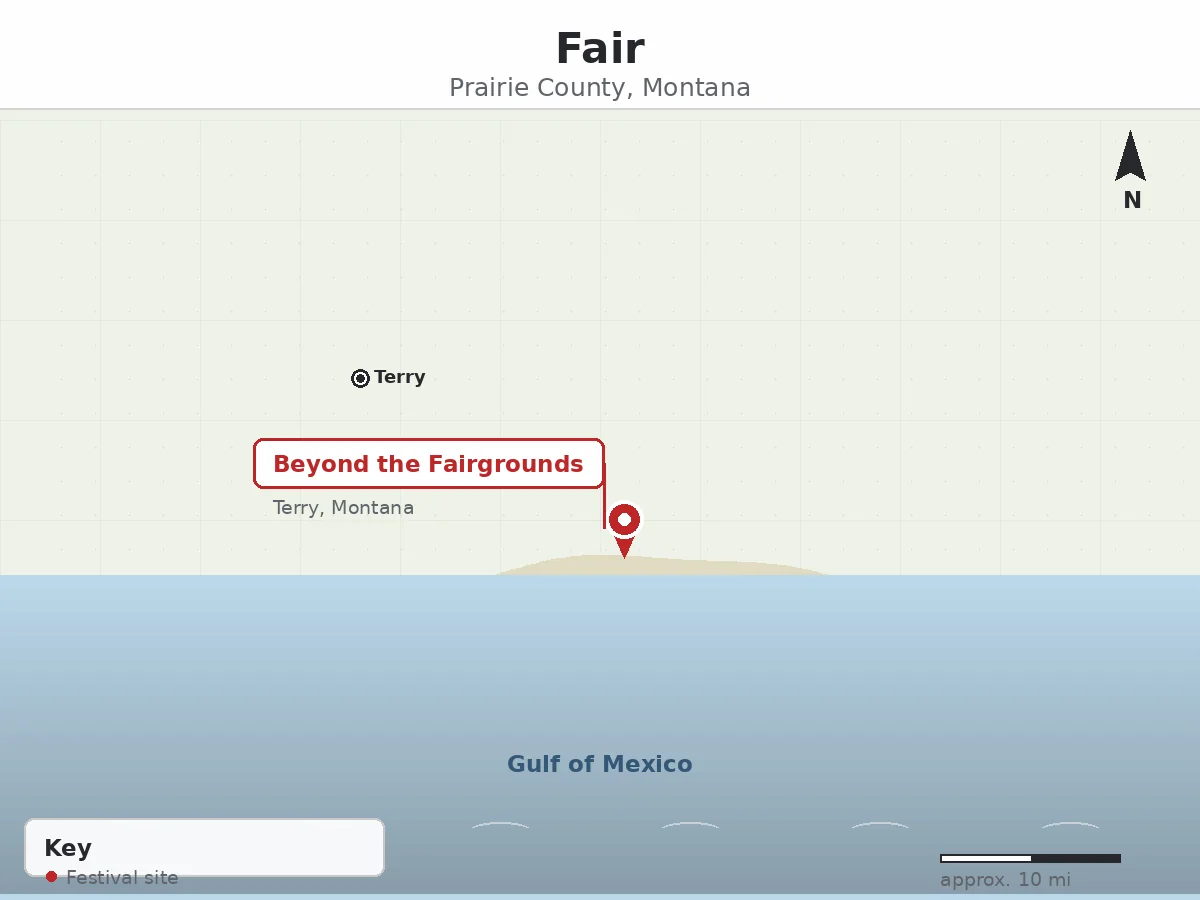
Terry rewards the visitor who lingers after the judging ends. It is the seat of Prairie County, set in Yellowstone River country where the valley cuts green through otherwise dry plains. The countryside around it, river bottom and open farm and ranch land, explains the fair better than any programme could, because nearly every exhibit began as work in that landscape. Keep the fairgrounds’ other gatherings in their proper place: they belong to the town’s wider life, not to fair week.
Why This Fair Matters to Prairie County
In a county of barely a thousand people, a fair is never only an event. It is one of the few mechanisms the county has for seeing itself whole: young people presenting a season of work, growers submitting the actual crops of the place to judgement, a board honouring an exhibitor of the year, and a newspaper printing the results so none of it evaporates. The fair converts private effort, done alone on farms and in kitchens and barns across a huge county, into public recognition, once a year, in one place.
Frequently Asked Questions
Where exactly is this fair held?
The Prairie County Fair is held at the Prairie County Fairgrounds in Terry, Montana, the Prairie County seat. The fair-side record publishes no street address for the grounds, and in a town of Terry’s size the fairgrounds are a familiar local landmark during fair week.
When does the fair take place?
The fair is an early-August event. The documented 2026 edition placed its 4-H exhibits across August 6 to 9, as previewed by the county paper, and each year’s span is published for that edition, so current dates should be confirmed before travelling.
How much does it cost to enter the fairgrounds?
The fair-side record publishes no admission, pass or parking price, so no figure can honestly be given here. The fair should not be described as free on the strength of that silence; confirm any charge locally and carry cash flexibility.
What is exhibited at the fair?
The documented core is 4-H livestock projects, including market steer, swine and lamb exhibits shown and sold at the fair, 4-H indoor projects assessed with interview judging, and a wide open class book whose published results run across livestock, agronomy, horticulture, floriculture and culinary departments, and beyond.
What to Expect From the Next Prairie County Montana Fair Festival
How often is the Prairie County Montana Fair Festival held?
Under its published name, the Prairie County Fair, the event is held once a year, in early August, at the fairgrounds in Terry, organised by the Fair Board with the county 4-H programme and Extension office.
When is the next Prairie County Montana Fair Festival?
The next edition is expected in early August of the coming fair season, following the documented 2026 edition whose 4-H exhibits ran August 6 to 9. The board, the Extension office and the county paper publish each year’s span in advance, and those notices are the authority for confirmed dates.
Will the dates change?
The precise days can move a little from year to year, since the fair is anchored to an early-August season rather than to fixed dates. The season itself, and Terry as the host town, are the stable elements to plan around.
Closing
Come to Terry in early August with the right expectations and this fair will meet them: a board-run county fair in a county of barely a thousand people, with livestock raised across a season, indoor projects defended in interview, chickpeas and sheaf forage judged beside the baking, and every result printed for the county to read. It calls itself the biggest little fair in all of eastern Montana. On its own record, the claim is a fair one.
One Comment