Nemaha County Kansas Old Albany Days Festival
Albany, Kansas is a town that survives mostly as a memory and a museum. The settlement that once stood a short distance north of Sabetha has shrunk to a preserved townsite, yet once each year that ground fills with tractors, quilts, horseshoe players and parade watchers for a weekend the published record calls, simply and consistently, Old Albany Days. No layer read for this article prints the longer county-first title used to file it here, and none adds the word Festival to the event’s name. What the sources describe is a museum fundraiser with deep local roots: an open-air collection of fifteen relocated and restored buildings, centred on a schoolhouse raised in eighteen sixty-seven, opening its gates on the weekend after Labor Day for demonstrations, contests and home-style food. The record behind the event is a good one, though it carries one honest disagreement about how long the celebration has been running, set out openly in the history section below.

About
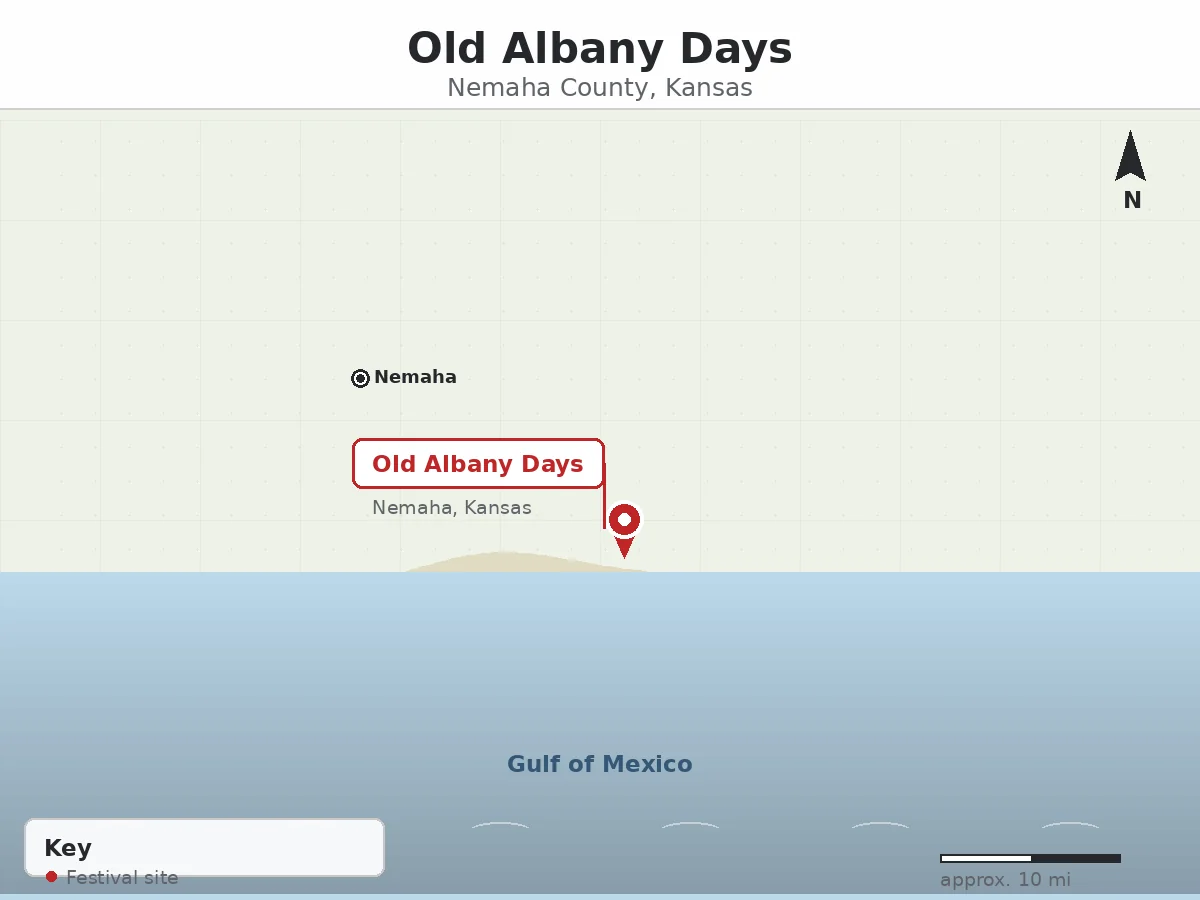
Old Albany Days is hosted by the Albany Historical Museum on its own grounds at the former townsite of Albany, roughly two miles north of Sabetha in Nemaha County. A ghost-town reference layer describes the weekend as the museum’s annual fundraiser, which frames its character well: this is a working heritage site raising support by showing visitors what it preserves. The fifteen buildings gathered on the grounds were moved there and restored over time, and the eighteen sixty-seven Albany School stands at the centre of the collection as its anchor and emblem. Sabetha, the community just south of the grounds, is the nearest town, but it is not the seat of Nemaha County; reference layers give Seneca as the county seat, a distinction worth keeping straight because the festival is sometimes casually filed under Sabetha’s name, as one festival-guide layer does when it lists the event as Old Albany Days – Sabetha. The museum itself is a standing attraction apart from the festival weekend, while Old Albany Days is the one concentrated occasion each year when the whole complex is animated by a full programme. The museum’s street address and telephone number appear in the state travel layer and are noted here by existence only.
Quick Facts
| Item | Detail |
| Published name | Old Albany Days |
| Host | Albany Historical Museum, on its own grounds |
| Setting | The former townsite of Albany, about two miles north of Sabetha |
| County seat | Seneca; Sabetha is not the seat of Nemaha County |
| Timing | The weekend following Labor Day |
| Documented editions | Nineteen ninety-eight, two thousand twenty-two and two thousand twenty-six |
| Grounds | Fifteen relocated and restored buildings centred on the eighteen sixty-seven Albany School |
| Admission recorded for two thousand twenty-two | Five dollars for visitors aged ten and over |
| Role for the host | Described by a ghost-town reference layer as the museum’s annual fundraiser |
History
The ground itself supplies the oldest date in this story. Albany was a living town when its schoolhouse went up in eighteen sixty-seven, and the settlement’s later fading is precisely why the museum exists: buildings from the surrounding countryside were brought to the townsite and restored so that a vanished community’s fabric would not vanish with it. Against that backdrop, the founding of Old Albany Days is where the sources part company. A state travel layer states plainly that the event has been taking place since nineteen sixty-five. A specialist magazine layer, however, bills the edition of September nineteen ninety-eight as the thirty-second annual, and that billing does not square with a nineteen sixty-five start, since a thirty-second annual running in nineteen ninety-eight would point to a beginning several years earlier. Neither claim is adopted here. The two statements are recorded exactly as their layers print them, side by side and unmerged, and no founding year is derived from the billing arithmetic, because the honest position is that the published record contradicts itself on the point. What is not in doubt is the event’s longevity in some form: the nineteen ninety-eight edition was already mature enough to earn a specialist listing, and the same specialist layer shows antique cars, tractors, steam and gas engines and a flea market on the grounds that year, which is the picture of an established show rather than a young experiment.
What to Expect
A visitor arriving during the weekend finds the museum grounds turned into a working fair of early farm and town life. The state travel layer’s standing programme lists food, farm equipment demonstrations, a quilt show, an antique tractor pull, a garden tractor pull, a parade, a flea market, a horseshoe tournament, train rides, music and horse team demonstrations, and a podcast layer also associates a threshing bee with the event. The mix matters: heavy machinery and animal power share the programme with needlework and music, so the weekend reads as a cross-section of the community the museum preserves rather than a single-theme show. The nineteen ninety-eight specialist listing adds antique cars and steam and gas engines to the picture for that year, and its flea market matches the one the travel layer still describes decades later, a small continuity worth noticing. Beyond the scheduled elements, the grounds themselves are the main exhibit. Walking among fifteen relocated buildings with the eighteen sixty-seven school at their heart gives the demonstrations a setting no fairground can imitate, because the tractors are pulling and the teams are working in a streetscape of the very era they belong to. Nothing in the layers read promises grandstand spectacle or headline performers; the appeal documented here is cumulative and close-up, built from many modest activities running at once.
Planning Your Visit
Timing is the first practical fact: a state travel layer and a ghost-town reference layer agree that Old Albany Days is held on the weekend following Labor Day, and the dated editions in the record fit that placement. The festival-guide layer lists the two thousand twenty-six edition on Saturday the twelfth and Sunday the thirteenth of September, which is the same calendar slot the specialist magazine recorded for the nineteen ninety-eight edition. On cost, the record speaks for one year only. The state travel layer states that admission for the two thousand twenty-two event was five dollars for visitors aged ten and over, and no other year’s terms are stated in the layers read, so no price is quoted here as current and no free-entry position is taken for any other edition. A traveller planning around the weekend should therefore treat the five-dollar figure as a documented historical term, not a promise. Sabetha lies about two miles south of the grounds and is the natural base for the trip, with Seneca, the county seat, elsewhere in the county for anyone combining the festival with courthouse business or a wider Nemaha County drive. Because the event is a fundraiser for the museum, spending on food and at the flea market while on the grounds goes toward the site’s upkeep.
For a useful comparison, see the Nemaha County Kansas American Freedom Festival for another county festival.
A Sample Itinerary
A full Saturday on the grounds might begin with a slow walk through the buildings before the programme thickens, taking in the eighteen sixty-seven schoolhouse first while the morning is quiet. From there, the farm equipment demonstrations and the horse team work reward lingering, since both are the kind of exhibit that unfolds gradually rather than to a fixed start time. Midday suits the food stands and the flea market, with the quilt show as an indoor pause among the machinery. The afternoon can be given to the pulls, antique and garden tractor alike, and to the horseshoe tournament, before the parade draws the crowd together. A shorter Sunday visit could reverse the order: parade and music first, then a last unhurried circuit of the buildings and the threshing bee if it is running that year.
How It Compares
Sabetha keeps several named events of its own, including a homecoming parade, a rodeo and Maple Leaf Festival mentions in the layers, and all of them are separate occasions from Old Albany Days despite the short distance involved; the museum weekend should not be confused with the town’s own celebrations. The distinction is one of purpose as much as place. A town festival celebrates a living community, while this event rallies around a preserved one, and its grounds are a museum collection rather than a main street. Albany-named festivals in other states also surfaced during the research and are disowned entirely; they share nothing with this Kansas event but part of a name. Within Kansas, other pioneer-flavoured weekends and old settlers gatherings exist in many counties, but the layers read document this one on its own terms, anchored to a specific schoolhouse, a specific townsite and a specific museum, and none of those other events’ facts are borrowed to fill out this account.
Checklist
- Set aside the weekend following Labor Day, and confirm the year’s exact September dates before travelling
- Carry small bills for food and flea market purchases on the grounds
- Budget for admission using the documented two thousand twenty-two figure only as a guide, since later terms are unpublished
- Allow time for all fifteen buildings, not only the headline demonstrations
- Put the eighteen sixty-seven Albany School at the top of the walking list
- Plan a stop in Sabetha, two miles south, around the visit
- Bring sun protection and walking shoes suited to open museum grounds
- Check whether the threshing bee and the tractor pulls are both running in the year of the visit
Beyond the Festival
The museum repays attention outside its big weekend as well, since the complex of relocated buildings stands at the Albany townsite year-round as a record of a community that otherwise left little behind. Sabetha, two miles south, gives the trip its everyday anchor, and Seneca’s role as county seat makes it the other natural pole of a Nemaha County visit. Travellers who come for the festival often find the quieter story just as compelling: a townsite that lost its town but kept its school, its memory and one crowded weekend a year. The surrounding county is farming country, and the festival’s programme of pulls, threshing and team work makes most sense against that landscape, where the skills on display were ordinary working knowledge within living memory.
Why It Matters
Old Albany Days matters because it converts preservation from a static duty into a public occasion. A museum of moved buildings can risk feeling like a warehouse of other places’ pasts, but a weekend of demonstrations, contests and food on those grounds argues the opposite case: the collection lives when people gather inside it. The fundraiser framing recorded by the ghost-town layer underlines the practical side of that argument, since the event’s gate and grounds spending support the institution that keeps the townsite intact. The unresolved founding question, far from being a defect in the story, is part of its honesty. Two respectable layers disagree about when the run began, and the article that admits that disagreement tells the reader more than one that quietly picks the tidier number.
Frequently Asked Questions
What name does the celebration actually carry in print?
Every layer read prints the short form Old Albany Days. The state travel layer, the festival-guide layer and the specialist magazine layer all use it, none attaches the word Festival, and none uses a county-first construction, so the longer title on this page is a filing label rather than the event’s published name.
Which September weekend should a visitor reserve?
Reserve the weekend following Labor Day. That placement is stated by both the state travel layer and the ghost-town reference layer, and the dated editions fit it: the nineteenth ninety-eight show ran on the twelfth and thirteenth of September, and the festival-guide layer gives the same twelfth and thirteenth of September for two thousand twenty-six.
What fills the grounds while the weekend is running?
The state travel layer lists food, farm equipment demonstrations, a quilt show, antique and garden tractor pulls, a parade, a flea market, a horseshoe tournament, train rides, music and horse team demonstrations, with a threshing bee associated through a podcast layer. The nineteen ninety-eight listing adds antique cars and steam and gas engines for that year.
Why do the sources disagree about the event’s age?
Because each prints its own claim without reconciling the other. The state travel layer says the event has been taking place since nineteen sixty-five, while the specialist magazine billed the nineteen ninety-eight edition the thirty-second annual, which implies an earlier start. This article records both exactly as printed and adopts neither as the founding year.
What to Expect From the Next Nemaha County Kansas Old Albany Days Festival
How often is Nemaha County Kansas Old Albany Days Festival held?
The layers describe a yearly rhythm tied to a fixed point in the calendar rather than to a roving date. The state travel layer and the ghost-town reference layer both place the event on the weekend following Labor Day, and dated editions across three different decades in the record — nineteen ninety-eight, two thousand twenty-two and two thousand twenty-six — all sit in that same September slot, which supports reading the pattern as a settled annual fixture of the museum’s year.
When is the next Nemaha County Kansas Old Albany Days Festival?
The most recent dated listing in the record is the festival-guide layer’s entry for Saturday the twelfth and Sunday the thirteenth of September two thousand twenty-six. Beyond that entry, the layers read carry no later dated edition, so the practical guidance is the standing placement itself: the weekend after Labor Day, confirmed against the museum’s own publicity nearer the time.
Will the dates change?
Nothing in the layers read suggests movement. The same mid-September weekend appears in a specialist magazine from nineteen ninety-eight and in a festival guide looking at two thousand twenty-six, a span of nearly three decades, and both descriptive layers anchor the event to the weekend following Labor Day rather than to a fixed numbered date. The numbered days will drift with the calendar, as they always do, but the anchoring rule behind them has held steady across the whole documented record.
Closing Thoughts
Old Albany Days is a small event with an unusually clear identity: one museum, one vanished townsite, fifteen saved buildings and a weekend that puts all of them to work. Its record is good without being perfect, and this account has kept the imperfections visible, from the single-year admission figure to the founding claims that refuse to agree. For a reader deciding whether the drive north of Sabetha is worthwhile, the documented programme is the answer — tractors and teams, quilts and horseshoes, a parade through a town that exists now mainly so that weekends like this one can happen.