Morris County Kansas Rock on Prairie Festival
In the middle of September, the small Morris County community of Dwight turns a local field over to live music. Concert archives and festival guides record the gathering as Rock On Prairie Fest, a bill of regional rock and indie acts whose lineups range from a dozen performers to more than thirty. Dwight is a small town rather than a county centre: Council Grove, not Dwight, is the county seat of Morris County. That smallness shapes the event’s paper trail. No organiser’s own site documents the weekend, and the fullest descriptions come from concert-archive layers that preserve dates, venues and the names of acts. Those layers agree on the outline of a grassroots music weekend in mid-September. This article follows that record closely, keeping its gaps visible rather than filling them with guesswork.

About
The first thing a reader meets is a spelling question. The booking sheet that prompted this article calls the event the Morris County Kansas Rock on Prairie Festival, with the final word spelled out in full. The sources themselves never write it that way. A concert-archive layer and a concert-listing layer both print Rock On Prairie Fest. A festival-guide layer prints Rock on Prairie Fest, and the same archive elsewhere styles it Rock on prairie fest, in lowercase. All three forms are carried here exactly as printed and left unmerged. The consistent thread is the word Fest: every surviving listing shortens the ending rather than spelling Festival out.
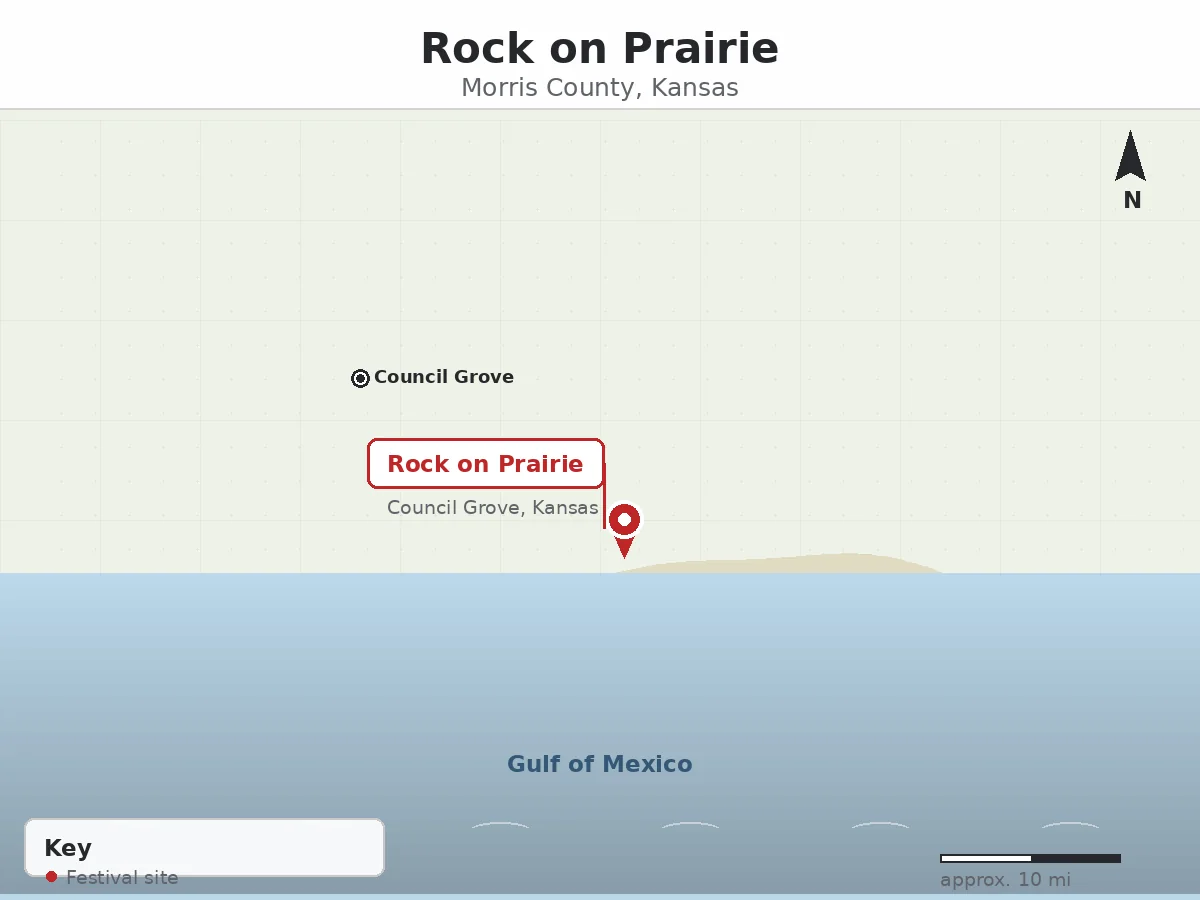
The host community is Dwight, one of the small towns of Morris County. Reference layers name Council Grove as the county seat, so Dwight hosts this weekend without being the county’s administrative centre. The venue picture is equally spare. For the two thousand twenty-five edition, a concert-archive layer gives the site simply as A Field, in Dwight, and no fuller venue name appears in any other layer consulted. A concert-listing layer prints a street address for the site; that address is noted here by its existence only and is not reproduced. Who runs the weekend is the record’s largest blank: no layer names an organiser, a committee, a sponsor or a presenting body, and rather than inventing one, this article leaves the chair empty and says so.
Quick Facts
| Item | Detail |
| Published name | Rock On Prairie Fest |
| Other printed forms | Rock on Prairie Fest; Rock on prairie fest |
| Host town | Dwight, Morris County, Kansas |
| County seat | Council Grove; Dwight is not the seat |
| Venue as printed | A Field, Dwight (two thousand twenty-five edition) |
| Organiser | None named in any layer read |
| Documented editions | Two thousand eighteen; two thousand twenty-four; two thousand twenty-five; two thousand twenty-six |
| Largest documented bill | More than thirty named acts (two thousand eighteen) |
| Admission | No published terms in any layer read |
History
The documented trail opens on Friday the twenty-first and Saturday the twenty-second of September, two thousand eighteen. A concert-archive layer covering those two days lists more than thirty named acts, the largest bill attached to any edition in the record. Then the trail goes quiet. The layers consulted document no edition for the years that follow until two thousand twenty-four, and no conclusion is drawn from that silence: an undocumented year is not the same thing as a cancelled one.
When the event resurfaces, on Friday the thirteenth of September, two thousand twenty-four, it does so through a single concert listing: the act The Rumours, its name printed exactly so, performing at five in the afternoon in Dwight. Two fuller editions follow in consecutive years. The two thousand twenty-five weekend, Friday the twelfth and Saturday the thirteenth of September, is documented by a concert archive with twelve named acts at A Field, and a festival-guide layer independently lists the same two dates. The two thousand twenty-six edition, Friday the eleventh and Saturday the twelfth of September, carries thirteen named acts in the archive, matching dates in the guide, and a Friday start from five in the afternoon in an events-listing layer. No layer offers a founding year or any annual numbering, so the four dated editions stand here as documented editions only, with no claim that they form an unbroken run.
For a useful comparison, see the Morris County Kansas Voices of the Wind People Festival for another county festival.
What to Expect
Music is the whole of the documented programme. Each surviving edition is built as a multi-act bill of regional rock and indie performers, spread across two days in the fuller years. The scale swings considerably: more than thirty named acts in two thousand eighteen, twelve in two thousand twenty-five and thirteen in two thousand twenty-six, while the two thousand twenty-four trace preserves a single named performance, The Rumours at five in the afternoon on the Friday. An events-listing layer gives the two thousand twenty-six Friday the same five o’clock starting point, though no layer prints a full running order or closing time for any year.
Just as striking is what the listings never mention. No food programme, craft market, children’s area or family entertainment appears in any layer read, and none is described here, because describing one would mean inventing it. The honest picture is of a field, a bill of acts and an audience gathered for the music itself. Travellers who need the practical trimmings larger festivals publish as a matter of course should treat their absence from this record as a prompt to check current listings before travelling, not as proof that nothing of the kind exists on the ground.
Planning Your Visit
Pin down the September weekend first, and treat the exact dates as movable. Every documented edition falls in mid-to-late September, always touching a Friday, and the fuller editions run into the Saturday: the twenty-first and twenty-second in two thousand eighteen, the twelfth and thirteenth in two thousand twenty-five, the eleventh and twelfth in two thousand twenty-six. With no organiser’s page anchoring the announcement, the concert archives, the festival guide and the events listings are where a future date will surface, and they deserve a fresh check before any trip.
Money needs the same caution. No layer consulted states an admission price, and none describes entry as free either, so no position on cost is taken here; a traveller should be ready for either arrangement and confirm through the freshest listing available. The ground itself is given only as A Field in Dwight, too spare a description for confident navigation, so allow extra time to locate the site, and note that one concert listing prints a street address for it even though that address is not reproduced here. Dwight’s scale cuts both ways: a small town means a compact, unhurried setting, and it also means the visitor should not assume the layered services of a big festival town. Carry what the day requires, from water and weather protection to a charged phone, since the published record promises nothing beyond the music.
A Sample Itinerary
A workable shape for the weekend follows the pattern the listings support. On the Friday, arrive in Dwight with time in hand, find the field, and settle in before the early-evening start that the two thousand twenty-six listing sets at five in the afternoon; the two thousand twenty-four record shows a named act on stage at that hour, so the opening slot is a real part of the bill rather than a warm-up to skip.

Saturday carries the fuller weight in the two-day years, when the weekend’s twelve or thirteen named acts are spread across the bill, so plan it as the main listening day: arrive early, pace the day with breaks away from the stage area, and stay through the closing sets. No layer documents camping, late-night programming or a Sunday session for any edition, so treat the run home as part of the same day. If only one day is possible, the Saturday of a two-day edition is the safer choice, while a Friday-only listing, like two thousand twenty-four, still rewards the trip with the headline hour around five.
How It Compares
The name invites one confusion above all others, and it is worth clearing away directly. Rock The Plains is a different event entirely: a country music festival at Tuttle Creek State Park, near Manhattan, in another county. Listings for the Dwight weekend are rock and indie bills in Morris County, and the two gatherings share nothing beyond a similar ring to their titles. A traveller who books for one expecting the other will end up in the wrong county with the wrong genre playing.
Two other Kansas events carry prairie wording without any connection to Dwight. The Land Institute’s Prairie Festival takes place in Salina, and the Tallgrass Prairie Festival belongs to Osage City; both are separate occasions in separate counties, and neither is a sister event to the Dwight weekend. Closer to home, Dwight itself holds another celebration, the Dwight Summerfest, which a city tourism layer names among the community’s events. Summerfest and the September music weekend are distinct fixtures in the same small town, and this article keeps them apart just as the sources do.
Checklist
- Confirm the September dates in a current concert listing before booking any travel
- Check the freshest events listing for admission terms, since the older layers publish none
- Allow extra time to find the field in Dwight; one listing carries a street address for the site
- Pack water, sun protection and a warm layer for an evening in an open field
- Plan the Saturday as the main day when an edition runs across two days
- Keep the September weekend separate from Dwight Summerfest when checking the town calendar
Beyond the Weekend
Dwight’s appeal outside the festival days is the appeal of a small Morris County community: quiet streets, open Flint Hills country at the edges of town, and a pace that makes a single field feel like a natural gathering place. The county seat, Council Grove, lies within the same county, and a visitor will likely pass through it for services the smaller community does not concentrate. The September timing places the weekend in the heart of the Kansas festival season, so a traveller can pair the trip with the wider circuit, provided each event is checked on its own listing. On the published evidence the weekend offers no surrounding programme of side events, so frame the trip as a music outing into small-town Kansas, with the landscape and the quiet doing the rest of the work.
Why It Matters
A festival with no organiser’s website, no named venue grander than a field and no admission terms in print might look like a footnote. The record suggests something else. Concert archives preserve four dated editions across nine years, with bills that reached more than thirty named acts in two thousand eighteen and still ran to thirteen in two thousand twenty-six. That is a real stage history for a community of Dwight’s size, and it survives only because listing and archive layers bothered to keep the lineups. The weekend also shows how regional music circulates in rural Kansas, through small-town dates where audiences meet acts in fields rather than theatres. Documenting the event on the evidence available, gaps included, protects that history from two opposite errors: inflating it beyond what the sources support, or letting it vanish because no institution published a tidy account of it.
Frequently Asked Questions
Is this the same gathering as Rock The Plains?
No. Rock The Plains is a country music festival at Tuttle Creek State Park near Manhattan, in a different county. The Dwight weekend is a rock and indie bill in Morris County, documented by concert archives under the name Rock On Prairie Fest. The similar titles are the whole of the connection, and confusing the two would put a traveller in the wrong county.
Who runs the weekend in Dwight?
The layers consulted name nobody. No organiser, committee, sponsor or presenting body is printed in the concert-archive, concert-listing, festival-guide or events-listing layers behind this article, and the gap is reported rather than filled. Practical questions about a future edition must wait on a fresher listing carrying more than dates and act names.
Why does every source shorten the name to Fest?
That is simply how the event is published. A concert archive and a concert listing print Rock On Prairie Fest, a festival guide prints Rock on Prairie Fest, and the archive elsewhere uses a lowercase Rock on prairie fest. The spelled-out Festival in this article’s title comes from the booking sheet, not from any source.
Do the listings mention food stalls or activities for children?
They do not. Across four documented editions, the layers describe music bills and nothing else: no food programme, no vendor market and no family entertainment is recorded for any year. That silence describes the paperwork, not necessarily the field, so families should check current listings before travelling.
What to Expect From the Next Morris County Kansas Rock on Prairie Festival
How often is Morris County Kansas Rock on Prairie Festival held?
Documented editions cluster in September, and the three most recent traces fall in consecutive years: two thousand twenty-four, two thousand twenty-five and two thousand twenty-six. The record also holds a two thousand eighteen edition followed by years no layer documents, so the honest summary is that September is the event’s home month, while the published material does not support a promise about how regularly it runs.
When is the next Morris County Kansas Rock on Prairie Festival?
The latest edition in the record is the weekend of Friday the eleventh and Saturday the twelfth of September, two thousand twenty-six, with thirteen named acts. Beyond that weekend, the layers consulted for this article carry no further Dwight date, so a next edition can only be reported when a concert archive, the festival guide or an events listing publishes one.
Will the dates change?
They already have, within limits. The September weekend moves as the calendar moves: the twenty-first and twenty-second in two thousand eighteen, the twelfth and thirteenth in two thousand twenty-five, and the eleventh and twelfth in two thousand twenty-six, while two thousand twenty-four is documented on a single Friday, the thirteenth. The month and the Friday-anchored shape look steady in the record; the exact days do not, and each year needs its own confirmation.
Closing
Rock on Prairie Fest, in any of its printed spellings, is a small record with a clear centre: a field in Dwight, a September sky and a bill of regional acts that the archives thought worth keeping. This article has added nothing to that record and smoothed none of its edges. Readers who go will be following the same trail the listings leave, and on the evidence, the music is reason enough.